
A Limitless Supply of Ninja Tools
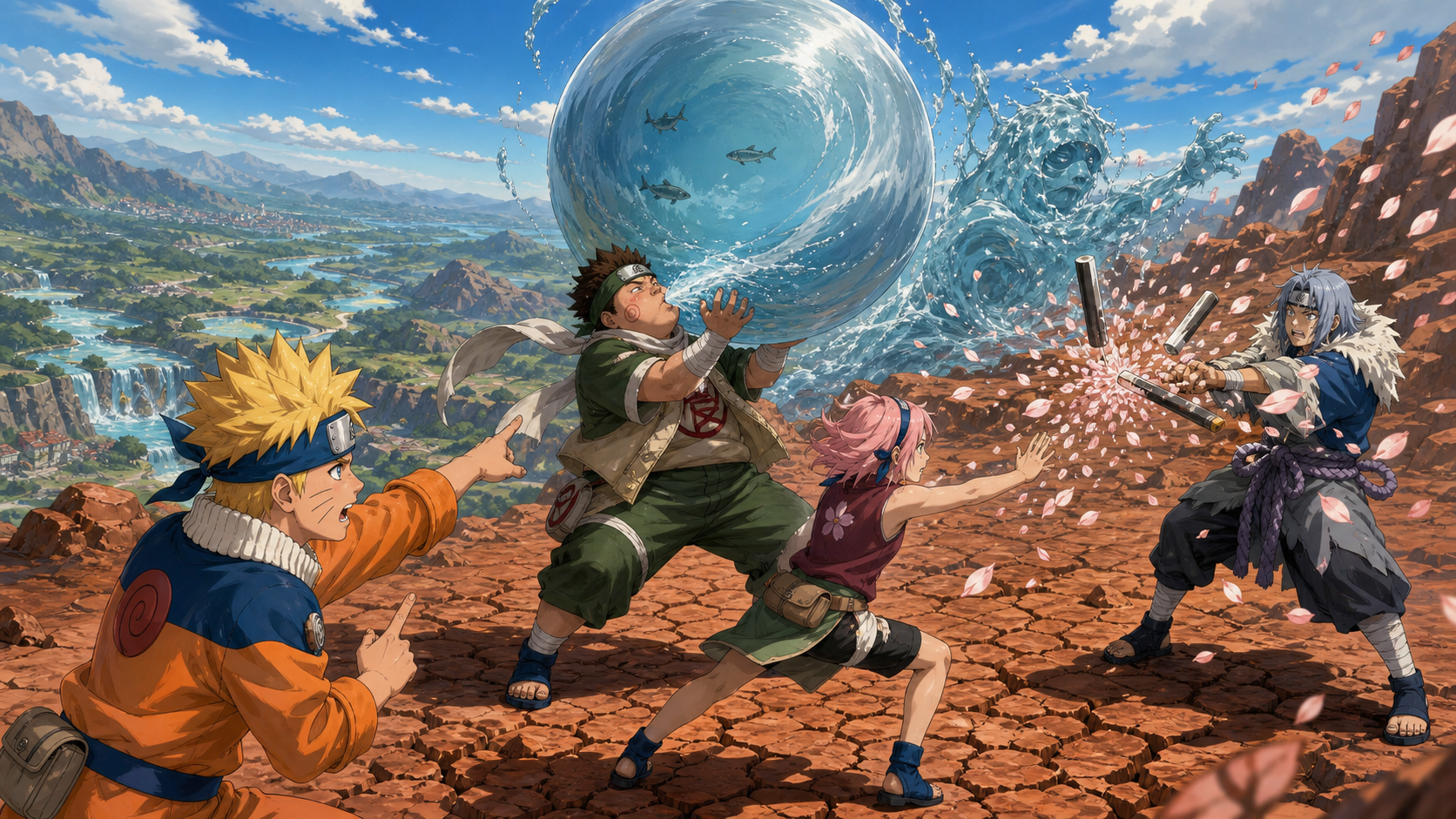
Naruto identifies the groundwater behind Ruiga’s endless arsenal, Yurinojou springs the trap, and Chōji removes the final weapon by drinking it.
Ruiga says his water never ends.
It ends.
The trick is figuring out that “limitless” really means “plentiful as long as nobody notices I keep avoiding dry ground.”
Episode 189 rewards observation and teamwork. Naruto spots a movement pattern. Yurinojou identifies the mechanism. Choji performs the only sensible response to a finite pool of water and drinks it.
Then Jiga murders his own defeated brother because fewer brothers mean larger profits.
The contrast is not subtle.
One side survives by combining what each person knows. The other side treats family as another share to eliminate.
Episode 189 Facts
- English title: A Limitless Supply of Ninja Tools
- Japanese title: 地下水 無尽蔵の忍具
- Original Japanese broadcast: June 14, 2006
- Story position: Third episode of the five-part Peddlers Escort Mission
- Ruiga's hidden dependency: Accessible groundwater located through dowsing tonfa
- Finishing team: Naruto, Yurinojou, and Choji
- Janin betrayal: Jiga kills the defeated Ruiga for a larger profit share
- Cliffhanger: Jiga overwhelms Naruto with magnetized iron-rich rock as Hinata arrives
The title applies to both Janin brothers featured here. Ruiga turns groundwater into an apparent endless arsenal. Jiga turns iron-rich terrain into flying ammunition. Both call environmental access personal power, and both become vulnerable when somebody identifies the dependency underneath the spectacle.
Ruiga Builds an Iron Wall From Water
Ruiga begins with Naruto trapped inside a mass of water.
Choji returns in time to pull his friend free, then discovers that brute force does little against Ruiga's defense. Water absorbs the impact of his attacks and reforms around the enemy.
Yurinojou's flowers create distance, but Ruiga keeps drawing more water from beneath the ground. He shapes it into barriers, waves, and a pursuing creature filled with piranha.
Kikunojou died inside that technique.
Ruiga believes the same supply makes another victory inevitable. Kunai run out. Paper bombs run out. Chakra can fail. The earth keeps providing water, so his weapon appears inexhaustible.
The claim sounds unbeatable because everyone is looking at the amount of water.
Naruto looks at the sticks in Ruiga's hands.
That observation matters because it returns the peddlers' ordinary knowledge to the center of the fight. Dowsing rods looked like local travel craft in Episode 187. Ruiga weaponizes the same principle. Naruto wins by remembering something learned outside formal combat training.
The Tonfa Are Dowsing Rods
Naruto notices that Ruiga holds his tonfa the same way the peddlers held their dowsing rods.
Earlier, those simple tools reacted to underground water and guided the caravan to a fresh source. Ruiga's weapons serve the same purpose. They locate the groundwater his technique needs, allowing him to stay where the land can keep feeding his defense.
Yurinojou understands the implication immediately.
The water is abundant, not universal.
Ruiga does not create an infinite resource from nothing. He finds favorable ground and turns its hidden supply into a battlefield advantage. His confident pursuit also conceals careful route selection.
Naruto remembers taking a shortcut through dry, craggy terrain while searching for the pursuers. Ruiga should have intercepted him there.
He did not.
The enemy avoided the region because his technique would fail without accessible groundwater.
That missing encounter becomes the map to victory.
Absence is evidence here. Naruto does not find a secret scroll explaining the technique. He remembers where an aggressive pursuer failed to appear and asks what the terrain lacked. Ruiga's route avoidance says more than his boasting.
Yurinojou Turns Observation Into a Trap
Knowing the weakness does not place Ruiga on dry land.
The team has to move him there without revealing why.
Naruto floods the field with shadow clones and pushes the chase. Yurinojou uses flower techniques to alter the pressure around Ruiga, damage his tonfa, and remove the instruments that keep him connected to favorable water sources.
Ruiga believes he is still hunting them.
Yurinojou is calculating where the hunt will end.
The plan matters because no one solves the fight alone. Naruto makes the initial connection between tonfa and dowsing. Yurinojou converts that insight into movement and timing. Choji waits for the moment when physical force will finally matter.
Kikunojou fought Ruiga alone and died.
His junior survives the same opponent by accepting help instead of trying to reproduce his senior's solitary stand.
Yurinojou does not dishonor Kikunojou by fighting differently. Repeating the exact conditions that killed his teacher would turn grief into imitation. Using Naruto's observation and Choji's strength lets the flower techniques contribute to a plan rather than carry the whole burden.
Choji Drinks the Last Weapon
The group reaches the rocky ground.
Ruiga calls for more water.
Nothing rises.
Naruto explains the route he reconstructed. Ruiga had avoided this area because no groundwater would answer his dowsing tools. Yurinojou deliberately broke the tonfa and guided him away from the terrain that made him strong.
Ruiga still controls a limited amount of water.
Naruto tells Choji to drink it.
This is why assembling the “wrong” team can produce exactly the right answer. A conventional fighter might block the remaining water, dodge it, or search for another counter-technique. Choji treats it as a beverage.
Once the supply is gone, Ruiga loses his defensive cushion and summoned creature.
Choji uses Human Boulder and ends the fight.
The limitless weapon was defeated by geology, teamwork, and one teammate whose appetite finally counts as battlefield specialization.
Choji's finish is funny, but it is not random. Once groundwater access is gone, Ruiga's remaining controlled volume becomes finite. Choji removes that volume from the battlefield, then applies the physical attack water previously absorbed. Consumption and force solve two different layers of the defense.
Jiga Rewards His Brother With Death
Ruiga survives the Leaf team's attack.
He asks Jiga for help.
Jiga looks at his defeated younger brother and calculates the profit split. If Ruiga dies, only Jiga and Renga divide the wealth they intend to extract from the Land of Greens.
He buries Ruiga beneath magnetic rocks.
The murder completes the Janin worldview introduced during the coup. Renga killed collaborating officials because people who betray once cannot be trusted. Jiga kills his brother because family loyalty interferes with financial gain.
Their refusal to trust does not protect them from betrayal.
It guarantees betrayal happens first.
Ruiga treated other people as prey and assumed blood would exempt him from the same logic. Jiga proves the category never existed. To the Janin, everyone becomes expendable when the reward is large enough.
Jiga's choice also destroys any argument that the brothers are restoring order to a corrupt country. They are not a loyal unit seeking rule. They are three predators temporarily sharing a target. The coup's promised prosperity cannot survive leaders who calculate family murder as improved distribution.
Hinata Refuses Haruna's Version of Naruto
While the Ruiga fight continues, Haruna rests with Hinata.
She still argues that using the merchants as decoys would have allowed an earlier escape. Kikunojou's death does not change her calculation. A ninja accepts death as part of duty, and Haruna's survival preserves the possibility of restoring the country.
She describes the childhood that created this belief.
Haruna was separated from her parents and held hostage in a foreign country. She endured isolation and bullying while adults called her suffering necessary for the Land of Greens. Compassion looked like something fools expected from people who always chose politics first.
Then she judges Naruto.
His emotions interfere with rational goals. He risks himself for strangers. Haruna calls that weakness and says someone so easily moved should not qualify as a ninja.
Hinata answers with the life Haruna does not know.
Naruto also grew up without parents. He lived alone and fought for recognition. He never used that pain to justify living at someone else's expense.
Hinata's defense is persuasive because she does not pretend Naruto emerged undamaged. His need for recognition creates reckless choices and loud behavior. The difference is direction: he reaches outward for bonds instead of making isolation into a rule everybody else must obey.
Similar Pain Does Not Produce the Same Choice
Hinata is not claiming Naruto and Haruna suffered identical childhoods.
Haruna immediately notes their different positions, and she is right. A political hostage carries responsibilities and threats Naruto did not face. Naruto's isolation inside the Leaf came from a different history.
The comparison concerns what they build from abandonment.
Haruna learned that dependence invites betrayal, so she tries to survive without owing anyone and treats other lives as strategic resources.
Naruto learned the agony of isolation, so he keeps forming bonds even when they create risk.
Neither response erases what happened to them.
Only one refuses to reproduce the same harm.
Haruna recognizes Hinata's feelings for Naruto and agrees to wait for the others. It looks like the first movement toward trust.
Then she knocks Hinata unconscious and leaves alone.
Understanding Naruto does not instantly undo years of survival training.
Haruna's brief agreement still matters. Hinata reaches her enough to produce hesitation, even if fear wins the next decision. Change often appears first as a pause inside an old habit, not an immediate personality replacement.
Naruto Pursues Someone He Knows Is Wrong
Naruto finds Hinata and learns Haruna escaped.
Hinata suggests returning to the Leaf for instructions. The original contract did not include protecting a princess from a coup, Yurinojou is injured, and two Janin remain. The team has every procedural reason to stop.
Naruto acknowledges that Haruna says and does terrible things.
He follows anyway.
That choice is not approval. Naruto does not excuse the merchant decoy, the false mission, or Haruna's attack on Hinata. He refuses to convert moral anger into permission for an isolated girl to be murdered.
Hinata and Choji stay with Yurinojou. Naruto runs after Haruna alone.
Compassion complicates the mission because living people are complicated.
Naruto would rather carry that problem than become “rational” enough to leave her body on the road.
That distinction keeps compassion from becoming moral surrender. Naruto can condemn Haruna's decisions, protect the people she endangered, and still refuse her execution by abandonment. Helping a person survive does not certify everything they believe.
Jiga Turns the Mountain Into Ammunition
Jiga reaches Haruna first.
Naruto intervenes and discovers a technique built for the iron-rich terrain. Jiga says he drank iron while growing up until it accumulated inside his body. He can turn himself into a magnet and magnetize objects he touches.
Shadow clones cannot solve a battlefield that moves toward the enemy on command.
Jiga magnetizes the surrounding rocks and launches them as Infinite Meteors. The mountain becomes his supply of ninja tools, crushing Naruto beneath attack after attack.
Hinata arrives despite Naruto's warning to stay back.
He tells her not to engage. Jiga is too dangerous.
Hinata sees the person who never gives up overwhelmed by a technique brute force cannot break.
Episode 189 ends with her choosing analysis over retreat.
Hinata's arrival also corrects Naruto's solo-pursuit impulse. He told her to remain behind because Jiga was too dangerous, but his own strength has already failed against the technique. The teammate he tried to protect may possess the perception required to save him.
That possibility follows the episode's larger rule. Power looks limitless only while its conditions remain invisible. Ruiga hid groundwater behind spectacle. Jiga hides dependence on iron-rich terrain and control of his own magnetic state. Hinata does not need a larger attack than Infinite Meteors. She needs to see what Jiga must keep doing for the attack to work.
Episode 189 ends before she finds the answer. The boundary matters because this chapter belongs to recognizing patterns and refusing isolation. The precise Byakugan counter is Hinata's work in Episode 190.
For now, noticing that a counter must exist is enough.
The Byakugan must find what magnetism is hiding.
Ruiga’s “limitless” power is borrowed from the terrain
He does not create water without cost or condition. He locates groundwater, chooses favorable ground, and uses tonfa shaped like the peddlers’ dowsing rods to reach it. The spectacle encourages opponents to measure volume instead of asking where the volume comes from. Naruto breaks the illusion by treating the battlefield as evidence rather than accepting Ruiga’s description of himself.
The missing interception becomes Naruto’s strongest clue
Ruiga pursued aggressively everywhere except the dry route Naruto crossed earlier. Absence matters because it contradicts the behavior of an enemy supposedly able to attack from any ground. Naruto remembers where Ruiga did not appear and connects that gap to the lack of accessible water. Observation is not only noticing what happens. It is noticing what should have happened and did not.
Peddler knowledge becomes combat intelligence
The dowsing rods first appeared as ordinary travel tools used to find water. Naruto remembers the posture and Yurinojou understands the dependency. Knowledge does not become valuable only after a ninja gives it a dramatic name. The caravan’s practical skill exposes the mechanism behind a technique that looked supernatural and infinite. The fight rewards attention to people the mission initially treated as background.
Yurinojou honors Kikunojou by refusing to repeat his isolation
Grief could push him into proving he can defeat Ruiga alone. Instead, he accepts Naruto’s observation and Chōji’s strength, then uses flower techniques to steer the enemy onto dry ground and break the tonfa. Fighting differently does not diminish his senior. It recognizes the exact condition that made Kikunojou’s sacrifice fatal and refuses to call repetition loyalty.
Chōji’s solution works because the team makes the resource finite
Drinking the remaining water sounds like a punch line, and it absolutely is one. It is also sound sequencing. First remove access to groundwater. Then eliminate the limited volume Ruiga still controls. Finally apply the physical attack his water defense previously absorbed. Chōji solves two separate layers of the technique through appetite and force, which is much smarter than simply hitting the same shield harder.
The team wins by combining incomplete pieces
Naruto recognizes the rods and route pattern. Yurinojou understands how to move Ruiga and disable the instruments. Chōji removes the last water and finishes the exposed opponent. No single observation wins the battle. Each becomes useful because the fighters share it. That is the direct opposite of the secrecy that killed Kikunojou and endangered the merchants.
Jiga murders Ruiga according to the coup’s real values
Ruiga expects family loyalty after defeat. Jiga sees a larger profit share. The murder proves the Janin never formed a governing alliance built on trust, duty, or even durable brotherhood. They are predators sharing access to the same country until one becomes more valuable dead. A regime founded on betrayal does not cure betrayal by killing everyone who demonstrates it.
Haruna mistakes emotional distance for rational leadership
She calls Naruto weak because strangers’ lives move him. Her version of rationality calculates which body can be spent for the desired outcome and treats grief as interference. Yet the Leaf team just defeated Ruiga through cooperation, observation, and responsibility to one another. Their attachments do not prevent clear thinking. They give the team reasons to share information and keep adapting when one person’s plan fails.
Hinata compares choices without pretending the childhoods were identical
Haruna was a political hostage. Naruto was isolated inside his own village. The causes and pressures differ. Hinata’s point is what each person builds from abandonment. Haruna reproduces the logic that once made her expendable. Naruto keeps reaching for bonds because he knows what isolation costs. Similar pain does not dictate identical conduct, and suffering does not excuse assigning the same suffering to somebody else.
Naruto can condemn Haruna and still refuse to abandon her
Following her does not approve the merchant decoy, false mission rank, or attack on Hinata. It separates accountability from execution. Naruto will argue with Haruna, protect the people she endangered, and still prevent the Janin from killing her alone on the road. Moral anger does not require becoming indifferent to whether the person survives long enough to change.
Hinata’s arrival corrects Naruto’s own isolation mistake
Naruto tells her to stay back because Jiga is dangerous, then discovers shadow clones and direct force cannot solve magnetized terrain. Protecting teammates by excluding them repeats the arc’s central failure in smaller form. Hinata brings the Byakugan, the exact perception needed to study a hidden dependency. Naruto’s desire to shield her cannot outweigh her right and ability to act.
The mountain is not Jiga’s personal arsenal
Like Ruiga, Jiga converts an environmental resource into the appearance of endless private power. Iron-rich rock answers his magnetism, so the whole landscape becomes ammunition. That scale is frightening, but it also implies conditions: material composition, magnetized contact, range, control, and the state of Jiga’s own body. Hinata does not need a larger pile of rocks. She needs the blind spot inside the process.
The mission record must preserve both victory and failure
Ruiga’s defeat demonstrates excellent adaptive teamwork. Kikunojou’s death demonstrates what the false briefing cost. The report needs both. If the Land of Greens records only that three genin defeated a Janin brother, future officials may treat dishonest ranking as efficient. Success under preventable disadvantage is not evidence that the disadvantage was acceptable.
RaeRae’s full take
Episode 189 takes two men bragging about unlimited weapons and asks the rude question: unlimited from where? Ruiga needs groundwater. Jiga needs iron-rich rock. Neither owns infinity. They are standing in favorable places and hoping nobody studies the floor.
The good side wins its first battle because people finally share what they know. Naruto notices. Yurinojou plans. Chōji drinks the problem. Kikunojou’s courage was never smaller than theirs, but secrecy forced him to carry every role alone.
Then Jiga kills his own brother over percentages. That is the Janin government in one act. No loyalty, no country, no future. Just three men counting shares while everybody around them becomes another resource to consume.
RaeRae checkpoint: “Limitless” power usually means nobody has found the supply line yet. Naruto finds Ruiga’s, Yurinojou cuts it, and Chōji handles the remaining inventory personally.
Receipts and official routes
- Episode number, licensed title, Ruiga’s groundwater arsenal, and Naruto’s reversal: Naruto Official Site.
- Japanese title, Ruiga’s attack, Haruna’s demand to Hinata, and June 14, 2006 broadcast record: TV Tokyo.