
The Cursed Warrior
Chishima spends his savings to reach a grieving friend, and Naruto’s promise leads Neji’s team to white armor containing no living body.
Naruto wants a mission connected to Sasuke.
He gets a broke messenger, a grieving young ruler, and a ghost in white armor.
Close enough, apparently.
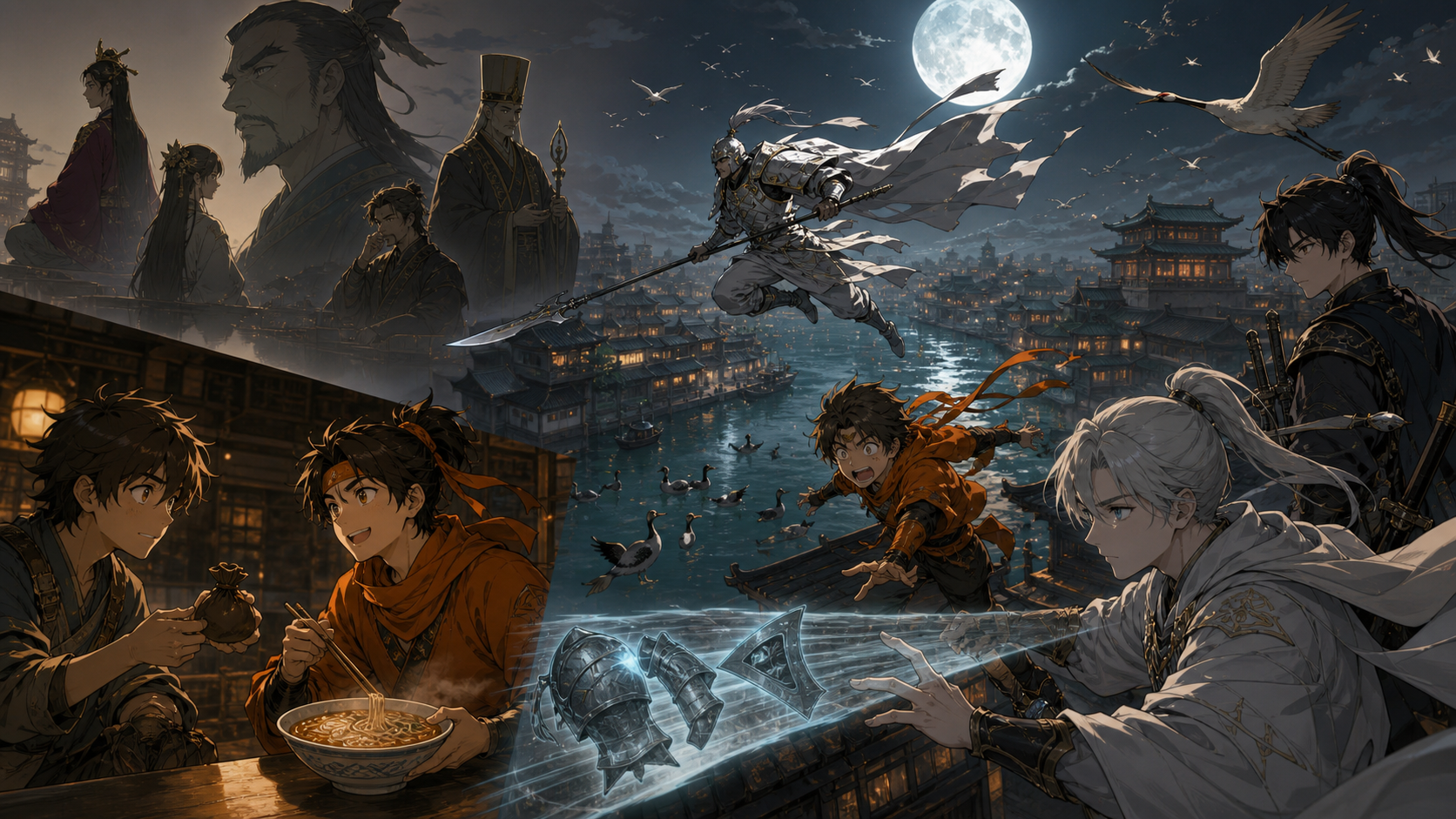
Episode 162 opens the Cursed Warrior Extermination Mission by placing an impossible story inside a painfully ordinary political crisis. The Land of Birds has lost its previous feudal lord. His son Sagi inherited the government, then lost his twin sister and withdrew from everyone who knew him. A spectral warrior now stalks the capital while rumors turn grief into public panic.
Tsunade does not want to commission ninja to punch a ghost. Chishima refuses to abandon his friend. Naruto hears that loyalty and recognizes the part that matters.
He failed to bring Sasuke home. He is not watching somebody else give up before trying.
Chishima Pays for Hope Himself
Naruto begins the episode training alone and hating it. Jiraiya has not returned, Guy and Lee are away, and repetition without a partner gives him too much room to think about the mission he actually wants.
He wishes Konoha would send him after Sasuke.
At the Hokage's office, Chishima is asking for help from a country that cannot afford it. He has traveled from the remote Land of Birds because an apparition called the Cursed Warrior is disturbing the capital and feeding public fear.
Tsunade sees two problems. First, shinobi missions address enemies and explainable threats. “Exterminate a ghost” is not useful operational language. Second, the offered payment barely covers the team's travel.
Chishima has no larger budget. His country is struggling financially. When Tsunade resists, he offers his personal savings and goes as far as threatening to take his own life rather than return having failed.
That desperation does not make the request clearer, but it reveals its weight.
Naruto meets Chishima outside Ichiraku. The stranger watches him eat because he has spent everything on the commission. Naruto complains that being stared at ruins good ramen, then does the decent thing and invites him inside.
One bowl gets Chishima talking.
The mission may cost his closest friend his life. Chishima grew up with Sagi, the young feudal lord of the Land of Birds. The title sounds grand, but Sagi is Chishima's age and once felt more like a brother than a ruler.
Then Sagi's father, Lord Owashi, died suddenly from illness. Sagi inherited the country. His twin sister Toki died soon afterward.
The cheerful friend Chishima knew disappeared behind a closed door. Sagi stopped receiving him, withdrew from public life, and became cold enough that Chishima fears something more than grief is happening.
He is not asking Konoha to protect a government office. He is trying to reach a friend who no longer lets him close.
Naruto Hears Sasuke in the Story
Chishima's explanation lands exactly where Naruto is most vulnerable.
Naruto could not stop Sasuke from leaving. That failure does not make him cautious about another friendship. It makes him incapable of treating Chishima's fear as somebody else's problem.
He promises they will save Sagi.
Naruto makes that promise before hearing the full assignment. Then he storms Tsunade's office and accuses her of taking Chishima's savings while refusing the mission. Calling the Hokage a devil goes about as well as expected.
Tsunade was not refusing. Most jonin and chunin are already deployed, and she was waiting for Neji to return so she could form a workable team. Guy and Lee remain away, leaving Neji to lead Naruto and Tenten.
Only after volunteering does Naruto learn they are hunting a ghost.
His confidence develops a visible crack.
Naruto insists a ninja cannot be afraid of spirits while asking whether ninjutsu works on them. Tsunade offers the sort of reassurance only Tsunade would consider helpful: test it and find out.
The comedy works, but it also exposes a useful limit in Naruto's approach. He knows how to confront people. A supernatural threat denies him the comfort of a body, motive, or technique he can challenge. He made the promise based on Chishima's pain, so fear no longer gives him permission to back out.
The Land of Birds Has Too Many Convenient Stories
The team travels with Chishima, who explains how the country reached this point.
The capital spreads around a lake where migratory birds rest. Canals draw water through a green, peaceful town. That postcard surface now covers a succession crisis.
After Owashi died, Sagi and the tactician Komei both stood near the question of who would rule. Komei argued that Sagi was too young. Sagi still inherited the position, with the high priest Moso serving as superintendent and guide.
Less than half a year later, Toki died.
Sagi retreated into his residence and handled state business in isolation. Around the same period, the Cursed Warrior began appearing in the streets.
Residents built a story from the timing. Perhaps Owashi did not die naturally. Perhaps his spirit returned in white armor to find whoever caused his death. Once fear enters politics, every unexplained movement becomes evidence for the version people already want to believe.
Tenten asks a sharper question: who benefited from Owashi's death?
Chishima rejects suspicion of Moso. He sees the priest as virtuous and selfless. That leaves Komei, the tactician who opposed Sagi's succession and continued criticizing the young lord afterward.
Naruto decides the mystery immediately. Komei wanted power, lost, and now uses a ghost story to torment Sagi. Case closed.
Neji does not share the enthusiasm.
This is why Tsunade put him in charge. Naruto reacts to loyalty and pain with speed. Neji slows the team down long enough to separate testimony from proof. Komei may be suspicious, but a political motive is not the same thing as evidence that a dead ruler now wears armor around town.
The Warrior Has No Body
Night gives the rumor its preferred stage.
The Cursed Warrior appears near Komei's residence in white armor, carrying a polearm and moving through the darkness as if it can fly. Guards panic. Naruto, Neji, and Tenten pursue.
Naruto is still afraid, though he would like the record to show otherwise. Tenten keeps pace. Neji watches.
When they corner the figure, Neji activates the Byakugan.
There is no living presence inside the armor.
That result should not be possible, which is not the same as saying the supernatural explanation has won. The Byakugan gives Neji a controlled observation: no person is visible within the suit. It does not tell him who moved it, how it flew, why it appeared near Komei, or whether the object they cornered is the same thing witnesses saw before.
Naruto hears “empty” and understandably arrives at “ghost.” Neji treats the absence as evidence that the mechanism is more complicated than a person hiding under metal.
The distinction defines the mission's opening. The Land of Birds has already converted grief, timing, and rumor into certainty. Naruto nearly converts a political motive into a solved case before meeting the suspect. Neji refuses both shortcuts.
A Friendship Mission Wearing a Ghost Story
Episode 162 does not reveal the Cursed Warrior. It builds the reasons each member will keep looking.
Chishima cannot reach Sagi through friendship alone. The title, residence, and grief that surround the young ruler have become walls. He spends his own money because official channels measure the mission in travel costs while he measures it in whether his friend survives.
Naruto joins because Sasuke's absence still sits inside every promise he makes. He cannot repair that failure here, but he can refuse to let it teach him helplessness.
Tenten asks who gains from the political disorder. Neji refuses to call a theory a fact. Their questions stop Naruto's loyalty from becoming another form of blindness.
Then the empty armor gives all three of them a genuine problem.
Maybe the Land of Birds has a ghost. Maybe somebody has found an excellent way to make fear perform political labor. Either way, the white warrior is not the whole danger. A young ruler has cut himself off after losing his family, an anxious public wants revenge to explain its uncertainty, and the people around the throne have reasons to shape both stories.
Naruto came hoping for a road back to Sasuke.
He found another friend standing outside another closed door.
This time, he intends to get there before the door becomes a grave.
Chishima spends personal savings because official help feels unreachable
The Land of Birds cannot offer Konoha a prestigious contract, so a young messenger places his own limited money on the table. That gesture shows how strongly he fears for Sagi. It also exposes an unequal mission system where communities with fewer resources may need private sacrifice before a powerful village treats their danger as actionable.
Naruto buys food before asking Chishima to prove the case
The ramen matters because hunger affects memory, judgment, and the ability to explain a complicated political crisis. Feeding the messenger is not a reward for useful intelligence. It is immediate care for someone who crossed a long distance while under-resourced. Naruto’s choice creates enough safety for Chishima to speak as a person rather than only as a petitioner.
Chishima’s friendship is evidence of change in Sagi
He remembers a childhood friend who existed before grief and office narrowed the ruler’s life. That memory cannot diagnose everything happening now, but it establishes a baseline. Sudden withdrawal after Owashi and Toki die may signal mourning, fear, coercion, illness, or a combination. The team should investigate the change without treating grief itself as guilt.
Naruto hears his unfinished promise to Sakura inside the plea
Chishima asking someone to reach a distant friend echoes Naruto’s failure to bring Sasuke home. The recognition motivates him to promise help before he knows the target may be a ghost. Empathy gets the mission moving. Naruto still needs to keep Sagi’s needs separate from his desire to repair his own history through somebody else’s reunion.
A promise made from identification can still exceed available evidence
Naruto cannot know whether Sagi wants contact, whether the Cursed Warrior is connected to the ruler, or whether Konoha has authority to intervene in succession politics. A responsible promise would be to investigate, protect Chishima, and seek the truth. Promising a particular emotional outcome risks turning a complex person into another version of Sasuke who must be recovered on Naruto’s terms.
Tsunade’s reluctance should produce a bounded mission, not dismissal
Reports of a ghost may sound unserious, and the payment is small. People are still frightened, a ruler is isolated, and the prior lord died suddenly. Tsunade can authorize reconnaissance with clear limits, escalation rules, and a requirement to avoid political interference without evidence. Skepticism should improve the plan rather than determine whose fear deserves attention.
Neji is the correct field leader for an evidence-poor case
Byakugan can test claims about invisible bodies, hidden mechanisms, and movement through structures. Neji also tends to separate observation from Naruto’s first emotional conclusion. His role is not to ridicule supernatural fear. It is to translate reported phenomena into facts the team can verify while protecting witnesses from whatever uses the legend.
Tenten gives the team tools for testing physical explanations
Wire, projectiles, powder, markers, and controlled traps can show whether armor has weight, casts a consistent shadow, disturbs water, or follows a hidden line. A ghost investigation should not become two boys arguing over belief while Tenten waits. Her equipment can create evidence at distance without requiring the team to grab an unknown object.
The team composition named in official records includes Lee
The episode’s local editorial focuses on Naruto, Neji, and Tenten as the active field unit, while the official synopsis identifies Lee among those sent to help. The post should preserve what the episode actually shows without erasing the licensed record. Clear facts prevent cast memory from drifting when a multi-part arc redistributes who appears and acts across scenes.
Owashi’s sudden death deserves an ordinary investigation before a supernatural one
A ruler dying unexpectedly can create succession pressure, concealed illness, poisoning, or opportunistic violence. Declaring the returning armor his ghost may discourage examination of records, witnesses, access, and beneficiaries. The legend could be sincere belief or deliberate cover. Either way, the death remains a material event with evidence somewhere in the living world.
Toki’s death deepens grief and weakens independent support around Sagi
Losing a twin after losing a parent can collapse the relationships that anchored the young ruler outside court. Isolation makes Sagi more dependent on whoever controls access and interprets events. Chishima’s concern matters because he may be one of the few people whose relationship predates the political office and does not depend on it.
Moso’s role as counselor carries power through proximity
A grieving ruler may rely heavily on the person filtering reports, visitors, and decisions. Moso’s guidance is not proof of conspiracy, but the team should document what information reaches Sagi and who benefits from continued isolation. Caretaking and control can look similar from outside when access is not transparent.
Komei’s opposition makes him a convenient suspect
Political disagreement with the succession creates a plausible motive that everyone can understand quickly. Plausibility is not proof. The team needs to ask what Komei opposed, whether he had access to the armor, who witnessed his movements, and whether evidence appears too neatly near him. A strategist’s unpopularity can make planted clues unusually effective.
The legend stabilizes power by making questions feel dangerous
If residents believe Owashi’s spirit punishes interference, they may avoid investigating the court or approaching Sagi. Fear can protect a conspiracy without every witness being bribed. The Cursed Warrior only needs to appear convincingly enough that people police their own curiosity afterward.
Naruto’s fear of ghosts does not make him useless
He is frightened because the usual rule of hitting an opponent feels uncertain. Admitting fear would let Neji and Tenten assign him a role suited to his strengths: clones can observe multiple routes, test pursuit patterns, and protect civilians. Pretending bravery may push him to charge the armor only to prove he is not scared.
The canal setting offers physical evidence
An armored figure moving above water should create reflection, displacement, sound, or a trail unless a technique prevents it. Nearby buildings may provide anchor points for wire or hidden operators. Neji can scan beneath and beyond the visible form while Tenten checks the path. Environment turns a ghost story into testable questions.
Appearing near Komei’s residence implicates him too efficiently
The location may indicate control, communication, surveillance, or deliberate framing. Investigators should resist choosing among those options before gathering more. Someone seeking to remove Komei would benefit from ensuring witnesses connect the spectacle to his home. The most obvious clue deserves the most careful chain of custody.
The armor seems to fly because the method remains outside ordinary sight
Movement without a visible body intensifies the supernatural interpretation. Flight can still result from wire, chakra, concealed carriers, projections, or substitution. Naming possibilities does not solve the case. It prevents fear from closing the investigation before the team tests how the armor accelerates, turns, and responds to obstacles.
Neji sees no living person inside the armor
This is the episode’s strongest fact. Byakugan detects no body or chakra network occupying the suit. The finding rules out one simple explanation: a conventional person wearing it. It does not prove Owashi’s spirit is present. Empty armor can be manipulated, and the mechanism becomes the next question.
Absence of evidence inside one boundary should narrow, not end, inquiry
Neji must scan above, below, behind, and along the route for external control. Tenten can test the armor’s response to cut lines or marked surfaces. Naruto’s clones can follow divergent paths. Good investigation turns a negative result into a more precise search rather than treating “empty” as synonymous with “impossible.”
The team should protect the armor as evidence if capture becomes possible
Breaking it may stop an immediate attack but destroy fibers, seals, residue, and construction details that reveal who built or operated it. Tenten is best placed to immobilize components while Neji monitors remote chakra. Evidence preservation matters because the political consequence of accusing the wrong court faction could exceed one night’s fight.
RaeRae’s full take
Episode 162 works because Chishima’s tiny purse gets treated as a measure of love, not the value of his country. He crosses the distance hungry because the friend he remembers has disappeared behind grief and office. Naruto recognizes the promise, feeds him, and moves.
Neji gives the arc the fact it needs: the armor is empty. That does not prove a ghost. It proves nobody is standing inside the suit. The next responsible question is how an empty object moves, who benefits from the legend, and why it appears exactly where suspicion can land on Komei.
I want the team to protect Sagi without turning grief into evidence against him. A young ruler who loses a father and twin needs access to trusted people, not a court where every visitor and explanation passes through someone else.
Witness accounts should be separated from court allegiance
Residents may have seen the armor, heard Owashi’s legend, or noticed movement near Komei’s estate. Investigators should record those observations before asking witnesses which political faction they support. Leading with allegiance can make every detail look partisan and discourage people who fear retaliation from speaking.
Chishima can help identify trusted interview routes without controlling what others say. His friendship with Sagi gives important context, but no single relationship should become the whole evidentiary frame. The case needs many small facts gathered independently enough to expose where stories agree and where someone has coordinated them.
RaeRae checkpoint: Neji proves the white armor contains no living body. He does not prove a ghost. The empty suit deepens the investigation and makes the political convenience of every appearance more important.
Watch Naruto Episode 162
- [Naruto Official episode guide](https://naruto-official.com/en/anime/naruto1/list/01_386)
- [Watch “The Cursed Warrior” on Crunchyroll](https://www.crunchyroll.com/naruto/episode-162-the-cursed-warrior-523724)
- [Browse official Naruto viewing options from VIZ](https://www.viz.com/anime/tv-show/naruto-video/video-unit/1)
Receipts and official routes
- Episode number, licensed title, official synopsis, and listed Leaf team: Naruto Official Site.
- Japanese title, synopsis, and November 30, 2005 broadcast record: TV Tokyo.