
Hunt or Be Hunted?! Showdown at the O.K. Temple!
Tokichi’s name is cleared during a Golden Bell heist even though Gatsu takes the arrest and leaves Naruto’s team with a failed mission report.
Sazanami is Tokichi. The wanted poster got that part right.
The murder accusation is another matter.
Episode 160 reveals how a poor swordsmith became a fugitive, follows Gosunkugi through a giant-bell theft that feels gloriously committed to the western-ninja nonsense, and ends with the Konoha team failing its assignment while helping the truth win.
That distinction matters. Naruto, Kiba, and Hinata were ordered to capture Gosunkugi. They do not. Another bounty hunter makes the arrest. Yet Tokichi's name is cleared because they chose to treat a wounded wanted man as a person before deciding the poster contained his entire story.
Sometimes the mission report says failure because the report is measuring the wrong victory.
The Man Behind Sazanami
Sazanami wakes in the hut and tries to leave despite wounds that make standing painful. Naruto and Kiba stop him and produce Tokichi's wanted poster.
He admits the identity. He denies the crime.
Before he lived as Sazanami, Tokichi was a swordsmith in a small country between larger nations. He was poor, but his life had shape and purpose. During a local festival, he left early to deliver a commissioned sword to a customer.
The customer's door stood partly open. Inside, Tokichi found Gosunkugi and a murdered family.
He fought with the sword he had come to deliver, but Gosunkugi escaped. When villagers arrived, they saw Tokichi holding a weapon beside three bodies. The scene looked simple. Nobody believed the explanation that another man had fled.
Tokichi was arrested for the murders.
This is exactly what Episode 159 prepared us to question. A wanted poster can distribute useful information quickly, but it freezes an accusation into a face. Once the village decided the swordsmith was the killer, every later person saw an official fugitive rather than an unresolved case.
Tokichi escaped custody. Eventually he found Gosunkugi's own poster and saw a possible route home. If he captured the real murderer, he might prove what happened. He adopted the name Sazanami and became a bounty hunter so he could gather information while surviving outside the law.
His pursuit is not mainly about the reward. It is an attempt to recover a name that other people turned into evidence against him.
Naruto Leaves Him Behind for the Right Reason
Naruto, Kiba, and Hinata resume their mission without Sazanami. That choice might look cold after hearing his history, but his injuries make another solo confrontation suicidal. Capturing Gosunkugi themselves could protect the target, fulfill Konoha's order, and produce evidence for Tokichi without asking him to bleed for it again.
Gatsu, the bounty hunter who dropped Tokichi's poster, returns. He could claim the wounded man immediately. Instead, he says Tokichi is not going anywhere in that condition and makes Gosunkugi his priority.
Gatsu's logic sounds purely financial. Gosunkugi carries the better prize, and Tokichi can be collected later. The decision also shows that he is watching the whole case more carefully than his rough entrance suggested.
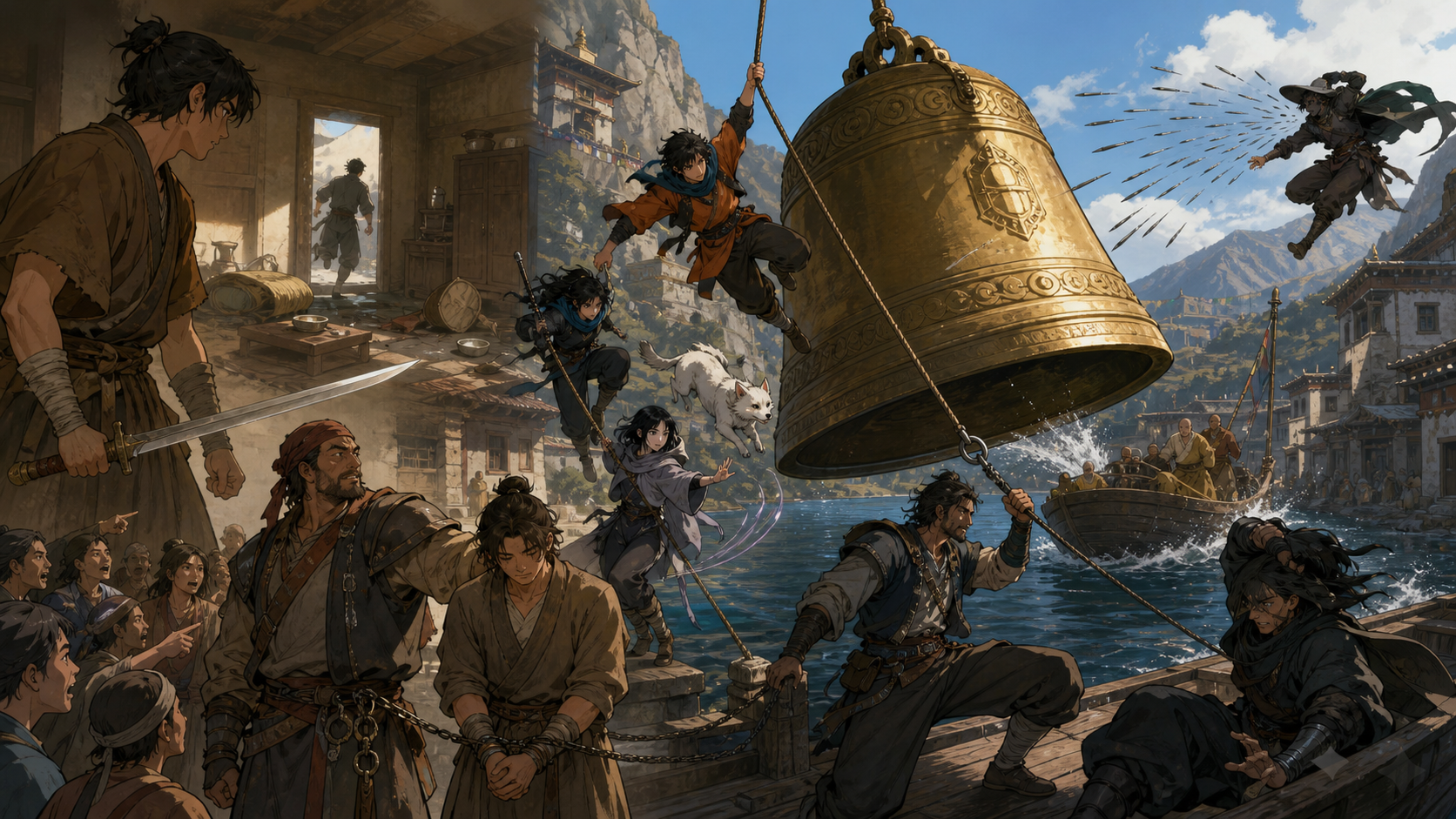
The Konoha team reaches another Land of Stone town governed by monks. Its main attraction is an enormous Golden Bell being raised toward the O.K. Temple on the mountain.
Kiba looks at the oversized public treasure hanging from ropes and points out the obvious: the thing is begging to be stolen.
Naruto agrees. If Gosunkugi steals for money and spectacle, the bell is the next target.
The Golden Bell Heist
Akamaru detects a breach near the temple approach. Gosunkugi's men attack, and Hinata's Byakugan spots danger moving below ground. Her warning lets the group avoid another nail strike.
Sazanami joins the fight despite every instruction his body should be giving him.
The visible attackers are distractions. While Naruto, Kiba, Hinata, and Sazanami engage them, Gosunkugi reaches the bell. By the time the group realizes the scheme, temple guards are down and the Golden Bell is being lowered along a rope toward an escape boat.
The team clears the remaining gang members with a compact display of what this lineup can do. Hinata uses the Gentle Fist. Kiba and Akamaru transform and drive through opponents with Fang Over Fang. Naruto supplies clones and the Uzumaki Naruto Barrage. Sazanami cuts his way forward with the sword skill that made three genin look helpless the night before.
Hinata and Kiba also keep the pursuit from becoming Naruto and Sazanami charging at the nearest visible problem. Akamaru finds the breach and later tracks movement around the bell. Hinata detects the underground attack before Gosunkugi can repeat the trap that shredded Sazanami. Their sensory work turns hidden danger into information the whole group can use. Nobody gives that work the dramatic finish, but without it, Naruto would spend the episode punching decoys while Gosunkugi sailed away beneath a tourist attraction.
Then they chase the bell itself.
The group slides down the supporting rope while Gosunkugi rides the stolen monument toward the water. He fires Flying Nail Mist Soaring from his mouth, filling the path with needles. Naruto's clones take the hits and create the opening for the real Naruto to land a punch.
Gosunkugi cuts the rope.
He and the bell drop onto the waiting boat. Naruto's team falls into the water. Sazanami throws a hooked line, catches the bell, and lets the fleeing boat drag him within striking distance.
He boards, cuts Gosunkugi's sword, and puts the man down.
For the first time since the murder, Tokichi stands over Gosunkugi with witnesses nearby and the real criminal unable to run.
Then Gatsu takes both of them.
Gatsu Claims Two Bounties and Tells the Truth
Chains bind Gosunkugi and Sazanami before the Konoha team can climb out of the water. Gatsu announces that he has captured two wanted men.
On paper, he is correct. Gosunkugi carries the larger bounty. Tokichi still has an active murder accusation attached to his name.
Local residents and authorities denounce Tokichi when they see him. Their confidence has survived years without a proper investigation because the poster told them certainty was official.
Gatsu tears into them.
He is a professional hunter who profits from wanted people, yet he understands the system better than the people who used it carelessly. A bounty is not permission to stop thinking. The village branded Tokichi a murderer after a shallow reading of one crime scene and let that first assumption become his permanent life.
Gosunkugi confesses or is otherwise established as the killer. Tokichi's name is cleared, and he is released.
The resolution arrives quickly, perhaps too quickly. The episode does not spend much time showing how the confession is secured or what formal process reverses the charge. After years of damage, one public correction feels thin.
Still, the truth Tokichi pursued is finally part of the record. He can return home without running from the name he was born with.
The Mission Fails, and That Is Fine
Naruto, Kiba, and Hinata did not capture Gosunkugi. Gatsu did. The Golden Bell is recovered and the murderer is in custody, but Konoha's team cannot claim the assigned result.
They worry about Tsunade's reaction on the way home.
Their concern is justified. Missions have clients, terms, and accountability. A good outcome does not mean the team performed every part correctly. They underestimated Gosunkugi, allowed Sazanami to incapacitate them, lost the target twice, and ended the chase in the water while a rival hunter completed the arrest.
Yet they also saved Tokichi after he attacked them, listened before surrendering him to a poster, and pursued Gosunkugi with enough pressure that the truth could surface. They helped create an outcome wider than the original order.
Episode 160 does not need to pretend those facts cancel each other. The mission can fail while the people involved succeed at something more important.
Tokichi began as a body worth one million ryo and Gosunkugi as a body worth three. Gatsu ends the story by collecting the criminals while refusing to let a careless label decide which man belongs in chains.
Naruto may return without the capture credit. Tokichi returns with his name.
That is a trade worth explaining to Tsunade, preferably from a safe distance.
Tokichi’s account explains why he chose a dangerous private pursuit
Villagers found a swordsmith armed beside murdered people and treated the scene as a complete story. Gosunkugi escaped while Tokichi became the easiest visible suspect. Fleeing custody and becoming Sazanami allowed him to keep searching, but it also placed him outside institutions that might have preserved evidence. His decision makes sense inside fear without becoming the safest possible path.
A weapon at a crime scene identifies presence, not necessarily guilt
Tokichi’s sword and proximity created reasonable suspicion. Investigators still needed time of death, witness accounts, injuries, tracks, missing property, and evidence linking the blade to the killings. The original case appears to have stopped when one available body matched the town’s expectation. Fast certainty protected the real murderer more effectively than any disguise.
The wanted poster amplified an incomplete investigation
Once Tokichi’s face, mark, and alleged crime entered a bounty system, every encounter became more dangerous. Hunters were rewarded for delivery, not for testing the accusation. The poster transformed local error into portable authority. Correcting that harm requires more than quietly releasing him; the issuing authority must withdraw the notice and communicate the exoneration wherever it circulated.
Hinata’s discovery created the chance for a better process
She matched Sazanami’s chest mark to the poster without claiming the mark proved murder. That distinction allowed the team to ask for his account while continuing care. Observation produced caution rather than immediate punishment. The episode’s final truth depends on someone noticing strong evidence and refusing to pretend it answers every question.
Tokichi should rest, but the case makes rest feel impossible
His Torpedo Nail wounds need treatment. Gosunkugi remains active and may destroy the only route to clearing his name. Telling Tokichi to stay behind without securing evidence or promising a fair hearing asks him to trust the same kind of system that already failed. A safer plan gives him medical support and a supervised role where his knowledge helps without requiring another solo confrontation.
The Golden Bell is cultural property and an enormous physical hazard
Gosunkugi targets an object whose size turns theft into a threat to buildings, roads, and people beneath it. Protecting the bell is not only about monetary value. The temple community has meaning attached to it, while its movement through populated terrain could crush bystanders. The team needs evacuation and stabilization plans alongside pursuit.
Akamaru finding the breach grounds the search in physical evidence
Scent and disturbed access reveal where the thieves entered. That information should be marked and preserved before everyone follows. A breach can show tool use, direction, accomplice count, and escape planning. Kiba and Akamaru’s work connects the temple crime to a route rather than letting the huge bell become the only clue anyone sees.
Hinata detects the underground nail attack before it lands
Byakugan provides advance warning against the same weapon that injured Tokichi. Her report allows the squad to move without repeating his mistake. The scene demonstrates why shared pursuit is safer than bounty competition. One person’s previous injury becomes useful intelligence when the team listens and keeps the specialist within communication range.
The descending bell creates a moving rescue problem
Once the bell travels toward the boat, every second matters, but speed cannot erase who may be below the route. Naruto’s clones can clear space and absorb decoy attacks. Kiba can track the real operators. Hinata can watch internal and underground movement. Coordinating those roles protects people while preserving a chance to recover the object.
Decoys exploit the squad’s focus on the most visible prize
A giant bell naturally pulls attention. Gosunkugi benefits if every shinobi chases the object while accomplices, traps, or the real escape route remain outside view. The team should assign one member to the bell, one to civilians, and one to the fugitive’s movement rather than letting the entire formation stretch along the same rope.
Cutting the rope turns theft into attempted destruction
When Gosunkugi severs the line, he risks the bell, pursuers, boat crew, and anyone along its fall. The action shows that possession matters to him only while useful. Tokichi hooking the bell prevents broader harm before it enables confrontation. That rescue deserves equal weight beside the later defeat of the murderer.
Tokichi boards the boat because the legal case and personal wound meet there
He finally reaches the person whose crime stole his name. Anger, proof, and survival collide in one fight. Capturing Gosunkugi alive is essential because testimony and evidence can clear Tokichi more reliably than killing him. Revenge might feel final while leaving the original record unchanged.
Defeating Gosunkugi does not itself prove every part of Tokichi’s account
The confrontation can expose technique, motive, knowledge of the murders, or stolen property. Investigators still need to document the admissions and connect them to the old scene. Justice becomes durable when the truth can be reviewed beyond the emotions of the boat fight. Tokichi deserves exoneration strong enough to survive after witnesses scatter.
Gatsu binds both wanted men because the posters define his authority
From a bounty hunter’s view, Tokichi and Gosunkugi are both listed targets. Detaining both temporarily may be safer than choosing a story in the middle of combat. The problem comes if custody becomes automatic guilt or a contest over reward. Gatsu must preserve the possibility that one notice is wrong.
Another hunter taking the arrest credit frustrates Naruto’s mission metric
Konoha was ordered to capture Gosunkugi. Gatsu performs the final binding, so the team may return without the formal success or bounty. That outcome should not erase what they accomplished. They protected the bell, survived traps, rescued Tokichi, produced evidence, and helped deliver the actual murderer into custody.
Mission reports should measure public outcome, not only possession
If the paperwork records “failed to capture target” without context, it teaches shinobi to compete for credit even when cooperation produces better justice. Tsunade should distinguish contractual completion from operational contribution. The village can learn from a mission where another authorized actor holds custody while Konoha’s team made safe capture possible.
Gatsu condemns the shallow investigation from inside the same bounty system
His recognition matters because he understands how posters shape hunter behavior. Clearing Tokichi should also prompt him to ask how many other rewards rest on incomplete evidence. One corrected case is valuable. Reform would require verification standards, a process for surrender, and consequences when issuing authorities publish accusations without adequate inquiry.
Tokichi needs restoration beyond freedom from immediate restraint
Release returns his body but not automatically his livelihood, home, reputation, or relationships. The town should publicly correct the accusation, compensate where possible, and help him resume swordsmithing if he chooses. Exoneration is incomplete when the innocent person must rebuild alone after institutions created the damage.
Naruto should learn that losing credit is not losing purpose
He often seeks visible recognition because being acknowledged once felt like survival. Watching Gatsu take the arrest can sting even when the outcome is good. Leadership asks him to value the people protected and truth restored without needing his name attached to the final restraint. That lesson matters for someone who wants responsibility over a whole village.
The arc ends with evidence replacing the easiest story
Sazanami looked like a helpful hunter, then an attacker, then a wanted fugitive. Tokichi looked like a murderer, then a framed swordsmith. Gosunkugi looked like one target among competing claims, then the person whose violence shaped both cases. The truth emerges because the team holds contradictions long enough to gather more than one label.
RaeRae’s full take
Episode 160 gives the Konoha team a failed line on paper and a better result in reality. They do not carry Gosunkugi home. They help protect the Golden Bell, expose the murderer, and return Tokichi’s name. If a mission system cannot recognize that as meaningful success, the system is measuring ownership instead of justice.
Hinata remains essential because she started the distinction the whole ending needs. The bird mark established identity. It did not establish guilt. That patience is what allows Tokichi’s story and Gosunkugi’s evidence to replace a wanted poster that had been treated as unquestionable truth.
I want the correction to travel as far as the accusation did. Tokichi should not have to meet every new person while carrying proof that he was cleared. The authorities who published his face owe him a public restoration, not only permission to walk away.
The correction must reach every active bounty channel
Releasing Tokichi at the temple does not protect him from a hunter in another town carrying yesterday’s poster. Gatsu and Konoha should send the corrected identity, Gosunkugi’s custody record, and the evidence supporting exoneration to every office that distributed the reward. A delayed update could turn the journey home into another arrest.
Tokichi should also receive a durable document he can present while systems catch up, but the burden cannot remain his forever. The authority that amplified the mistake must perform the repair. Public records, bounty boards, and village notices should name the correction as clearly as they once named the accusation.
RaeRae checkpoint: Konoha loses the capture credit and helps produce the just result. Tokichi’s release, Gosunkugi’s arrest, and the corrected record matter more than which hunter tied the final rope.
Watch Naruto Episode 160
- [Naruto Official episode guide](https://naruto-official.com/en/anime/naruto1/list/01_384)
- [Watch “Hunt or Be Hunted?! Showdown at the O.K. Temple!” on Crunchyroll](https://www.crunchyroll.com/watch/GY195371R/hunt-or-be-hunted-showdown-at-the-ok-temple)
- [Browse official Naruto viewing options from VIZ](https://www.viz.com/anime/tv-show/naruto-video/video-unit/1)
Receipts and official routes
- Episode number, licensed title, and official synopsis: Naruto Official Site.
- Japanese title, synopsis, and November 16, 2005 broadcast record: TV Tokyo.