
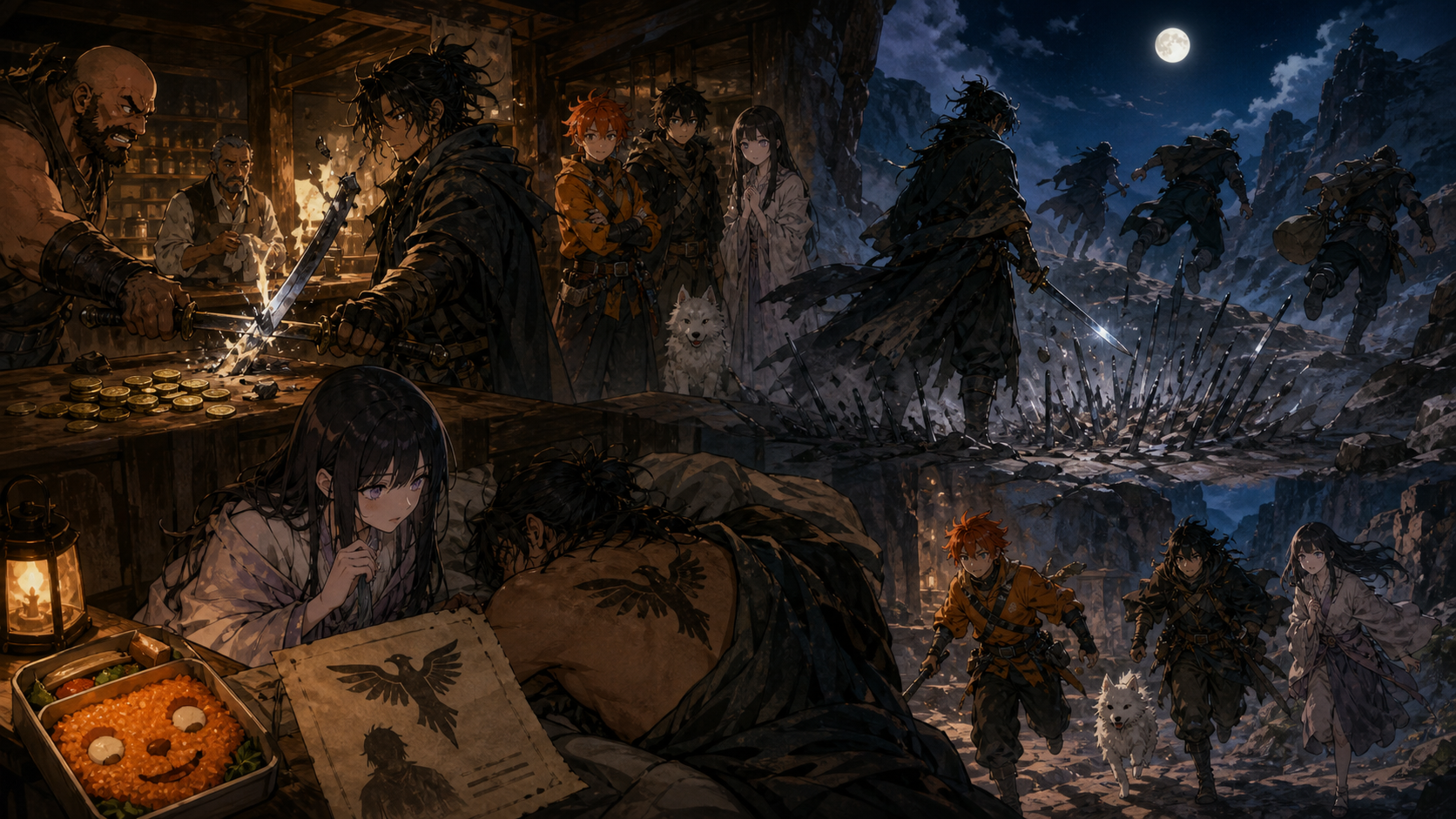
The Bounty Hunter from the Wilderness
A skilled stranger turns Gosunkugi’s capture into a competition, then a matching bird mark makes the rescuer in Naruto’s care look like a wanted killer.
Naruto, Kiba, and Hinata leave Konoha expecting an easy arrest. Their target is Gosunkugi, a thief with a wanted poster, a three-million-ryo bounty, and a stolen tea utensil somewhere in his history.
By the end of Episode 159, the stranger who saved them in a tavern has beaten all three unconscious, lost a fight to Gosunkugi, needed their help to survive, and turned out to have his own wanted poster.
So much for easy paperwork.
The episode plays like a ninja western and builds its mystery around official value. A mission rank says how dangerous a target should be. A bounty says how much a captured body is worth. A poster claims to tell you who committed a crime. Everyone keeps trusting those labels right up until the labels contradict the person in front of them.
Hinata Packs the One Thing Nobody Can Price
Naruto fills in for Shino on a mission with Kiba, Hinata, and Akamaru. Tsunade orders them to capture Gosunkugi in the Land of Stone. He stole a valuable item called Misogi from the Tea Country daimyo and now carries a considerable bounty.
Naruto and Kiba are not impressed. The assignment sounds like a simple hunt for an ordinary thief, and neither is especially fired up.
Hinata brings lunch.
She has arranged the food in Naruto's likeness, which is sweet, detailed, and deeply awkward when Naruto realizes he has to bite into his own face. He gets over that quickly once he tastes it. Then he tells Hinata she will make a good wife someday, and she nearly short-circuits on the spot.
The scene is light, but it gives the episode a kind of value that the bounty plot cannot measure. Hinata made something because she cared whether Naruto ate. No arrest, reward, or reputation changes hands. It is the only major exchange in the episode that is not trying to buy, claim, or manipulate someone.
Then the team reaches the first Land of Stone town, where nearly every other interaction comes with a price.
Ramen Was Not on the Menu
Akamaru notices Gosunkugi's wanted poster before the group enters a rough tavern to ask questions. The bartender refuses to provide information unless they become customers, so Naruto orders ramen while Kiba asks for a cheeseburger and milk.
They might as well have requested room service on the moon.
The regulars laugh, the bartender gets angry, and Naruto produces his wallet to prove he can pay. That attracts Michizo Manaka, a wanted brute who decides the kid's money should become his.
Naruto fights back, and the tavern starts turning into a group brawl. A lone swordsman stops it.
He cuts Michizo's blade and drops him with speed the three genin barely follow. Then he claims the man's bounty and leaves the reward with the bartender to pay for drinks and damage.
The gesture makes him look capable, controlled, and honorable. He takes no reward beyond the posted bounty and leaves no frightened patron owing him a favor. Naruto's group follows him outside, impressed.
His name is Sazanami, and he makes his living capturing wanted people.
Gosunkugi Is Not an Ordinary Thief
When Naruto shows him Gosunkugi's image, Sazanami corrects the team's assumptions. Gosunkugi is not simply a man who stole an expensive object. He is an A-rank criminal linked to numerous killings and thefts.
That should make the team pause. Their written assignment produced confidence without understanding. Sazanami's experience fills in the danger that the mission summary left flat.
Naruto tells him they are Konoha shinobi ordered to make the capture. Sazanami offers to buy them a meal. Naruto and Hinata ask for ramen, Kiba repeats the cheeseburger request, and Sazanami leads them into empty wilderness where no restaurant exists.
The invitation was a trap.
Sazanami wants Gosunkugi for himself. Whether the motive is money, pride, or something more personal remains hidden, but he will not share the target.
He grabs Hinata first and knocks her out. Kiba attacks with Akamaru and discovers that Sazanami's sword work is faster than the tavern demonstration suggested. Sazanami disables Kiba and Akamaru, then cuts through Naruto's shadow clones.
Naruto tries to come at him from below and behind. Sazanami catches the move and knocks him unconscious with the hilt rather than the blade.
That restraint matters. Sazanami attacks children and leaves them helpless in the wilderness, which is reckless at best. He also chooses not to kill them when doing so would protect his lead completely. The episode is building suspicion, not a clean villain label.
The Hunter Finds a Shinobi
Sazanami tracks Gosunkugi and his men at night. He has the skill to locate them and the confidence to confront the group alone.
Gosunkugi reveals why his reputation exceeds ordinary theft. He scatters nails across the ground, then uses Torpedo Nails to drive them through the earth and launch them upward beneath Sazanami. One wrong step activates a field of hidden blades.
Sazanami is badly cut before he can close the distance.
His sword technique dominated Naruto, Kiba, and Hinata because he controlled the pace and never let them build a coordinated response. Gosunkugi denies him that clean duel. The bounty hunter came alone to keep the prize, and now no teammate is present to check the ground, draw attention, or pull him out.
Naruto's group wakes and returns to town, but Sazanami has vanished. Akamaru follows his trail toward the mountains. They arrive before Gosunkugi's men finish him.
Naruto surrounds the gang with shadow clones. Gosunkugi retreats rather than risk a prolonged fight against reinforcements, leaving the team with no arrest and one bleeding rival.
They save Sazanami anyway.
A Wanted Man in the Patient's Bed
The Konoha team carries Sazanami to a hut and treats his wounds. Kiba recognizes that Gosunkugi has shinobi training, forcing the group to update the easy mission one more time.
Another bounty hunter crashes into the shelter. His name is Gatsu, and he is not there for Gosunkugi. He wants Sazanami.
Naruto and Kiba drive him away before he can claim the injured man. In the retreat, Gatsu drops a wanted poster.
The face belongs to a man named Tokichi, accused of murdering a family of three. The poster identifies a distinctive bird-shaped mark on his chest.
Hinata looks at the wounded bounty hunter they have been protecting. Sazanami has the same mark.
The episode stops at the right moment. A matching mark creates a serious question, not a complete answer. Sazanami may be Tokichi. That does not yet establish whether every accusation on the poster is true, why he changed his name, or why capturing Gosunkugi matters enough that he attacked the Konoha team and walked alone into a trap.
Naruto has to sit with uncertainty instead of deciding in one breath that the man is either a hero or a murderer.
What Is a Wanted Poster Worth?
Episode 159 keeps converting people into amounts. Michizo becomes enough money to repair a tavern. Gosunkugi becomes three million ryo and a competition between hunters. Sazanami evaluates Naruto's team as interference, while Gatsu evaluates Sazanami as another claim.
The posters contain useful facts. Michizo attacks Naruto. Gosunkugi uses lethal techniques and travels with armed men. Ignoring official warnings would be foolish.
Yet a poster cannot carry motive, context, or proof beyond the decision of whoever printed it. The same paper that helps identify a dangerous thief now tells Naruto that the man spared his life, received his medical care, and saved him from a tavern fight murdered three people.
That contradiction is the real cliffhanger.
Naruto began the mission bored because Gosunkugi looked like a routine target. Sazanami taught him that a name on paper can hide greater danger. Now Sazanami's own poster asks the reverse question: can a terrifying accusation hide a different truth?
Episode 160 will have to supply evidence. For now, Naruto, Kiba, and Hinata are sheltering a wanted man while the thief they were ordered to capture remains free.
The easy mission has officially left the building, probably because it could not get ramen there either.
A three-million-ryo bounty changes every encounter around Gosunkugi
The reward encourages skilled people to pursue the same target without sharing plans, evidence, or custody rules. Konoha’s team sees a mission subject. Independent hunters see income. Gosunkugi sees competitors he can manipulate against one another. A price may attract help, but it also creates incentives to rush, conceal information, and value possession of the body over a safe arrest.
Naruto’s team needs a clear authority for capture
Tsunade sends them across a border to the Land of Stone, where local enforcement and bounty hunters may already be active. The mission should define who can detain Gosunkugi, where he must be delivered, and how claims are documented. Without that structure, every meeting can turn into a fight over who owns the capture rather than cooperation around public safety.
Shino’s absence changes the team’s detection balance
Naruto fills the open position beside Kiba, Hinata, and Akamaru. The squad retains scent tracking and wide visual reconnaissance, but loses Shino’s patient field leadership and insect surveillance. Naruto brings speed and numbers. He also brings a tendency to react before evidence settles. The team should name those differences instead of pretending any fourth member makes the formation identical.
Hinata’s handmade lunch establishes care without a transaction
The Naruto-shaped meal is personal, slightly awkward, and offered without a price. That small act becomes a moral counterpoint to the bounty system surrounding the episode. Nearly everyone else calculates what a body, capture, or reputation is worth. Hinata prepares food because she wants someone to be nourished, even if her feelings are never rewarded in the way she hopes.
The tavern is an information site and a place full of civilians
Naruto’s team enters looking for leads, then conflict begins around patrons and staff who did not consent to become part of a shinobi confrontation. Any response must keep weapons away from bystanders and preserve the bartender’s ability to speak freely after the fighters leave. Gathering intelligence becomes harder when the investigators help turn the room into another dangerous place.
Sazanami’s controlled sword work creates immediate credibility
He defeats the threatening brute efficiently and leaves bounty coins rather than using the scene to dominate everyone present. Skill, restraint, and payment make him look professional. Those observations are real. They still cannot answer who he is or why he wants Gosunkugi. Competence should earn attention, not automatic trust.
A warning about an A-rank killer deserves verification
Sazanami tells the team Gosunkugi is more dangerous than they understand. The claim aligns with later evidence, but the squad should ask what techniques, weapons, accomplices, and patterns justify the rank. Specific intelligence can change formation and medical preparation. A dramatic label alone may produce fear without a usable plan.
Sazanami attacks the team to preserve exclusive claim
He saves them in one moment and disables them in another because cooperation threatens his control over the bounty. Sparing their lives limits the harm but does not make the assault acceptable. He removes authorized ninja from the field, reduces surveillance on a violent fugitive, and creates a period where the unconscious team cannot protect itself or nearby civilians.
Leaving opponents alive does not erase the risk of incapacitation
Unconscious people can aspirate, suffer head injuries, become targets for animals or criminals, and lose critical time. Sazanami cannot know that all four will recover safely. Restraint should be measured by the danger he creates, not only by whether he chooses a killing blow. Professional competition does not justify abandoning injured rivals in unfamiliar territory.
Gosunkugi’s Torpedo Nails exploit predictable pursuit
Sazanami hunts alone, following the route his target expects a hunter to take. Hidden nails turn ground into a weapon and punish forward focus. The trap shows why a tracker, visual scout, perimeter partner, and capture specialist should work together. Independence preserves Sazanami’s claim while stripping away every layer that could have detected the ambush.
A lone hunter has no one to verify injury or continue evidence collection
Once Sazanami falls, the pursuit nearly ends with him. He cannot treat himself, secure the trap site, or report Gosunkugi’s direction. The bounty system rewards the appearance of self-sufficiency while making failures disappear off the record. Cooperation can protect both the hunter and the integrity of the case.
Naruto’s team rescues the person who attacked them
That choice is morally important. Immediate medical need outweighs resentment and competition. Rescue does not require forgetting what Sazanami did. The team can stabilize him, secure his weapons, document the earlier assault, and ask questions once he is able. Care and accountability can occupy the same room.
Driving off Gatsu protects a patient from becoming property
Another bounty hunter sees injured Sazanami as a claim to collect. The team refuses to let vulnerability decide ownership. A wanted notice may authorize detention, but treatment and identity verification still matter. An unconscious person cannot explain a mistaken record, surrender safely, or protect evidence from someone paid to deliver a body.
Hinata notices the matching bird mark
Her observation links Sazanami to the wanted poster for Tokichi. This is strong identification evidence because the mark appears distinctive and physically present. It establishes a reason for caution. It does not independently prove the murder accusation printed beside the image. Identity and guilt are separate questions, even when the same document presents them together.
Wanted posters compress complicated cases into actionable symbols
A face, name, mark, charge, and reward must communicate quickly. That efficiency helps people recognize danger. It also encourages readers to treat accusation as completed judgment. The team should verify issuing authority, date, jurisdiction, and whether Tokichi is wanted alive for trial. A poster is a lead and a custody instruction, not the entire evidentiary record.
Hinata should share the discovery without confronting him alone
Sazanami is injured but skilled, and the group has already seen him disable them. Quietly alerting Kiba and Naruto, moving weapons out of reach, and maintaining medical care would protect everyone. Her evidence is valuable because she observes before reacting. The team should preserve that advantage instead of turning recognition into an immediate accusation beside the patient.
Kiba and Akamaru can help confirm continuity
Scent may connect Sazanami’s belongings, movements, and the person named on the notice, though it cannot prove a legal charge. Kiba can also monitor whether the patient is preparing to flee or attack. Using scent beside Hinata’s visual evidence creates a stronger identity assessment while keeping each technique within its actual limits.
Naruto’s instinct to trust a rescuer needs disciplined follow-through
Sazanami saved the team at the tavern and later became their attacker and patient. Naruto often treats one emotionally clear act as proof of a whole person. This episode presents a useful contradiction. Someone can protect strangers, make harmful choices, carry a false accusation, or hide a dangerous truth. Trust should remain open to revision as evidence grows.
Sazanami’s secrecy may protect a plan while endangering potential allies
If he is Tokichi and believes Gosunkugi framed him, he may fear arrest before clearing his name. That motive would explain avoiding Konoha without making the assault necessary. Sharing limited evidence or proposing supervised cooperation could have preserved both goals. Secrecy feels protective when institutions may fail, but total isolation gives the real offender more room.
The next step should preserve the patient and the case
The team needs to treat Sazanami’s wounds, secure the wanted poster, record Hinata’s observation, and ask for his account without promising belief. Gosunkugi remains active, so someone must also maintain perimeter awareness. The mystery should not pull every teammate into a bedside debate while the target who planted the nails escapes.
RaeRae’s full take
Episode 159 keeps changing what Sazanami means. He is rescuer, rival, attacker, patient, and possibly the wanted man Tokichi. Every label has evidence behind it. None is enough by itself. That is the point I want the team to hold instead of choosing the version that feels emotionally easiest.
Hinata finds the most important evidence because she pays attention while providing care. The bird mark identifies the person in front of them. It does not prove the poster’s accusation. Protecting everyone means treating the wound, securing the weapons, and letting the story become more complete before deciding what justice requires.
The bounty system makes all of this worse. Three million ryo turns capture into ownership and rewards people for keeping information to themselves. Gosunkugi benefits every time the people hunting him compete harder than they cooperate.
The poster and trap site need an evidence chain
Hinata should record where the wanted notice was found, who handled it, and when she observed the matching mark. The team should also preserve a Torpedo Nail and map the ambush location if safety permits. Those details may connect Gosunkugi to the attack and prevent Sazanami’s hidden identity from swallowing the investigation into the person who caused the current injury.
Evidence custody sounds less dramatic than a bounty chase, but it protects everyone from a story built only from reputation. Tokichi deserves a fair account of the accusation. Gosunkugi’s victims deserve a case strong enough to survive challenge. The Konoha team can pursue both by documenting before another hunter carries the poster, weapon, or patient away.
RaeRae checkpoint: Hinata proves Sazanami matches the wanted identity. She does not prove the murder charge. Care, caution, and evidence can coexist while Gosunkugi remains the active danger.
Watch Naruto Episode 159
- [Naruto Official episode guide](https://naruto-official.com/en/anime/naruto1/list/01_383)
- [Watch “The Bounty Hunter from the Wilderness” on Crunchyroll](https://www.crunchyroll.com/watch/G6X04Q8NY/the-bounty-hunter-from-the-wilderness)
- [Browse official Naruto viewing options from VIZ](https://www.viz.com/anime/tv-show/naruto-video/video-unit/1)
Receipts and official routes
- Episode number, licensed title, and official synopsis: Naruto Official Site.
- Japanese title, synopsis, and November 9, 2005 broadcast record: TV Tokyo.