
For a Friend!
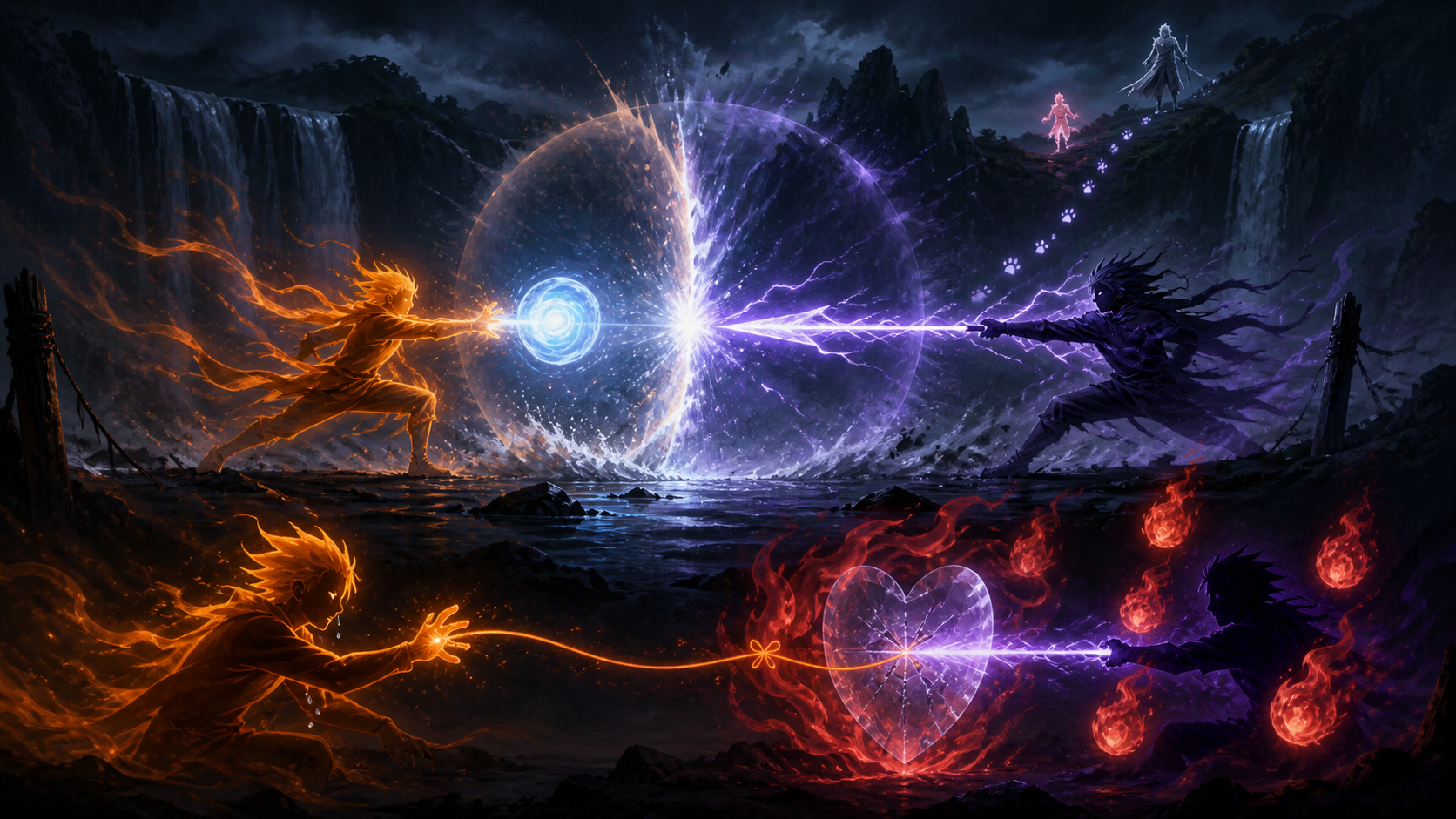
Naruto fights to preserve his closest bond while Sasuke accepts that same friendship as the price of Mangekyo and strikes to kill.
RaeRae Reacts
Episode 132 makes “for a friend” mean two opposite things.
Naruto fights to keep his friend alive and bring him home.
Sasuke tries to kill that same friend because Itachi told him the bond could be converted into Mangekyo Sharingan.
The first Rasengan and Chidori collision throws both boys apart without deciding anything.
Then Sasuke stops treating the battle like a contest.
He uses Phoenix Sage Fire to distract Naruto and drives Chidori through his chest.
That strike says more clearly than the argument ever could.
Sasuke has accepted murder as the price of power.
Naruto's body answers with the Nine-Tails.
The friend Sasuke chose as a sacrifice is not ready to stay dead.
Sakura Knows This Can Become Fatal
Sakura goes to Kakashi because fear has moved beyond Sasuke leaving the village.
She understands Naruto followed him and knows enough about both boys to recognize where pride, hurt and desperation can lead.
The boys are far outside Konoha. Sasuke has accepted Orochimaru's curse mark. Naruto made a promise he treats as absolute.
Sakura cannot chase them safely herself.
She does the useful thing available and gives Kakashi the warning.
Her concern is correct.
By the end of the episode, one teammate has put his hand through the other's chest.
Kakashi Starts the Pursuit
Kakashi reassures Sakura and immediately shifts into tracking.
He summons his ninken and sends them to find Naruto and Sasuke.
The dogs expand the search while scent lets Kakashi follow after visual traces disappear.
Kakashi understands the danger personally.
He already stopped Chidori and Rasengan from colliding on the hospital roof. He warned Sasuke that revenge leaves emptiness behind. He knows Naruto will not abandon someone he calls a friend.
Now those same forces are moving without a barrier, teacher or village wall nearby.
Kakashi is no longer preventing a fight.
He is racing toward one already underway.
Sasuke Accepts the Price
Sasuke believes killing Naruto can awaken Mangekyo Sharingan.
Naruto is not a convenient target selected because he happened to follow.
The requirement only matters because Sasuke recognizes him as his closest friend.
That makes the decision uglier and more revealing.
Sasuke knows the bond exists. He understands Naruto matters. He treats that emotional value as the reason murder would purchase greater power.
Itachi designed the rule to make attachment self-destructive.
The closer Sasuke becomes to another person, the more valuable that person becomes as a sacrifice under Itachi's system.
Sasuke has reached the point where he accepts that math.
Naruto Builds Rasengan
Naruto forms Rasengan with the help of a shadow clone.
The technique carries Jiraiya's training, Naruto's persistence and the promise that he could learn power without surrendering himself to Orochimaru.
It is also dangerously concentrated force.
Naruto wants to stop Sasuke, not kill him, but Rasengan is not a gentle persuasion tool. The stakes have moved past anything ordinary restraint can handle.
Naruto needs enough power to survive Chidori and make Sasuke physically incapable of continuing toward the Sound.
His solution still points toward return.
The technique is meant to create another chance for the conversation.
Sasuke's solution points toward finality.
Sasuke Builds Chidori
Sasuke gathers lightning around his hand.
Chidori was the technique Kakashi taught him to protect teammates and face Gaara during the Chunin Exams.
At the Valley of the End, Sasuke directs it toward one of those teammates.
The shift exposes how technique inherits purpose from the person using it. Chidori has not become evil. Sasuke's chosen target changed.
He is not using the attack to escape an enemy threatening Team 7.
He is using it to kill the friend Team 7 gave him.
That is another bond converted into ammunition for revenge.
Kakashi's training becomes part of the power Sasuke carries toward Orochimaru.
Chidori Meets Rasengan
The techniques collide.
Lightning and rotating chakra push against each other until the force sends both boys flying apart.
Neither attack wins cleanly.
The stalemate reflects more than comparable destructive power. Naruto and Sasuke remain attached to opposing goals with enough conviction that neither gives ground.
Naruto will use force to preserve the bond.
Sasuke will use force to sever it.
The collision cannot reconcile those intentions. It proves each boy possesses enough power to injure the other and not enough power to make the other agree.
The fight continues because technique can settle position, not meaning.
Naruto Cries Without Stopping
Naruto silently cries for Sasuke.
The tears do not make him passive.
He keeps fighting because grief and determination occupy the same body. Naruto is mourning the friend who stands in front of him while refusing to treat that friend as already gone.
That refusal is one of his strengths and one of the reasons this battle becomes so dangerous.
Naruto will absorb punishment long after a safer person would retreat because leaving Sasuke feels like confirming the abandonment both of them fear.
He is not only trying to win.
He is trying to prove the bond can survive Sasuke's attempt to destroy it.
Sasuke Says Blows Can Communicate
Sasuke tells Naruto that skilled shinobi can read one another through exchanged blows.
He asks whether Naruto can read his mind.
The idea acknowledges that combat contains information beyond spoken language. Timing, target choice, hesitation and force reveal intent.
Sasuke's blows say he is willing to hurt Naruto enough to leave.
Naruto's restraint says he still imagines both of them surviving the return.
The question also shifts responsibility.
If Naruto can read Sasuke through combat, Sasuke no longer needs to explain pain in words he does not trust.
He can demand understanding while continuing to attack.
Naruto receives the message.
He refuses the conclusion.
The Curse Mark Tilts the Fight
Sasuke activates the curse mark to gain the upper hand.
Borrowed power enters the argument again.
The mark increases strength and chakra while rewarding the exact decision Orochimaru wants: use more, rely on it, and associate leaving Konoha with becoming harder to stop.
Sasuke does not experience the mark as loss of agency in the moment.
He experiences results.
Every advantage confirms that Orochimaru's route works faster than the village route he abandoned.
Naruto now has to overcome Sasuke's own skill and a system designed to make betrayal feel physically superior.
Phoenix Sage Fire Hides the Finish
Sasuke uses Fire Release: Phoenix Sage Fire Technique as a distraction.
Multiple flames force Naruto to track movement and defense while Sasuke prepares the lethal line.
The fire is not the finish.
It controls Naruto's attention so Chidori can become the finish.
Sasuke's tactics show full intent. He is not throwing attacks in emotional chaos and accidentally creating mortal danger.
He creates cover, positions himself and commits to a strike designed to kill.
The closest-friend requirement has moved from memory into operational planning.
Itachi's instruction is now shaping the sequence of Sasuke's hands.
Chidori Goes Through Naruto's Chest
Sasuke drives Chidori through Naruto's chest.
The strike lands where a normal body cannot survive.
This is the moment any softer reading of Sasuke's intention has to stop. He is not bluffing Naruto into retreat or aiming for a harmless demonstration.
He accepted Naruto's death and followed through.
The wound also proves the difference between fighting for someone and deciding what they must endure for that rescue.
Naruto's goal remains compassionate.
The cost to his own body is catastrophic.
He cannot keep a friend alive if he dies in front of him.
That should end the fight.
Naruto is not alone inside his body.
The Nine-Tails Answers the Wound
Nine-Tails chakra begins covering Naruto.
The energy responds to mortal injury and starts restoring what Chidori destroyed.
Sasuke did not account for this recovery because he has never witnessed Naruto survive a wound like the one he delivered.
The jinchuriki system that isolated Naruto now preserves his chance to keep fighting for the bond built despite that isolation.
There is no sentimental cooperation here yet. The Nine-Tails has its own interest in keeping the host alive.
The result still changes the battlefield.
Sasuke used the strongest lethal answer he had.
Something behind Naruto's blue eyes has begun answering back.
What Changes After Episode 132
Sakura warns Kakashi that Naruto and Sasuke may genuinely kill each other.
Kakashi summons his ninken and begins tracking them.
Sasuke accepts Naruto's death as the price of Mangekyo Sharingan.
Naruto forms Rasengan while Sasuke forms Chidori.
Their first collision throws both fighters apart without a winner.
Naruto silently cries for the friend he refuses to abandon.
Sasuke says skilled shinobi can read each other through exchanged blows.
The curse mark gives Sasuke another advantage.
Phoenix Sage Fire distracts Naruto from the lethal setup.
Sasuke drives Chidori through Naruto's chest.
Nine-Tails chakra begins responding to the fatal wound.
The sustained cloak counterattack and rapid healing belong to Episode 133.
Sakura recognizes lethal danger before an adult reaches the valley
Sakura knows Naruto and Sasuke well enough to understand that rivalry has crossed into something neither boy may be able to stop. She does the responsible thing and seeks Kakashi. Her fear is not melodrama. It is an accurate reading of two children carrying weapons, grief, and conflicting promises.
The episode lets her emotional knowledge become actionable intelligence. The tragedy is that institutional response still begins after the retrieval team has already been scattered.
Kakashi finally enters pursuit with adult-scale urgency
Kakashi summons his ninken because tracking two students through a forest requires more than intuition. The method is competent and appropriate. It also highlights how long the mission operated without a senior shinobi moving beside the children.
Adult intervention matters, but timing is part of adequacy. Arriving eventually cannot erase what minors were required to survive while help assembled.
Sasuke accepts the closest-friend price because Itachi defined the transaction
Sasuke admits Naruto has become his closest friend and then treats that bond as the condition for Mangekyo power. The confession should be tender. It arrives as a death sentence because Itachi taught him intimacy is valuable mainly when sacrificed.
Sasuke is choosing, but he is choosing within a rule planted through torture. Freedom requires more than acting on an instruction nobody is visibly repeating.
Naruto hears friendship and refuses to hear a farewell
Being named closest friend confirms the connection Naruto has been fighting to preserve. He cannot accept Sasuke’s belief that acknowledging the bond requires destroying it.
Naruto’s refusal is emotionally honest. He still needs a rescue plan that protects Sasuke without reducing friendship to another claim on Sasuke’s body.
Rasengan carries instruction built through relationship
Jiraiya taught Naruto the technique through stages, mistakes, and a challenge calibrated to how Naruto learns. The sphere therefore represents power developed inside imperfect mentorship rather than power purchased by surrender.
Naruto brings that relational history into the clash. His strength grew because somebody stayed near enough to teach him.
Chidori carries both Kakashi’s trust and Sasuke’s dangerous reinterpretation
Kakashi taught Chidori as a controlled technique with conditions and limits. Sasuke now directs it toward the teammate Kakashi expected him to protect. The jutsu has not changed; its ethical context has.
Training a child in lethal force creates an ongoing duty to monitor how that force is used, especially after trauma and curse-mark manipulation become visible.
The first collision turns mentorship into a painful comparison
Rasengan and Chidori meet with enough force to tear the landscape. Jiraiya’s student and Kakashi’s student bring adult-taught techniques into a confrontation those adults failed to prevent in time.
The spectacle is earned. The spectacle also records institutional failure. Children should not have to use their teachers’ greatest lessons to decide whether one of them may leave alive.
Naruto cries while continuing to fight
His tears do not interrupt movement because grief and action have become inseparable. Naruto is angry, terrified, hurt, and determined at once. Crying does not weaken his resolve. It reveals the emotional cost of maintaining it.
The scene refuses the idea that serious fighters must become numb. Feeling remains present even when neither boy can translate feeling into safety.
Sasuke claims blows can communicate what words cannot
There is truth in the idea that bodies reveal commitment. Combat can expose hesitation, fear, and power. Violence is still a terrible substitute for conversation because injury changes what the participants are able to say afterward.
Sasuke uses fighting to avoid language that might make departure harder. Calling the blows communication does not make the exchange mutual or safe.
The curse mark changes capacity and narrows choice
Orochimaru’s mark gives Sasuke immediate power while linking that power to pain, desire, and the promise waiting outside Konoha. Every successful use advertises the predator’s offer from inside Sasuke’s skin.
The mark does not erase agency. It materially alters the conditions under which agency operates, and that should intensify the village’s duty of care.
Sasuke’s strength is real even when exploitation amplifies it
He has trained, studied, and developed extraordinary skill. Naming the curse mark’s manipulation should not reduce him to a puppet. It should clarify why authentic talent does not make Orochimaru’s route legitimate.
Predators often attach themselves to real ambition. The victim’s ability becomes camouflage for the exploitation.
Phoenix Sage Fire hides an attack inside spectacle
Sasuke uses multiple flames and projectiles to control Naruto’s attention and movement. The sequence demonstrates tactical intelligence under emotional pressure. He is not fighting blindly.
That competence increases responsibility. Deliberate planning means the harm cannot be dismissed as a momentary loss of control.
Naruto’s clones keep placing bodies between Sasuke and departure
Shadow clones externalize Naruto’s refusal to be left. Every copy pursues, grabs, or absorbs an attack. The technique makes attachment physically numerous.
Yet more Naruto cannot solve Sasuke’s fear of being claimed. Quantity intensifies the confrontation unless paired with a future Sasuke can choose.
Chidori through Naruto’s chest crosses a moral boundary
Sasuke drives a lethal technique into his friend. Naruto’s unusual body and the Nine-Tails’ chakra may keep him alive, but Sasuke cannot ethically rely on miraculous recovery while striking.
Context explains how he arrived at the act. The act remains attempted killing, and compassion for Sasuke must coexist with protection for Naruto.
Sasuke redirects the strike from the heart without making it safe
The placement suggests conflict inside his decision. Some part of him may resist completing Itachi’s condition even as he inflicts a devastating wound. Hesitation matters because it reveals the bond is not dead.
It does not transform the attack into mercy. Naruto’s life still depends on a power Sasuke does not control.
The Nine-Tails answers injury before Naruto can choose the terms
Red chakra emerges as a survival response. Naruto gains healing and force, but the help comes from a sealed being whose relationship with him is not yet cooperative. Protection and danger arrive together.
Like Sasuke’s curse mark, the power complicates agency. Unlike Orochimaru’s mark, it was imposed on Naruto as an infant by village leadership rather than sought during crisis.
Both boys carry adult decisions inside their bodies
Sasuke bears a curse mark placed by Orochimaru. Naruto bears a tailed beast sealed by Minato and managed by Konoha through secrecy and stigma. Their bodies become battlefields for choices adults made around them.
The boys remain accountable for how they fight. Adults remain accountable for creating the conditions that make bodily escalation possible.
Friendship cannot require either boy to disappear
Sasuke believes he must kill a friend to gain power. Naruto believes he must physically prevent a friend from leaving. Each position risks making one person’s need consume the other’s autonomy.
A healthier bond would protect life, permit disagreement, and create routes for leaving or returning without surrender to a predator.
Sakura’s absence does not make her irrelevant to the fight
Her warning sends Kakashi toward them. Her plea remains part of Naruto’s promise. Her relationship with both boys shapes why the rupture feels like Team Seven breaking rather than a private rivalry ending.
Still, Sakura should not be reduced to the girl waiting for two boys to settle her future. She identified danger and sought intervention when others had not.
Kakashi is racing against lessons he helped normalize
He trained students for lethal missions, encouraged competition, and taught techniques capable of killing. He also taught teamwork and tried to interrupt Sasuke’s revenge. Both parts of his mentorship are now present.
The pursuit asks whether care can catch up after a system made violence the children’s most fluent language.
Itachi’s command remains the invisible third combatant
Every time Sasuke looks at Naruto as the closest friend, Itachi’s instruction reframes the relationship. The older brother does not need to be physically present. His imposed logic chooses the stakes.
Sasuke will not be free merely by surpassing Itachi’s strength. He must reject Itachi’s definition of what strength costs.
The episode makes power look expensive in different currencies
Naruto’s power consumes control and risks releasing the Nine-Tails. Sasuke’s power deepens the curse mark and moves him toward Orochimaru. Both transformations answer vulnerability while creating new danger.
More force cannot be the only measure of who wins. The real question is who remains able to choose a life afterward.
RaeRae’s full take
Episode 132 gives us the collision everybody remembers, but the jutsu are carrying adult fingerprints. Jiraiya taught Rasengan. Kakashi taught Chidori. Orochimaru marked Sasuke. Konoha sealed the Nine-Tails inside Naruto. Two children meet at the valley with an entire system inside their bodies.
Sasuke calling Naruto his closest friend should be the moment the bond becomes undeniable. Itachi poisoned that recognition years ago by assigning friendship a murder price. Naruto refuses the transaction, and I am with him there. A person is not fuel for somebody else’s awakening.
I also cannot pretend dragging Sasuke home solves the deeper crisis. Friendship must offer more than possession from the loving side and sacrifice from the grieving side. Both boys deserve a future where closeness does not demand that one of them disappear.
RaeRae checkpoint: Being Sasuke’s closest friend makes Naruto a person to protect, not a price to pay. Any power that demands a loved one’s death is another form of control.
RaeRae's Verdict
“For a Friend!” is a title split down the middle.
Naruto cries and fights because Sasuke is his friend.
Sasuke attacks with lethal intent because Naruto is his friend.
Itachi turned the bond into a price tag, and Sasuke has decided Mangekyo is worth paying it.
Rasengan and Chidori collide without settling which purpose wins.
Then Sasuke removes ambiguity and puts Chidori through Naruto's chest.
That should end everything.
Instead, red chakra rises around the person Sasuke tried to sacrifice.
The bond did not save Naruto from the strike.
The beast sealed inside him keeps the argument alive.
Receipts and official routes
- Episode number and licensed title: Naruto Official Site.
- Japanese title, synopsis, and April 27, 2005 broadcast record: TV Tokyo.
- Streaming availability varies by region; use the licensed route maintained in the episode directory.