
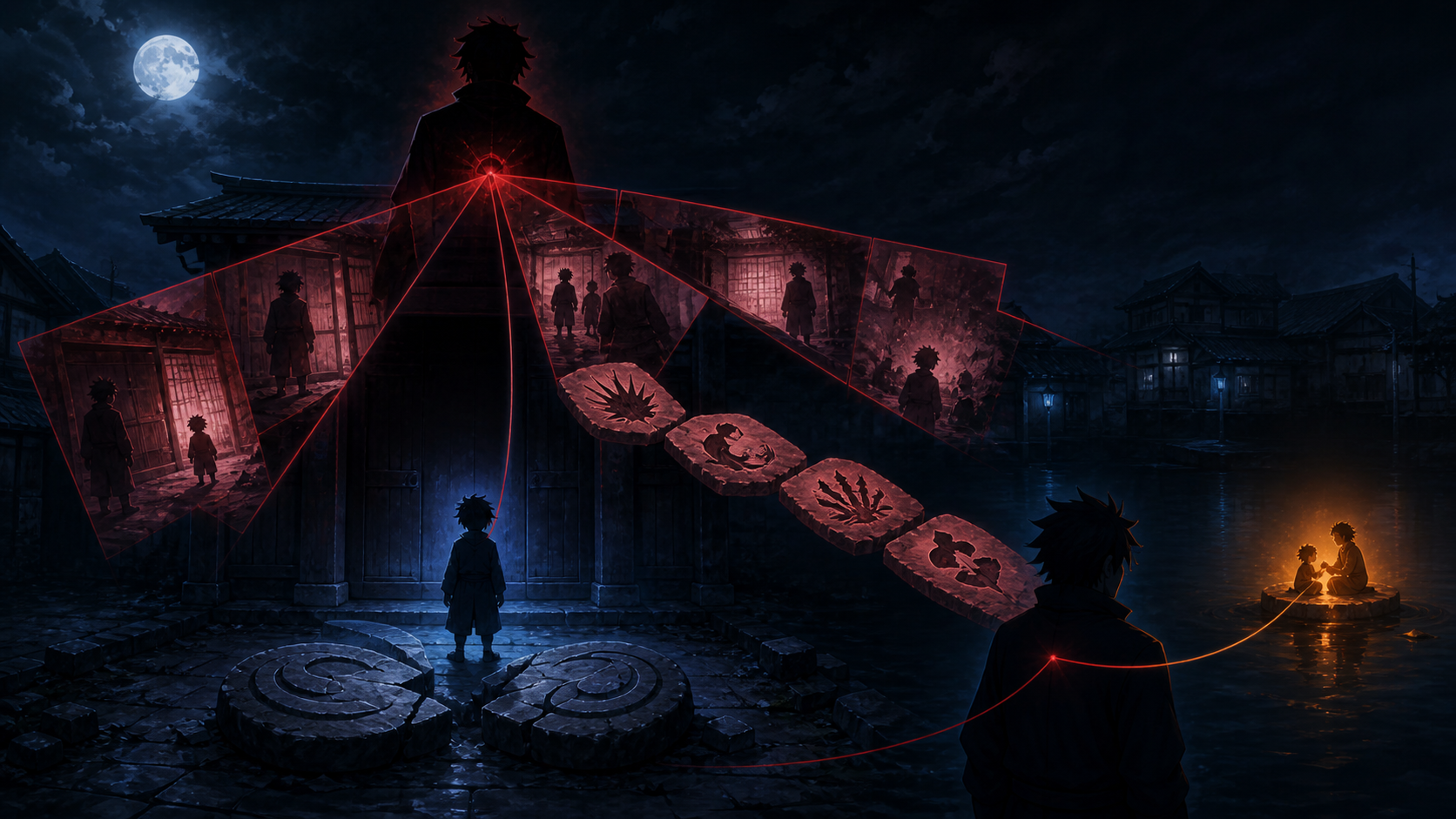
The Secrets of the Mangekyo Sharingan!
Itachi did more than destroy Sasuke’s family: he prescribed hatred, power and the closest friend’s death as the survivor’s future.
RaeRae Reacts
Episode 131 reveals the nastiest part of Itachi's massacre from Sasuke's perspective.
He did not only kill the clan.
He told the surviving child how to spend the rest of his life.
Hate me.
Become stronger.
Kill your closest friend if you want the eyes powerful enough to reach me.
Sasuke thinks revenge is his rebellion against Itachi.
The plan came from Itachi's mouth.
At the Valley of the End, Sasuke looks at Naruto and identifies the final requirement. Naruto is his closest friend, which makes killing him useful under the system Itachi designed.
To defeat the brother who destroyed every bond, Sasuke is asked to destroy the strongest bond he managed to rebuild.
That is not liberation.
It is obedience wearing hatred.
Naruto Sinks While Sasuke Watches
Naruto falls deeper into the water after Sasuke's attack.
Sasuke watches quietly and resolves to obtain power no matter how much darkness lies ahead.
He is not raging blindly or losing control to the curse mark. He is thinking.
Naruto's body below him represents the choice Itachi prescribed years earlier. If Sasuke can kill the person closest to him, Mangekyo Sharingan may give him the power required for revenge.
The present scene opens the memory because Sasuke is not merely remembering trauma.
He is consulting an instruction.
The massacre becomes a manual he has carried since childhood.
The Uchiha District Is Too Quiet
Young Sasuke returns from the Academy and finds the Uchiha district unnaturally silent.
The lights are wrong for the hour. Streets that should contain relatives, neighbors and familiar routines offer no ordinary movement.
Then he finds blood.
Bodies replace the people who defined home.
The horror builds through recognition. Sasuke knows the buildings, faces and relationships. Every step removes another part of the world he expected to remain stable.
He runs toward his parents because home should still contain an explanation.
Instead, home contains the answer.
Itachi Stands Over Their Parents
Sasuke finds Fugaku and Mikoto dead.
Itachi stands over them.
The brother who carried Sasuke, taught him clan history and served as the standard for everything he hoped to become now occupies the center of the slaughter.
Sasuke cannot reconcile those versions.
He asks why.
Itachi answers with cruelty calculated to destroy any remaining sense that family love was real. He claims he killed everyone to measure his capacity.
The explanation turns the clan into test material.
Parents, relatives and neighbors become objects Itachi supposedly destroyed to learn the extent of his own power.
Young Sasuke hears that his entire world was worth less than one experiment.
Mangekyo Forces Him to Watch
Itachi uses Mangekyo Sharingan on Sasuke.
He does not leave the child to process what he discovered.
He forces Sasuke to witness the deaths.
The technique converts memory into deliberate torture. Sasuke sees the massacre through the power he will later be told to pursue, which binds the desired weapon to the trauma it inflicted.
Mangekyo becomes both threat and promised solution.
Itachi demonstrates overwhelming control, then tells Sasuke how he might obtain the same class of power.
That is grooming through terror.
Sasuke is made to relive helplessness and given one route out: become more like the person causing it.
“To Measure My Capacity” Is a Trap
Itachi's stated motive sounds empty because emptiness serves the purpose.
If he offered a political explanation, Sasuke might direct questions toward the clan, village or systems around them.
Instead, Itachi presents himself as a monster interested only in testing power.
That gives Sasuke one target and one language.
Strength caused the massacre.
Greater strength can avenge it.
The capacity claim reduces a complicated history Sasuke does not know into a private contest between brothers. It makes revenge feel comprehensible at the exact moment everything else becomes incomprehensible.
Sasuke builds his life around that simplified answer because a child needs some structure after the whole world collapses.
Itachi supplies one designed around hatred.
Sasuke Is Told He Is Not Worth Killing
Itachi leaves Sasuke alive and says he is not worth killing.
The insult targets the wound Fugaku's approval already created.
Sasuke spent childhood trying to become worthy of the Uchiha crest and his father's attention. Now the brother who defined excellence tells him he does not even qualify as a meaningful victim.
Survival becomes humiliation.
Itachi turns being spared into another measurement Sasuke failed.
That ensures revenge will not only honor the clan. It will answer the accusation that Sasuke is too weak to matter.
Every later increase in power can feel like movement toward the day Itachi must finally acknowledge him as an equal threat.
The dead family and damaged self-worth become one objective.
Live in Hatred
Itachi instructs Sasuke to hate him, survive and become stronger.
Those words become the architecture of Sasuke's identity.
Hatred keeps Itachi central.
Survival preserves the future confrontation.
Power supplies the only progress Sasuke trusts.
The order hijacks ordinary recovery. Healing could reduce hatred. New bonds could make revenge less absolute. A future outside Itachi could make the confrontation unnecessary.
Under the instruction, all three possibilities look like failure.
Sasuke believes loyalty to his murdered family requires maintaining the wound exactly as Itachi left it.
Pain becomes duty.
The Closest-Friend Requirement
Itachi tells Sasuke that awakening Mangekyo Sharingan requires killing his closest friend.
The requirement is vicious because it does more than demand murder.
It requires Sasuke to build or recognize a bond, then destroy it deliberately for power.
The act would reproduce the emotional logic Itachi displayed during the massacre: treat a relationship as material for measuring capacity.
Sasuke could defeat Itachi only after proving willing to become the version of Itachi he hates.
The weapon and moral injury arrive together.
That is why Mangekyo is a trap in this episode. It offers greater sight while narrowing Sasuke's ability to imagine any route that does not pass through betrayal.
Itachi Authors Sasuke's Revenge
Sasuke experiences revenge as personal will.
He chooses training, leaves Konoha and accepts Orochimaru's curse mark because nobody else owns his purpose.
Yet the sequence follows Itachi's instructions.
Hate.
Survive.
Gain power.
Kill the closest friend.
Return when the eyes match.
Sasuke's defiance remains trapped inside a path created by the person he wants to defy.
Orochimaru exploits that arrangement without needing to invent it. He only offers faster access to the power Itachi taught Sasuke to prioritize.
Two older men shape the road while Sasuke calls the road independence.
Naruto Is the Closest Friend
Back in the present, Sasuke identifies Naruto as his closest friend.
The admission is not tender, but it is real.
Naruto became the person capable of provoking Sasuke's rivalry, anger, recognition and instinctive sacrifice. Their bond grew through Team 7 even when neither boy knew how to name it without turning the feeling into competition.
That makes Naruto the person Itachi's rule targets.
Killing a stranger would not satisfy the instruction. Killing an acquaintance would not prove the required severance.
The power demands the person whose loss would matter most.
Sasuke's willingness to consider it proves the bond exists at the exact moment he tries to erase it.
The Episode Does Not Excuse the Choice
Sasuke is a traumatized child following an instruction planted through torture.
He is also considering killing Naruto.
Both facts remain true.
Understanding manipulation does not make the intended harm harmless. It explains why Sasuke sees murder as meaningful without requiring us to accept his logic.
Naruto's insistence on bringing him home responds to that complexity. Sasuke chose to leave, but the choice grew inside trauma, a curse mark and adult exploitation.
Stopping him by force is not a complete solution.
Letting him continue is not respect for healthy autonomy.
The fight exists because every available option has already been damaged.
What Changes After Episode 131
Sasuke watches Naruto sink and resolves to gain power regardless of darkness.
Young Sasuke returns to a silent, bloodied Uchiha district.
He discovers murdered relatives and finds Fugaku and Mikoto dead.
Itachi stands over their bodies and claims the massacre measured his capacity.
Mangekyo Sharingan forces Sasuke to witness the deaths.
Itachi says Sasuke is not worth killing.
He orders Sasuke to hate him, survive and become stronger.
Itachi states that Mangekyo requires killing one's closest friend.
The instruction asks Sasuke to reproduce betrayal as the price of revenge.
In the present, Sasuke identifies Naruto as his closest friend.
Killing Naruto becomes the route Sasuke associates with power capable of defeating Itachi.
The developed present battle and Kakashi's pursuit remain for Episode 132.
Naruto sinking gives Sasuke time to choose what the fight means
Sasuke watches Naruto disappear into the water and repeats that he will obtain power no matter what. The pause matters because nobody is forcing his next interpretation. He can see a friend in danger or a sacrifice placed on the road to Itachi.
Trauma and manipulation constrain him, but they do not make the choice morally empty. The episode asks us to understand the machinery without pretending Naruto’s life is disposable.
The quiet Uchiha district is a child’s first warning
Young Sasuke returns to streets that should contain neighbors, footsteps, and ordinary evening noise. Silence turns the familiar route into a threat before he sees a body. Home becomes uncanny one doorway at a time.
The sequence understands that catastrophe begins for a child through missing routine. The absence of expected life announces danger before language can organize it.
Sasuke discovers violence inside the place meant to protect him
The district is not a distant battlefield. The victims are relatives, neighbors, and people woven into daily recognition. Every familiar location becomes attached to death.
Safety does not merely disappear. Its symbols reverse meaning. The crest, streets, and family home become proof that belonging can be destroyed from within.
Finding his parents collapses every remaining boundary
Sasuke reaches the room where Fugaku and Mikoto lie dead and sees Itachi standing over them. Brother, home, and murder occupy the same frame. The person Sasuke trusted most becomes the apparent author of total loss.
No child could process that scene safely alone. Yet Sasuke receives no protection from what follows.
Mangekyo makes witnessing into repeated assault
Itachi does not allow Sasuke to encounter the massacre once. He forces the child to watch it again through genjutsu, multiplying terror while controlling every angle and duration.
The technique attacks memory itself. Sasuke’s later obsession grows inside images deliberately planted and rehearsed by the brother who tells him how to survive them.
The explanation about measuring capacity is designed to destroy moral sense
Itachi claims he killed the clan to test his own ability. Whether the statement reflects his full motives is irrelevant to the child hearing it. The message says human lives are instruments for evaluating power.
Sasuke is taught that exceptional strength sits beyond ordinary attachment and that love becomes evidence of weakness unless it can be sacrificed.
Itachi defines Sasuke as too weak even for death
Leaving Sasuke alive might sound like mercy from outside the scene. Itachi frames survival as humiliation. The child is spared because he is supposedly unworthy of the same attention given the murdered adults.
That cruelty makes living feel like a test Sasuke failed. Revenge then becomes the imagined route to retroactive worth.
Live in hatred is an instruction, not a spontaneous coping strategy
Sasuke’s anger belongs to him, but Itachi gives the anger a program. Hate me. Grow stronger. Return when your eyes match mine. The older brother authors the milestones that organize Sasuke’s future.
What looks like independent revenge is therefore entangled with obedience. Sasuke spends years following the path selected by the person he wants to defeat.
The closest-friend requirement weaponizes future intimacy
Itachi says Mangekyo power requires killing the person closest to him. The instruction contaminates every bond Sasuke might later form. Closeness no longer offers only comfort. It becomes a resource that can allegedly be converted into strength.
A child taught this rule may begin measuring affection by its potential sacrifice. That is coercion reaching forward through relationships that do not yet exist.
Itachi makes loneliness appear strategically necessary
If bonds create vulnerability and killing a bond creates power, isolation looks like preparation. Sasuke can protect the revenge plan by refusing attachment or exploit attachment once it forms.
Either route serves the original instruction. Itachi’s control persists because every emotional option has been framed around him.
Naruto becomes the closest friend through ordinary persistence
The bond develops through rivalry, teamwork, arguments, shared danger, and the slow recognition that each boy understands something about being alone. Naruto does not replace Sasuke’s family. He becomes a new relationship with its own history.
That is precisely why the Mangekyo instruction becomes active now. A real friendship has finally created the sacrifice Itachi described.
Sasuke naming Naruto as closest friend is both confession and threat
The acknowledgment confirms what Naruto has fought to preserve. It also places Naruto in the role of required victim. Intimacy and danger arrive in the same sentence.
Sasuke is not emotionless. He is trying to use the depth of emotion as proof that destroying it will produce greater power.
Orochimaru benefits from a command Itachi planted years earlier
Orochimaru promises accelerated strength, but Itachi established the deeper premise that strength requires severing care. Sasuke moves toward one exploiter while following the psychological architecture created by another.
The men are not identical. Both make a child’s body and relationships serve their own designs.
Konoha failed to interrupt the revenge script
The village knew Sasuke survived a clan massacre and continued training him as a shinobi. It provided teammates and a teacher, but no visible truth process or sustained trauma care capable of challenging Itachi’s command.
Friendship helped Sasuke live. Institutions still left the central wound largely untouched until a predator offered an answer.
Kakashi’s warning about revenge arrived after the script had years to harden
Kakashi recognized the danger because he also carries loss. His conversation mattered, but one talk could not compete with repeated genjutsu, family silence, village secrecy, and Orochimaru’s active recruitment.
Support has to be consistent and materially credible. Insight delivered at crisis point cannot repair every earlier absence.
Sasuke’s choice is manipulated without being meaningless
It would be too simple to call him fully free or entirely controlled. He chooses to attack Naruto. The available meanings of power, love, and duty have also been shaped by adults who withheld truth and exploited grief.
Accountability should name the harm while distributing responsibility across the systems that narrowed his choices.
The episode refuses to make Itachi’s mystery more important than Sasuke’s pain
Viewers may suspect hidden motives or missing context. The child in the memory has only the scene imposed on him. Whatever later revelations add, the terror and coercion remain events Sasuke experienced.
A secret explanation cannot retroactively make psychological torture protective.
Power gained through murdered intimacy would confirm Itachi’s worldview
If Sasuke kills Naruto for Mangekyo, he may gain an ability while accepting the belief that strength outranks human life. Defeating Itachi through that method would reproduce the moral order Sasuke claims to oppose.
Revenge would no longer honor the murdered clan. It would teach their survivor to treat another precious person as material.
Naruto’s survival challenges the role assigned to him
Naruto does not know the exact Mangekyo instruction yet, but his refusal to disappear resists being reduced to Sasuke’s stepping stone. His body insists that friendship contains a person with a future, not merely a test.
That resistance is ethical before it is tactical.
The massacre memory explains urgency without excusing attempted murder
Sasuke’s terror, loneliness, and indoctrination deserve compassion. Naruto still deserves safety. Holding both truths prevents empathy from becoming permission for further harm.
The goal should be to stop the attack and widen Sasuke’s possibilities, not to punish him as if adults played no role.
The Uchiha survivor has been made responsible for restoring meaning alone
Sasuke believes killing Itachi is the only act capable of answering the dead. No child should carry sole responsibility for justice after mass violence. The village’s secrecy leaves him with vengeance as the only visible process.
Collective harm requires collective truth and accountability. Private revenge cannot bear the whole weight.
The title calls Mangekyo a secret, but secrecy is the larger weapon
The technique’s awakening condition is one secret. The clan conflict, Itachi’s orders, village involvement, and adult calculations form a deeper hidden structure around Sasuke.
Every missing fact makes the most manipulative available explanation more powerful.
RaeRae’s full take
Episode 131 is not simply the chapter where we learn a rule about special eyes. We watch a child find his whole community dead, discover his brother over their parents, and then get trapped inside repeated images of the murders. After that, Itachi hands him a life plan made of hatred.
The closest-friend requirement is especially cruel because it colonizes relationships Sasuke has not formed yet. Years later, Naruto becomes precious, and Sasuke interprets that preciousness through a command designed by the person who traumatized him.
I can understand why Sasuke reaches this edge and still refuse to treat Naruto as acceptable payment. Killing a friend for power would not free Sasuke from Itachi. It would prove Itachi still gets to decide what Sasuke’s love is for.
RaeRae checkpoint: Itachi did not only traumatize Sasuke’s past. He planted instructions for Sasuke’s future relationships. Refusing those instructions is part of reclaiming a life.
RaeRae's Verdict
“The Secrets of the Mangekyo Sharingan!” reveals that Itachi left Sasuke a life sentence disguised as a training plan.
He killed the family, forced Sasuke to watch and called him too weak to deserve death.
Then he prescribed hatred, survival and the murder of a closest friend.
Sasuke spends years believing revenge will free him from Itachi while following every step Itachi provided.
Naruto is now the final step.
That is the cruelty of the requirement.
Sasuke rebuilt one bond after the massacre, and the promised weapon asks him to destroy it.
Mangekyo offers the power to defeat Itachi by demanding that Sasuke become more like him.
The eye may see more.
The path makes Sasuke's world smaller.
Receipts and official routes
- Episode number and licensed title: Naruto Official Site.
- Japanese title, synopsis, and April 20, 2005 broadcast record: TV Tokyo.
- Streaming availability varies by region; use the licensed route maintained in the episode directory.