
The Beast Within!
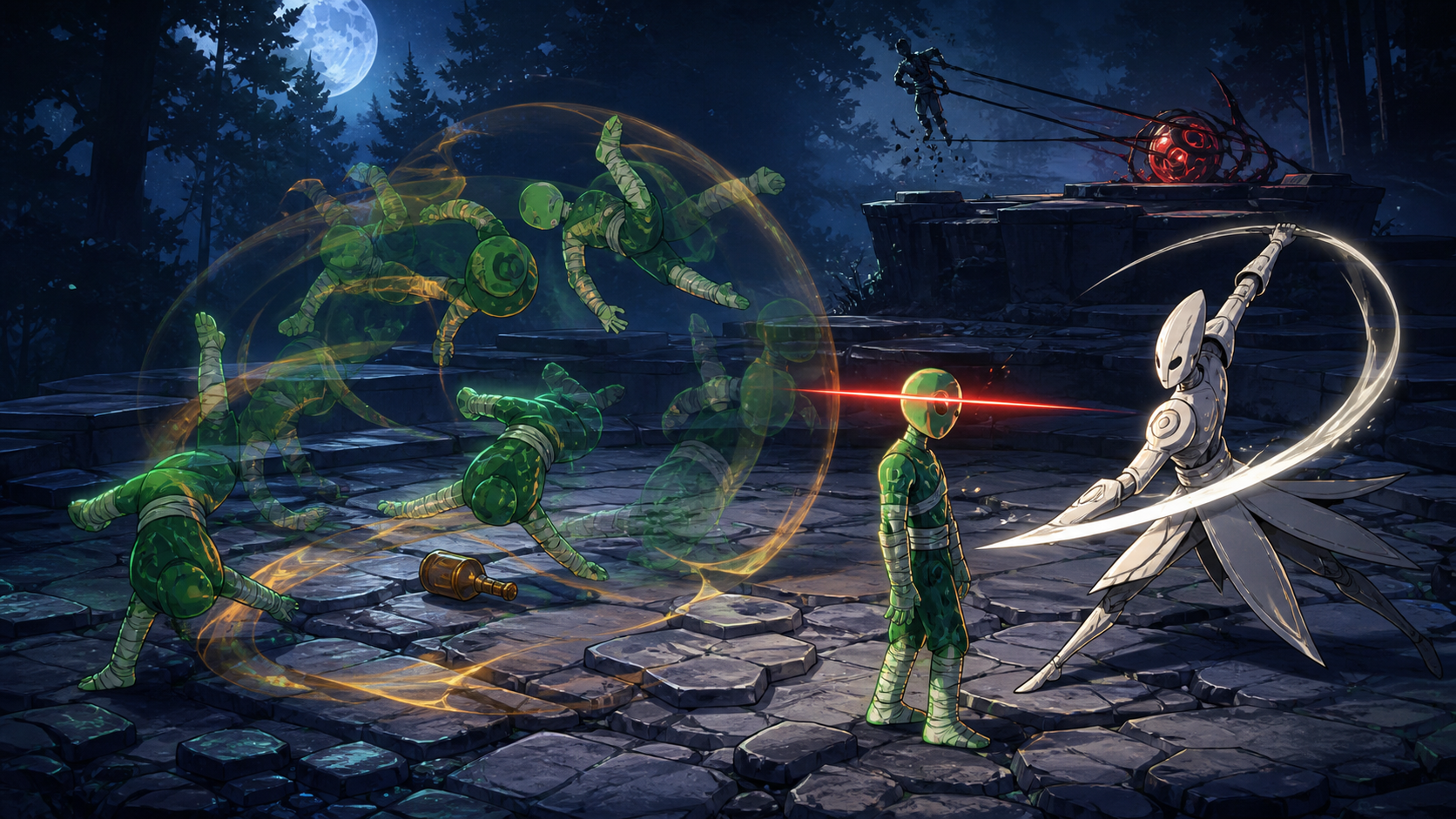
Lee’s accidental Drunken Fist chaos finally makes Kimimaro unreadable until one bone strike sobers him and restores the danger.
RaeRae Reacts
Episode 124 turns Rock Lee's worst medication mistake into Kimimaro's first real problem.
Lee spent years drilling every stance, step and strike until his body could execute them perfectly.
Kimimaro reads that precision.
Then the sake hits.
Lee staggers, sways, falls asleep in the middle of combat and attacks from angles that make no sense to anybody watching.
Kimimaro cannot predict him because Lee is no longer consciously following the patterns he trained.
It is hilarious.
It is also a recently operated child fighting a bone-wielding killer while accidentally drunk, so let us keep one foot planted in reality.
The chaos buys Naruto the road to Sasuke.
It does not make Lee safe.
Naruto Leaves Kimimaro to Lee
Lee takes over the Kimimaro fight, allowing Naruto to pursue Sasuke.
That transfer matters more than whether Lee wins immediately.
Naruto has finally reached the stage where Sasuke moves under his own power. Every additional second spent fighting Kimimaro lets Sasuke create more distance and move closer to Orochimaru.
Lee understands the mission without needing a full briefing.
Naruto made Sakura a promise.
Lee can hold the enemy standing between them.
Lee joins late, wounded and uninvited.
He still knows exactly where to stand.
The Sake Changes Lee's Rhythm
Lee believes he took medicine from the hospital.
He took sake.
Alcohol transforms his movement before Kimimaro understands what has changed. Lee's stable stance becomes a loose sway. Straight approaches collapse into stumbling curves. A fall that looks like vulnerability becomes an attack setup.
This is Drunken Fist, and Lee is a natural practitioner despite having no sober intention to use it.
The style does not make him slower or less capable.
It makes his speed arrive without the clean signals Kimimaro learned to read.
Lee's shoulders, feet and gaze stop promising where the next strike will land.
For once, the discipline that built him disappears from the surface while remaining inside the reflexes carrying every block and counter.
Kimimaro Loses the Pattern
Kimimaro handled Lee's initial taijutsu because trained combinations contain recognizable transitions.
Drunken Lee refuses those transitions.
He appears off balance because he is off balance. He recovers through motions that would be mistakes in conventional form. Kimimaro begins an attack against the position Lee should occupy, only for Lee to tumble somewhere else and answer from the floor.
The unpredictability is genuine.
Kimimaro cannot model a conscious decision that Lee never made.
That forces the Sound fighter to react rather than dictate.
Lee has changed the battle from a technical reading exercise into a moving accident with excellent reflexes.
Falling Asleep Becomes a Feint
At one point, Lee sprawls as if he has fallen asleep.
In almost any fight, that would be the end of it.
Kimimaro approaches a body that appears unconscious and discovers the pose is still dangerous. Lee blocks, counters and even lands an attack without opening his eyes in the ordinary way.
He cannot assume that a stumble means weakness, a collapse means helplessness or a closed eye means no awareness.
Lee's drunken body converts failures of presentation into attacks.
Kimimaro has spent his life using complete bodily control as a weapon.
Now he faces somebody whose temporary lack of visible control produces equally effective violence.
Lee Pushes Kimimaro Back
Naruto's clone army could not land a clean hit.
Drunken Lee blocks and counters enough to push Kimimaro backward.
Lee presents the exact tactical problem Kimimaro was not prepared to solve.
The clone attacks multiplied familiar approaches.
Lee produces unfamiliar approaches from one body.
Kimimaro can cut through a crowd when every attacker moves toward the same objective. He struggles when one opponent's balance, timing and intention change between heartbeats.
For a few glorious minutes, the bottle switch creates what training could not.
It removes predictability.
Lee looks ridiculous.
Kimimaro is the one losing ground.
This Is Not a Safe Power-Up
Drunken Fist is funny, but the circumstances are awful.
Lee has just undergone surgery for injuries that threatened his entire career. He left the hospital before recovery, entered a lethal fight and consumed alcohol by mistake.
His body is doing extraordinary things without reliable judgment.
The style gives him unpredictability, not invulnerability.
He can still be cut. He can still aggravate the damage Tsunade repaired. He may not understand when the fight requires retreat.
Guy knows Lee becomes genuinely dangerous after drinking, including to himself.
The beast within is not a clean transformation Lee controls.
It is chaos borrowing his training.
Kimimaro Identifies Drunken Fist
Kimimaro does not remain confused forever.
He watches Lee's speed, irregular rhythm and reflexive counters until the pattern inside the lack of pattern becomes clear.
Lee is drunk.
Recognizing Drunken Fist does not tell Kimimaro where every attack will land. It tells him what condition sustains the advantage.
The problem is Lee's altered state, not a new taijutsu sequence that can be memorized.
Kimimaro needs to end that state or overwhelm it with a threat too dangerous for the drunken rhythm to absorb.
His bloodline gives him exactly that option.
He stops trying to read Lee like an ordinary martial artist and turns his own body into the corrective shock.
Bone Cuts Through the Chaos
Kimimaro escalates his kekkei genkai.
Bone emerges as weapon and defense, changing the cost of every close-range exchange. Lee may evade conventional strikes through unpredictable movement, but he still has to enter a space filled with sharpened skeletal attacks.
Kimimaro cuts Lee across the face.
Pain snaps Lee back to sobriety.
The counter is cruelly efficient. Kimimaro does not need to solve every drunken feint if one clean injury can restore the version of Lee whose movements he understands.
The wild rhythm disappears.
Lee returns to conscious control and realizes what he drank.
He returns to the original problem: a recently operated body facing an opponent who can grow blades from his skeleton.
The temporary advantage is gone.
Predictability Returns With Sobriety
Sobriety gives Lee his judgment back.
It also gives Kimimaro the readable movement he had already begun countering.
That trade is brutal.
Lee can understand the danger again, but understanding does not repair his body or remove Kimimaro's bones. The fight has consumed the surprise that let Lee dominate the exchange.
Kimimaro now knows Lee's trained form and his accidental variation.
Lee knows his best recent attacks came from a state he cannot safely reproduce or deliberately command.
He still refuses to abandon the battlefield.
Naruto is farther ahead because Lee stayed.
Every second Lee remains upright continues serving the mission even after the flashy advantage ends.
Shikamaru Reaches Empty
While Lee fights, Shikamaru's Shadow-Neck Binding weakens.
His chakra is running out.
Tayuya's second state already pushed his restraint toward its limit. The closer-range bind created more force, but it also became a contest his exhausted body cannot sustain indefinitely.
Shikamaru remembers another moment when he reached empty during the Konoha Crush.
Asuma appeared and saved him.
That memory does not comfort him now. It sharpens the difference.
Shikamaru believes nobody is available this time.
His teammates are scattered across separate battles. The pursuing reinforcements have not appeared. Releasing Tayuya means death, and maintaining the bind is becoming physically impossible.
The strategist has reached a position with no move left on the board.
The Mission Has Spent Everyone
Kiba and Akamaru are wounded and hiding from Sakon and Ukon.
Shikamaru is nearly out of chakra against transformed Tayuya.
Lee has been cut sober against Kimimaro.
Naruto continues after Sasuke alone.
Choji and Neji lie behind the squad with outcomes nobody knows.
The retrieval plan has bought forward movement by spending one fighter after another until every remaining battle sits at the edge of collapse.
Episode 124 does not resolve that cost.
It lets the exhaustion settle after the comedy of Drunken Fist.
Lee's chaos created time.
Time is not rescue.
Someone still has to arrive before each solo stand becomes a final one.
What Changes After Episode 124
Naruto leaves Kimimaro to Lee and continues pursuing Sasuke.
The sake Lee mistook for medicine activates his natural Drunken Fist ability.
Lee's irregular movement makes his attacks impossible for Kimimaro to read conventionally.
He blocks, counters and pushes Kimimaro backward through unpredictable feints.
Kimimaro recognizes that Lee is drunk rather than merely clumsy.
He escalates his bone-based kekkei genkai.
A bone attack cuts Lee's face and the pain snaps him back to sobriety.
Lee loses the rhythm that created his advantage.
Shikamaru's Shadow-Neck Binding weakens as his chakra runs out.
He remembers Asuma rescuing him from exhaustion during the Konoha Crush and believes nobody is coming now.
Kiba and Akamaru remain wounded as three unknown figures approach.
The separated Leaf fighters are all reaching their limits.
Naruto leaves Kimimaro because Lee restores the mission objective
Lee tells Naruto to continue after Sasuke while he holds Kimimaro. The handoff corrects Naruto’s earlier fixation on defeating the barrier instead of passing it.
A rear guard succeeds by creating time, not necessarily by winning the clean fight. Lee understands that before Naruto does.
Sasuke keeps moving because the curse-mark procedure did not restore connection
Naruto reaches the trail and calls after him, but Sasuke refuses engagement. Physical consciousness has returned while emotional distance continues widening.
The retrieval cannot depend on one shouted appeal. Sasuke needs an environment where Orochimaru’s coercion is interrupted long enough for an actual choice.
Lee arrives with skill and a body still under medical instruction
His taijutsu gives Kimimaro a new movement problem. His recent surgery means every impact carries risk beyond an ordinary mission injury.
The episode wants the comeback thrill and keeps reminding us that recovery has not ended merely because Lee can fight.
The bottle mistake exposes weak medication safeguards
Lee grabs what he believes is medicine and drinks alcohol from Tsunade’s supply. The mix-up is played for comedy, but a recovering minor should not have access to an unlabeled or confusing container beside prescribed medication.
Storage, labeling, and supervision are part of patient safety. Individual responsibility cannot carry a system designed badly.
Alcohol changes Lee’s rhythm rather than granting disciplined mastery
Drunken Fist makes his movement irregular, loose, and difficult to predict. Kimimaro loses the timing model he formed from Lee’s sober taijutsu.
The advantage comes from altered coordination and inhibition. It is not a healthy training shortcut or proof that intoxication improves a recovering body.
Kimimaro’s first problem is uncertainty
He excels at reading angles and answering direct attacks with bone defense. Lee’s swaying changes acceleration and direction without the usual preparation cues.
Skill built around prediction becomes vulnerable when the opponent’s own movement is not fully planned in advance.
Falling asleep becomes a feint because Kimimaro expects continuity
Lee appears to stop in the middle of combat, then attacks from the pause. Whether intentional or intoxicated instinct, the interruption breaks the rhythm Kimimaro uses to decide when danger has ended.
A battlefield pause is never safe when the opponent’s state cannot be read accurately.
The comedy works because Lee remains unmistakably Lee
Even intoxicated, he carries politeness, intensity, and total commitment into absurd movement. The behavior exaggerates established traits instead of replacing him with random chaos.
Character comedy lands when the joke reveals another angle of the person we already know.
Pushing Kimimaro back does not make the condition safe
Lee lands attacks and creates openings because unpredictability changes the matchup. Alcohol also impairs judgment, masks pain, disrupts balance, and interacts unpredictably with medication and recent surgery.
A tactical advantage can coexist with serious medical danger. Success in one exchange does not validate the method.
The “beast within” is not a supernatural upgrade
Lee has an extreme response to alcohol that turns familiar taijutsu into erratic Drunken Fist. Framing that response as hidden power risks romanticizing intoxication.
The real skill still comes from years of physical training. Alcohol removes predictable structure from a trained body; it does not create the foundation.
Guy’s knowledge of Lee’s reaction should have informed care planning
If Guy knows Lee becomes dangerous after minimal alcohol, that information belongs in medical and mission safeguards. The risk affects Lee and everyone nearby.
Care networks fail when personal knowledge stays anecdotal instead of reaching the people managing medication and recovery.
Kimimaro identifies the style and begins building a new model
Once he understands Drunken Fist, surprise starts losing value. He watches how Lee’s instability cycles and prepares counters around the moments where chaos still has physical limits.
Naming a technique does not defeat it. It gives analysis a useful category.
Adaptation separates Kimimaro from opponents who only complain about unpredictability
He does not demand that Lee return to a fair rhythm. He changes distance, timing, and defense until the movement becomes manageable.
Effective fighters treat confusion as a temporary state to investigate, not an excuse.
Bone defense meets a body with no safe impact margin
Kimimaro can create blades and spikes directly from his skeleton. Lee has recently undergone surgery to repair damage that threatened his entire career.
Every close exchange therefore contains an asymmetry. Kimimaro’s body produces weapons while Lee’s body remains the vulnerable site of recovery.
One clean strike restores the medical reality
Kimimaro’s bone attack cuts through Lee’s erratic pressure and sobers the tone of the fight. The comedy cannot protect him from structural damage.
The moment reminds us that altered pain perception and confidence never made the wound risk disappear.
Sobriety returns predictability before it returns safety
As the alcohol effect fades, Lee’s movements become familiar enough for Kimimaro to read again. His control improves while his tactical surprise decreases.
Being more medically aware does not place him on equal footing with a dying opponent whose body remains an arsenal.
Lee’s sober skill deserves a plan beyond trying harder
He needs to use terrain, timing, and Kimimaro’s illness rather than simply increasing speed against bone defense. Determination cannot be the only adjustment.
The same lesson Naruto faced with clones now reaches Lee: persistence must change method when evidence changes.
Shikamaru reaches for support and finds the squad gone
His fight with Tayuya has consumed chakra and tools. The formation that once offered specialized answers has become separate battles beyond communication.
Command now means continuing without knowing who is alive, injured, or still pursuing Sasuke.
The mission has spent every person it recruited
Choji, Neji, Kiba, Akamaru, Shikamaru, Naruto, and Lee have each been pushed into extreme individual risk. The retrieval continues because bodies keep replacing missing institutional support.
A village should not measure mission efficiency only by whether the target returns. It must count what the rescuers were required to lose.
Lee’s return is meaningful because he chooses solidarity
He could focus entirely on his own recovery and still deserve respect. He joins because friends face danger and he has a skill that can help.
The choice becomes admirable without turning refusal into cowardice. Agency requires both paths to remain morally possible.
Kimimaro and Lee mirror purpose built around damaged bodies
Kimimaro serves Orochimaru while dying from illness. Lee serves the retrieval while recovering from surgery. Both connect identity to usefulness in combat.
The moral difference lies in relationship and exploitation, but both stories warn what happens when belonging feels conditional on bodily output.
Naruto follows Sasuke while others buy the distance
Lee’s stand, Shikamaru’s trap, Kiba’s escape, Neji’s victory, and Choji’s sacrifice all feed the route Naruto now travels. The final pursuit is collective work carried by one visible runner.
Remembering that chain keeps the mission from becoming another myth about one hero doing everything alone.
RaeRae’s full take
Episode 124 gives Lee one of the funniest entrances in Naruto and refuses to let the joke make his body invincible. Drunken Fist scrambles Kimimaro’s timing because even Lee cannot fully predict Lee. Then one bone strike restores every medical consequence.
The bottle mix-up is hilarious in animation and unacceptable as care practice. A recovering child should not be able to confuse alcohol with prescribed medicine while heading into combat.
Lee still gives Naruto exactly what the mission needs: a route past Kimimaro. His return matters because solidarity survives injury. Konoha must learn that welcoming someone back means protecting recovery, not celebrating how quickly the recovering body can be spent again.
RaeRae checkpoint: Drunken Fist makes Lee unreadable. It does not make alcohol safe, surgery complete, or a recovering body available for unlimited mission use.
A medical interruption should remain medical
Kimimaro honoring Lee’s request to take medicine creates a bizarre pocket of courtesy. That pause does not convert the duel into a safe or supervised event.
Lee still needs monitoring for pain, bleeding, exhaustion, and medication effects. The mission benefits from his arrival, but benefit cannot become retrospective clearance for every risk he takes afterward.
RaeRae's Verdict
“The Beast Within!” is one of the funniest dangerous fights in the series.
Lee falls, sleeps and swings through positions no sensible fighter would choose. Kimimaro cannot read him because there is no clean conscious sequence to read.
Then bone meets face and the comedy ends.
Lee sobers up inside the same injured body that should still be recovering in Konoha.
His accidental advantage disappears, but the time he bought remains. Naruto is farther along Sasuke's trail because Lee accepted Kimimaro.
Elsewhere, Shikamaru reaches empty and remembers the last person who saved him.
He thinks nobody is coming.
Episode 124 leaves every solo stand balanced on that belief.
Receipts and official routes
- Episode number and licensed title: Naruto Official Site.
- Japanese title, synopsis, and March 2, 2005 broadcast record: TV Tokyo.
- Streaming availability varies by region; use the licensed route maintained in the episode directory.