
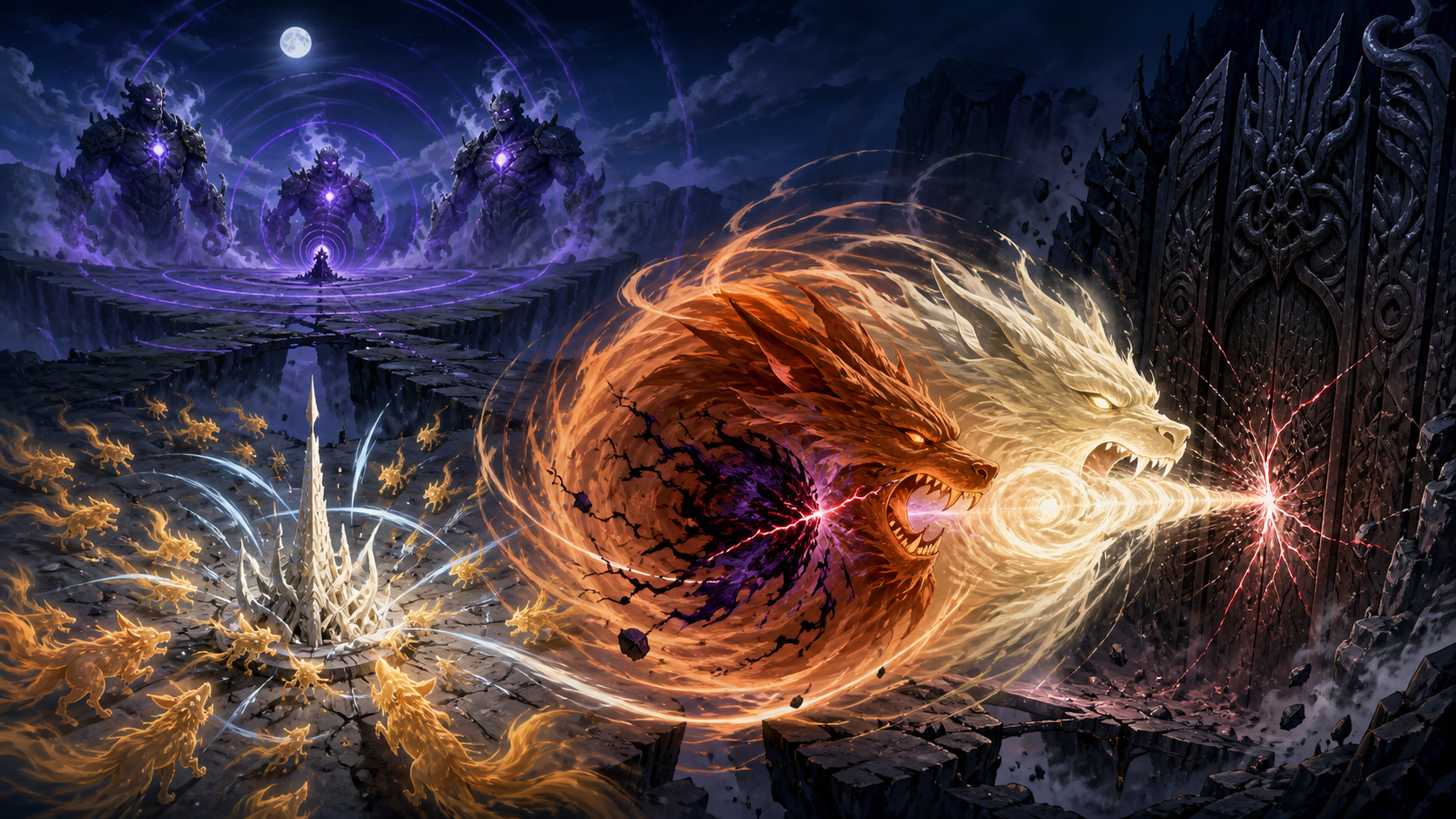
Roar and Howl! The Ultimate Tag-Team!
Three battles test three kinds of connection as Kiba and Akamaru trust each other, Tayuya commands the Doki, and Ukon turns shared flesh into a weapon.
RaeRae Reacts
Episode 120 splits one rescue mission into three fights about what it means to share power with somebody else.
Tayuya summons three giants and plays them like weapons.
Naruto throws an army of himself at Kimimaro and learns that more bodies do not automatically create an answer.
Kiba and Akamaru become one enormous two-headed wolf because their entire fighting style runs on trust.
Then Ukon crawls out of Sakon's body and turns physical closeness into something horrifying.
The loudest attack belongs to Kiba and Akamaru.
The nastiest move belongs to Kiba alone.
When Ukon merges into his body, Kiba stabs himself.
If the parasite wants to share his flesh, he can share the damage too.
Tayuya Brings Out the Doki
Shikamaru begins his solo fight against Tayuya with a serious information problem.
He knows she uses sound-based genjutsu and attacks through her flute. He does not know the full range of what the instrument controls.
Tayuya answers by summoning three enormous creatures called Doki.
They are not decorative monsters standing around while she plays a soundtrack. Every note directs their movement, turning the battlefield into a remote-controlled assault from three directions.
Shikamaru cannot simply rush the musician. The Doki occupy the space between them, and each one can crush him before his shadow reaches Tayuya.
He needs the rules.
How does each melody map to movement? How quickly can she change commands? Does she need uninterrupted sound? Which creature responds first?
Until Shikamaru learns that language, Tayuya controls both distance and tempo.
The Curse Mark Tightens Tayuya's Control
Tayuya activates the first level of her curse mark to improve her control over the Doki.
The escalation matters because Shikamaru usually wins by forcing an opponent to reveal a pattern and then exploiting the delay between decision and action.
Tayuya reduces that delay.
Her music carries instructions while the curse mark gives her the power to direct the giants with greater precision. Shikamaru faces a commander whose troops do not question orders, fear injury or improvise badly.
That sounds efficient until we remember what those troops are.
They are summoned bodies under control. Tayuya does not need a relationship with them. She needs obedience.
Shikamaru led teammates who volunteered to remain behind because they trusted the mission and trusted him. Tayuya moves her fighters like pieces because they have no choice.
Both sides use battlefield coordination.
Only one side has consent.
Naruto Tries to Win With Numbers
Naruto catches Kimimaro while he still has Sasuke's container.
There is no time for a patient assessment. Every second Kimimaro keeps moving brings Sasuke closer to Orochimaru, so Naruto fills the area with shadow clones and attacks.
Kimimaro does not panic.
He cuts through the clones with brutal economy.
Naruto has volume, stamina and urgency. Kimimaro has precision, a bloodline built for close combat and absolute focus on delivery.
The army looks impressive until one disciplined fighter starts removing it piece by piece.
Naruto cannot reach Sasuke by wanting it harder than Kimimaro wants to serve Orochimaru.
He needs an actual answer to Kimimaro's body.
Ukon Comes Out of Sakon
The ravine fight finally explains why Sakon has always looked slightly wrong.
Ukon emerges from his brother's body.
The reveal is not a normal reinforcement arriving from another location. Ukon has been there, sharing Sakon's flesh through their kekkei genkai.
Kiba and Akamaru thought they were fighting one opponent after the fall.
They were fighting two people occupying one body.
Their bond is biological and weaponized.
Kiba and Akamaru also fight as a pair with near-instant coordination, but theirs comes from years of training and mutual trust. The episode places those partnerships directly against each other and refuses to pretend they are the same.
Sharing space does not automatically mean sharing care.
Both Sides Stop Holding Back
Sakon and Ukon push their curse marks farther.
Kiba and Akamaru answer with Human Beast Combination Transformation: Double-Headed Wolf.
The transformation combines them into one enormous two-headed wolf. It is exactly as wild as it sounds, and it works because neither partner can hesitate about the other's movement.
This is not Kiba using Akamaru as ammunition.
It is both of them committing their bodies to the same attack.
The visual comparison with Sakon and Ukon is deliberate. Both teams can occupy a shared form. One pair builds that unity through trust. The other uses bodily access as a weapon against everyone, including each other.
Fang Wolf Fang Hits Like a Disaster
The Double-Headed Wolf launches Fang Wolf Fang.
Kiba and Akamaru spin at such speed that the attack becomes a living drill tearing through the battlefield. The technique sacrifices clear vision for destructive force, so they track the target through scent.
That trade makes sense for the Inuzuka pair. Smell is not a backup sense in their fighting style. It is a primary targeting system.
Sakon and Ukon cannot simply step aside and laugh this one off.
They summon Rashomon, a gigantic defensive gate, to absorb the attack.
But forcing a defense is not the same as ending the fight.
The transformation cannot last forever.
Akamaru Pays the Price
When the Double-Headed Wolf transformation disperses, Akamaru is badly injured.
That changes Kiba's priorities immediately.
The mission still matters. Sasuke still matters. The teammates fighting above them still matter.
Akamaru is bleeding in front of him.
Kiba has already chosen his partner once, when Sakon trapped Akamaru beside an explosive tag. He makes the same choice here without turning it into a speech about duty.
He protects the person who has fought beside him through every technique.
Sakon and Ukon see the injury as an opening.
Kiba sees a responsibility.
That difference is the whole moral argument of the fight.
Ukon Invades Kiba's Body
Ukon uses Parasite Demon Demolition Technique and merges into Kiba's body.
This is where the brothers' bloodline stops being merely strange and becomes violating.
Ukon does not possess Kiba like a ghost. He joins Kiba's cells and begins destroying him from inside, using the victim's own body as the battlefield.
Ukon assumes the technique has removed every meaningful choice.
He has entered the one place Kiba cannot attack without hurting himself.
That calculation would work against somebody unwilling to accept pain.
Ukon picked Kiba.
Kiba Finds the Ugliest Counter
Kiba stabs himself in the abdomen.
There is no clever feint hiding inside the action. He drives the weapon into his own body because Ukon now shares whatever damage that body receives.
It is a horrifying solution and an intelligent one.
Ukon's technique depends on treating Kiba's flesh as conquered territory. Kiba proves he still controls what happens to it, even when the only available command is pain.
The move destroys Ukon's assumption that self-preservation will keep the host compliant. Kiba is willing to suffer before he lets Ukon use his body without consequence.
The parasite wanted shared flesh.
Kiba forces him to accept shared stakes.
Three Battles, Three Kinds of Connection
Tayuya controls the Doki through music.
Sakon and Ukon share one body through blood.
Kiba and Akamaru combine through trust.
Naruto creates copies of himself because he currently has nobody beside him against Kimimaro.
Every fight in Episode 120 revolves around bodies working together, but the emotional structures are completely different.
Control produces obedience.
Invasion produces terror.
Trust produces cooperation.
Numbers produce pressure, but not necessarily understanding.
Shikamaru needs to decode Tayuya's system. Naruto needs to understand why his usual pressure cannot break Kimimaro. Kiba needs to protect Akamaru while surviving an enemy inside his own skin.
Nobody gets a clean fight.
Everybody gets a problem that punishes the first obvious answer.
What Changes After Episode 120
Tayuya summons three Doki and controls them through her flute.
She activates the first level of her curse mark to sharpen that control.
Naruto attacks Kimimaro with a mass of shadow clones.
Kimimaro defeats the clones without surrendering Sasuke's container.
Ukon emerges from Sakon's body and reveals the brothers' shared-body bloodline.
Sakon and Ukon escalate their curse marks.
Kiba and Akamaru transform into the Double-Headed Wolf.
They use Fang Wolf Fang and force the brothers to defend with Rashomon.
The transformation ends with Akamaru badly injured.
Ukon merges into Kiba's body through Parasite Demon Demolition Technique.
Kiba stabs himself so the damage reaches Ukon too.
All three battles remain active, but none of the Sound fighters gets the effortless control expected.
Tayuya turns sound into battlefield command
Her flute directs the Doki while keeping her body outside their immediate reach. Shikamaru cannot treat the summoned creatures as independent targets because their movement follows information traveling through music.
The real control point is the performer. Reaching her requires surviving the weapons she can position without entering their range.
The Doki make one opponent occupy several spaces
Three massive summons pressure Shikamaru from different directions while Tayuya remains mobile. Shadow Possession becomes harder because every line he controls can expose another angle.
Numbers matter differently when one mind coordinates them. The summons function as a distributed body for Tayuya’s strategy.
The curse mark tightens control and increases the cost
Tayuya escalates through Orochimaru’s mark to strengthen herself and the creatures she directs. The transformation improves performance while binding her more visibly to the system that made her useful.
Power arrives with no route toward independence. Every higher state makes Orochimaru’s investment more valuable and Tayuya’s body less fully her own.
Shikamaru has to solve the music before he can solve the movement
The attacks are patterned, but the pattern sits inside sound cues he must decode while avoiding impact. He listens for relationships between notes and actions.
Analysis becomes physical labor under pressure. One wrong hypothesis does not produce a low score. It puts him beneath a weapon.
Naruto tries to overwhelm Kimimaro with the method that usually creates options
Shadow clones let Naruto attack from many angles, test defenses, and preserve the original body. Against Kimimaro, volume reveals how completely the new enemy controls movement and bone-based defense.
More attackers do not create more pressure when each one enters the opponent’s preferred rhythm.
Kimimaro’s calm makes the power gap feel worse
He moves through clones without visible urgency because delivering Sasuke remains the objective. Naruto’s anger cannot force him into the emotional fight Naruto wants.
A composed opponent controls pace. Kimimaro spends only what the mission requires while Naruto burns chakra trying to make persistence close a technical gap.
Ukon’s emergence changes the meaning of Sakon’s body
Kiba believed he was fighting one opponent. Ukon separates from the same body and reveals a partnership based on shared flesh. The numerical and anatomical assumptions of the fight collapse at once.
Hidden capacity becomes most dangerous after a defender has already committed resources around the original count.
Sakon and Ukon are a tag team built through involuntary proximity
The brothers share space and can separate when combat requires it. Their coordination is intimate, efficient, and aggressive. Individual boundaries operate differently for them than for ordinary teammates.
The technique provides tactical advantage while raising questions about autonomy inside a body neither brother occupies alone.
Kiba and Akamaru answer with a partnership based on practiced consent
They train together, communicate through scent and movement, and combine transformations without reducing either partner to equipment. Their techniques work because each understands the other’s timing.
The battle places two kinds of paired identity against each other: shared embodiment and chosen interspecies coordination.
Fang Wolf Fang turns trust into controlled chaos
Kiba and Akamaru transform and rotate at extreme speed, sacrificing ordinary vision for scent-guided attack. Each partner must trust the other to maintain rhythm while the technique tears through terrain.
The power looks uncontrolled from outside. Inside the movement, coordination is the only thing keeping force directed.
The attack hits like a disaster because precision has limits at that speed
Fang Wolf Fang can destroy obstacles and overwhelm opponents, but missing costs energy and exposes the pair during recovery. Sakon and Ukon can exploit any interruption in scent or formation.
High output never removes the need for information. It increases the price of getting information wrong.
Akamaru pays for the fight as a full participant
He is injured, exhausted, and placed in direct danger. The story cannot celebrate the Inuzuka technique while treating the ninken’s pain as a temporary effect attached to Kiba.
Partnership means medical care, recovery, and mission recognition belong to Akamaru too.
Kiba’s fear becomes sharper when the threat reaches Akamaru
He can accept damage to himself more easily than watching his partner suffer. Sakon and Ukon understand that attachment and use it to disrupt judgment.
Love creates strength and a pressure point. Ethical teamwork protects the bond without pretending opponents will ignore it.
Ukon’s invasion turns Kiba’s own cells into the battlefield
Ukon merges with Kiba’s body and begins destroying him from within. Ordinary distance disappears. Attacking the enemy now risks attacking the self.
The technique is horrifying because it violates bodily boundaries and converts intimacy into occupation without consent.
Kiba cannot solve internal invasion with an external strike
Claws, speed, and tracking do not remove someone merged into his tissue. The matchup forces him away from the skills that normally define competence.
Adaptation begins with accepting that the familiar toolbox no longer matches the problem.
Hurting himself becomes the ugliest available counter
Kiba stabs his own body because Ukon shares the damage while merged. The choice makes self-injury a weapon of separation.
It is clever and desperate. Survival should not make us comfortable with a child forced to harm himself because no teammate or medic can reach the internal threat.
Ukon miscalculates Kiba’s willingness to pay the shared cost
The invasion assumes Kiba will protect his own body enough to leave the parasite safe. Kiba changes the equation by accepting controlled injury to make remaining inside intolerable.
Control fails when the target can alter the cost relationship, even through a terrible sacrifice.
Three battles reveal three forms of connection
Tayuya directs summoned bodies through sound. Sakon and Ukon share flesh. Kiba and Akamaru coordinate through a chosen bond. Each fight asks who controls movement and whose pain counts.
Connection is not automatically care. It can support partnership, hierarchy, or invasion depending on consent and responsibility.
Shikamaru’s shadows depend on reading another person’s pattern
His technique links bodies and controls movement, which could resemble Tayuya’s command from a distance. The difference lies in purpose and context. He uses restraint against an armed opponent to protect a rescue route.
Even justified control should remain limited to the danger. Power over another body always needs an accountable boundary.
Naruto’s clones show collective form without independent agency
Every clone extends Naruto’s will and returns experience to him. Kimimaro destroys them without harming separate lives, but the visual still fills the field with bodies serving one objective.
The episode keeps returning to multiplied selves and asks what makes a group a partnership rather than one person distributed across tools.
The remaining squad members can no longer support one another
Naruto, Shikamaru, Kiba, and Akamaru occupy separate battles. Each has information the others cannot access and injuries nobody can see.
The original formation survives only as trust that every person will keep the route open. Communication has collapsed under distance.
Konoha’s lack of backup turns ingenuity into emergency medicine
Kiba has to use self-inflicted injury as a counter. Shikamaru decodes a lethal performance alone. Naruto spends clone after clone against Kimimaro.
Their creativity is impressive. It also shows what happens when a village asks children to compensate for absent specialists and reinforcements.
RaeRae’s full take
Episode 120 earns “ultimate tag team” by giving us several versions of bodies moving together and refusing to pretend they mean the same thing. Kiba and Akamaru’s partnership grows through trust. Sakon and Ukon share flesh. Tayuya commands creatures through music.
Ukon’s invasion is the ugliest expression because connection becomes occupation. Kiba can only drive him out by stabbing the body they temporarily share, turning self-harm into tactical leverage.
The fights are inventive and the situation is unacceptable. Every remaining squad member is isolated, and Konoha’s staffing crisis keeps making children solve lethal problems with whatever part of themselves they can afford to spend.
RaeRae checkpoint: Kiba and Akamaru show partnership. Ukon shows invasion. Sharing a body or technique means nothing without consent and mutual care.
The tag-team label must include Akamaru
Akamaru is not the technique Kiba activates. He tracks, decides, risks injury, and coordinates the transformation as a partner.
Any account of the battle that credits only Kiba repeats the exact logic their bond rejects: treating the nonhuman teammate as useful equipment instead of a participant whose choices and recovery matter.
RaeRae's Verdict
“Roar and Howl! The Ultimate Tag-Team!” gives Kiba and Akamaru the huge combination attack the title promises, then makes the quieter counter hurt more.
Fang Wolf Fang can tear through the battlefield.
It cannot solve an enemy who crawls into Kiba's body.
Kiba solves that himself.
He stabs the body Ukon thought he had captured and makes the invader experience the cost of being there.
Meanwhile, Shikamaru faces monsters controlled by music, and Naruto learns that a hundred versions of himself still cannot force a path through Kimimaro.
This episode is not really about having a partner.
It is about what that connection permits.
Tayuya commands. Ukon invades. Kiba and Akamaru trust.
That is why the Inuzuka pair remains the real ultimate tag team, even when the fight leaves both of them bleeding.
Receipts and official routes
- Episode number and licensed title: Naruto Official Site.
- Japanese title, synopsis, and February 2, 2005 broadcast record: TV Tokyo.
- Streaming availability varies by region; use the licensed route maintained in the episode directory.