
Bitter Rivals and Broken Bonds
Kakashi stops the rooftop collision, two water tanks expose the comparison consuming Sasuke, and Orochimaru’s agents arrive exactly where insecurity opens the door.
RaeRae Reacts
Episode 108 stops Naruto and Sasuke from killing each other, then lets every adult involved realize the children arrived on that roof carrying weapons the adults handed them.
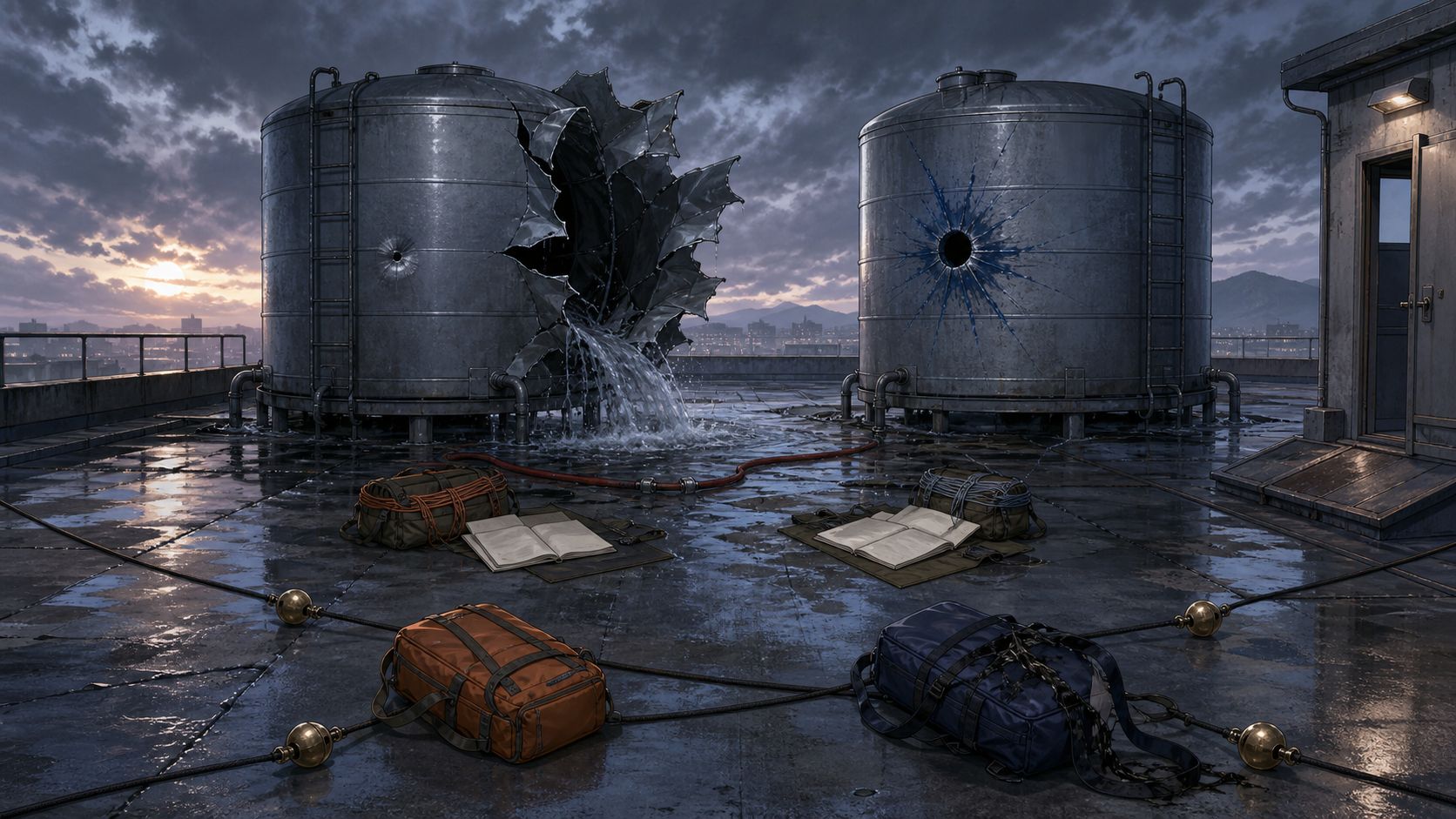
Kakashi redirects Rasengan and Chidori into separate water tanks.
Sasuke sees the visible damage from Chidori and believes he won the comparison. Then he walks behind Naruto's tank and finds the entire rear blown apart.
Kakashi and Jiraiya blame each other for teaching lethal techniques to boys who turned them on a teammate.
Kakashi tells Sasuke revenge will not restore the dead and reveals that everyone closest to him has already been killed.
Sakura tells Naruto about Orochimaru's curse mark.
The Sound Four arrive while Sasuke is deciding whether his new bonds matter enough to interrupt revenge.
Orochimaru does not create the crack.
He sends people to widen it.
Kakashi Stops the Collision
Kakashi arrives before Rasengan and Chidori hit flesh.
He throws Naruto and Sasuke apart and redirects both attacks into water tanks.
The intervention prevents an injury neither boy could easily take back. It does not make the decision to use those techniques disappear.
Naruto and Sasuke were willing to strike a teammate with force designed for lethal combat. That fact changes how Kakashi must read the rivalry. This is no longer rough competition that can burn itself out through sparring.
The boys have connected identity, grief and worth to the outcome.
Kakashi saves their bodies in the immediate moment.
He still has to address why both students reached the point where a hospital visit ended in attempted mutual destruction.
The Water Tanks Tell Two Different Stories
Chidori punches visibly through Sasuke's tank.
Rasengan appears to leave less impressive damage on Naruto's.
Sasuke initially reads the result as reassurance. His technique looks stronger. The old ranking may still hold.
Then he sees the rear of Naruto's tank has been destroyed.
The Rasengan's rotational force produced internal damage that the front view concealed. Sasuke's relief collapses into envy because the comparison changes after he already accepted the answer he wanted.
This is not merely a power-level demonstration.
The tanks expose Sasuke's dependence on visible hierarchy. He does not ask what each technique does differently or how both could contribute in a mission.
He asks which boy is stronger.
Naruto's tank gives him an answer he cannot emotionally survive without changing course.
Naruto's Growth Is Not an Attack on Sasuke
Naruto learned Rasengan through persistence, improvisation and Jiraiya's instruction.
None of that growth happened to humiliate Sasuke.
Sasuke experiences it as humiliation because his sense of progress depends on maintaining distance from the teammate he once considered weakest. If Naruto closes the gap through bonds and training, Sasuke's isolation stops looking like the necessary price of exceptional strength.
That possibility threatens more than pride.
It threatens the strategy Sasuke built his life around.
He believed cutting ordinary connection would keep his purpose pure. Naruto keeps becoming stronger while forming more bonds, not fewer.
The damaged tank therefore carries an argument: power and attachment may coexist.
Sasuke cannot accept the argument without questioning the path toward Itachi.
Kakashi and Jiraiya Share the Blame
Kakashi is stunned that Naruto mastered Rasengan and identifies Jiraiya as the teacher.
He criticizes Jiraiya for giving Naruto a technique capable of killing Sasuke.
Jiraiya returns the accusation. Kakashi taught Chidori to a child consumed by revenge, and Sasuke could have killed Naruto just as easily.
Both men are right.
Both are also trying to place the danger one teacher away from themselves.
They trained the boys for a violent profession and selected techniques suited to each student's strengths. Neither built enough control around when those techniques must never be used.
Technical mastery arrived before emotional readiness.
The argument does not mean teachers should keep students powerless. It means teaching capacity without sustaining judgment creates weapons whose first available targets may be the people closest to them.
The adults interrupted the outcome.
They helped construct the conditions.
Jiraiya and Orochimaru Appear Inside the Pattern
Kakashi compares Naruto and Sasuke to Jiraiya and Orochimaru.
Naruto views Sasuke as his greatest rival and a bond worth defending. Sasuke increasingly experiences Naruto's progress as a threat he must escape or dominate.
The older Sannin relationship shows where that imbalance can lead.
Jiraiya continued caring about Orochimaru after Orochimaru chose power through violation and abandonment. That care did not stop the departure. It gave Jiraiya a wound he recognizes in Naruto before Naruto fully understands it.
The comparison is not destiny.
Sasuke is not Orochimaru yet.
It is a warning that one person's loyalty cannot substitute for the other's choice. Naruto can value the bond completely and still fail to keep Sasuke inside it.
Kakashi Ties Sasuke Down for the Conversation
Kakashi restrains Sasuke and tells him not to use Chidori against comrades.
The physical restraint is necessary because Sasuke has just demonstrated that ordinary instruction may not hold him. The conversation that follows tries to reach beyond punishment.
Kakashi advises him to abandon revenge.
That advice sounds impossible to Sasuke because revenge organizes the meaning of his survival. Asking him to drop it without replacing the purpose would feel like asking him to betray his clan and accept the massacre as finished business.
Kakashi knows the goal cannot heal him.
Sasuke knows no other goal large enough to contain the dead.
Their conflict is not about whether murder is healthy.
It is about what remains when the only future Sasuke imagined is removed.
Sasuke Tells the Wrong Person He Cannot Understand Loss
Sasuke says Kakashi would understand if everyone important to him were killed.
Kakashi answers that they already were.
The response strips Sasuke of the argument that grief makes him uniquely inaccessible. Kakashi lost his father, teammates and teacher. He knows the emptiness without needing Sasuke to summarize it.
Kakashi does not use shared loss to claim identical experience. He uses it to reject the idea that revenge is the only honest response available to a survivor.
Both found new people after devastating loss.
Those bonds do not replace the dead. They keep the survivor from making death the only relationship left.
Kakashi offers Sasuke an identity that includes his clan without requiring every living connection to become expendable.
The offer is real.
Sasuke has to choose it.
Sakura Finally Tells Naruto About the Curse Mark
Sakura takes Naruto aside and explains that Orochimaru placed a curse mark on Sasuke during the Chunin Exams.
Naruto was unconscious when it happened and has remained outside critical information about his teammate's danger.
Sakura believed Kakashi had handled the seal. The rooftop fight makes that reassurance harder to trust.
Her disclosure matters because protection requires shared knowledge. Keeping Naruto uninformed may once have seemed like avoiding panic or respecting Sasuke's privacy. Now secrecy leaves one teammate unable to recognize Orochimaru's influence or the stakes of Sasuke's instability.
Sakura has carried fear alone long enough.
Telling Naruto does not solve the curse mark.
It turns Sasuke's condition back into a team reality instead of Sakura's private burden.
The Sound Four Arrive at the Exact Opening
Sasuke considers Kakashi's words and the bonds he has formed with Naruto and Sakura.
Then the Sound Four attack.
Orochimaru's timing is strategic. Sasuke is hurt, ashamed and uncertain. Naruto's growth has destabilized his belief in the path he chose. Kakashi has asked him to abandon revenge without giving him a quick replacement for its purpose.
The Sound Four arrive offering power.
They do not need to persuade a secure child to leave a healthy life. They need to make isolation look like the only route out of humiliation.
Their attack begins the recruitment by proving that Sasuke's current strength is insufficient.
Orochimaru understands the most effective offer of power starts with engineered helplessness.
What Changes After Episode 108
Kakashi prevents Rasengan and Chidori from striking Naruto and Sasuke.
The water tanks reveal Rasengan's greater hidden damage and intensify Sasuke's envy.
Kakashi and Jiraiya confront their responsibility for teaching lethal techniques to emotionally unstable students.
Kakashi warns Sasuke against revenge and reveals that everyone closest to him has already died.
He argues that new friends can matter without replacing the dead.
Sakura tells Naruto about Orochimaru's curse mark on Sasuke.
The Sound Four attack Sasuke while he weighs Team 7 against revenge.
The rupture remains a choice.
Orochimaru's agents have arrived to influence it.
Kakashi arrives at the moment consequences become irreversible
Chidori and Rasengan are already moving when Sakura steps between them. Kakashi redirects both attacks before they reach bodies. His speed prevents catastrophe, but the timing exposes how long the crisis developed without adult interruption.
Stopping impact is necessary. It is not the same as addressing why two injured, traumatized students turned a hospital roof into a lethal test.
Sakura should never have been the human barrier
Sakura enters the collision because neither boy will disengage and no adult is present. Her choice is brave, but praising bravery without naming the failure around it would be cruel.
The least powerful member of the immediate conflict carries the greatest bodily risk because she is the only person still prioritizing the relationship over the verdict. Team 7’s fracture becomes visible in where she has to stand.
The water tanks reveal power and distort what Sasuke sees
Sasuke initially looks at the visible damage and believes Chidori proved stronger. Then he sees the back of Naruto’s tank torn open by the Rasengan. The hidden destruction overturns the comparison he wanted.
The scene works because the evidence arrives without explanation. Sasuke cannot dismiss it as encouragement or pity. Naruto’s growth is physically present in metal peeled away where Sasuke did not expect it.
Hidden damage is the episode’s governing image
The front of the tanks tells one story. The backs tell another. Team 7 operates the same way. Missions, jokes, and rivalry remain visible while grief, fear, jealousy, and the curse mark keep expanding behind the surface.
A crack becomes dangerous when everybody relies on the intact side as proof that the structure is sound.
Naruto’s growth is not aggression against Sasuke
Naruto trained, struggled, and learned the Rasengan because he wanted recognition and the ability to protect people. He did not become stronger to humiliate Sasuke. Sasuke experiences the result as a threat because comparison controls his sense of safety.
Another person’s progress can trigger pain without becoming wrongdoing. The response requires care for the pain, not a demand that the other person remain small.
Sasuke interprets equality as loss because hierarchy once protected him
At the Academy, Sasuke could look at Naruto and know where he stood. The class failure sat below the gifted Uchiha. Their later bond included rivalry, but the ranking offered Sasuke a stable identity.
Naruto catching up removes that refuge. Sasuke must confront the possibility that talent and bloodline will not guarantee the power he needs against Itachi.
Kakashi and Jiraiya trained techniques without coordinating emotional risk
Kakashi taught Chidori to Sasuke. Jiraiya taught Rasengan to Naruto. Both techniques require concentration and carry lethal force. Neither teacher appears to have prepared the boys for what happens when rivalry turns those lessons toward one another.
Instruction does not end at execution. Teachers remain responsible for storage, context, restraint, and signs that a student is using power to answer an emotional crisis.
The sannin pattern appears before the boys understand it
Jiraiya and Orochimaru represent paths already pulling at Naruto and Sasuke. Jiraiya’s teaching is imperfect but connected to Konoha and protection. Orochimaru offers power by exploiting fear, isolation, and impatience.
The younger rivalry risks repeating an older fracture because adults recognize the pattern without building enough support to interrupt it.
Kakashi restrains Sasuke because the conversation cannot happen during escape
Tying Sasuke to the tree prevents him from leaving and creates a physical pause. Kakashi knows a gentle invitation will not hold a boy who has converted every vulnerable feeling into anger.
Restraint can stop immediate flight. It cannot force trust. The conversation still depends on whether Sasuke believes Kakashi understands anything beyond the behavior being corrected.
Kakashi speaks from loss and keeps too much of that loss hidden
Sasuke tells him that he cannot understand what it would mean to lose everyone. Kakashi answers that the people he cared about are already dead. The disclosure punctures Sasuke’s assumption and briefly creates common ground.
Kakashi’s restraint preserves privacy, but it also limits the bridge. Sasuke hears that loss can be survived. He does not hear how guilt, friendship, and chosen bonds shaped that survival.
Shared trauma does not automatically produce shared conclusions
Kakashi lost people and chose continued connection to Konoha. Sasuke lost his clan and chose revenge as the organizing purpose of his life. Similar pain can produce different survival strategies because age, support, circumstances, and manipulation differ.
Kakashi cannot simply present himself as proof that Sasuke should let go. He can offer evidence that another life remains possible.
The lecture asks Sasuke to protect bonds without making those bonds feel secure
Kakashi warns that revenge will leave emptiness and points toward the teammates Sasuke still has. The message is morally sound. Sasuke is already afraid those bonds are making him weak and moving him farther from his promise to kill Itachi.
He needs ongoing support that can survive anger, not one powerful conversation followed by separation.
Sakura finally tells Naruto about the curse mark
Sakura has carried knowledge about Orochimaru’s mark because Sasuke demanded secrecy and because she feared what disclosure might do. After the rooftop fight, silence becomes more dangerous than breaking confidence.
Telling Naruto changes the team’s information balance. It also reveals how much responsibility Sakura has held without adult support.
Confidentiality cannot become protection for an active recruitment threat
Sasuke’s privacy matters. The curse mark connects him to an adult predator who already tried to claim his body and future. Keeping that risk secret leaves teammates unable to interpret escalating behavior.
Responsible disclosure should be limited and purposeful. This is exactly the kind of danger that requires trusted adults and coordinated safeguarding.
Naruto’s reassurance comforts Sakura and understates the threat
Naruto insists Sasuke will not accept Orochimaru’s invitation because he trusts their bond. Sakura needs that confidence. The certainty also allows him to avoid imagining how desperate Sasuke has become.
Hope is useful when it supports action. Hope becomes denial when it replaces surveillance, conversation, and protection.
The Sound Four arrive after Konoha leaves the opening exposed
Orochimaru’s agents approach Sasuke after the rooftop humiliation, Kakashi’s warning, and Naruto’s visible advantage. They do not create the vulnerable moment. They exploit it.
Recruiters look for isolation, grievance, urgency, and a target who believes ordinary routes have failed. Sasuke is carrying every condition.
Their offer will sound convincing because it names his fear accurately
The Sound Four can tell Sasuke that staying in Konoha will not make him strong enough for revenge. That message works because Sasuke has been making the same argument internally.
Manipulation often contains an accurate observation wrapped around a destructive solution. Refuting it requires addressing the real fear, not only condemning the recruiter.
Konoha knows enough to act and still responds too narrowly
The village knows Orochimaru marked Sasuke. It knows Itachi returned and hospitalized him. Kakashi witnesses the rooftop escalation. These are connected warning signs around a child being targeted by a powerful adult.
A coordinated response would include protection, monitoring, trauma support, medical assessment of the mark, and honest discussion of revenge. One lecture cannot carry that workload.
The invisible crack is institutional as well as personal
Sasuke and Naruto are breaking apart, but the village structure around them is also failing to share information and responsibility. Teachers address separate pieces. Sakura holds a secret. Sasuke isolates. Orochimaru operates across the gaps.
The episode’s title applies to every connection that looks intact until pressure reveals where communication stopped.
RaeRae’s full take
Episode 108 gives us the water tanks because words are no longer enough. Naruto’s hidden impact terrifies Sasuke, and the intact front mirrors a team that still looks functional from the outside.
Kakashi saves three lives on the roof and offers Sasuke an honest fragment of his own grief. That intervention matters. It remains too small for a child carrying massacre trauma, Itachi’s manipulation, Orochimaru’s curse mark, and a collapsing identity.
The Sound Four do not arrive out of nowhere. They arrive through an opening made from secrecy, comparison, and adults treating connected warning signs as separate problems. The bond is breaking because Sasuke is choosing harm, and because the people who love him have not built a strong enough net beneath that choice.
RaeRae checkpoint: The water tanks expose what Team 7 hides: the visible surface still stands while pressure has already torn open the back.
RaeRae's Verdict
“Bitter Rivals and Broken Bonds” stops the rooftop collision and exposes every adult fingerprint on it.
Jiraiya taught Rasengan. Kakashi taught Chidori. Both boys aimed those lessons at a teammate. The teachers are right to blame each other and wrong to stop there.
Kakashi offers Sasuke shared grief instead of judgment. Sakura offers Naruto the truth about the curse mark. Team 7 still has routes toward honesty.
Then the Sound Four arrive with Orochimaru's answer to insecurity: more power, fewer bonds and no healing required.
Naruto's water tank did not break Sasuke.
It showed him the path he trusted was not working.
Orochimaru is waiting with a worse one.
Receipts and official routes
- Episode number and licensed title: Naruto Official Site.
- Japanese title, synopsis, and November 10, 2004 broadcast record: TV Tokyo.
- Streaming availability varies by region; use the licensed route maintained in the episode directory.