
A Fierce Battle of Rolling Thunder!
Naruto carries Idate to the shrine, Idate takes the race back under his own power, and Sasuke leaves the first crack in Aoi’s stolen certainty.
RaeRae Reacts
Episode 105 gives Idate a shrine orb, a staircase and one extremely persistent former mentor blocking the route.
The Chunin Exam memory expands. Ibiki was the proctor behind the tenth-question pressure test when Idate's team failed. That shame helped Aoi recruit him.
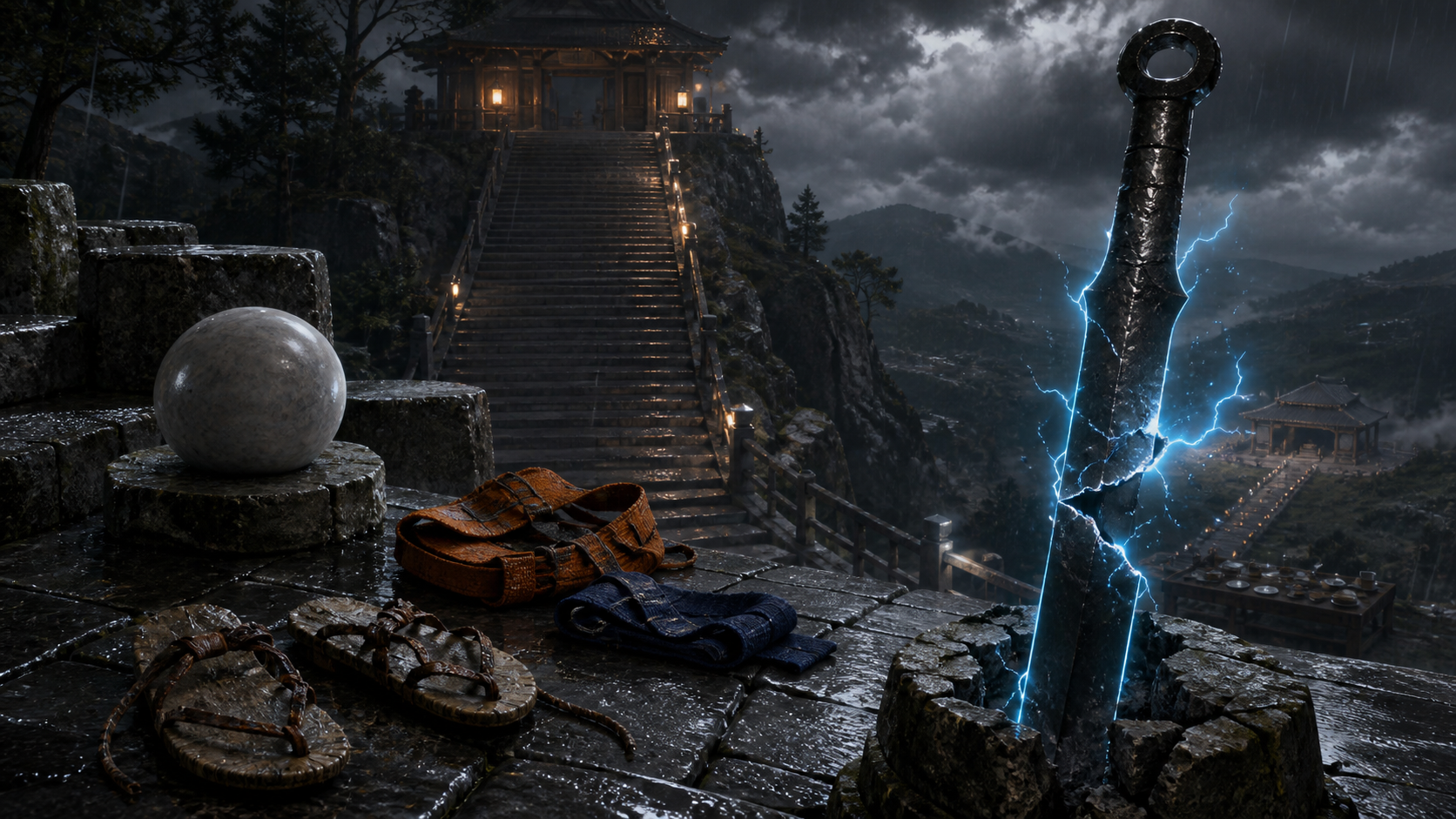
In the present, Naruto carries the injured Idate up the long steps to Modoroki Shrine. Idate takes the ceremonial orb and returns to his own feet.
Aoi arrives with the Sword of the Thunder God.
Naruto's Rasengan gets repelled.
Sasuke's Chidori gets repelled too, but cracks the blade.
Borrowed power looks absolute until somebody leaves the first mark.
Idate's Chunin Exam Failure Gets Context
Idate's history returns to the Chunin Exams, where his older brother Ibiki served as the proctor behind the tenth question.
The test did not measure ordinary knowledge. It forced examinees to decide whether to risk their team's future for the chance to continue. Withdrawal protected the group from the stated permanent consequence. Staying required trust in oneself and the squad.
Idate wanted advancement badly.
His team still failed.
That failure carried more than a missing promotion because Ibiki stood on the other side of it. Idate did not only feel judged by an institution. He felt judged by his brother, a respected shinobi whose authority made the result personal.
Shame created the opening Aoi later used.
The exam did not make Idate betray Konoha.
It made him desperate for another interpretation of himself.
Aoi Offered the Answer Idate Wanted
Aoi found Idate after failure and offered a route around the village's judgment.
That is how manipulative mentorship works. It rarely begins with “betray everyone who raised you.” It begins by naming a real hurt and presenting the manipulator as the only person willing to understand it.
Aoi could tell Idate the exam was unfair, his brother did not respect him and the village would never recognize his ability. Each statement would feel like relief before becoming leverage.
Idate remained responsible for the choices that followed.
Aoi remained responsible for designing those choices around a vulnerable student.
The episode refuses the easy idea that Idate hated ninja for no reason. He learned to associate guidance with hidden demands because one authority figure turned his need for belief into a weapon.
Fukusuke Celebrates Before the Race Ends
Fukusuke, the Wagarashi runner, eats and celebrates with women because he believes victory is secure.
Aoi warns him that the race is not finished.
The contrast tells us who understands the operation. Fukusuke sees the advantage and mistakes it for a result. Aoi knows Idate has survived every previous attempt to remove him.
Premature celebration also exposes the entitlement behind the Wagarashi effort. Fukusuke does not act like an athlete who has earned a lead. He acts like the clan's hired violence converted the finish into paperwork.
The race remains open because Idate keeps moving.
Fukusuke rests on sabotage somebody else performed.
Idate advances through pain his opponents caused.
One runner treats the event as inheritance.
The other has to reclaim every mile.
Naruto Carries Idate Up the Shrine Steps
Naruto carries the injured Idate up the long staircase to Modoroki Shrine.
This is the correct form of assistance for the moment. Naruto does not carry Idate across the finish line or pretend the race belongs to Team 7. He gets the runner through a section his injuries have made impossible so Idate can complete the required act himself.
The image also reverses their early conflict.
Idate once treated ninja help as control. Now he allows Naruto to bear his weight because Team 7 has proven that protection can preserve his agency rather than replace it.
Naruto does not demand gratitude while climbing.
He moves.
The work is exhausting, unglamorous and exactly what the mission needs.
Sometimes heroic support is a giant attack.
Sometimes it is carrying an injured man up far too many stairs because whoever designed the race hated knees.
Idate Takes the Orb Himself
At the shrine, Idate collects the ceremonial orb and resumes running on his own feet.
That detail protects the legitimacy of his performance.
Naruto assists him to the checkpoint, but Idate fulfills the requirement. The runner remains the person competing. Team 7 restores his opportunity rather than manufacturing a victory.
The distinction matters because the Wasabi and Wagarashi families are already surrounding the event with hired force. If Leaf ninja simply completed the course for Idate, the protective mission would become another form of interference.
Idate chooses to stand despite injury.
Naruto respects the choice by letting him.
Trust now runs both directions. Idate accepts help when his body needs it. Team 7 releases control when the runner can continue.
That is the coordination Episode 102 lacked.
Aoi Blocks the Route With Stolen Authority
Aoi waits with the Sword of the Thunder God.
The weapon carries the name and power of the Second Hokage, but Aoi's possession does not give him the legitimacy attached to its origin. He stole a symbol of Konoha's authority and uses it to reinforce the claim that betraying the village made him strong.
This is Aoi's entire method in object form.
Take something meaningful, detach it from the responsibility that gave it value and use the remaining power to dominate somebody vulnerable.
He did it with mentorship.
He did it with Idate's need for recognition.
He does it with the sword.
The lightning blade is genuinely dangerous. Calling the authority stolen does not make its attacks less real.
Team 7 must break the power without mistaking possession for worthiness.
Rasengan Meets the Lightning Blade
Naruto attacks Aoi with the Rasengan.
The Sword of the Thunder God repels it.
That failure matters because the Rasengan has carried enormous narrative momentum. Naruto mastered it against Tsunade's deadline, used it to defeat Kabuto and proved he could wield a technique associated with the Fourth Hokage.
Aoi's blade interrupts the assumption that a new signature move solves every opponent.
The Rasengan remains powerful. The matchup and Naruto's condition matter.
Techniques do not fight in a ranking chart detached from bodies, timing and weapons. Aoi has prepared the confrontation around an artifact built to channel lightning force.
Naruto does not receive an automatic win because his move has a better emotional backstory.
The mission continues after the hero attack fails.
Sasuke's Chidori Creates the First Crack
Sasuke follows with Chidori.
The sword repels that attack too, but the blade cracks slightly.
Sasuke does not defeat Aoi. He changes the team's understanding of the weapon.
Before the crack, the Sword of the Thunder God appears absolute. After it, the defense has a limit. The next attack can be built around evidence rather than hope.
This is a valuable contribution even though Sasuke does not get the finish.
His technique reveals vulnerability.
The moment also complicates the rivalry with Naruto. Rasengan failed visibly. Chidori failed less completely. Sasuke can read that difference as proof of superiority at a time when his insecurity is already hunting for measurements.
For the mission, the crack is progress.
For Sasuke, progress may become comparison before the fight is over.
Borrowed Power Is Still Breakable
Aoi relies on a stolen sword, hired support and an old student's shame.
Every part of his authority comes from something taken or manipulated.
That does not make him fake. A person can cause real harm with power they did not earn. The danger lies in confusing effectiveness with legitimacy.
Sasuke's crack exposes the difference.
The artifact can repel attacks, but it cannot make Aoi invulnerable. His control over Idate can reopen wounds, but it cannot erase the trust Team 7 has built. His plan can delay the runner, but Fukusuke's celebration cannot turn delay into a completed race.
Aoi has assembled an image of certainty.
Episode 105 leaves the first fracture running through it.
What Changes After Episode 105
Idate's Chunin Exam history expands, including Ibiki's role as the tenth-question proctor and the team's failure.
Fukusuke celebrates before the race is complete.
Naruto carries the injured Idate up the steps to Modoroki Shrine.
Idate collects the ceremonial orb and resumes running under his own power.
Aoi blocks the route with the Sword of the Thunder God.
The blade repels Naruto's Rasengan.
It also repels Sasuke's Chidori, but Chidori leaves a crack.
Aoi still controls the path.
His weapon is no longer flawless.
Idate’s failed exam became an opening for manipulation
Idate entered the Chūnin Exam wanting advancement and recognition. Ibiki’s final test forced candidates to choose between individual ambition and loyalty to their teammates. Idate made the choice the institution was designed to expose, then experienced collective failure as humiliation.
Aoi arrived where shame had already weakened trust. He offered certainty, a shortcut, and the approval Idate believed Konoha had denied him. Manipulation often succeeds by turning a real wound into evidence for a false solution.
Ibiki’s lesson may have been valid while its delivery left damage
The exam tested whether a shinobi would sacrifice comrades for rank. That principle matters in a profession built around teams. The method still placed young candidates inside a deliberately confusing moral trap and allowed failure to become an identity judgment.
Institutions cannot stop caring after a test produces the intended result. A failed student needs debriefing, support, and a route forward. Otherwise, the institution identifies vulnerability and leaves it available for the next adult to exploit.
Aoi did not simply recruit Idate; he rewrote what mentorship meant
As Idate’s instructor, Aoi had access to his ambition and insecurity. He presented theft as proof of courage and betrayal as independence. The scheme used the language of training while reversing the duty a teacher owes a student.
That abuse follows Idate long after the stolen weapon changes hands. He distrusts shinobi because the person who taught him how to become one used that relationship as cover.
The stolen Lightning God Sword carries authority Aoi never earned
Aoi wields a weapon associated with the Second Hokage and treats possession as legitimacy. The blade gives him destructive reach and a symbol he can display as evidence of superiority.
Objects cannot transfer character. A stolen relic may amplify power, but it does not create the judgment, loyalty, or responsibility connected to the office from which it came.
Fukusuke celebrates because privilege mistakes advantage for merit
The rival runner rests while hired shinobi poison, delay, and attack Idate. His confidence depends on work performed outside public view. The finish will look athletic even though sabotage created the distance.
Privilege often appears calm because somebody else is absorbing the risk required to maintain it. Fukusuke can believe in his inevitable victory only by refusing to examine the machinery carrying him there.
Naruto carrying Idate changes what the race measures
Idate is injured, poisoned, and exhausted. Naruto lifts him and climbs the shrine steps because reaching the ritual checkpoint matters. The act violates any clean idea of an individual race, but clean competition ended when hired ninja entered the course.
The race now measures solidarity under attack. Naruto’s strength keeps Idate inside a contest designed to remove him through violence.
Help should restore agency rather than replace it
Naruto carries Idate when his body cannot continue safely. At the shrine, Idate insists on taking the orb himself. That distinction matters. Support gets him within reach; his own action completes the required task.
Care becomes respectful when it expands what a person can choose. It becomes controlling when the helper claims the finish and calls dependence proof of weakness.
Idate taking the orb reclaims a decision from Aoi
Aoi manipulated Idate by telling him what action would prove his worth. The shrine moment gives Idate a chance to act from a commitment he chose after learning what trust can look like.
The object is small, but the agency is not. He participates in his own rescue instead of becoming cargo inside Team 7’s mission.
Aoi waits near the goal because he wants more than victory
Stopping Idate earlier would have secured the rival family’s advantage. Confronting him near the finish adds humiliation. Aoi wants Idate to see the goal and believe he remains powerless before the former teacher who betrayed him.
Abusers often return to prove their earlier control still defines the victim. The battle therefore concerns identity as much as the race.
Naruto fights the teacher Idate was never equipped to defeat
Naruto steps between Idate and Aoi after hearing the history. He is not only protecting a client. He is challenging the authority that taught Idate resistance was hopeless.
The intervention matters because recovery does not require a survivor to defeat every source of harm alone. Community can carry part of that confrontation without taking ownership of the survivor’s future.
Rasengan and the lightning blade represent different relationships to power
Naruto learned the Rasengan through difficult practice, repeated failure, and guidance that required him to understand the technique. Aoi stole the sword and uses its reputation as a substitute for earned mastery.
Both powers are inherited from earlier generations in some sense. Naruto receives knowledge and builds capacity. Aoi takes an object and claims status. The difference is responsibility.
Sasuke’s earlier Chidori strike leaves evidence that borrowed power can break
Sasuke does not win the final clash, but the crack he created matters. His effort changes the conditions Naruto inherits. Team victories often depend on damage, information, or openings created before the decisive moment.
The series likes spectacular finishing attacks. Episode 105 quietly reminds us that the final blow can be collective work compressed into one image.
Sasuke’s contribution also intensifies the rivalry beneath the mission
Naruto succeeds where Sasuke’s Chidori could not complete the job. Sasuke has already been struggling with Naruto’s growth. Even cooperative contributions can become painful when a teammate measures worth through comparison.
The mission does not pause to resolve that insecurity. The crack in the sword sits beside the widening crack in Team 7.
The Lightning God Sword breaks because symbolism cannot protect bad stewardship
Aoi treats the relic as though its history guarantees dominance. The blade fails under pressure created by Sasuke and Naruto because stolen authority has no special immunity from consequence.
The broken weapon exposes Aoi’s dependence. Once the symbol fails, he must face the fact that he built superiority around possession rather than integrity.
Idate’s shame belongs to the person who exploited it, too
Idate made choices with real consequences. Accountability should not erase the power imbalance between student and instructor. Aoi selected a vulnerable moment, supplied the false route, and benefited from Idate’s trust.
Recovery becomes possible when Idate can own his actions without accepting Aoi’s version of him as permanently foolish or disloyal.
Ibiki and Idate need a conversation beyond discipline
The brothers’ relationship carries disappointment, comparison, and silence. Ibiki may understand coercion professionally, yet his younger brother experienced failure without enough protection from the next manipulator.
Reconciliation cannot rest on Idate winning a race. It needs acknowledgment of what each brother knew, what neither said, and how institutional severity entered their family relationship.
The race keeps pretending violence can be converted into a legitimate result
Officials will still look toward the finish line and declare a winner. That ceremony cannot cleanse poison, hired attacks, or political intimidation. A legitimate community cannot outsource fairness to whoever crosses first.
The Wasabi family’s survival matters, but the structure deciding it remains corrupt. Winning may prevent immediate harm without fixing the system that made sabotage useful.
Naruto’s anger becomes productive when it serves another person’s agency
Naruto began by defending shinobi pride against Idate’s insults. After hearing the history, his anger shifts toward the adult who abused shinobi authority. That change makes his loyalty more mature.
He no longer needs Idate to praise the profession. He needs Aoi to stop controlling what Idate believes about himself.
RaeRae’s full take
Episode 105 turns the Land of Tea race into a fight over who gets to define Idate. Aoi says one manipulated failure proved Idate was weak and available for control. Team 7 answers by protecting him without demanding that he become agreeable first.
Naruto carries him, Idate takes the orb, Sasuke’s crack weakens the stolen blade, and the Rasengan finishes work built by the whole team. That sequence respects support without erasing agency.
The Lightning God Sword looks like inherited greatness in Aoi’s hand. It breaks because history cannot make theft honorable. The stronger inheritance is the one Team 7 practices: skills shared, risks carried together, and power used to return a choice to the person who lost it.
RaeRae checkpoint: Naruto can carry Idate to the shrine, but Idate takes the orb himself. Good support returns agency instead of claiming the finish.
RaeRae's Verdict
“A Fierce Battle of Rolling Thunder!” puts stolen power against earned trust.
Aoi took a vulnerable student's shame and called the manipulation mentorship. He took the Second Hokage's sword and treated possession like proof that betrayal made him superior.
Naruto answers by carrying Idate up the stairs, then letting him take the orb and run for himself.
That is what support looks like when it respects agency.
Rasengan fails.
Chidori fails too, but cracks the blade.
The episode does not finish the fight. It does something more useful for the middle chapter.
It proves Aoi's borrowed certainty can break.
Receipts and official routes
- Episode number and licensed title: Naruto Official Site.
- Japanese title, synopsis, and October 20, 2004 broadcast record: TV Tokyo.
- Streaming availability varies by region; use the licensed route maintained in the episode directory.