
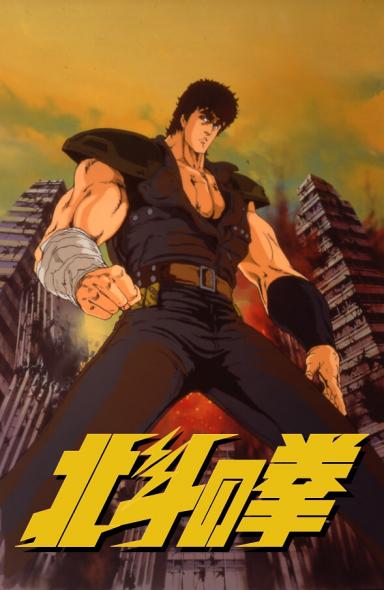
Fist of the North Star: The Movie (1986) Review: A Beautiful Brutal Compression
The 1986 film turns an enormous social tragedy into a concentrated spectacle, gaining visual force while sacrificing some of the people who make the world matter.
Spoilers: This Review discusses the complete film, its alternate continuity, and its ending.
This movie is gorgeous enough to make you suspicious
Fist of the North Star: The Movie is what happens when a sprawling social collapse gets invited to the theater and told it has 110 minutes to look immortal. Toyoo Ashida’s film is muscular, mournful, beautifully staged, and ruthless about throwing away connective tissue. It gives Kenshiro, Raoh, Shin, Rei, Jagi, Yuria, Lin, and Bat the visual weight of figures carved into the end of civilization. It also reduces many of the people living beneath those figures to evidence that the apocalypse is bad.
That tradeoff does not ruin the movie. It defines the movie. The theatrical version gains impact, velocity, color, and a kind of operatic inevitability. It loses routine, recovery, and the slow political education that happens when Kenshiro moves through one exploited community after another. If you want the legend concentrated until it can crack a screen, this film understands the assignment. If you want to know why the legend matters to anybody without a named fighting style, the television series gives you more room to breathe.
A retelling is not a sequel and compression is not neutrality
The film reorganizes early manga and television material instead of continuing it. Toei’s official synopsis makes the divergence plain from the beginning: Shin takes Yuria, Jagi is present when Kenshiro is thrown into the abyss, and Raoh kills Ryuken as the rival lines begin converging. Years later, Kenshiro returns to confront Jagi and Shin before Yuria is drawn into Raoh’s orbit. Familiar events remain, but cause, timing, and proximity change.
Calling this a summary undersells how aggressively it constructs its own machine. A summary tries to preserve hierarchy while shortening detail. This movie changes hierarchy. It chooses which relationship becomes structural, which death becomes punctuation, which civilian can carry symbolic weight, and which transition can happen without the audience seeing the labor between events. Those choices deserve to be judged as choices. “They had to cut things” explains the pressure. It does not finish the criticism.
The craft has names, dates, and decisions behind it
The film opened in Japan on March 8, 1986, after the manga and television anime had already turned the property into a phenomenon. Toei Animation lists a 110-minute runtime, Toyoo Ashida as director, Susumu Takaku as screenwriter, Masami Suda as animation director, Sukeyuki Tanaka as art director, Tamio Hosoda as cinematography director, and Katsuhisa Hattori as composer. KODOMO BAND performs the theme, “Heart of Madness.” Those credits matter because the film’s personality is not an accident produced by a title.
Ashida had already served as chief director on the television production, while Suda’s character work helped define the anime’s monumental anatomy. The movie does not abandon that visual identity. It concentrates it. Bodies become architecture, capes become weather, and the distance between two fighters can feel like territory about to change ownership. Theatrical resources do not make every shot equally fluid, but they let the key confrontations carry scale the weekly production could only reach intermittently.
The movie starts by making betrayal a group photograph
Placing Shin, Jagi, Raoh, Kenshiro, and Ryuken so close to the opening conflict creates immediate mythic clarity. The audience does not have to wait for separate rivalries to reveal their relationship to the same inheritance crisis. Everybody is already inside the wound. That efficiency is exciting, and it also makes the world feel as if it exists mainly to arrange these men for collision.
The television journey lets threats arrive as systems before every system resolves into a famous face. Gangs control food and wells. Military structures weaponize procedure. Prisons turn bodies into inventory. The movie announces the named constellation early, which sharpens momentum while making ordinary domination look like background radiation. The apocalypse becomes the stage on which legendary men settle family business, rather than a society whose family business keeps producing rulers.
Invincibility is the least interesting thing about him
Kenshiro works because power and temperament pull in opposite directions. His body promises domination. His behavior keeps asking whether strength can enter another person’s crisis without claiming ownership of the person. The movie preserves his stillness, his grief, and the terrifying calm before Hokuto Shinken finishes an argument. It has less time to show the small attentions that keep that calm from becoming emptiness.
When the television series pauses for a seed, a frightened child, a meal, or a village learning to defend itself, Kenshiro’s ethics become observable. The movie relies more heavily on recognition. If you already know the character, a look can carry the history of those choices. If you do not, he can read as a magnificent instrument moving toward the next required rival. The film gives him myth. It sometimes borrows his humanity from versions of the story it no longer has time to include.
Children cannot only be witnesses when the future is supposedly theirs
Lin and Bat give the wasteland a future tense. They are not powerful enough to resolve the central battles, which makes their judgment more important, not less. They show whether legendary violence looks like protection from below. They also reveal what survival requires between confrontations: food, improvisation, loyalty, nerve, and the ability to recognize when an adult’s promise is about to become another grave.
The film elevates Lin during its climax in a way that deliberately breaks from the television and manga routes. That intervention gives a child symbolic authority over men who have made force their entire language. It is a striking idea. It also risks making her less a person than a sacred brake the plot can pull when two bodies have exceeded ordinary persuasion. The scene lands because Lin matters. It remains complicated because the movie has not given her enough ordinary life to make the authority fully hers.
A symbol of compassion still deserves to be a person
Yuria carries the franchise’s gentlest promise and one of its most persistent structural problems. Men organize desire, rivalry, regret, and redemption around her. The story insists her compassion can change people, then repeatedly removes the conditions under which compassion would be a choice. Kidnapping, protection, prophecy, and political symbolism keep passing her body between narratives built by men.
The movie’s compression intensifies that problem because it has little space for interior contradiction. Yuria can appear spiritually central while remaining dramatically inaccessible. Everyone tells us what she means. Fewer scenes let her determine what meaning costs or what she wants beyond the survival of men who turned love into a battlefield. Beauty does not correct that absence. A luminous image can make symbolic confinement look respectful while the character still lacks room to move.
Love becomes possession the moment her answer stops mattering
Shin is compelling when the story understands that genuine feeling and abusive entitlement can occupy the same man. He loves Yuria. He also decides his love authorizes violence, abduction, isolation, and a city constructed around the fantasy that magnificence can turn refusal into consent. His tragedy is not that love made him evil. It is that he keeps calling ownership love after her answer has made the distinction clear.
The movie moves quickly through his place in Kenshiro’s wound, which preserves the iconic rivalry but reduces some of Southern Cross’s political grotesquerie. Shin’s world is powerful because private desire becomes municipal planning. People labor beneath a skyline built to persuade one imprisoned woman that her captor’s feelings are reality. When the film compresses that machinery, Shin becomes a sharper rival and a thinner governor. The romance was never only personal. The city was the confession.
He steals the name because he cannot survive the meaning
Jagi offers a different answer to inheritance. Raoh wants to dominate the world under his own title. Jagi borrows Kenshiro’s because humiliation has hollowed him out. The theft is more than tactical. He wants the reputation without the discipline, the fear without the responsibility, and the scars without the choices that gave those scars moral weight.
Bringing Jagi close to the opening betrayal makes the pathology easy to read. It also reduces the slow poison of discovering what he has done across communities. In the longer version, a stolen name damages people Kenshiro has never met. Reputation becomes infrastructure. The movie makes Jagi vivid as a corrupted brother, but it has less space to make identity theft political. His resentment explodes beautifully. The social debris clears too quickly.
Grace is not the opposite of brutality
Rei’s Nanto Suichoken gives the movie a different motion language. Kenshiro strikes with controlled inevitability. Rei seems to cut through air before the body understands it has been divided. Masami Suda’s design and the film’s theatrical staging let that elegance become dangerous without turning it into softness. Rei looks beautiful because precision is beautiful, and the story refuses to make beauty incompatible with rage.
His emotional life suffers under compression more than his fighting identity. Airi’s disappearance, his distrust, his alliance with Kenshiro, and the loyalties that reshape him need accumulation. The film can present the wound and the gesture, but it has less time for the corrections between them. Rei remains magnetic. The version of him who learns that rescue is not possession and friendship is not weakness belongs more fully to the longer road.
Charisma is part of the weapon, not evidence for the defense
Raoh enters every frame with the visual authority of somebody who believes scale is an argument. The armor, horse, cape, posture, and stillness turn one man into public architecture. That is not decorative excess. It is how empire teaches people to experience domination as natural weather. He looks inevitable because inevitability is one of the services his image performs.
The movie understands his charisma and risks falling in love with it. Raoh can recognize greatness, grieve, admire strength, and maintain a code. None of those qualities refund the people forced beneath his expansion. Complexity explains how tyranny sustains emotional loyalty. It should not be used to pretend emotional loyalty changes the structure. The film is strongest when his magnificence frightens us and weakest when magnificence itself begins functioning like mitigation.
The body horror works until suffering becomes wallpaper
Fist of the North Star violence has always balanced horror, release, comedy, and judgment. A tyrant who has made other bodies disposable discovers that his own body is not exempt. The reversal can feel brutally satisfying because the series spends time establishing the harm that came first. In a compressed movie, consequence sometimes arrives before social context has fully accumulated.
The theatrical animation makes impact tactile. Flesh stretches, pressure builds, bone and muscle stop obeying the person who assumed control was permanent. The craft is undeniable. The ethical question is whether the victimized people remain visible after the spectacle claims attention. When they do, violence reads as interruption of a system. When they disappear, violence becomes the system the audience came to consume.
The wasteland looks best when it remembers people live there
The film’s most powerful images combine monumental figures with environments that communicate use: roads worn by movement, settlements constructed from remains, interiors that show scarcity, and crowds whose arrangement reveals fear before dialogue names it. Those images make the apocalypse social. Ruins are not only dramatic shapes. They are failed infrastructure repurposed by whoever survived.
At other moments, the wasteland becomes a magnificent empty corridor between rivals. The scale is seductive, but emptiness can absolve power. If nobody appears to live in a place, destroying it feels abstract. Ashida’s direction repeatedly pulls the movie back toward faces, hands, and witnesses. The tension between environment as society and environment as arena runs through the entire feature.
The performances keep myth from becoming a silent monument
Katsuhisa Hattori’s score and KODOMO BAND’s “Heart of Madness” give the film a theatrical identity distinct from the television series without severing it from the franchise’s rock-driven intensity. Music helps the feature move between funeral weight, violent propulsion, and the strange tenderness these enormous men often discover only when a scene has made escape impossible.
The Japanese cast carries continuity across the altered story. Akira Kamiya’s Kenshiro uses restraint as pressure. Kenji Utsumi gives Raoh command without making every line the same declaration. Kaneto Shiozawa’s Rei keeps elegance sharp. Toshio Furukawa lets Shin’s pride crack around need. Yuriko Yamamoto gives Yuria calm without access to all the interior material the character deserves. Performance restores some of what compression removes.
A child stops the legend because the legend cannot stop itself
The movie’s different climax is not a small alternate ending pasted onto familiar combat. It changes the moral authority in the scene. Kenshiro and Raoh have reached the point where martial language cannot produce a future. Lin enters as the person who can name a limit neither man’s system contains. Raoh responding to her disrupts the assumption that only greater force can end force.
I admire the choice and remain uneasy about what it asks Lin to become. A child should not have to function as sacred conscience for adult men who built a world where conscience required a miracle to be heard. The scene can be moving and unfair at the same time. Its power comes from giving the least physically dominant person the decisive voice. Its weakness comes from turning her vulnerability into the final special effect.
The movie earns admiration, not immunity
The 1986 film is not the best substitute for the television series and it is not a disposable digest. It is a deliberate theatrical adaptation with its own hierarchy, rhythms, images, and ending. Toyoo Ashida and the production team make the franchise look enormous enough to justify the word legend. They also reveal what gets lost when legend occupies nearly every available minute.
Watch it for the animation, the concentrated rivalries, the Japanese performances, the music, the alternate structure, and the audacity of its final intervention. Then notice the villages, women, children, routines, and political textures pushed toward the edge so the central bodies can appear even larger. The film is great enough to survive that examination. In fact, the examination is what keeps admiration from becoming another form of obedience.
Censorship changes rhythm even when the plot survives
Violence in this film has circulated in different presentations, and viewers often meet the movie through memories of a version softened for a particular market or release. I am not going to fake a universal cut history when availability changes by territory and edition. The useful critical point is that obscuring impact does more than remove gore. It changes timing, emphasis, and the moral shape of retaliation.
Fist of the North Star builds suspense around a body that has already crossed the point of no return. The pause between Kenshiro’s strike and the visible consequence is part of the sentence. If a release blurs, darkens, reframes, or shortens that consequence, the viewer still understands that somebody died, but the scene’s mixture of horror, comedy, punishment, and bodily betrayal lands differently. Restoration should recover craft without pretending every restored detail is automatically profound.
Limited movement and spectacular movement are not moral categories
The movie does not move with the uninterrupted fluidity modern marketing teaches audiences to expect from every expensive anime clip. It uses held poses, impact frames, repeated motion, pans across drawings, and selective bursts of animation. That economy belongs to the production language, not to a failure of ambition. The question is where the film spends movement and what that spending tells us to value.
Raoh can become intimidating through stillness because the frame organizes everyone else around him. Rei needs speed and directional clarity because his technique depends on grace becoming damage before an opponent recognizes it. Kenshiro often receives controlled preparation followed by a violent release. The film understands that motion is not the only source of intensity. Composition can make a body feel inevitable before a single cel changes.
The apocalypse is not just brown dirt and red blood
The feature’s color design keeps the wasteland from collapsing into one dead register. Bruised skies, poisoned light, cold interiors, theatrical reds, and moments of impossible beauty give emotional temperature to places that might otherwise function as interchangeable ruins. Color tells us when a location belongs to ordinary survival, private obsession, or a ruler’s performance of permanence.
That variety also protects the violence from monotony. Red carries little meaning when every frame is already screaming. The film often surrounds impact with quieter stone, shadow, skin, metal, and sky, allowing sudden color to feel invasive. Its best palettes do not make the apocalypse attractive. They make attraction part of the danger. The world can look magnificent while remaining unlivable.
Size tells us who thinks the world belongs to him
Low angles and monumental framing are obvious tools for a franchise built around men who seem physically incompatible with doors. The movie uses them well, but the most revealing compositions are relational. Who occupies the center? Who is pushed to an edge? Who appears above a crowd, and whose face disappears when a cape, fist, or piece of architecture enters the frame?
Raoh’s scale often converts hierarchy into geometry. Kenshiro can dominate a frame while still orienting his body toward somebody vulnerable. Shin surrounds himself with structures meant to certify desire as authority. Lin becomes powerful at the ending not because her body suddenly grows, but because the composition allows her presence to interrupt two men who assumed the frame belonged to them. Visual politics happens before dialogue.
Muscle is armor, language, and a very loud prison
These bodies are absurd, and the absurdity is purposeful. Muscle represents capacity in a world where institutions have collapsed, but it also becomes a demand. Men must appear impossible before anyone will believe they can protect, rule, avenge, or survive. Physical scale turns into emotional job description.
The film allows tears and grief inside that architecture, which remains one of the franchise’s most radical pleasures. It also keeps making pain legitimate through bodily payment. A man can confess love once he is dying. He can admit fear after defeat has removed the need to perform certainty. The movie challenges emotional repression and still relies on the violent ritual that finally gives emotion permission to speak.
The film remembers scarcity, then rushes past its administration
The wasteland is not frightening because stores are closed. It is frightening because scarcity has become governable. Someone controls a well, a gate, a supply route, a prison, a clinic, or the armed bodies that decide who receives access. The television series repeatedly turns those arrangements into episode-level conflicts. The movie keeps the visual evidence but often moves before administration becomes legible.
That matters because tyrants do not rule through personality alone. Raoh’s charisma, Shin’s obsession, and Jagi’s resentment become socially dangerous when organizations distribute their will. A deep adaptation would show who counts water, who enforces labor, who records punishment, and who benefits below the famous leader. The film gives us the crown and the screams. It has less time for the bureaucracy between them.
Kenshiro and Rei need more road than the runtime can give them
Friendship in this franchise is rarely casual. Men meet as threats, rivals, mirrors, or temporary allies, then discover loyalty through situations designed to weaponize the people they care about. Kenshiro and Rei become meaningful to one another because trust is tested under conditions where suspicion would be rational.
The film preserves attraction between their fighting identities, but the emotional conversion happens quickly. We see why they respect each other. We receive less of the lived evidence that turns respect into brotherhood. The television road gives them meals, interruptions, disagreements, and people they protect together. Those unglamorous intervals make later sacrifice feel like history rather than an efficient dramatic appointment.
The dead keep teaching lessons they should not have had to die to teach
Fist of the North Star loves a death that clarifies everything. A final breath can reveal loyalty, correct a misunderstanding, expose a tyrant, complete a love story, or give a surviving man the emotional vocabulary he resisted while the dying person still had time. The movie intensifies that habit because every death must carry several narrative jobs.
Some of those scenes are devastating. The problem is not that death lacks meaning. The problem is how often meaning arrives only after a body becomes unavailable to contradict the lesson. A character should not need to die beautifully before the story grants full interiority. The film makes mortality operatic. It also makes us ask how many people were treated as messages addressed to somebody else.
Yuria, Lin, and Airi carry different kinds of narrative labor
It is too easy to say the movie has “strong women” because Lin acts decisively, Yuria possesses moral authority, and Airi matters to Rei. Strength is not a quantity distributed by compliments. The sharper question is whether each woman gets to define the problem she is inside.
Yuria becomes a moral center while men control her movement. Lin becomes decisive while the climax asks her to save adult masculinity from itself. Airi gives Rei’s search emotional urgency while her own recovery receives less space than his devotion. These roles are not identical, and none of the characters is worthless. The pattern appears in how often a woman’s suffering becomes the instrument that reveals a man.
A declaration changes when the room believes it
Fist of the North Star dialogue thrives on certainty. Techniques are named, deaths are announced before bodies understand them, and rulers speak as if grammar itself has joined their army. In weaker hands, the language becomes camp by accident. The Japanese cast and direction understand that conviction must have different textures.
Kenshiro’s certainty often arrives quietly because power does not need to audition. Raoh projects certainty outward as political weather. Shin’s declarations strain toward the person he needs to convince. Jagi performs a name he stole. Shigeru Chiba’s narration can turn escalation into ritual and, when needed, release pressure with vocal electricity. Authority sounds different depending on whether the speaker owns it, fears losing it, or borrowed it.
Catharsis can make us stop asking who cleans up
The movie knows exactly how to make retaliation feel good. It gives cruelty a face, lets that face announce its confidence, and then reveals that the body enforcing the hierarchy has become vulnerable. The release is honest. People living under arbitrary violence deserve an interruption more decisive than polite disagreement.
Catharsis becomes dangerous when it completes the audience’s responsibility. We cheer, the tyrant falls, and the film moves toward another legendary conflict. Who reopens the well? Who treats the injured? Who decides whether the former guards remain part of the village? Who helps children sleep after watching a body explode? The television format sometimes has room for those questions. The movie often spends its ticket on the impact.
The second viewing belongs to everyone outside the duel
On a first watch, the movie pulls attention toward arrivals, transformations, rivalries, and the alternate ending. On a rewatch, the edges become louder. Notice how crowds organize around fear. Notice when women are present but not consulted. Notice how frequently a settlement disappears once its suffering has motivated a fight.
Also notice the craft that does not advertise itself: a held expression after bravado fails, a change in distance between allies, the color temperature before violence, or the silence that lets a performance carry what the script compressed. Rewatching does not have to become prosecution. It is how admiration matures beyond the scenes already famous enough to introduce themselves.
The movie folds the wasteland until every road reaches a famous man
Long-form Fist of the North Star makes distance expensive. Travel consumes food, exposes children, produces encounters, and lets communities reveal how power changes from one territory to the next. The movie folds that distance. Important places feel connected by dramatic necessity because the feature cannot spend twenty minutes proving that a road is dangerous before a named rival appears.
The compression improves propulsion and weakens scale in a different sense. The landscape looks enormous while the social world feels smaller. Geography becomes a sequence of entrances rather than a network of people, supply routes, rumors, and decisions. The film can show us miles of ruined earth and still make the apocalypse feel less inhabited than one cramped television village.
Famous enemies crowd out the systems that made them possible
The feature understands that audiences came to see the faces already burned into the franchise: Shin, Jagi, Rei when he still looks dangerous, and Raoh above them all. Lesser threats appear as acceleration lanes. They demonstrate brutality, invite retaliation, and clear the stage before they can develop a politics of their own.
That hierarchy is efficient fandom engineering. It is also why the movie can feel like a greatest-hits album with new transitions. The famous men become more visually distinct while the worlds beneath them become more interchangeable. A tyrant’s personality changes. The civilians still arrive frightened, injured, hungry, or available to prove that the next technique is deserved.
Reputation travels faster than the man carrying it
A legendary name can protect people before Kenshiro arrives because fear changes an oppressor’s calculation. It can also attract challengers, imitators, and men who want authority without responsibility. Jagi’s theft exposes how power operates through story. Most people cannot verify a martial lineage. They respond to what the name has already taught them to expect.
The film uses recognition as shorthand with its audience too. “Kenshiro” arrives loaded. Viewers who know the series bring patience, compassion, lost friends, and village histories into his silence. New viewers receive the scars, technique, pursuit, and rivalries. That difference explains why the same performance can feel restrained to one audience and underwritten to another.
The child becomes important enough to lose ordinary childhood
The ending grants Lin a form of authority larger than physical power, but the film also surrounds her with the suggestion that she carries exceptional destiny. Prophecy can protect a vulnerable character from being dismissed. It can also imply that ordinary children lack standing unless the universe has certified them as special.
Lin matters before any cosmic or political meaning attaches to her. She matters because she witnesses harm, forms judgment, trusts carefully, and keeps insisting that survival should lead somewhere. The movie’s climax works best when her intervention grows from that personhood. It becomes less satisfying when destiny seems to do the speaking for her.
The kid doing logistics deserves more than comic oxygen
Bat is practical in ways the legendary fighters cannot afford to notice. He reads danger, finds resources, improvises, complains, and keeps moving. Humor protects him from becoming a tiny solemn mascot, but comedy should not erase the intelligence underneath it.
The movie uses him to keep the myth from sealing itself airtight. His reactions remind us that these bodies and declarations are objectively ridiculous even when the stakes remain real. What compression costs Bat is cumulative competence. The television road lets survival skill become character history. The feature needs him to puncture tension and keep pace.
The franchise laughs because unbroken solemnity would become self-parody
Fist of the North Star lives one inch from comedy even when nobody is telling a joke. Men announce secret techniques in ruined streets, villains transform confidence into strange death noises, and anatomy obeys emotion more than medicine. The movie does not eliminate that absurdity. It manages the release so the myth can remain sincere without pretending it is naturalistic.
Humor becomes a pressure valve and a moral risk. A spectacular death can feel funny because cruelty has reversed direction, but the body remains a body. The franchise invites laughter at the collapse of arrogance. The film’s speed leaves less time to distinguish laughing at a tyrant’s certainty from treating all bodily destruction as a punchline.
The stars explain people until people start disappearing inside the stars
Hokuto and Nanto turn martial traditions into cosmology. Destiny, succession, and celestial identity give private conflict an order larger than individual choice. That structure can make grief feel inevitable, which is emotionally powerful and politically convenient. If the stars required the collision, nobody has to ask who maintained the road toward it.
The movie embraces myth because feature length rewards clear symbolic lines. Kenshiro and Raoh become more than brothers or rivals. Lin becomes more than a child. Yuria becomes more than a kidnapped woman. The danger is obvious: “more than” can mean “less specifically human.” Symbols survive compression better than contradictions.
Everybody says the word while arguing over control
Love drives Shin, Kenshiro, Rei, Yuria, Raoh, and the loyalties surrounding them, but the film refuses to give the word one moral meaning. Love can be patience, memory, possession, rescue, grief, admiration, or the justification someone uses after ignoring another person’s will.
The most important distinction is not who feels most intensely. It is whose feeling leaves room for another person to remain free. Shin’s intensity cannot answer Yuria’s refusal. Raoh’s capacity for grief cannot undo conquest. Kenshiro’s love becomes meaningful when it guides protection without demanding ownership. The movie knows this, even when its plot keeps moving women like evidence between male conclusions.
A foretold collision still contains decisions
The franchise loves destiny because destiny gives every meeting thunder. Successors, stars, bloodlines, and inherited techniques tell characters that history has already reserved their bodies. The film amplifies that fatalism by removing many of the ordinary detours where someone might become different.
Choice survives in the manner of arrival. Toki uses knowledge to heal. Raoh uses fear to stabilize his world. Rei lets vengeance widen into loyalty. Kenshiro refuses to treat unmatched force as permission to govern. Destiny can name the arena. It cannot make those ethics interchangeable. The Review has to keep responsibility visible whenever mythology tries to turn action into weather.
A restored image cannot restore everything the release history changed
Older anime reaches modern viewers through transfers, edits, subtitles, dubs, aspect decisions, compression, and whatever edition happens to be available in a territory. “The movie” is therefore both one production and several viewing experiences. Color density, line clarity, darkness, and violence can feel different before interpretation even begins.
Preservation matters because craft deserves to be seen, but no edition arrives without mediation. A cleaner transfer can recover background work and facial acting. It can also intensify gore that some viewers remember only through altered releases. Responsible criticism identifies the version when a specific difference matters and avoids treating one memory as universal.
Iconic images can become a cage around the work that made them
The seven scars, the finger point, the giant horse, the pressure-point delay, and the declaration that death has already happened travel easily outside the film. They become clips, jokes, references, poses, and shorthand for an entire era of masculine anime spectacle.
Legacy keeps the work visible and can flatten it into merchandise for its loudest moments. The film deserves recognition for the images strong enough to escape it. It also deserves viewers willing to return and find the quieter structures those images overshadow: a child’s judgment, a captive woman’s missing choices, a community outside the duel, and a hero whose restraint matters more than the explosion.
The best entry point depends on what you want to understand
If you want a concentrated introduction to the franchise’s theatrical visual identity, major early rivals, Japanese performances, and mythic scale, the 1986 film is an excellent door. If you want the clearest continuity route, the fullest community politics, or gradual character relationships, it is a dazzling side entrance.
Existing fans should watch it as an adaptation that argues with familiar material. New viewers should know that confusion around altered events is not a personal failure. The movie changed the arrangement. Nobody needs to study 109 episodes before enjoying it, but the feature should not be allowed to convince them that the longer story contains nothing beyond what survived compression.
Removing Toki does more than remove another brother
Toki is not simply one more beloved fighter waiting for a later entrance. He proves that Hokuto knowledge can become medicine, patience, and care. Without him, the film’s inheritance argument narrows toward competing forms of lethal authority. Kenshiro still represents restraint, but the art itself receives less evidence that healing belongs inside its purpose.
His absence also changes Raoh. Toki gives Raoh a brother whose moral power cannot be dismissed as physical weakness, even when illness changes what his body can do. Removing that relationship makes the family line cleaner and less ethically crowded. The movie moves faster because it has fewer answers to compare.
Mamiya leaves a hole shaped like self-determined survival
Mamiya complicates the franchise because she refuses the easy separation between protected woman and active fighter. Her story is imperfect and often pulled back toward male desire, but her presence forces Rei and Kenshiro to encounter a woman who makes tactical decisions inside the same danger.
Without that relationship, Rei’s emotional path centers more heavily on Airi and male alliance. The film retains his beauty, rage, and loyalty while losing an important test of how protection can slide toward control. Absence is not neutral trimming. It changes which ethical questions a character has to answer.
Momentum can hide the moment a choice becomes inevitable
The film edits toward collision. Scenes often end once they have supplied the information or emotion required for the next confrontation. That discipline keeps 110 minutes from collapsing under the weight of the material. It also makes transformation look cleaner than lived change usually feels.
A rival becomes an ally, a prisoner becomes a symbol, and a wounded man becomes legend because the movie must preserve destination over hesitation. The missing hesitation is where people often reveal themselves. Television can afford failed conversations and emotional residue. The feature converts residue into forward pressure.
Fast is not the same as shallow, but speed chooses what cannot deepen
The movie is not shallow simply because it moves quickly. A glance, composition, vocal pause, or cut can carry density without extended dialogue. Several scenes achieve exactly that. The problem appears when every relationship competes for the same compressed oxygen and spectacle predictably wins.
Action receives setup, escalation, impact, and aftermath because the film knows viewers need to feel its shape. Recovery often receives a transition. That allocation tells us what the adaptation considers indispensable. The answer is understandable for a theatrical event and revealing for a story supposedly concerned with what survives violence.
Ruins become ideology when they reveal who rebuilt them
Sukeyuki Tanaka’s credited art direction helps distinguish spaces through scale, material, and atmosphere. The most useful environments show not only that civilization fell, but how survivors reorganized its remains. Walls become checkpoints. Towers become declarations. Scraps become homes for people who cannot afford monumental architecture.
A ruined city is not automatically political. It becomes political when the frame shows who occupies its height, who walks its exposed ground, and who controls the passages between safety and scarcity. The film’s environments are strongest when design tells that story before a villain explains his title.
Masami Suda makes anatomy carry personality
Masami Suda’s animation-direction credit sits at the center of the film’s visual identity. Kenshiro, Raoh, Shin, Jagi, and Rei do not share one generic heroic body. Proportion, face, posture, costume, and movement express different relationships to power. Raoh expands into authority. Rei narrows into precision. Jagi looks assembled around resentment.
The designs are exaggerated enough to become symbols while remaining specific enough for performance. A brow lowering by a fraction matters because the surrounding body is already shouting. The film’s artistry lives in that contradiction: monumental anatomy carrying emotional changes small enough to miss if you only wait for an explosion.
Inevitable suffering can become an alibi for preventable choices
The franchise often frames conflict through stars, succession, and destinies that make catastrophe feel written before anyone arrives. Tragedy needs pressure larger than one person. It also needs choices, or else grief becomes weather and responsibility evaporates.
Shin chooses possession. Jagi chooses theft and humiliation as identity. Raoh chooses empire. Kenshiro chooses restraint without always knowing what restraint can save. The movie gains grandeur from fate and retains meaning through those decisions. Whenever destiny begins excusing a character, the tragedy becomes public relations.
A beautiful atrocity still needs a point of view
Animation can make destruction visually irresistible. The ethical demand is not that art make violence ugly enough to punish viewers for looking. It is that the scene know who is experiencing the damage and why the audience has been invited to enjoy its form.
The movie often aligns pleasure with the collapse of an abuser’s certainty. That alignment gives catharsis moral context. When a crowd or settlement disappears before the impact, the same craft can float free of consequence. Spectacle is not the enemy. Amnesia is.
Faithfulness is a weak question unless we name what deserved protection
Counting changed events can document difference, but it cannot judge adaptation by itself. The film is unfaithful to some chronology and deeply faithful to the franchise’s monumental emotion, martial mythology, and visual appetite. The useful question is which values survive the restructuring.
Does the adaptation preserve the belief that strength owes something to the vulnerable? Does it preserve the difference between love and ownership? Does it let community remain more than scenery? The movie answers yes, yes, and sometimes. That mixed answer is more interesting than a percentage score for plot fidelity.
The world still needs water after the legend has finished posing
The film ends with emotional and mythic resolution, but the wasteland remains. That unfinished material reality is not a plot hole. It is the pressure the franchise keeps generating and rarely resolves. One victorious body cannot become agriculture, public health, conflict mediation, and accountable government.
Kenshiro’s refusal to rule protects him from becoming Raoh. It does not automatically produce institutions better than Raoh. The stories are honest enough to show liberation repeatedly required and less prepared to imagine maintenance. The question after the credits is not whether Kenshiro won. It is whether anyone now has enough safety to build without waiting for his return.
Nuclear ruin is the premise, not the villain
The destroyed world can make every later cruelty look inevitable. If civilization has already ended, perhaps armed men owning water is simply nature returning. The film’s moral argument depends on refusing that excuse. Radiation and collapse create scarcity. People still choose whether scarcity becomes mutual care, trade, triage, theft, or hereditary rule.
The apocalypse removes infrastructure and exposes values. It does not manufacture every tyrant from nothing. Shin, Jagi, and Raoh carry desires that existed before the ruins. The wasteland gives those desires fewer obstacles and more frightened bodies to organize.
Kenshiro’s chest is evidence everybody thinks they understand
The scars make private trauma publicly readable. Strangers see a constellation before they know the man, and the story turns that visibility into reputation. Kenshiro cannot choose when the wound enters a conversation. His body announces betrayal even when he remains silent.
Jagi’s manipulation of the image proves that evidence can be copied and meaning cannot. A pattern of wounds may identify Kenshiro, but it does not produce his ethics. The franchise keeps asking viewers to distinguish the appearance of power from the responsibility that gives power value.
A city built for one woman is still a city built without her consent
Southern Cross is romantic obsession translated into labor, architecture, and policing. Shin does not merely imprison Yuria in a room. He reorganizes resources and people around the belief that sufficient magnificence can overwrite her answer. The city is what entitlement looks like after it acquires contractors.
The film gives us the grandeur faster than the television route can, and it spends less time on the people forced to maintain that grandeur. The missing labor matters. Every tower intended to impress Yuria is also a record of people whose lives became material inside someone else’s courtship.
A succession system becomes dangerous when family cannot survive selection
Ryuken’s death concentrates the failure of an inheritance structure that asks brothers to become rivals before it gives them a language for grief. One successor may be required, but exclusivity does not explain why rejection must become humiliation or why knowledge powerful enough to shape nations remains governed like a private family wound.
Raoh’s violence belongs to Raoh. The system still deserves examination. Institutions reveal themselves through predictable failure. If succession repeatedly produces resentment, secrecy, and catastrophic competition, tradition cannot answer criticism by pointing to tradition.
The rivalry is strongest when Yuria is not treated as the trophy
Kenshiro and Shin are easy to frame as men competing for the same woman. That frame repeats Shin’s error. Yuria is not a reward that proves which martial art or masculine style deserves victory. Her choice exists before their duel.
Kenshiro’s moral advantage does not come from loving more intensely. It comes from recognizing that love does not erase another person’s will. The movie knows the distinction, but its compressed structure still lets Yuria function as the line connecting male destinies more often than as the author of her own route.
Resentment and possession share a fear of another person’s answer
Jagi cannot tolerate a world where Kenshiro’s selection means something about his own limits. Shin cannot tolerate Yuria’s refusal. Both men answer an unwanted truth by attacking the person or symbol that delivered it. Their violence tries to convert disagreement into proof of authority.
The similarity matters because neither man lacks emotion. They lack the capacity to let another person’s reality remain intact when it injures their self-image. The film turns that fragility into spectacular threat without confusing threat for strength.
Finding someone is not the same as returning her life
Rei’s search for Airi gives his violence a legible purpose, but rescue stories often stop where recovery should begin. A person found after captivity does not return to the emotional moment before harm. Safety, agency, trust, and ordinary decision-making have to be rebuilt.
The feature does not have time to make that rebuilding central. Rei receives the momentum of devotion while Airi carries the quieter aftermath. The imbalance does not make his love false. It shows how easily the rescuer’s journey becomes more narratively attractive than the survivor’s future.
Killing the teacher does not free Raoh from the lesson
Raoh rejects the authority that denies him succession and then builds an authority even less capable of accepting refusal. The rebellion is therefore incomplete. He destroys the gatekeeper and preserves the gate’s logic inside himself: one ruler, one answer, one hierarchy beneath which disagreement becomes weakness.
That repetition makes him tragic and responsible. He recognizes the violence of exclusion when it touches him. He refuses to generalize the recognition to anyone living under his empire. Pain becomes insight only when it changes what a person permits himself to do to others.
The film turns moral corruption into anatomy, then complicates its own shortcut
Villain bodies stretch, swell, distort, and betray the men who used them as instruments of fear. The imagery makes arrogance visible and turns punishment into body horror. It also participates in an old visual shortcut where unusual or excessive bodies signal moral failure before behavior has done the work.
Fist complicates that shortcut by making heroic bodies equally impossible, but the distribution is not identical. Heroes receive beauty, grief, and composure. Disposable enemies often receive deformity as joke and verdict. The film can be exhilarating while still asking viewers to notice whose body is allowed dignity at death.
The camera admires men and sanctifies women
The film looks at male bodies as engines, monuments, and sites of damage. It looks at women more often as beauty, innocence, captivity, or moral interruption. Admiration gives men action. Sanctification can remove women from ordinary contradiction.
Yuria’s luminous presentation protects her from vulgar dismissal, but reverence is not the same as subjectivity. A pedestal controls movement as effectively as a cage when the person placed there did not choose the architecture. Lin escapes some of that treatment through motion and speech, then the ending raises her into symbol.
Impact begins before the image confirms it
The film’s violence depends on sound as much as drawing. A strike, internal pressure, tearing material, sudden silence, and vocal rupture teach the audience how to feel a body changing. Sound can make limited visual movement feel enormous because the ear supplies mass the frame only suggests.
The best effects preserve sequence. We hear confidence interrupted, the technique land, and consequence approach. That delay lets dread and comedy occupy the same second. When every effect competes at maximum volume, distinction disappears. The film generally knows when to let one sound own the room.
Kenshiro’s quiet is active when the frame lets us watch him choose
Silence works when behavior remains specific. Kenshiro watches, reorients, waits, lowers his voice, or positions himself between danger and another person. Those actions turn quiet into decision. Without them, stillness would become a blank surface onto which viewers project whatever hero they prefer.
The film’s visual confidence often lets Kamiya’s restrained performance carry interior pressure without explanation. Compression becomes a problem when the next event arrives before the quiet has produced meaning. Silence needs duration, not merely absence of dialogue.
Shigeru Chiba turns exposition into weather
Narration can feel like information pasted over images that failed to communicate. Shigeru Chiba refuses that flatness. His voice supplies momentum, ritual, alarm, and the heightened conviction that makes this world’s impossible declarations feel native to it.
The performance also carries an audience relationship. It knows the material is enormous and occasionally ridiculous without standing outside it to sneer. That balance protects sincerity. The narrator invites us to feel the thunder and remain awake enough to recognize the theater.
A theatrical adaptation has to justify leaving the television at home
The movie cannot win by reproducing weekly episodes with fewer pauses. It needs scale, concentration, and images that make the theater feel necessary. The production answers with redesigned encounters, heightened violence, dense staging, and an ending that belongs specifically to this route.
Its success as an event helps explain its limitations as an introduction. Event cinema rewards recognition and culmination. A newcomer needs orientation and accumulation. The film offers enough to follow and more to feel, while trusting the franchise’s cultural weight to fill gaps it deliberately leaves.
The men are allowed to cry after proving nobody can stop them
The franchise deserves credit for making tears compatible with enormous masculine bodies. It also sets an exhausting admission price. Emotion becomes safest after combat has established dominance or death has removed future vulnerability. Men earn tenderness through damage.
Kenshiro’s restraint offers another route because care appears in action before confession. Rei’s loyalty grows through shared risk. Shin and Raoh reveal what happens when feeling becomes authority instead of relationship. The movie contains several masculinities and remains trapped by the belief that violence must certify most of them.
Raoh offers certainty because uncertainty is what everyone fears
Empire becomes seductive after collapse because it promises roads, order, predictable authority, and an end to local chaos. Raoh embodies that promise in one body. The cost is that safety remains conditional on obedience and all institutions point upward toward a man who cannot be questioned.
The film’s concentration makes his offer visually persuasive and politically thin. We see command, troops, fear, and spectacle. We see less administration. That absence can make empire look like personality rather than a network of people choosing, benefiting, enforcing, and surviving beneath it.
Kenshiro saves people best when they do not become his property
Kenshiro’s heroism is not purity. He kills, intimidates, and occupies a power position nobody around him can meaningfully challenge. The distinction lies in what he refuses to build from that advantage. He does not turn gratitude into permanent allegiance or protection into title.
Refusal alone cannot govern the future, but it prevents the savior from becoming the next owner. The film gives this ethic a magnificent silhouette. The longer franchise has to test whether communities can transform the opening he creates into something durable.
Watch the movie once for impact and again for the people impact pushed aside
The first viewing should be allowed to work. Let the color, bodies, music, voices, rivalries, and ending hit at theatrical speed. Criticism does not require interrupting every scene with a footnote while it is happening.
Return later and watch the edges. Count who speaks, who decides, whose recovery is skipped, and which community disappears after motivating a fight. The second viewing does not cancel pleasure. It gives pleasure enough context to become judgment rather than reflex.
The film is excellent at punishment and uncertain about repair
Kenshiro can identify immediate cruelty and end the body enforcing it. That clarity feels righteous because the perpetrators have usually removed every peaceful option from the people beneath them. Punishment stops an active harm. Justice has to answer what happens after the cheering.
The movie rarely has enough time for restitution, testimony, shared decision-making, or the return of stolen resources. Its justice is therefore emergency justice. Necessary intervention becomes visually complete while social repair remains offscreen. The limitation belongs partly to runtime and partly to the franchise’s imagination.
Kenshiro’s restraint is meaningful because it is selective
Mercy cannot mean refusing to act while powerful people destroy others. Kenshiro’s restraint appears in how he distinguishes coercion, fear, weakness, and committed predation. He does not distribute identical consequences to everyone standing on the wrong side of a fight.
The movie has less room to establish those distinctions for minor enemies, so some deaths operate through genre shorthand. Named rivals receive history and grief. Disposable men receive grotesque certainty. The difference makes narrative sense and exposes whose humanity the feature has budgeted enough time to examine.
Every survivor carries a different version of the same legend
Kenshiro’s story becomes public through witnesses, rumors, fear, gratitude, and imitation. The man cannot control all those versions. A community may remember rescue. An enemy remembers humiliation. Jagi sees a name available for theft. Raoh sees a rival whose existence limits absolute authority.
The movie itself participates in that memory economy. It selects the images and relationships most likely to survive 110 minutes, then becomes the version some viewers remember first. Adaptation is not only retelling. It is competition over which memories become portable.
Old animation is not a defect and nostalgia is not analysis
Viewers meeting the film today may find the anatomy, timing, effects, gender politics, or vocal style unmistakably from another era. Age does not excuse every choice, and contemporary smoothness does not automatically improve meaning. A work can look old and remain visually intelligent.
Nostalgia creates the opposite error by turning familiarity into immunity. The correct response is not reverence or embarrassment. It is attention. Ask what the production achieves with its tools, what assumptions it reproduces, and why some images still communicate before a viewer knows the context.
Direction and design understand exactly what movie they are making
Ashida’s direction earns its strongest marks for scale, clarity, visual authority, and the confidence to construct a different ending. Suda’s character work makes personality legible through anatomy. Tanaka’s environments give collapse material form. Hattori’s music and the Japanese cast keep the mythology emotionally alive.
The craft loses ground when compression makes social geography generic or emotional change too inevitable. Those weaknesses are not proof of laziness. They are the cost of an adaptation that chose concentrated legend as its governing form.
The men arrive monumental while the women arrive meaningful but constrained
Kenshiro, Raoh, Shin, Jagi, and Rei retain distinct philosophies and physical identities. Their conflicts remain readable even when history is compressed. Lin receives decisive moral authority, and Yuria remains central to the emotional structure.
The imbalance lies in agency and ordinary life. Men act, fail, revise, conquer, and die. Women more often endure, inspire, interrupt, or become the moral truth men discover. The movie occasionally breaks the pattern and never fully escapes it.
The film sees tyranny clearly and administration dimly
Ownership, scarcity, imprisonment, militarized authority, and empire remain visible. The feature knows that domination presents itself as order and that charisma can make hierarchy feel safer than uncertainty.
What it lacks is the layer between ruler and victim. Officials, logistics, incentives, collaborators, and post-liberation governance receive little sustained attention. Politics arrives as spectacular embodiment. The television series sometimes gives systems more room to show their machinery.
The movie can break your heart before it fully earns the biography
Performance, music, image, and franchise memory let emotional peaks land with enormous force. A viewer may grieve a relationship the film only sketches because the scene understands loss at the level of gesture and sound.
That power is real. So is the borrowed depth supplied by the manga, television series, and cultural familiarity. New viewers may feel the shape of tragedy without knowing all the life that gave the tragedy weight. The film trusts emotion to leap across missing history.
Content warnings are orientation, not a demand to avoid the work
The movie contains graphic animated violence, body horror, captivity, coercive control, sexualized gender assumptions, child endangerment, and mass-casualty imagery. Different editions may present violent detail differently. Viewers deserve that information before deciding what they want to encounter.
A warning does not reduce the film to its hardest material. It gives people control over timing and context, which is precisely the control many characters inside the story are denied. Thoughtful fandom does not test devotion by surprising people with harm.
Where the movie fits without pretending continuity is a straight hallway
New viewers can watch the movie first if theatrical craft matters more than preserving every reveal. They should then treat the television series as a fuller route, not as an extended cut that merely restores deleted scenes.
Existing fans can place the film after enough early material to recognize its reordering, or watch it separately as an alternate adaptation. The canonical hub labels it beside the television branches rather than after them because relation and sequence are not the same thing.
What does strength owe people who cannot answer it with strength?
Every major conflict returns to this question. Shin answers that strength may own love. Jagi answers that strength may steal identity. Raoh answers that strength may impose order. Kenshiro tries to answer that strength owes protection without ownership.
The film does not settle whether protection can become durable community. It does make the moral difference visible. Power becomes heroic when it creates room for another person’s will. It becomes tyranny when another person’s will is treated as inefficiency.
Ten thousand words later, the explosion is still not the point
The bodies are unforgettable because the film makes force visible. The movie survives because force keeps colliding with grief, love, fear, memory, and people who refuse to become property. Its greatest achievement is turning absurd spectacle into sincere mythology without completely hiding the political cost of that mythology.
Its greatest limitation is how often civilians, women, recovery, and institutions recede so the named men can appear larger. I recommend it strongly and without worship. Watch the legend. Then look behind the legend at everyone required to make its silhouette possible.
The movie’s love stories are arguments about whether no remains a complete sentence
Yuria’s refusal should end Shin’s claim. It does not end his feeling, but feeling is not a deed another person owes obedience. The city, captivity, and rivalry all grow from his decision to treat an answer he dislikes as a temporary obstacle. That is not heightened romance. It is coercive control wearing monumental architecture.
Kenshiro’s love becomes ethically different because he does not need Yuria’s will to disappear before his devotion feels secure. The movie sometimes recenters the men despite that distinction, yet the distinction survives. Love is not measured by how much destruction a man can endure or cause. It is measured by whether the beloved remains a person whose answer can change the future.
Lin’s final intervention exposes the poverty of power that only hears prophecy
Raoh listens when Lin interrupts the climax, and the moment opens a possibility the duel could not produce. Authority recognizes a limit from a physically vulnerable voice. The scene is moving because force pauses without being defeated by greater force.
It is also an indictment. Why must Lin appear exceptional before powerful men will hear her? An ordinary child witnessing terror already possesses moral standing. The ending reaches toward a world where authority can listen and accidentally reveals how rarely that world allows ordinary people to count. Raoh’s response matters. The conditions required to obtain it remain unacceptable.
Understanding a character is not the same as defending what the character does
This Review treats interiority as necessary and absolution as earned, not automatic. Shin’s love explains his desperation. Jagi’s humiliation explains his theft. Raoh’s fear of powerlessness explains his empire. Explanation makes their choices more legible and therefore more available for judgment.
I apply the same standard to the film. Production limits and feature length explain compression. They do not make every omission neutral. Theatrical ambition explains spectacle. It does not make spectacle morally self-justifying. Admiration becomes meaningful when it can name cost without pretending cost cancels achievement. That is how a dark iconic movie gets taken seriously instead of protected from thought.
The film helped make emotional excess look like a serious artistic language
The movie matters beyond continuity because it demonstrates how animation can make impossible bodies carry recognizable grief without apologizing for either half of the equation. Its scale influenced what audiences expect from martial mythology, masculine vulnerability, theatrical violence, and the visual grammar of a hero who becomes frightening before he becomes reassuring.
That influence deserves examination rather than automatic celebration. Later works inherited the poses, pressure, silhouettes, and emotional thunder. They also inherited the temptation to make women symbolic, civilians disposable, and power politically simple. The 1986 film remains alive because artists and viewers are still choosing what to preserve, what to question, and what a new adaptation should finally be brave enough to change.
Depth means following consequences, not repeating that the movie is iconic
A long Review earns its length by changing the question as evidence accumulates. This piece begins with theatrical compression, moves through performance and visual form, then follows those choices into gender, authority, scarcity, memory, consent, and the future left after violence. The point is not to say the same opinion with eighty-five headings. The point is to show how one adaptation decision can alter several lives and several meanings at once.
That is also why this Review refuses the empty safety of calling every flaw “a product of its time.” Time supplies context, tools, conventions, and pressures. People inside a time still make choices. The film deserves credit for choices that remain powerful and criticism for choices that narrow its humanity. Treating both with precision is respect. Worship would be easier, shorter, and far less useful to anybody trying to understand why this beautiful, brutal movie still reaches into the psyche.
Production records and continuity anchors
Toei Animation’s official film record supplies the release date, runtime, official synopsis, Japanese cast, principal staff, and theme-song credits used in this Review. Toei Animation’s official television record anchors the comparison with the 152-episode combined television production and its staff.
Editorial interpretation, including the analysis of compression, gender, political authority, spectacle, and the alternate ending, is CVM Sekai criticism rather than an official production claim.