
Fairy Tail Episode 35 React: Voice of Darkness
Voice of Darkness
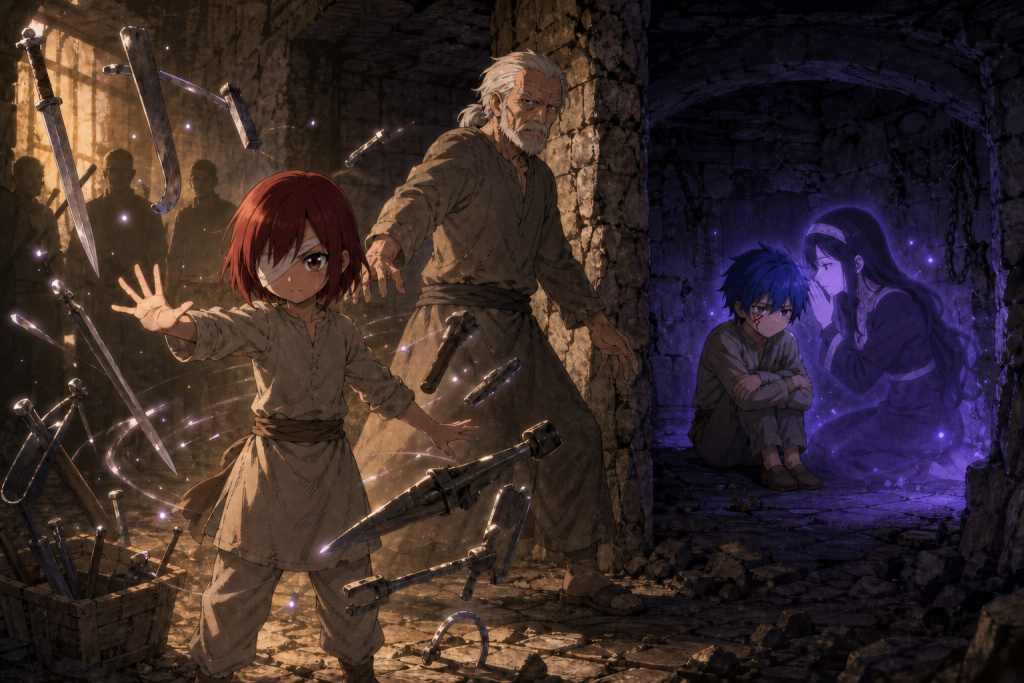
Bottom line: Episode 35 shows two children reaching for freedom at the same time. Erza turns grief over Rob’s death into her first great act of magic and leads the revolt. Jellal, isolated under torture, hears Ultear pose as Zeref’s spirit and redirect his rage into a new prison. One child learns power can break chains. The other is taught that freedom means controlling everybody else.
That manipulation explains Jellal’s turn. It does not make the people he later harms imaginary.
The receipt box
- Episode: 35
- English title: Voice of Darkness
- Japanese title: 闇の声
- Romanization: Yami no Koe
- Original Japanese air date: June 28, 2010
- Series: Fairy Tail (2009–2013)
- Episode type: Manga canon
- Manga material: Chapters 81–83
- Arc: Tower of Heaven
- Opening: “Ft.” by Funkist
- Ending: “Gomen ne, Watashi.” by Shiho Nanba
- Where to watch: Watch Voice of Darkness on Crunchyroll
The revolt does not begin because fear disappears
Erza and the other prisoners rise against the tower guards while Jellal remains captive. The workers are frightened, injured, and accustomed to punishment. Resistance does not make those conditions vanish.
Erza asks them to keep fighting and rescue Jellal. Many run when the Magic Troops attack. That response is not proof they lack character. Enslaved people do not owe an audience picturesque courage. Survival under organized violence produces different choices in different moments.
Erza keeps moving because Jellal previously gave her language for resistance. She carries his belief that they should fight rather than accept the tower’s rule.
That is the first tragedy of the episode. The idea that helps Erza free herself is being twisted inside the room where Jellal is held.
Rob's protection costs his life
Rob steps between Erza and the guards, uses his remaining Fire Magic, and dies protecting her. The scene reveals that he once belonged to Fairy Tail and taught Erza that magic comes from the heart.
He also listened to her dream of becoming a wizard who could fly freely and told her she could make it real.
Rob’s death should not be framed as a useful sacrifice that manufactures Erza’s strength. He deserved to survive the revolt. Erza did not need to lose another caregiver in order to qualify for magic.
His choice matters because he treats her future as valuable when the tower treats every child as material. He spends his last power protecting the possibility that Erza can become more than a worker inside somebody else’s resurrection plan.
The series often turns protective sacrifice into a heroic shortcut. Here, consequence remains visible. Rob’s death becomes part of Erza’s grief, guild connection, and habit of placing her own body between danger and other people.
She inherits his care and his dangerous willingness to disappear for someone else.
Erza's first magic is grief finding structure
After Rob dies, Erza calls surrounding weapons and metal objects into motion. This awakening anticipates the Requip and sword control that later define her as Titania.
The magic is not random spectacle. Erza has spent years surrounded by tools, chains, weapons, and construction material controlled by guards. In this moment, the objects stop belonging only to the institution.
She directs them.
That reversal explains why Erza’s adult magic centers choice and inventory. Requip lets her decide which armor appears, which weapon enters her hand, and how her body meets danger. The child who had no control over clothing, labor, movement, or punishment develops a system based on immediate selection.
Symbolism does not replace mechanics. Her magic power awakens under extreme emotion, and she manipulates multiple weapons against the troops. The later spell ledger will grow far beyond this scene. The creative meaning starts here: Erza turns the tower’s material language against its owners.
“Magic comes from the heart” is not sentimental fluff
Rob’s teaching can sound like standard fantasy encouragement. Episode 35 gives it a harder meaning.
The heart is not merely where good feelings live. It holds anger, grief, memory, desire, and will. Erza’s magic emerges from a heart under unbearable pressure.
That makes power ethically conditional rather than automatically pure. If magic comes from the heart, then the condition of the heart matters. Erza’s grief produces resistance. Jellal’s rage is cultivated into domination.
Both children have real pain. The difference is not that one feels the correct emotion. The difference is how people around them shape what the emotion is allowed to become.
Rob connects Erza’s pain to freedom and protection. Ultear connects Jellal’s pain to hatred and control.
Mentorship is creative direction with consequences.
Ultear enters through isolation
Jellal has been tortured and separated from the others. Ultear appears as a magical projection while posing as the spirit or voice of Zeref. She tells him Zeref is not gone and encourages him to surrender to hatred.
This is targeted manipulation. She does not invent Jellal’s rage. The guards supplied plenty. She gives that rage a cosmology, a mission, and a false source of authority.
The distinction matters. Saying “Ultear made him evil” is too neat. Jellal is a child under torture whose judgment is being deliberately destabilized. Saying “Jellal simply chose evil” ignores coercion and the unknown spell affecting his heart.
The episode describes Ultear gaining control over him through words and magic. That establishes diminished agency. It does not yet give viewers a meter showing which later action contains what percentage of control.
Accountability has to remain evidence-specific. Manipulation explains the turn. Later conduct still has victims. Future episodes and arcs must decide what repair looks like without pretending either fact cancels the other.
The false voice gives hatred a sacred costume
Ultear does not approach Jellal as an ordinary adult recruiting a vulnerable child. She borrows Zeref’s name and presents hatred as revelation.
That move repeats the Tower of Heaven’s larger ideology. The cult calls forced labor a path to resurrection and paradise. Ultear calls revenge a route to freedom.
Sacred language makes domination feel larger than personal appetite. If Jellal believes he serves a transcendent power, then controlling other prisoners can look like a necessary step instead of a betrayal.
This is why creator intent and character belief must stay separate. Jellal believes the voice represents Zeref. The episode shows viewers Ultear. The lie is part of the text, not a fan theory.
Later claims about Zeref’s actual presence or wishes cannot be backfilled into this scene. Ultear is using his reputation.
Jellal kills the guards and rebuilds the prison
When Erza reaches him, Jellal kills the guards who tortured him. He then refuses to leave and declares that the R-System must be completed to revive Zeref. He offers Erza a place beside him. When she refuses, he expels her and threatens the others if she tells anyone or returns.
The abused child becomes the tower’s new ruler.
That does not mean abuse naturally creates abusers. Most survivors do not reproduce the harm done to them. Jellal’s turn requires active manipulation, magical influence, isolation, and a system already designed for control.
Still, the structural repetition is exact. The guards used captivity and threat to force labor. Jellal keeps the remaining prisoners through captivity and threat to finish the same project.
He changes the story around the chains. He does not remove the chains.
That is why calling the tower his “paradise” deserves contempt. Freedom for the ruler is not freedom.
Erza is expelled with a threat, not rescued
Jellal sends Erza away and warns that he will kill the others if she exposes the tower or comes back. She wakes on a beach alone.
This is not a successful escape in any complete sense. Erza’s body leaves the site while her choices remain controlled by hostage threat. She carries responsibility for people she cannot reach and silence she did not freely choose.
That coercion explains why she stays away and why Sho later believes Jellal’s lie that she destroyed the escape ships and abandoned them.
Erza did not simply fail to return. She was told returning would kill everyone.
Her later guilt remains emotionally real because survivors often judge themselves using information and power they did not have. The factual ledger matters precisely because guilt is a poor historian.
Sho hears two stories and has to choose how to think
In the present, Sho enters after hearing Erza’s account. He has spent years believing Jellal’s version: Erza sabotaged the escape and left them behind.
Simon reveals that he suspected or knew Jellal was lying. He intentionally left space for Fairy Tail’s team to follow because defeating Jellal would require stronger mages.
Sho’s shock is not resolved by one comforting sentence. He has to reconsider childhood memory, adult loyalty, his kidnapping of Erza, and the ruler who gave his pain a target.
Erza comforts him and apologizes for not returning. Her compassion makes sense. Her apology should not be mistaken for confirmation that Jellal’s accusation was true.
She can regret the outcome without accepting false blame.
That distinction is one of the Editorial Bible’s recurring accountability rules for a reason. Feelings are evidence of experience, not automatic proof of causation.
Simon's knowledge creates its own accountability question
Simon believed Erza and allowed the rescue team to follow. That helps correct Jellal’s plan. It also means he participated in an abduction strategy while withholding what he knew from Sho, Wally, and Millianna.
His caution may be understandable. Openly challenging Jellal or the group’s shared belief could have endangered him and ended any chance of rescue. The plan still uses Erza and her team as pieces.
The story should resist dividing the childhood group into one wise believer and three foolish followers. Simon has better information, but he also makes unilateral choices.
Trust damaged by manipulation is not repaired by a new secret plan, even when that plan points toward the right enemy.
Etherion moves one vote closer
The Magic Council continues debating Etherion. Another vote supports firing, leaving only one more approval needed.
Council members acknowledge that authorizing the weapon will destroy the current Council as an institution. That sounds like accountability until we notice the order: first kill everyone in the tower, then accept political consequences.
Resignation after mass death is not prevention.
The Council’s urgency is real. The R-System could revive an extraordinarily dangerous mage. Jellal is inviting conflict and controlling the site. None of that removes the obligation to distinguish targets from captives.
The Council treats uncertainty as a reason for larger force. Ethical leadership treats uncertainty as a reason for better information.
Natsu puts on a cat helmet because the show refuses one mood
While searching for Happy, Natsu finds a cat helmet, puts it on, and cannot remove it. Wally appears with his Polygon Rifle.
The gag is absurdly placed and very Fairy Tail. It interrupts an episode about child slavery, death, manipulation, and a pending magical strike.
Does it work? Mostly. Natsu’s physical comedy belongs to the present rescue plot and does not mock Erza’s testimony. The sudden tonal shift reminds us the team is still moving through an active tower rather than sitting inside a prestige-drama confession chamber.
The risk is emotional whiplash. Comedy cannot be used to rush viewers past Rob’s death or Jellal’s coercion. Here, the episode gives those scenes enough room first.
Happy is still missing. The stupid helmet does not make the rescue less urgent. It makes Natsu look like the specific idiot who will conduct it.
Adaptation and direction
Episode 35 adapts Chapters 81–83. The anime can contrast warm light around Erza’s awakening with colder violet imagery around Ultear’s manipulation. That visual division is useful because the episode presents two uses of inner pain without claiming they are morally identical.
Rob’s death requires restraint. The meaning lies in protection, teaching, and Erza’s response, not in graphic injury. Jellal’s torture also requires a boundary. Viewers need to understand coercion. The production does not need to aestheticize a child’s suffering to prove it happened.
The strongest direction keeps Ultear’s false presentation legible. She is not literally Zeref’s spirit. The audience should see the manipulation even while Jellal cannot.
The episode also shifts from flashback to present testimony. Erza remains the narrator of her own history. That frame protects some agency inside a story about control.
RaeRae's verdict
Episode 35 refuses a simple origin story.
Erza does not become strong because suffering was good for her. Rob protects her, teaches her, and dies. She turns grief into action because the revolt still needs a leader.
Jellal does not become dangerous because tortured children naturally become monsters. Ultear finds him isolated, borrows Zeref’s authority, and directs real rage toward control. Then Jellal reproduces the tower’s system and threatens the people Erza loves.
Manipulation is part of the accountability record. So are the consequences.
Erza survives with a lie wrapped around her freedom. Sho grows up inside that lie. Simon quietly doubts it. The Council prepares to solve everything with Etherion because apparently nuance is harder to fund than a magical death beam.
The voice in the darkness belongs to Ultear. The choices it shapes will take much longer to untangle.
Continue the watch
- Previous: Fairy Tail Episode 34 React: Jellal
- Next: Fairy Tail Episode 36 React: Heaven’s Game
- Browse every Fairy Tail episode
- Open the Fairy Tail Episode Reacts hub
- Return to the Fairy Tail hub
Sources
- Crunchyroll: Fairy Tail Episode 35, “Voice of Darkness”
- Fairy Tail manga, Chapters 81–83 by Hiro Mashima