
Fairy Tail Episode 25 React: A Flower Blooms in the Rain
Elfman proves trauma is history, while Juvia discovers the weather around her is not destiny.
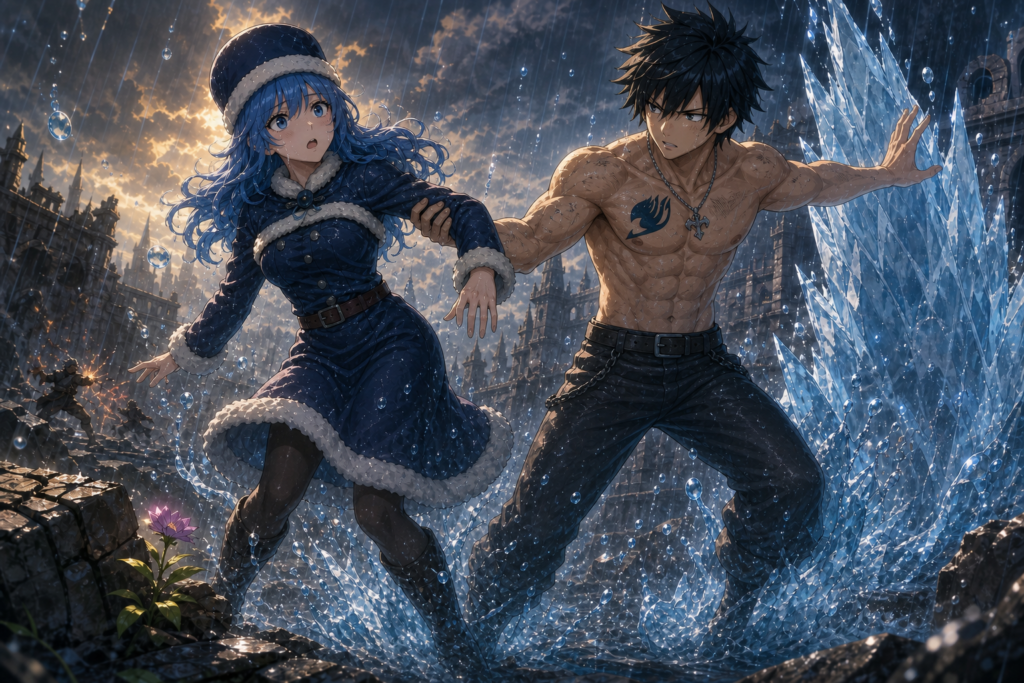
Bottom line: Episode 25 lets Elfman use Full-Body Take Over without repeating Lisanna’s death, then gives Gray a battle with Juvia that changes the weather around her. Sol insists trauma is destiny. Elfman proves it is history. Juvia has spent her life believing the rain she carries makes closeness impossible. Gray does not cure her with romance. He defeats an opponent and becomes the first interruption in a story she thought could never change.
The receipt box
- Episode: 25
- English title: A Flower Blooms in the Rain
- Japanese title: 雨の中に咲く華
- Romanized title: Ame no Naka ni Saku Hana
- Original Japanese air date: April 12, 2010
- Series: Fairy Tail (2009–2013)
- Episode type: Manga canon
- Manga material: Chapters 56–57 and Chapter 58 through page 6
- Arc: Phantom Lord
- Where to watch: Watch A Flower Blooms in the Rain on Crunchyroll
- Spoiler boundary: This React discusses events through Episode 25 only.
Elfman uses the power he feared without pretending fear vanished
Sol pushes Elfman toward the memory of losing control during Full-Body Take Over. Mirajane is captive. Abyss Break is forming. The present recreates enough of the old danger to make paralysis feel responsible.
Elfman transforms anyway.
The choice is not proof that trauma has been conquered forever. It is proof that fear can coexist with a different action.
He has more experience now, clearer stakes, and people who trust him. Full-Body Take Over is not identical to the event in his memory simply because it uses the same magic.
Avoidance protected him from one kind of risk while freezing his growth. This battle forces him to practice control under conditions where refusing power also endangers someone he loves.
Sol wants confession to function as surrender
Sol repeatedly invokes Lisanna because Elfman’s guilt does half the restraining work.
He does not seek accountability or truth. He seeks compliance.
This is the difference between naming harm and weaponizing shame. Honest accountability asks what happened, who was affected, what repair is possible, and how future choices change. Shame says the person is permanently identical to the worst outcome.
Sol needs Elfman to believe transformation always ends with a sister hurt because then Mirajane remains an unbeatable hostage.
Elfman breaks that logic by acting carefully in the present rather than winning an argument about the past.
Full-Body Take Over becomes integration instead of possession
Take Over magic asks the user to inhabit traits associated with another form. For Elfman, the danger is losing the boundary between access and control.
His successful transformation shows a more integrated relationship with power. He does not deny the beast. He does not let the beast erase judgment.
That balance mirrors Episode 19’s body-swap lesson. Access to a body or ability is not mastery. Mastery requires coordination among intention, knowledge, emotion, and physical capacity.
Elfman becomes stronger when he stops treating the powerful part of himself as either total identity or forbidden contamination.
Mirajane's trust matters more than Sol's accusation
Sol narrates Elfman as a danger to his sisters. Mirajane’s presence carries another record.
She knows the grief they share. She also knows the years Elfman has spent living after it. Her trust does not erase what happened to Lisanna, but it refuses Sol’s claim that the accident removed Elfman’s right to protect anyone ever again.
Survivors of family trauma need people who can remember the event without making it the only evidence.
Mirajane is not useful merely because her faith inspires a male fighter. She is a witness with standing inside the history Sol is exploiting.
Her understanding has more moral authority than his taunt.
Defeating Sol weakens a system, not only an opponent
Elfman’s victory reduces the elemental power feeding Abyss Break.
The fight therefore operates on two scales. He frees himself from Sol’s psychological trap and removes one component from Phantom Lord’s institutional weapon.
Personal healing and collective protection meet without becoming identical. Elfman does not transform for therapy. He transforms because people are in immediate danger. The action still gives him new evidence about what he can survive and control.
Growth often arrives while doing necessary work, not in a perfectly protected room.
That does not mean people should need a war to heal. It means crisis can reveal capacities shame kept hidden.
Juvia arrives carrying weather everybody treats as personality
Juvia’s rain follows her. People have responded to that rain as though it proves something undesirable about the person beneath it.
Persistent weather becomes social stigma. Others experience inconvenience and decide Juvia is the inconvenience.
Over time, she internalizes the judgment. Isolation appears natural because the rain appears constant. If every relationship ends under the same clouds, perhaps she is the condition making connection impossible.
This is how stigma works. A visible trait becomes a complete explanation for rejection, and repeated rejection trains the person to anticipate it before anybody speaks.
Gray is the worst possible elemental matchup and the most useful interruption
Gray’s ice interacts directly with Juvia’s water. The battle is technically suited to both characters and emotionally suited to neither.
Juvia expects opposition. Gray provides it. What changes her response is not that he refuses to fight, but that his attention does not treat her existence as contamination.
He sees a dangerous Phantom Lord mage and responds to her choices in the battle. That is more respectful than false gentleness based on pity.
Being held accountable as an equal can feel radically different from being rejected as a condition.
Gray does not need to romanticize Juvia to recognize her personhood.
The rain stopping is relief, not a marriage contract
After Juvia is defeated, the weather clears.
For someone whose life has been organized beneath constant rain, seeing blue sky is profound. Gray becomes associated with that interruption.
Association is not consent to a romance.
Juvia’s sudden attachment is understandable as emotional intensity. It should not become permission to ignore Gray’s boundaries or convert every neutral interaction into destiny. A first experience of relief can feel like love because both expand the imaginable future.
The ethical next step is not possession. It is learning who the other person is outside the crisis.
The flower can bloom without wrapping itself around the nearest man.
Juvia has been taught to confuse being chosen with being cured
Repeated rejection makes acceptance feel medicinal. If one person wants Juvia, perhaps the rain, loneliness, and shame will all become bearable.
That places impossible responsibility on the relationship and dangerous pressure on the other person.
Gray cannot cure Juvia’s history by becoming the correct boyfriend. Juvia cannot secure belonging through intensity alone. She needs community, agency, and a self-concept broader than weather or romantic status.
The episode opens that possibility by changing the sky. Later storytelling must decide whether it lets her grow into it.
Gray's recent grief shapes how he meets hers
Gray has just returned from Galuna Island, where he confronted Ur’s sacrifice and his own willingness to die. He knows what it means to build identity around one permanent condition.
For him, the condition was guilt. For Juvia, it is rain and rejection.
The episode does not need Gray to deliver a therapeutic speech. His refusal to accept emotional permanence already exists in how he fights. He survived the story that said Iced Shell was his only responsible ending.
Juvia encounters someone who has just learned that a lifelong weather system can change.
That parallel gives their meeting more substance than elemental attraction.
Natsu confronts another specialist while the larger spell continues
Natsu moves through Phantom Mk II toward the remaining Element 4 threats. The fights keep him from treating destruction of Jupiter as the end of his work.
His task is now connected to Mirajane’s analysis. Every elemental mage defeated slows Abyss Break.
That connection matters because Natsu’s battles can otherwise feel like isolated showcases. Here, each result changes a shared system outside the room.
The guild’s distributed plan is working. Elfman and Gray do not need Natsu to rescue them from their opponents. Natsu does not need to defeat every enemy personally for his loyalty to count.
Lucy remains vulnerable while everyone focuses on the giant threat
Fairy Tail places Lucy in a safehouse because Phantom Lord’s contract targets her. Gajeel still reaches her despite Loke’s effort to prevent it.
This is the cruel arithmetic of layered attacks. Phantom Mk II and Abyss Break consume attention while a smaller team continues the original abduction objective.
Large visible threats can function as cover for targeted violence.
Lucy is not unsafe because the guild does not care. She is unsafe because Jose controls multiple fronts and has already weakened leadership.
Protection plans must account for the possibility that the obvious emergency is also a diversion.
Loke's failure is not evidence that Lucy was unworthy of protection
Loke tries to reach Lucy and cannot prevent Gajeel from taking her.
Failure under overwhelming conditions is painful. It should not be rewritten as indifference or personal moral collapse.
Loke’s hidden circumstances make his capacity unstable, but Episode 25 does not yet give Lucy the full explanation. What she can know is that someone tried and the attacker still succeeded.
Communities need redundancy precisely because one protector can be delayed, injured, deceived, or overwhelmed.
Lucy deserves a system, not a single bodyguard whose success determines whether everyone cared enough.
Gajeel uses the safehouse attack to restore Phantom Lord's leverage
Gajeel already demonstrated that he uses targeted bodies as messages. Taking Lucy while the main battle rages continues that method.
He is not only completing a contract. He is giving Jose control over Fairy Tail’s priorities.
Once Lucy is captive again, every member has to weigh the mass threat of Abyss Break against immediate harm to one person. Jose benefits from forcing that choice.
The ethical answer is not to declare one scale more important by default. It is to maintain enough coordination that the guild can address both.
That is why defeating the Element 4 and preserving rescue capacity are part of the same fight.
The flower image belongs to Juvia, not to Gray's ownership
The title describes a flower blooming in rain. Juvia is the flower.
Gray may be part of the change in conditions, but blooming is her action. The metaphor should preserve that agency.
A flower responds to light, water, soil, time, and its own living structure. It does not become the property of the first person who notices it.
Juvia’s future can include affection for Gray. It also needs friendships, ethical accountability for her role in Phantom Lord, and choices unrelated to romance.
The sky clearing gives her space. What she grows there must remain hers.
Adaptation notes
Episode 25 adapts Chapters 56 and 57 and the opening of Chapter 58. It resolves Elfman’s battle with Sol, centers Gray’s fight with Juvia, and continues the threat against Lucy.
The parallel structure links three kinds of captivity. Elfman is trapped by shame, Juvia by a social story about her rain, and Lucy by Phantom Lord’s renewed physical control.
Not all three can be solved through the same method. Elfman acts through feared power. Juvia experiences a break in emotional weather. Lucy still needs direct rescue.
The episode’s strength is allowing different vulnerabilities to remain different.
RaeRae's verdict
Episode 25 lets two people discover that repetition is not destiny.
Elfman uses Full-Body Take Over and does not lose Mirajane. Sol’s story about him fails because the present produces new evidence. Juvia fights Gray beneath the rain she believes has defined every relationship. The sky clears, and a future she never expected becomes imaginable.
I am not signing a romance license because one man caused a weather event. Juvia’s relief is real. Gray’s boundaries are also real.
Meanwhile, Gajeel reaches Lucy while the guild’s attention is divided. The giant spell and the targeted kidnapping are not separate threats. They are Jose’s strategy at different scales.
A flower blooms in the rain. Fairy Tail still has to keep Phantom Lord from cutting it down and calling that a contract.
Continue the watch
- Previous: Fairy Tail Episode 24 React: So No One Sees the Tears
- Next: Fairy Tail Episode 26 React: Wings of Flame
- Browse every Fairy Tail episode
- Open the Fairy Tail Episode Reacts hub
- Return to the Fairy Tail hub
Sources
- Crunchyroll: Fairy Tail Episode 25, “A Flower Blooms in the Rain”
- Fairy Tail manga, Chapters 56–58 by Hiro Mashima