
Fairy Tail Episode 24 React: So No One Sees the Tears
Jupiter falls, Phantom Mk II rises, and Sol tries to reduce Elfman's whole life to Lisanna's death.
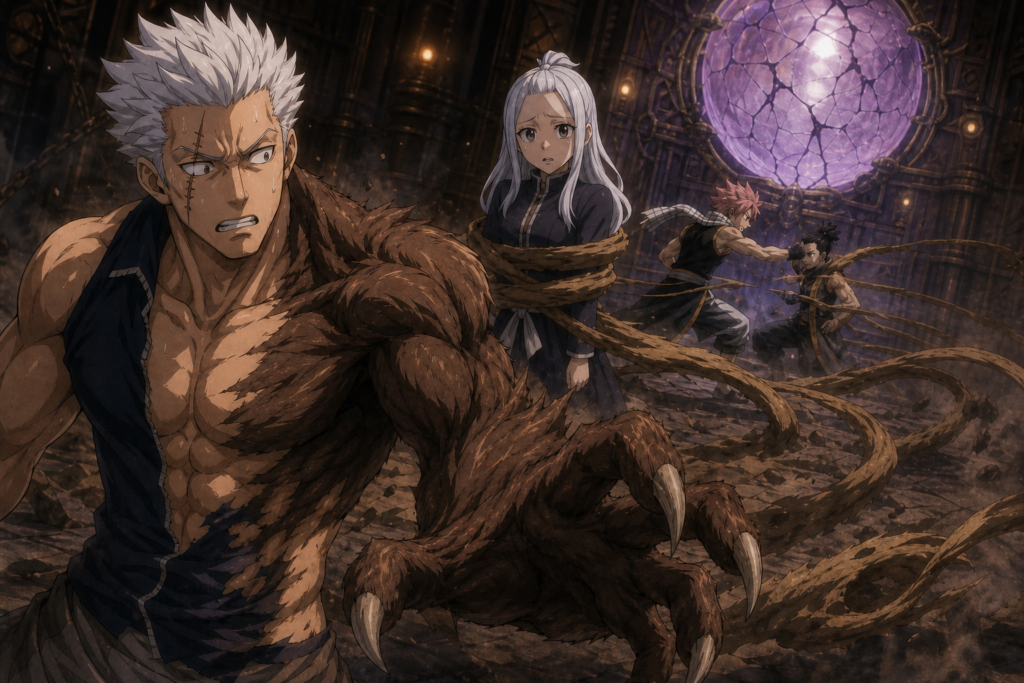
Bottom line: Episode 24 destroys Jupiter and immediately reveals that the cannon was only Phantom Lord’s first system. The guild transforms into Phantom Mk II and begins casting Abyss Break. Natsu, Gray, and Elfman split up because the spell is powered by the Element 4. Elfman meets Sol, who does not attack only his body. Sol weaponizes Lisanna’s death and Mirajane’s capture, forcing Elfman to fight the story that he is the worst thing he ever did.
The receipt box
- Episode: 24
- English title: So No One Sees the Tears
- Alternate dub title: To Keep from Seeing Those Tears
- Japanese title: その涙を見ない為に
- Romanized title: Sono Namida o Minai Tame ni
- Original Japanese air date: March 29, 2010
- Series: Fairy Tail (2009–2013)
- Episode type: Manga canon
- Manga material: Chapter 53 from page 8, Chapter 54, and Chapter 55
- Arc: Phantom Lord
- Where to watch: Watch So No One Sees the Tears on Crunchyroll
- Spoiler boundary: This React discusses events through Episode 24 only.
Destroying one weapon does not dismantle the institution
Natsu reaches Jupiter, fights Totomaru, and destroys the cannon’s lacrima. The immediate fifteen-minute deadline ends.
Then Phantom Lord changes form.
This is a useful correction to hero logic. Breaking the obvious weapon matters, but Jose built redundancy into the assault. The organization can lose Jupiter and continue toward mass destruction through Phantom Mk II and Abyss Break.
Natsu completed the assigned objective. The threat still evolves.
Success in one operation should not be confused with victory over the system that produced it.
Totomaru's control of fire challenges Natsu's assumed ownership
Totomaru manipulates fire, including flames Natsu normally treats as his natural element.
That ability disrupts Natsu’s confidence. Dragon Slayer Magic gives him unusual authority over fire, but it does not make every flame in the world his property. Another specialist can understand, redirect, or contaminate the element.
The fight is useful because it forces adaptation rather than a larger blast. Natsu tries deception, physical pressure, and the chaotic assistance of Gray and Elfman.
Power becomes interesting when an opponent can change its meaning.
Totomaru also reminds us that technical mastery is ethically neutral. Control can prevent fire from spreading or turn it into another institution’s weapon.
Help arrives without reducing Natsu's contribution
Gray and Elfman intervene in the fight with Totomaru. The encounter does not need to remain a pure one-on-one contest to count.
That is one of Fairy Tail’s better habits. A battle is not automatically dishonorable when friends stop watching and participate. The goal is to disable a cannon before it kills people, not preserve Natsu’s personal scorecard.
Individual pride matters less than the shared objective.
The guild’s opponents use coordinated institutional violence. Fairy Tail cannot answer effectively while pretending every hallway must contain a private tournament.
Phantom Mk II turns architecture into a body
The mobile guild transforms into a giant magical form and begins constructing the circle for Abyss Break.
The image makes Jose’s leadership philosophy physical. Phantom Lord is one enormous body directed toward his will. Members become power sources, the building becomes limbs, and the spell becomes institutional intention.
Fairy Tail’s strength comes from distributed relationships. Phantom Lord’s strength comes from concentration.
Concentration is efficient. It is also vulnerable if the people powering the structure can be separated from the master’s objective.
Mirajane identifies that vulnerability.
Mirajane reads the spell as a system
Mirajane realizes Abyss Break depends on the four elemental mages powering Phantom Lord’s giant form.
Her contribution is not a dramatic attack. It is diagnosis.
She identifies components, connects them to the casting rate, and gives the fighters an actionable plan: defeat the remaining Element 4 members.
This is expertise under pressure. The guild would waste precious time attacking the visible giant without understanding what sustains it.
Mirajane’s current noncombat role does not make her passive. Information changes the whole battlefield.
The team splits because one hero cannot be everywhere
Natsu, Gray, and Elfman take separate routes toward the remaining power sources.
Splitting up increases personal risk while reducing the time Abyss Break has to complete. It is a calculated trade, not the genre’s usual refusal to stay together for plot convenience.
Each fighter carries a different relationship to Fairy Tail’s current crisis. Natsu wants to protect Lucy and the guild. Gray is applying the lesson of Galuna by staying alive inside shared work. Elfman is entering a battle where Phantom Lord can reach his deepest family wound.
The plan depends on all of them, not only the strongest member.
Sol attacks identity before strength
Sol of the Element 4 uses earth magic, flexible movement, and psychological pressure. He learns what hurts Elfman and makes that pain part of the battlefield.
This is not incidental trash talk. Sol is trying to control Elfman’s decisions by narrowing his identity to one traumatic event.
Elfman believes he caused Lisanna’s death during a failed Full-Body Take Over. Sol repeats the accusation until shame becomes a restraint more effective than earth.
A person who sees himself as dangerous may stop using the very power needed to protect someone in the present.
Sol weaponizes accountability by removing every possibility of growth from it.
Elfman's guilt is not the same as responsibility
Elfman has reason to grieve what happened to Lisanna and examine his choices. That is responsibility.
Believing he is permanently unworthy of strength, family, or trust is guilt turned into identity.
The difference matters because responsibility can guide safer action. Shame only says the person himself is the hazard.
Sol wants Elfman trapped in the second state. If Elfman cannot imagine becoming different from the terrified boy in the memory, he cannot act effectively now.
Healing does not require denying harm. It requires refusing the claim that one harmful moment contains every future choice.
Mirajane's capture repeats the conditions of the old trauma
Sol uses Mirajane as leverage while invoking Lisanna.
Elfman is placed in a familiar structure: a sister is in danger, his power may save her, and losing control may hurt her. The battle does not merely remind him of trauma. It recreates its decision pressure.
This is why “just be brave” is inadequate. Elfman has to distinguish the present from the past while the enemy works to make them feel identical.
Mirajane is not Lisanna. Elfman is not the same child. His magic can be approached with knowledge earned since the accident.
The resemblance is real. It is not destiny.
“Manliness” has been Elfman's shield against grief
Elfman constantly talks about what a man should do. The language sounds comic and repetitive until the Lisanna story gives it an origin.
He built a rigid performance after an event that made him feel powerless and dangerous. If he can define courage loudly enough, perhaps nobody will see fear underneath it.
Sol sees the fear and tries to turn it into collapse.
The healthier path is not becoming more aggressively masculine. It is allowing courage to include fear, care, and help.
Elfman does not need to stop crying forever. He needs to stop treating tears as evidence that he cannot protect anyone.
The title is about preventing pain, not hiding emotion
“So No One Sees the Tears” can sound like an instruction to conceal grief. The episode works better as a statement of protective purpose.
Fairy Tail fights so the people it loves are not forced into preventable pain. That includes Lucy’s coercion, Erza’s injuries, Mirajane’s fear, and Elfman’s unresolved grief.
The danger is believing protection means nobody should ever witness tears. Tears can communicate harm and invite care. Hiding them isolates the person who most needs witnesses.
The goal should not be a guild where nobody cries. It should be a guild where nobody has to cry alone because an abuser made vulnerability unsafe.
Abyss Break turns the four elements into administrative violence
Abyss Break requires earth, fire, air, and water. The Element 4 supply the components while Phantom Mk II assembles the spell.
No single element carries the whole moral responsibility, but each contribution makes the final attack possible.
This is how harmful institutions distribute action. One person powers a system, another maintains it, another targets it, and leadership claims the result as strategy. Participants can tell themselves they handled only one piece.
Mirajane’s diagnosis reverses that distribution. If each component matters, interrupting any component matters too.
Shared responsibility creates shared vulnerability.
Natsu's destruction of Jupiter still matters
The appearance of Phantom Mk II could make the earlier mission feel pointless. It was not.
Jupiter would have fired again. Destroying it removed one mass-casualty path and forced Jose to reveal another system. The guild now understands more of Phantom Lord’s capacity.
Progress during crisis often looks like this. Stop one harm, discover the deeper structure, and keep moving.
Demanding that every successful action solve the entire problem is a reliable way to make necessary work look futile.
Natsu bought the guild a different battlefield. Erza’s sacrifice remains productive because the cannon she blocked will not fire again.
Mirajane is not merely a hostage
Sol captures Mirajane because Elfman cares about her and because her analysis threatens Phantom Lord’s plan.
That second reason matters. She is not selected only as somebody’s sister. Her knowledge has operational value.
Stories often transform competent women into hostages the moment a male character needs emotional motivation. Episode 24 risks that pattern. We should retain the evidence that Mirajane was already changing the fight before capture.
Elfman’s task is to free a person, not reclaim a symbol of his ability to protect women.
Mirajane’s agency should continue after rescue.
Phantom Lord uses trauma as intelligence
Sol’s knowledge of Lisanna suggests preparation. Phantom Lord does not attack Fairy Tail as an anonymous mass. Its members exploit specific histories.
This is a different kind of power from Jupiter. Artillery attacks the group from distance. Psychological intelligence enters a person’s private meaning and destabilizes action from inside.
Fairy Tail’s openness creates vulnerability. Members love publicly, argue publicly, and carry visible marks. Enemies can map those bonds.
The answer cannot be emotional secrecy. It must be a community strong enough that known wounds do not become solitary weak points.
Elfman needs the truth of what happened, the trust of his surviving family, and support using his magic safely.
Adaptation notes
Episode 24 adapts the latter portion of Chapter 53 and continues through Chapters 54 and 55. It closes the Jupiter objective, introduces Phantom Mk II and Abyss Break, and divides the counterattack among Natsu, Gray, and Elfman.
The episode shifts from a mechanical deadline to psychological conflict. The giant spell progresses outside while Sol slows Elfman by forcing him back into Lisanna’s death.
That parallel gives the title its weight. The visible threat is a magic circle. The quieter threat is shame convincing Elfman that action will only repeat harm.
RaeRae's verdict
Episode 24 proves Jose did not build one weapon. He built a guild that can keep becoming the next weapon.
Natsu destroys Jupiter. Phantom Lord transforms into Phantom Mk II. Mirajane identifies the Element 4 as Abyss Break’s power system. Natsu, Gray, and Elfman divide the work.
Then Sol does the cruelest thing in the episode: he takes Elfman’s real grief and edits out every year of growth after it.
Elfman does not need a speech claiming Lisanna’s death never happened. He needs the right to be more than the boy who lost control.
The guild cannot stop Abyss Break by hiding pain. It stops the spell when people use knowledge, accept help, and refuse to let Phantom Lord decide what their worst memories mean.
Continue the watch
- Previous: Fairy Tail Episode 23 React: 15 Minutes
- Next: Fairy Tail Episode 25 React: A Flower Blooms in the Rain
- Browse every Fairy Tail episode
- Open the Fairy Tail Episode Reacts hub
- Return to the Fairy Tail hub
Sources
- Crunchyroll: Fairy Tail Episode 24, “So No One Sees the Tears”
- Fairy Tail manga, Chapters 53–55 by Hiro Mashima