
Ebisu Returns
Naruto wants a spectacular teacher, Kakashi gives him a fundamentals specialist, and the boy discovers that raw chakra is not the same thing as usable skill. Then Jiraiya walks into the hot-spring lesson carrying talent, secrets, and absolutely no respect for privacy.
Naruto Episode 52 is the episode where the series finally says raw power is not a substitute for control, then admits Naruto’s control problem is not entirely his fault. Kakashi assigns Ebisu to prepare Naruto for the finals. Naruto hears rejection. Ebisu sees a student wasting chakra. Both readings are true enough to hurt.
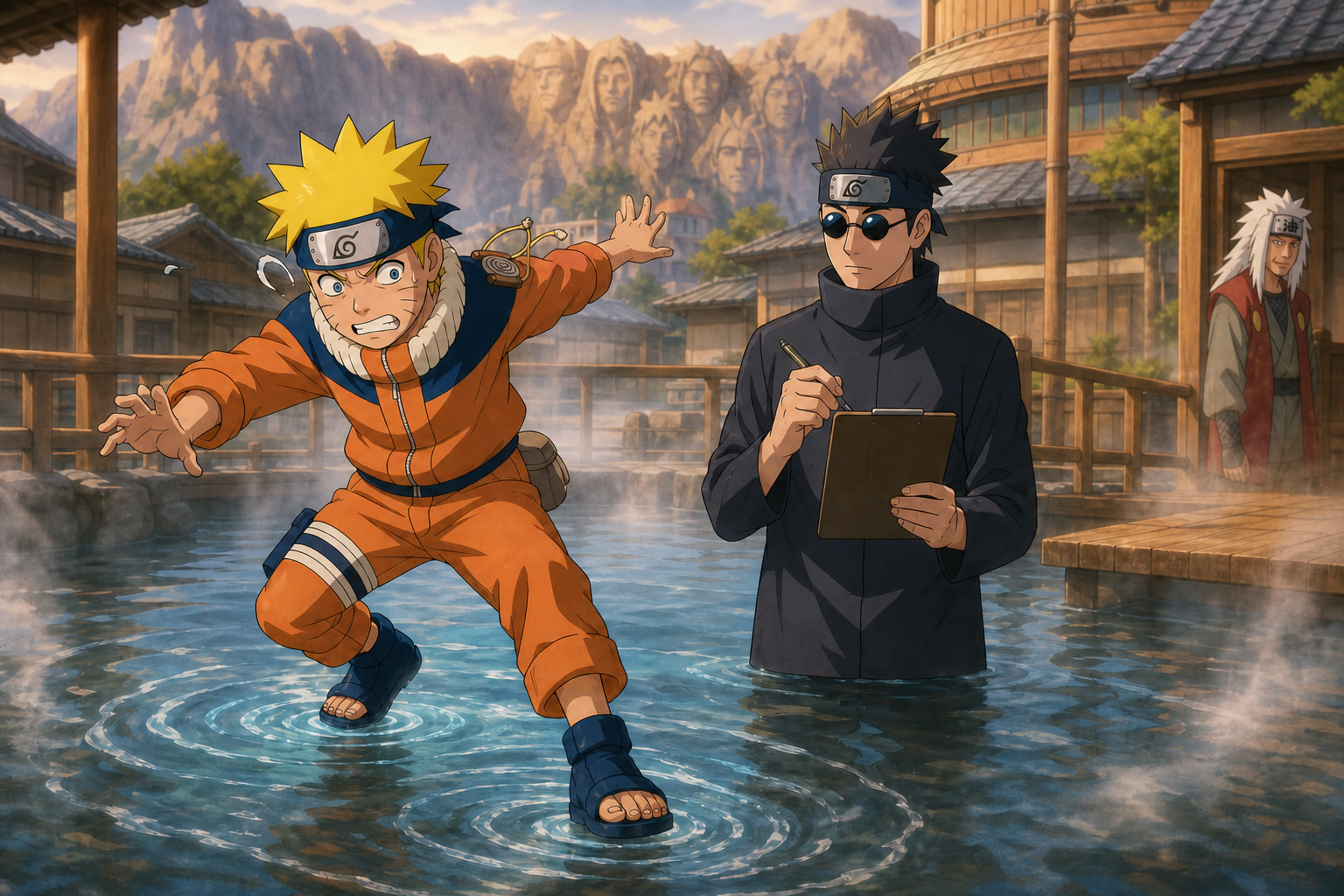
The water-walking lesson gives Naruto a practical test with immediate feedback. He cannot bluff the surface, overpower it, or shout until gravity respects his dream. He must release the correct amount of chakra from the soles of his feet and keep adjusting. When he improves quickly, Ebisu has to revise his prejudice. When Naruto still struggles more than expected, the story quietly preserves a bigger explanation for the stranger about to enter.
Naruto asks Kakashi for help and hears the oldest insult in his life
Naruto has one month before facing Neji. He wants Kakashi to train him because Kakashi is his team leader, understands the Sharingan, and just watched every preliminary match. Instead, Kakashi says he will focus on Sasuke and hands Naruto to Ebisu. On paper, this is sensible triage. Sasuke carries Orochimaru’s curse mark, has a dangerous finals matchup with Gaara, and remains a target inside the village.
Naruto does not experience that decision on paper. He experiences it as another adult choosing the talented Uchiha first. That reaction is not proof Kakashi hates him. It is evidence that years of neglect have trained Naruto to read reassignment as abandonment. A child who has survived by demanding recognition will not calmly translate “specialist referral” into “thoughtful educational planning.” He hears, “You are not worth my time.”
Kakashi could communicate more clearly, because adults do not get credit for good intentions they leave sealed in their own heads. Still, he chooses Ebisu for a reason. Naruto’s problem is not a shortage of courage or chakra. It is efficiency. The flashy student needs a teacher who respects fundamentals enough to make him practice them.
Ebisu arrives with baggage, expertise, and a face Naruto wants to punch
Ebisu is not a neutral choice. He previously judged Naruto through his reputation and treated him as a bad influence on Konohamaru. Naruto remembers that contempt. The return therefore asks both characters to work past evidence they collected when they were behaving badly.
Ebisu’s old prejudice does not erase his professional skill. He specializes in elite instruction, and the episode lets that title mean something concrete. He observes Naruto’s chakra use, compares input with output, and identifies waste. Naruto can produce enormous reserves, but he spends too much energy achieving results that more controlled shinobi reach with less.
That distinction matters far beyond one training montage. Shinobi work depends on endurance, judgment, and repeatable technique. If Naruto empties the tank every time he starts the engine, a long mission will punish him even when his first attack looks impressive. Ebisu is teaching survival math, not trying to shrink Naruto’s personality.
Chakra control is the difference between possessing power and directing it
The lesson breaks chakra use into a relationship between physical energy, spiritual energy, molding, and release. Naruto’s reserves are not a blank check. Every technique requires the correct mixture and a controlled route through the body. Too little release fails. Too much wastes energy and can destabilize the result.
This is why the episode’s educational material earns its time. The story is not pausing to recite a magic glossary. It is explaining why Sakura can outperform Naruto in control exercises while Naruto can overwhelm her in total reserve. Different measures describe different kinds of competence. Fandom power charts love one vertical number because one vertical number is easy. Naruto’s system keeps insisting that capacity, control, knowledge, timing, and matchup are not interchangeable.
Ebisu also names a social problem. Naruto’s poor classroom foundation did not appear from nowhere. He skipped lessons, acted out, and chased attention. The village also isolated him, hid the reason for that isolation, and expected ordinary academic discipline from a child carrying extraordinary stigma. Personal responsibility and institutional failure can occupy the same sentence. We do not have to throw one away to keep the other.
Water walking gives the lesson nowhere to hide
Tree climbing required a stable surface and a steady amount of chakra. Water changes beneath the body, so the student must keep adjusting. The exercise turns control into continuous attention. Naruto cannot find one successful setting and freeze it. He has to feel the surface, correct the release, and remain balanced while the environment moves.
The hot spring makes that work visually funny without making it meaningless. Naruto splashes, overcorrects, argues, and tries again. The comedy comes from his impatience meeting a surface that does not care how loudly he announces his determination. Water is a ruthless teacher. It does not respect protagonist status.
Ebisu watches Naruto begin to catch the technique faster than expected. That observation changes him. He does not cling to the old idea that Naruto is hopeless merely because admitting improvement would bruise his authority. A competent teacher revises the student model when the student supplies new evidence.
Ebisu’s best moment is changing his mind
Early Ebisu treated Naruto as a social contaminant around Konohamaru. Here, direct instruction forces him to see work ethic, adaptability, and unusual potential. Naruto is still rude. Ebisu is still stiff. Respect does not require either person to become pleasantly beige.
This is where the episode quietly repairs a relationship without pretending the original harm never happened. Ebisu’s expertise becomes useful to Naruto, and Naruto’s effort becomes undeniable to Ebisu. Reciprocity begins through labor. The teacher offers accurate guidance. The student takes the exercise seriously enough to make the guidance matter.
Confucian readings of the teacher-student relationship can help here if we keep them honest. Authority earns weight through responsibility, knowledge, and cultivated conduct, not through title alone. The student owes effort, but the teacher owes instruction fitted to the student in front of him. Ebisu becomes more worthy of respect when he stops protecting his judgment and starts serving Naruto’s growth.
Naruto’s progress exposes a problem Ebisu cannot yet diagnose
Naruto improves, but his chakra flow remains more difficult than the simple “careless student” explanation can cover. The audience already knows Orochimaru tampered with Naruto during the Forest of Death. Naruto does not. Ebisu can teach better control, but he does not have the information or specialized eye needed to identify every obstruction affecting the system.
That boundary protects Ebisu from the lazy “useless teacher” verdict. A specialist can be correct about the visible weakness and still miss a hidden intervention outside the available record. Medicine works this way. Engineering works this way. Teaching works this way. Diagnosis depends on both expertise and access to the relevant evidence.
The next mentor will not replace the value of this lesson. He will add information Ebisu lacks. Naruto’s development is built by multiple adults, not one magical father substitute who downloads competence into him during a dramatic sunset.
Jiraiya enters as a solution wrapped in a workplace complaint
The stranger at the hot spring is Jiraiya, one of the Legendary Sannin. He is also spying on women. The series introduces elite knowledge beside behavior that deserves side-eye, not a ceremonial excuse.
That contradiction becomes central to Jiraiya. He can understand seals, summon toads, gather intelligence, train dangerous students, and still violate boundaries for comedy. The story often wants charm to soften the second list. RaeRae does not have to cooperate. Skill does not erase conduct, and misconduct does not make the skill imaginary.
His arrival changes Naruto’s training path because he can see more than Ebisu can. It also changes the comic rhythm. Ebisu is formal authority. Jiraiya is anti-formal authority with greater institutional history than almost anyone in the room. Naruto will be drawn to the spectacular teacher, but Episode 52 has already shown why spectacle alone would not be enough.
The hot spring gag carries a real cultural boundary
Communal bathing and hot-spring settings have ordinary social and cultural roles in Japan; the setting itself is not the joke. The violation is spying across the gendered boundary. Flattening the entire sequence into “Japan is weird” confuses a recognizable place with the character choosing to behave badly inside it.
The anime uses embarrassment, pursuit, and exaggerated reaction to frame Jiraiya’s conduct as transgressive comedy. That framing explains the intended tone. It does not require every viewer to find the gag harmless. Adaptation analysis has to separate what a scene asks us to laugh at from whether the laughter still works.
For me, the useful part is the collision between reputation and behavior. Naruto meets a legendary man without the protective museum glass. Great shinobi are not automatically great people in every room. The series will keep returning to that gap because inherited authority is one of its favorite things to interrogate, even when its comedy gets cowardly.
Kakashi’s teaching decision looks better after the lesson
Kakashi knew Naruto needed control work. Ebisu proves him right. That does not make the emotional delivery perfect, but it does show the assignment was not a consolation prize. Kakashi matches Naruto with the instructor whose specialty addresses the immediate weakness.
He is also managing more crises than Team 7 can see. Sasuke’s curse mark, Orochimaru’s infiltration, the finals, and the threat around Gaara demand attention. Leadership under pressure often means distributing care rather than personally performing every task.
The danger is that distributed care can feel like abandonment when nobody explains the network. Naruto needs to learn that another teacher is not evidence that Kakashi has stopped being his teacher. Kakashi needs to learn that children with abandonment wounds do not infer security from an org chart.
Japanese performance credits without pretend criticism
Junko Takeuchi performs Naruto, Nobuo Tobita performs Ebisu, Kazuhiko Inoue performs Kakashi, and Hōchū Ōtsuka performs Jiraiya in the original Japanese anime. Those verified credits identify the central cast across the reassignment, lesson, and hot-spring interruption.
I am not inventing breath, pitch, timing, or vocal texture without a lawful Japanese-track rewatch. Names in a cast record are receipts, not scene criticism. The visible direction still gives us evidence to discuss: Naruto’s physical imbalance, Ebisu’s rigid observation, the shifting water, and the entrance that turns a controlled lesson into a collision with a much messier mentor.
Fandom misreadings that need correction
“Kakashi abandons Naruto for Sasuke.” Naruto feels abandoned, but Kakashi assigns a control specialist whose lesson directly addresses Naruto’s weakness.
“Ebisu is useless.” He correctly diagnoses inefficient chakra use, selects an advanced control exercise, and helps Naruto improve. He lacks the information needed to identify Orochimaru’s hidden interference.
“Naruto is bad at everything except having lots of chakra.” He adapts quickly once the task gives him useful feedback. Control is a trainable skill, not a moral verdict.
“Jiraiya being legendary makes the spying harmless.” Rank explains his access to knowledge. It does not grant permission to violate strangers’ privacy.
“This is only setup for the real teacher.” The episode establishes the technical foundation that makes the next diagnosis meaningful. Removing Ebisu turns growth into magic.
What Episode 52 changes
Naruto begins serious finals training with a clear technical target: reduce wasted chakra and sustain control on a moving surface. Ebisu sees enough progress to revise his opinion. Naruto receives evidence that he can learn fundamentals without becoming a different person.
Jiraiya’s arrival introduces the mentor equipped to recognize the deeper problem affecting Naruto’s chakra. The episode therefore bridges two kinds of teaching: careful correction based on visible performance and specialized diagnosis based on hidden structure.
Most importantly, Naruto’s path toward fighting Neji does not begin with a larger explosion. It begins with balance. The loudest child in Konoha has to learn that control is not surrendering power. It is finally making power answer to him.
Episode 52 works because it makes remedial training feel like character truth. Naruto’s inefficient chakra, Ebisu’s prejudice, Kakashi’s divided attention, and Jiraiya’s messy entrance all ask the same question: who gets to define what a student needs?
Ebisu earns his place by teaching the lesson in front of him and changing his mind when Naruto changes the evidence. Jiraiya arrives because another problem sits underneath that lesson. Naruto needs both. One gives him balance. The other will explain why somebody secretly tied a weight to his ankle.
Receipts and official routes
Episode number, licensed title and official synopsis: Naruto Official Site. Japanese title, synopsis and October 1, 2003 broadcast record: TV Tokyo. Licensed streaming route: Crunchyroll. Availability varies by region.