
The Ultimate Battle: Cha!
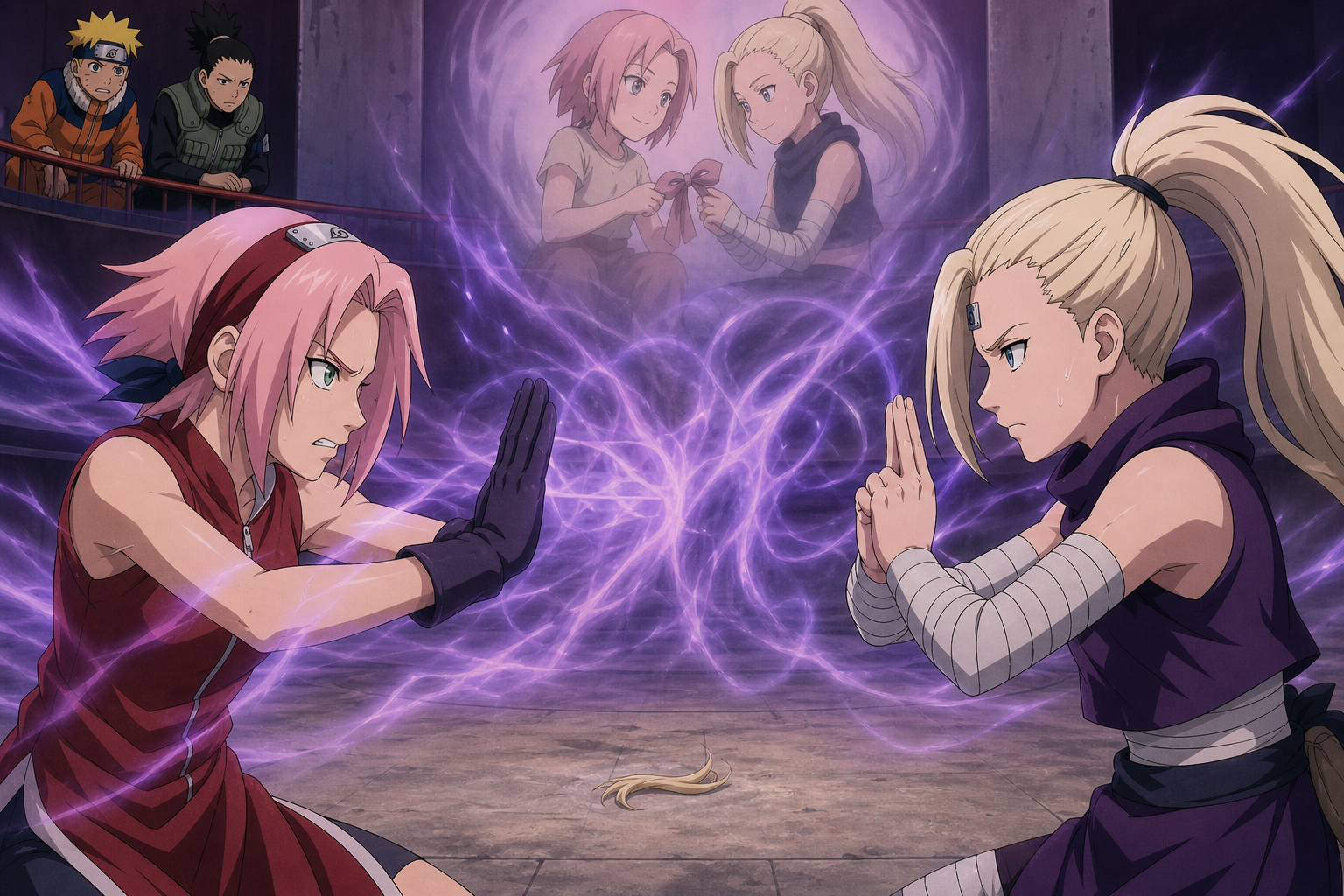
Ino cuts her hair, turns the discarded strands into a trap and reaches Sakura’s mind. Sakura answers with the loudest part of herself, because the girl Ino once helped stop hiding refuses to disappear inside anybody else.
Episode 42 makes Sakura and Ino equal by refusing to crown either girl the superior version of womanhood. Ino has the clan technique and the cleaner trap. Sakura has abnormal internal resistance and the endurance to drag herself back into the fight. Both land the final punch. Both fall. The draw is not the story avoiding a winner. It is the emotional answer to a rivalry built around who had to stand above whom.
And let me be very clear: the Mind Transfer sequence is not proof that Sakura has a cute second personality waiting to deliver a gag. “Inner Sakura” is the survival voice she developed while performing politeness outside. Ino once taught Sakura not to hide her forehead. Now that same buried force throws Ino out of Sakura’s body. The friendship helped build the resistance that defeats the friend’s technique. Messy, poetic and a little rude. Perfect.
The fight begins with years already in the room
Sakura Haruno and Ino Yamanaka step into the preliminary arena as candidates from different teams. They also enter as former childhood friends whose rivalry helped shape how each girl learned to see herself.
Sakura admired Ino’s confidence. Ino protected Sakura from bullies and gave her a ribbon. Sakura later returned that ribbon when she declared they would stand as rivals, especially after learning they both liked Sasuke.
The exam does not create their conflict. It gives the conflict a legal floor, a referee and an audience.
The opening exchange refuses a talent gap
The girls trade punches, blocks and movement without one immediately dominating. Their basic academy foundations look comparable because they trained in the same system and came from the same graduating class.
That equality frustrates viewers who want every matchup reduced to a stat hierarchy. The story has a different job. It needs both girls to confront the version of the other they carried from childhood.
A quick blowout would confirm an old role: Ino as the stronger rescuer or Sakura as the girl who finally surpassed her. An even exchange forces recognition instead.
Sakura has knowledge without a famous clan technique
Sakura enters the exams without an inherited combat system. She has strong chakra control, academic knowledge and determination, but no signature offensive jutsu comparable to the Yamanaka Mind Transfer.
That gap matters. The academy can teach common foundations, while clan families transmit specialized knowledge through private lineages. Students share a classroom without sharing equal access to technique.
Sakura therefore has to win through reading, timing and resistance. The match exposes the limits of her current training without reducing her to nothing.
Ino’s Mind Transfer is powerful because it is risky
The Mind Body Switch Technique sends Ino’s consciousness into a target and gives her control of that body. The technique can decide a match without physical overpowering.
Its limitations keep it from becoming an automatic win. The projected mind travels along a committed path, and a miss leaves Ino’s own body vulnerable while her consciousness returns. A moving target can evade it.
That is why Ino needs setup. Clan technique does not remove strategy. It gives strategy a sharper consequence.
Cutting her hair is not surrender
Ino cuts her ponytail during the fight. Sakura and the audience can read that action as emotional sacrifice or a dramatic answer to Sakura’s earlier haircut in the Forest of Death.
Ino uses the hair as material. Chakra placed through the strands helps create a restraint on the floor, limiting Sakura’s movement long enough to make the Mind Transfer viable.
The image matters because femininity becomes tactical without being mocked. Hair can carry beauty, identity, memory and battlefield function in the same scene.
Ino turns Sakura’s expectation into the trap
Sakura knows the Mind Transfer requires a target who cannot easily dodge. She believes movement protects her. Ino encourages that confidence, then changes the conditions under Sakura’s feet.
The cut hair looks discarded. It is actually part of the route to immobilization. Ino does not simply use her clan technique; she engineers the moment when its weakness stops mattering.
This is the best receipt for Ino’s intelligence in the match. She predicts what Sakura knows and uses that knowledge against her.
Taking Sakura’s body does not settle who Sakura is
Ino successfully enters Sakura and attempts to make her forfeit. On the surface, control of the mouth should decide the match. The referee needs a spoken surrender.
But bodily control and identity are not identical here. Sakura’s consciousness remains present enough to resist. The person inside the body is not erased because another mind reached the controls.
The scene extends the arc’s body-ownership argument. Orochimaru imposed a mark on Sasuke. Puppet users animate constructed bodies. Ino enters a living opponent through clan technique. Consent, agency and resistance decide the ethical texture of each case.
Inner Sakura is the self she trained to hide
“Inner Sakura” visualizes the aggressive, blunt and emotionally loud thoughts Sakura usually keeps behind a socially acceptable exterior. The gag exaggerates the split, but the underlying mechanism is recognizable.
Sakura learned to monitor how she looked and sounded because peers had already punished her appearance. Politeness became armor. Anger went somewhere else.
Inside the Mind Transfer, that repressed force becomes defense. Ino encounters a Sakura more crowded and stubborn than the visible presentation suggested.
Naruto’s voice gives Sakura an external anchor
Naruto calls out from the balcony. He cannot remove Ino’s mind or fight Sakura’s battle. His recognition reminds Sakura that somebody outside still expects her to answer as herself.
Naruto knows what it feels like to have another presence inside one body and to be defined by what that presence might do. The parallel is not mechanically exact, but his voice carries thematic weight.
Support works as an anchor, not a rescue. Sakura supplies the resistance. Naruto helps her find the direction.
Sakura ejects Ino through will, not a new bloodline
Sakura forces Ino out and regains control. The achievement surprises observers because ordinary resistance to the technique should be difficult.
The story attributes the break to Sakura’s unusually forceful inner self and determination. It does not reveal a secret inherited eye or retroactively give her a clan advantage.
That keeps the victory personal. The same emotional intensity Sakura has often used for comedy becomes a meaningful combat resource.
Both girls throw the final punch
After the mental contest, Sakura and Ino return to direct combat. Exhausted and angry, they strike at the same moment.
Both collapse. Neither advances. The draw preserves the exact equality the fight established through technique, endurance and relationship history.
A draw can feel evasive when a story fears commitment. Here it is commitment. The match refuses to make friendship legible only through hierarchy.
The draw changes what rivalry can mean
Sakura wanted to stop being beneath Ino. Ino wanted her earlier care to be recognized without becoming evidence that Sakura had outgrown her.
Ending together makes “equal” material. Neither girl receives the fantasy of proving she is the only worthy one.
That does not instantly repair the friendship. It creates a new fact the relationship must absorb: each can meet the other without disappearing.
Sasuke is almost irrelevant to the actual mechanics
The crush helped structure the rivalry, but Sasuke does not give Sakura her resistance or Ino her trap. He does not decide the draw.
When fandom reduces the episode to girls fighting over a boy, it repeats the exact flattening the match overcomes. The girls’ abilities, pride and shared history do the work.
Sasuke matters as a symbol around which competition formed. He is not the author of the people competing.
The episode exposes unequal access to shinobi capital
Ino arrives with a clan technique designed for intelligence and coordination work. Sakura arrives with common academy instruction and personal aptitude.
That is a form of inherited capital. Village institutions present candidates as individual merit while families transmit specialized tools before the test begins.
Sakura’s resistance is impressive partly because she answers a structural disadvantage without pretending the disadvantage never existed.
Gender changes the audience’s patience
Male rivals can spend entire arcs projecting family trauma through punches and still be treated as mythic. Sakura and Ino mention a crush, and some viewers dismiss every other layer.
The double standard turns female emotion into proof of triviality while male emotion becomes destiny. Episode 42 gives us technique mechanics, childhood harm, identity formation and a mutual knockout.
If that still reads like nothing, the issue may not be the fight.
Japanese performance lets the comedy become force
Chie Nakamura performs Sakura in the original Japanese anime. The “shānnarō” energy often attached to Inner Sakura begins as comic punctuation and becomes a sound of self-assertion under mental occupation.
Ryōka Yuzuki gives Ino confidence, tactical focus and genuine alarm when Sakura resists. The performance does not reduce Ino to a smug rival waiting for punishment.
Junko Takeuchi’s Naruto cuts through the mental struggle with direct belief. The ensemble lets a heightened anime device carry a sincere interpersonal function.
Direction turns memory into active pressure
Flashbacks to the ribbon and childhood friendship do not pause an unrelated fight. They explain why every present gesture lands harder.
Hair becomes a bridge between timelines. Ino once styled Sakura’s visibility with care. Now Ino cuts her own hair and uses it to control Sakura’s movement.
The match is choreographed through objects that already carry relationship meaning. That is economical storytelling with receipts.
A Confucian reading asks whether rivalry can cultivate
Friendship once helped Sakura develop confidence. Rivalry later pushed both girls to train and define themselves.
Confucian relational ethics values growth through roles and reciprocal recognition. The relationship fails when rivalry becomes a demand for one person’s inferiority. It becomes useful when each treats the other as worthy of full effort.
The draw can therefore be read as mutual acknowledgment rather than mutual failure.
A Buddhist lens loosens the need to be above
Sakura and Ino are attached to comparison. Each wants proof that she is no longer the weaker, needier or less desirable girl.
The match gives neither permanent possession of superiority. Both experience the limits of control and collapse together.
Equality does not erase desire or history. It interrupts the fantasy that winning another person’s inferiority would settle the self.
What Episode 42 changes
Ino demonstrates a tactical hair restraint and successfully lands the Mind Transfer. Sakura resists and expels her through unusual internal will, aided by Naruto’s external encouragement.
The girls exhaust their remaining strength and knock each other out simultaneously. Neither advances from the preliminary.
The rivalry now has material proof of equality. Their friendship remains complicated, but the old rescuer-and-rescued hierarchy no longer describes the whole relationship.
RaeRae’s verdict
Ino used her own haircut as battlefield infrastructure, entered Sakura’s mind and still found Sakura waiting inside like an angry tenant who knows the lease. That is not a throwaway girl fight.
The draw is correct. Neither one needed a crown. They needed the other to admit she had become impossible to dismiss.
Fandom misreadings I am rejecting
“They only fight over Sasuke.” The crush matters, but friendship, shame, dependence and equality carry the match.
“Ino’s technique failed because she is weak.” She engineered a successful hit; Sakura produced unusual resistance after possession.
“Inner Sakura is only a joke.” The comic device represents suppressed anger and becomes functional defense.
“Naruto saved Sakura.” His call anchors her. Sakura performs the mental resistance.
“A draw means nothing changed.” The old hierarchy becomes materially impossible to sustain.
“Hair makes the fight superficial.” Ino turns identity-coded material into a tactical restraint.
Receipts and official routes
Episode number, English title and official synopsis: Naruto Official Site. Japanese title and original broadcast record: TV Tokyo. Streaming availability varies by region; use the official options linked from the episode directory.