
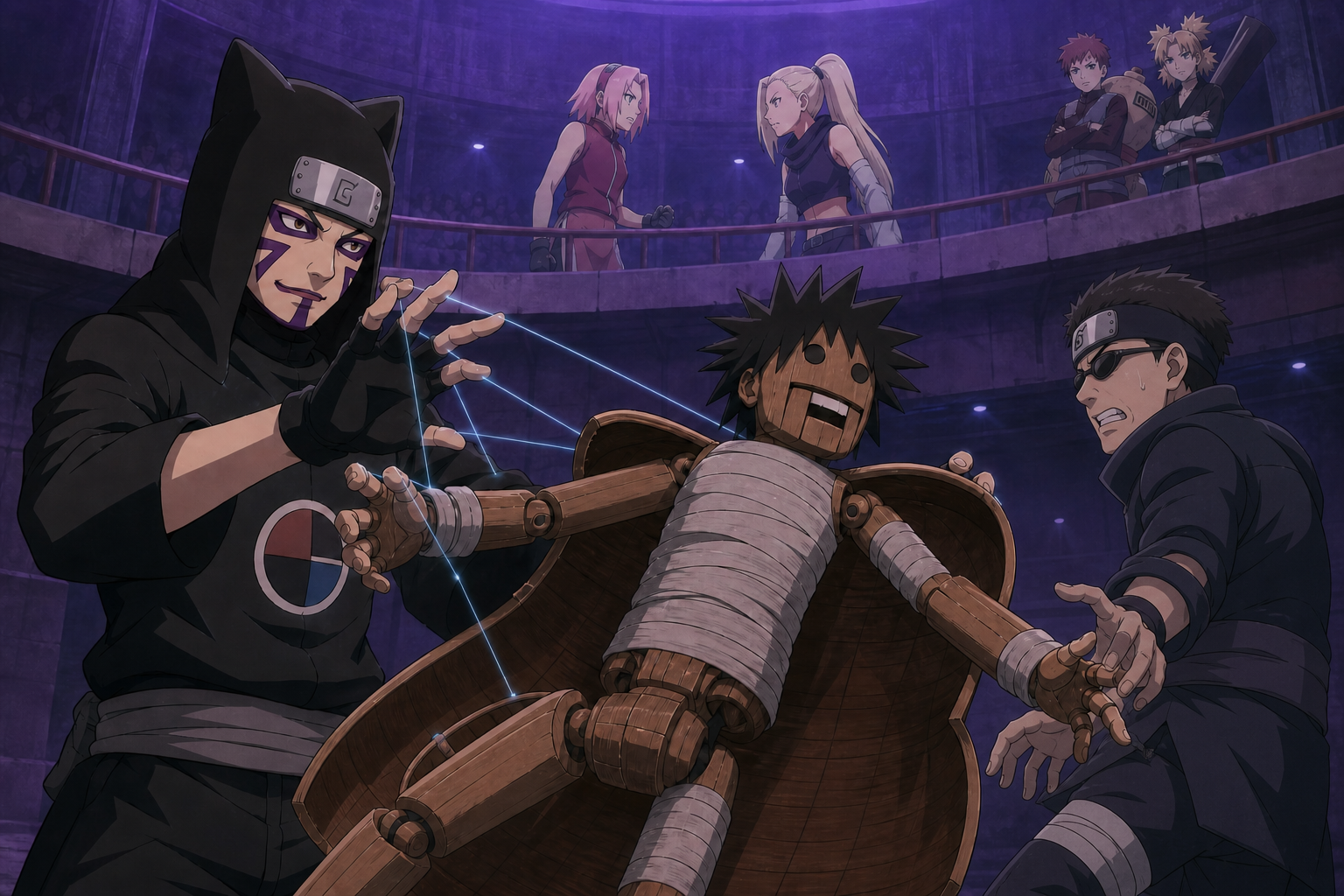
Kunoichi Rumble: The Rivals Get Serious!
Kankurō lets Misumi win against the wrong body, then introduces him to Crow. After the puppet lesson, Sakura and Ino step onto the floor carrying years of friendship, humiliation, gratitude and rivalry.
Episode 41 punishes anyone who confuses controlling a body with understanding the person inside it. Misumi wraps himself around what he thinks is Kankurō, only to discover he captured a puppet. Kankurō wins because he decides what counts as his exposed body and what counts as bait.
Then Sakura and Ino enter with a different body argument. Their rivalry grew around hair, beauty standards, bullying, friendship and Sasuke, but Sasuke is not the whole relationship. Ino once gave Sakura language for confidence. Sakura later turned equality into distance because gratitude felt too close to inferiority. This fight is two girls demanding to be recognized as full rivals, not two accessories competing for a boy-shaped coupon.
Shino closes the system he spent a match studying
The episode finishes the logic established in Episode 40. Zaku believes his arm cannons make direct force the only important question. Shino Aburame understands that force needs a pathway.
Once kikaichū obstruct the air outlets, pressure has nowhere safe to escape. Zaku’s own mechanism turns consequence inward. Shino does not overpower the blast after it launches. He prevents the infrastructure from functioning as intended.
That victory establishes the standard for the episode: information beats confidence when confidence never bothered to inspect its tools.
Kankurō enters carrying a body nobody should trust
Kankurō walks into the arena with the large wrapped object we have seen on his back. The audience knows it matters. Misumi does not know how.
Kankurō’s costume, face paint and covered bundle make concealment part of his combat identity. He does not advertise where his actual range begins or which silhouette is alive.
Puppet technique turns preparation into battlefield presence. The weapon is not a kunai drawn after the match begins. It is a second body Kankurō has already positioned inside the opponent’s assumptions.
Misumi’s flexibility is a real specialty
Misumi Tsurugi can loosen and dislocate joints to wrap his body around an opponent. The ability makes conventional grappling rules unreliable. He can approach from strange angles and bind limbs with more contact than an ordinary human frame permits.
That is dangerous because immobilization can end a fight without a long exchange. If Misumi secures the real body, raw striking power becomes less useful.
His mistake is not having a weird technique. His mistake is assuming successful contact proves correct identification.
He captures Kankurō and loses
Misumi wraps the apparent Kankurō and applies pressure. For a moment, the match reads as an efficient trap. Then the body changes meaning.
The captured figure is Crow, Kankurō’s puppet. Misumi committed his flexible body around wood, joints and hidden mechanisms while the real puppeteer maintained distance.
That reveal is satisfying because the earlier image was not false. Misumi truly caught what looked like Kankurō. The missing fact was that Kankurō controlled the look.
Crow makes bodily imitation into a weapon
Crow carries a humanoid shape with separable sections, hidden blades and mechanical joints. Its resemblance to a body is functional. Opponents read torso, head and limbs before they read compartments and hinges.
Kankurō’s chakra strings coordinate that artificial anatomy. The puppet can move with enough intention to attract attacks while keeping the controller outside immediate reach.
This is not simple remote control. A puppeteer needs fine chakra control, spatial awareness, timing and knowledge of every mechanism. The visible wood is only the physical half of the technique.
Kankurō wins through authorship of the scene
Misumi thinks he is deciding the fight by choosing when to grapple. Kankurō already decided which body would receive the grapple. That is control at a higher level.
He authors the opponent’s information. The wrapped bundle, substitution-like reveal and chakra strings turn the arena into a staged misunderstanding.
The victory also previews why puppet users become terrifying with preparation. Their attack may start before anyone recognizes the combat object.
Sand displays a different kind of military labor
Gaara advertises overwhelming force. Temari carries ranged wind control. Kankurō represents technical construction, hidden weapons and distance management.
Together, the Sand siblings show a village roster with complementary specialties. The Chūnin Exams function as military marketing, and Kankurō’s match demonstrates that Sunagakure can build more than one kind of threat.
His puppet also reflects an industry behind the fighter. Somebody designs mechanisms, selects materials, maintains joints and understands poisons. One candidate carries a chain of specialized knowledge onto the floor.
Misumi and Kankurō both manipulate bodies, but consent divides them
Misumi uses his own altered flexibility to seize another person’s body. Kankurō animates an object built to receive his control. The techniques may both look bodily, yet the ethical structures differ.
Crow has no independent will being overridden. Misumi’s target does. Orochimaru’s work elsewhere in the arc keeps that distinction hot because he treats living people like containers and components.
The series will complicate puppet bodies further, but Episode 41 already asks who controls movement and whether the controlled thing is a tool or a person.
The next board turns history into a matchup
The electronic display selects Sakura Haruno and Ino Yamanaka. To the bracket, they are two candidates. To each other, they are former friends who built parts of their identity in relation to the other.
Sakura carries the memory of being mocked for her forehead and of Ino interrupting that shame. Ino carries the memory of offering friendship and later being treated as a rival Sakura needed to defeat.
The match cannot start from zero because relationships do not obey bracket graphics.
Ino gave Sakura a ribbon and a social vocabulary
As children, Ino reached toward an isolated Sakura. She offered friendship, confidence and a ribbon that helped Sakura stop hiding behind her hair.
The gesture was not shallow fashion advice. Hair and presentation were where bullying had lodged itself. Ino helped Sakura change how she occupied visible space.
That makes their later rivalry hurt. The person who helped Sakura stand upright became the person Sakura felt she had to oppose to prove the confidence was truly hers.
Sakura confused equality with separation
Sakura eventually returned the ribbon and declared rivalry, especially once both girls liked Sasuke. The boy provided a clear contest, but the deeper issue was dependence.
Sakura did not want to remain “the girl Ino saved.” She wanted to stand beside Ino without feeling smaller. Instead of renegotiating the friendship, she used rivalry to create distance.
That choice is understandable and unfair. Growth sometimes includes pushing away the person whose help reminds us of an earlier self we are ashamed to remember.
Sasuke matters, but he is not the emotional whole
Both girls liked Sasuke, and the story absolutely uses that crush as part of their split. Pretending otherwise would be fake sophistication.
Reducing the entire relationship to a boy is equally lazy. Ino and Sakura care about how the other sees them, who stands ahead, who needed whom and whether friendship can survive equality.
Sasuke is the easiest object around which those questions organize. He is not the author of their childhood bond.
The label “kunoichi” does not make this lesser combat
The English title highlights a kunoichi rumble. Fandom sometimes hears that framing and prepares for a secondary “girl fight” while waiting for male characters to return.
Sakura and Ino are taking the same promotion exam under the same military institution. Their techniques, judgment and endurance will be evaluated for the same rank.
Gender shapes how viewers judge their motives and presentation. It does not turn the match into an extracurricular activity.
Beauty standards live inside ninja training too
Sakura’s forehead, Ino’s hair and the ribbon carry social meaning because child soldiers are still children inside a society. Training does not erase beauty standards, insecurity or gendered expectations.
The academy teaches jutsu while peer groups teach which faces and bodies receive approval. Ino once used style as care rather than punishment. She gave Sakura a way to resist hiding.
The same visual language later becomes rivalry. Hair and clothing are not proof that the girls lack serious goals. They are parts of identity the culture already taught them to read.
Direction lets one reveal hand the episode to another
Kankurō’s match uses concealment and sudden mechanical exposure. The episode then shifts toward emotional history that has also been concealed beneath public rivalry.
Crow opens to reveal construction. Sakura and Ino’s confrontation opens a relationship to reveal old care and old resentment.
The rhythms differ, but both ask the viewer to revise an easy first reading.
Japanese performance separates swagger from history
Yasuyuki Kase performs Kankurō in the original Japanese anime with confidence suited to someone who knows the opponent grabbed the wrong body. Kunihiro Kawamoto gives Misumi urgency that turns to alarm when control reverses.
Chie Nakamura and Ryōka Yuzuki carry Sakura and Ino from sharp rivalry toward something more personal. Their voices need competitive heat without erasing the fact that each knows exactly where the other’s insecurity lives.
Shinji Kawada’s Shino remains measured through consequence. The contrast reinforces the episode’s argument that volume and control are not the same quality.
A Confucian reading sees friendship as reciprocal cultivation
Ino’s childhood support helped Sakura develop confidence. That is reciprocal cultivation at the interpersonal level: one person uses strength to help another grow.
The relationship faltered when equality became competitive proof rather than renewed reciprocity. Sakura wanted independence; Ino experienced rejection.
The fight can become destructive comparison or a new way to recognize what each has built. Rivalry is not automatically the enemy of friendship, but it needs respect to avoid becoming punishment.
A Buddhist lens asks what the girls are defending
Sakura and Ino are attached to identities formed through the other: rescuer, rescued girl, prettier girl, weaker girl, Sasuke’s admirer, rival.
Those labels simplify a complicated bond. Fighting exposes how tightly each has held the version that protects pride.
Letting go would not require indifference. It would require seeing the other person beyond the role she played in one childhood wound.
What Episode 41 changes
Shino completes his systems-based victory over Zaku. Kankurō defeats Misumi by revealing Crow and establishes puppet technique as one of the Sand’s major specialties.
The bracket selects Sakura and Ino for the next preliminary. Their childhood friendship and later rivalry become the emotional basis of the match.
The episode moves the preliminaries from hidden mechanisms into hidden relationship history. Both demand better reading than the first visible surface provides.
RaeRae’s verdict
Misumi wrapped himself around a puppet and thought he had solved the man. That is the whole episode in one image. Baby, check whether the body is wood before you celebrate the chokehold.
And Sakura versus Ino is not “blonde and pink fight over Sasuke.” It is what happens when gratitude, shame, admiration and competition never learn how to share a sentence.
Fandom misreadings I am rejecting
“Kankurō only wins through a gimmick.” Concealment, chakra control, construction and misdirection are the technique.
“Misumi is useless.” His grappling specialty is dangerous against the correct body. Kankurō denies him that condition.
“Sakura and Ino stopped being friends only because of Sasuke.” The crush matters, but equality, dependence and pride shaped the break.
“Ino’s ribbon was superficial.” It addressed the exact visible shame Sakura used to hide herself.
“A kunoichi match is separate from serious exam business.” They face the same rank gate and institutional judgment.
“Shino wins because bugs are gross.” He wins by identifying infrastructure and controlling pathways.
Receipts and official routes
Episode number, English title and official synopsis: Naruto Official Site. Japanese title and original broadcast record: TV Tokyo. Streaming availability varies by region; use the official options linked from the episode directory.