
Fairy Tail Episode 9: Natsu Eats a Village
Hunger makes the strongest team everybody else’s cleanup problem.
RaeRae Reacts • Fairy Tail Episode 9
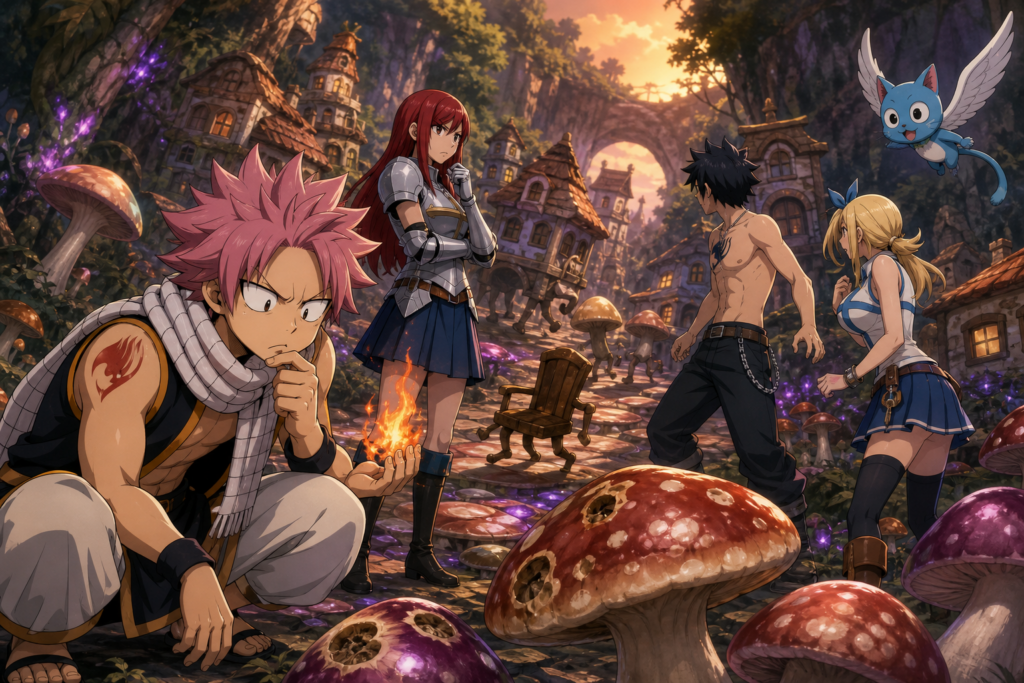
Bottom line: Episode 9 is Fairy Tail taking one deep breath after Eisenwald and immediately using it to ask, “What if hunger made everybody stupid?” The answer is funny, but it is not empty. “Natsu Eats a Village” turns two small Hiro Mashima bonus stories into a full anime-original detour about appetite, teamwork, bad judgment, and the way a guild master can quietly clean up a disaster without stealing the younger characters’ spotlight. It is not required mythology. It is useful character work wearing a mushroom hat.
Receipt Box
- Episode: 9
- Japanese title: ナツ、村を食う!!
- Romanization: Natsu, Mura o Kuu!!
- Official English streaming title: “Natsu Eats a Village”
- Alternate licensed English title: “Natsu Devours a Village”
- Japanese broadcast: December 7, 2009
- Placement: Immediately after the Eisenwald/Lullaby mission
- Episode type: Mixed adaptation and anime-original material
- Adapted material: “Happy’s Little Job” and “Happy’s Little Job 2,” bonus manga stories
- Anime-original material: Clover Canyon, the deserted moving village, the larger team’s participation, and the Alive Magic crisis
- Japanese production: A-1 Pictures and Satelight; series director Shinji Ishihira; series composition Masashi Sogo
- Japanese cast heard in the core team: Tetsuya Kakihara as Natsu, Aya Hirano as Lucy, Rie Kugimiya as Happy, Yūichi Nakamura as Gray, Sayaka Ohara as Erza, and Shinpachi Tsuji as Makarov
- Where to watch: Crunchyroll
The accessible official archive confirms the series-level staff above but does not expose this episode’s full end-credit slate. I am leaving unverified episode-level names out instead of turning a database guess into a receipt.
The hunger is the plot, but the behavior is the point
Natsu, Lucy, Happy, Gray, Erza, and Makarov are trying to get home after stopping Eisenwald. They are lost in Clover Canyon, tired, and hungry enough to treat common sense like an optional guild fee. That setup matters because Episode 8 ended with the team saving guild masters from a mass-casualty attack. Episode 9 does not pretend heroes stay grand once the emergency is over. Sometimes the people who stopped a death flute are ten minutes away from arguing over a fish that tastes terrible.
That is one of Fairy Tail’s better instincts. It lets competence and foolishness live in the same body. Natsu can read an opponent’s fire, fight through pain, and still see an unknown mushroom as lunch. Gray can construct tactical weapons from ice and still join the bad-decision committee. Happy loves fish so much that the promise of a rare delicacy overrides the possibility that rare does not mean good.
Lucy remains the audience’s sanity check, but the show does not make her untouchable. She is still new enough to recognize the madness and involved enough to get dragged into it. Erza tries to impose discipline. Makarov has the authority to end the nonsense. Neither can completely stop hunger from reorganizing the group’s priorities.
That is the joke: Fairy Tail has hierarchy, but it is not a military unit. Erza can give an order. Makarov can carry the title. Natsu and company will still investigate lunch like lunch personally issued the mission request.
Happy finally gets a story that belongs to Happy
The episode borrows its flying-fish and mushroom business from Mashima’s “Happy’s Little Job” bonus stories. In those short pieces, Happy is not merely Natsu’s transportation or the tiny voice delivering a joke from the edge of the frame. He sees a request, wants the reward, and pursues the thing that matters to him: fish.
The anime changes the reason for the hunt. Instead of presenting the flying fish and mushroom gathering as ordinary paid jobs led by Happy, it folds them into the group’s desperate search for food. That gives the television episode a cleaner road-trip structure, but it also costs Happy a little agency. The bonus-story version begins with him choosing work. The anime version begins with the whole group being hungry.
The adaptation gives some of that focus back through comedy. Happy catches the unpleasant fish. Happy develops the same mushroom problem as Natsu and Gray. Happy fights a moving chair while his friends assume he is playing. When he complains that nobody helped him, the joke works because he is right. His size and cheerful voice make the others treat his struggle as cute before they treat it as real.
That is a small interpersonal pattern worth noticing. Fairy Tail loves Happy, but love does not prevent condescension. The guild’s mascot framing can reduce his labor until he demands recognition. The episode does not build a sermon around it. Good. Happy yelling at his useless friends is sharper than a speech would be.
Rie Kugimiya’s Japanese performance helps the joke land because Happy’s emotional turns are fast and precise. His appetite is bright, his disgust is immediate, and his wounded complaint has just enough sincerity under the comic pitch. The show does not need to make him less cute to make him a person. It needs to let the cuteness carry an opinion.
Erza has one functioning survival instinct in a canyon full of fools
Erza reads the deserted village correctly. Fresh food with no visible residents is not hospitality. It is evidence. She tells the group to investigate and warns them not to eat what they find.
Naturally, this is Fairy Tail, so her authority lasts about as long as an uncovered plate.
The comedy depends on Erza being credible. If everybody were equally reckless, the scene would just be noise. Erza gives the episode a line of reason, which allows Natsu, Gray, and Happy to sprint across it. Sayaka Ohara’s controlled delivery also creates contrast. Erza does not have to shout every warning. Her composure tells us she has already noticed the danger while the others are still ranking it by flavor.
Still, the episode does not make Erza a flawless camp counselor. Once the village’s objects and creatures begin moving, even she participates in the effort to subdue them and figure out what is happening. She can impose order, but she is also a wizard whose first language is action. The difference is that Erza acts after observing. Natsu acts because his stomach filed a complaint.
Alive Magic makes the village more than a random gag
The deserted village is eventually connected to dangerous magic that animates or transforms the settlement and its inhabitants. The specific event is anime-original, so it should not be smuggled into the manga chronology as if Mashima staged the same crisis in a main chapter. The television staff uses it as connective tissue around the two bonus-story premises.
That choice is smart because it gives the episode one visual rule: everything that looks like an object may have movement, appetite, or intention. Houses shift. Chairs gallop. Food is not safely food. The environment behaves like a prank with magical infrastructure.
The magic also changes the ethical shape of the fight. Natsu, Gray, Erza, Lucy, and Happy initially respond to living objects as threats and possible meals. Later, the group learns that a village and its people are tied to the transformation. The reveal turns slapstick damage into a reminder that magic has owners, histories, and consequences even when the heroes do not yet understand them.
I would not inflate this into a major thesis about personhood. The episode does not stay with the villagers long enough to earn that. But it does reinforce a rule Fairy Tail keeps returning to: power used without understanding can turn someone else’s home into the battlefield for your confusion.
Makarov’s role is important here. He appears to understand more than the younger wizards and quietly helps restore the situation, then refuses to make the resolution about himself. That is leadership as cleanup, not branding. He does not need a victory pose. He needs the dangerous circle gone and the villagers warned not to repeat the mistake.
It is also a gentle preview of Makarov’s larger pattern. He lets the guild members grow through messy experience, but he remains close enough to prevent every lesson from becoming a funeral. That balance will not always hold. Here, it does.
Lucy is learning that “strongest team” does not mean “best supervised”
Lucy joined Fairy Tail because the guild represented freedom, belonging, and a life she chose for herself. Episode 9 gives her another practical definition: belonging means being trapped in a canyon with powerful people who will taste the cursed scenery.
Her role is not only to react. Lucy brings Celestial Spirit Magic into the encounter and summons Taurus when force becomes necessary. The episode continues the early series’ effort to establish that she contributes to fights even when Natsu or Erza has the larger spectacle. Her magic is contractual and relational. She cannot simply produce any solution without the correct key, availability, and spirit relationship.
Taurus also carries the series’ recurring problem with sexual comedy. The character’s attraction to Lucy’s body is treated as a gag, but the repetition can crowd her authority as his contractor. A useful React should say that plainly without pretending one joke destroys the episode. Lucy calls a powerful spirit for help. The direction should support her command. When the gag pulls focus toward her body instead, the show undercuts the competence it just gave her.
The question is not whether fans are allowed to laugh. The question is what the scene trains viewers to notice first. Lucy’s magic or Lucy’s measurements? Fairy Tail will keep making that choice, and RaeRae will keep keeping receipts.
The adaptation earns its filler by doing actual adaptation work
Calling Episode 9 “filler” without explanation hides what the staff built. This is not a wholly unrelated television invention dropped between manga chapters. It takes two Mashima bonus stories, changes their job-based framing, adds Gray, Erza, and Makarov, and constructs an anime-original village plot to turn separate gags into one broadcast episode.
That makes “mixed adaptation” the useful label. Fans deciding whether to watch deserve more than a red or green box. The flying fish and mushrooms come from published Mashima material. The canyon crisis and living village expand television continuity. Neither fact requires pretending the episode advances the central villain plot.
Creative structure matters here. After Eisenwald, the series needs decompression before “Natsu vs. Erza” redirects the story toward guild discipline and Galuna Island. Episode 9 lowers the stakes while keeping the new team together. It lets the audience watch their habits collide outside a formal mission.
That is not wasted time. Team chemistry is not only built during speeches and boss fights. It is built when one person gives a reasonable instruction and everybody else immediately proves why the instruction was necessary.
Japanese performance keeps the stupidity character-specific
Tetsuya Kakihara gives Natsu’s hunger the same forward force he gives combat. Natsu does not cautiously consider eating the strange thing. His voice commits before his brain requests jurisdiction. Yūichi Nakamura makes Gray’s participation drier, which keeps him from sounding like a second Natsu even when both men are making the same bad choice.
Aya Hirano keeps Lucy’s disbelief active rather than passive. Lucy is not a neutral narrator floating above the group. Her frustration has rhythm, and her reactions help organize scenes that could otherwise become five characters shouting over animated furniture.
Sayaka Ohara anchors Erza with authority, while Shinpachi Tsuji gives Makarov the tired confidence of a man who has supervised this guild long enough to know that dignity is not coming to rescue him. These differences matter. The group comedy works because the cast members are not performing one shared setting called “loud anime person.”
RaeRae’s verdict
Episode 9 is a side story, and that is not an insult. It adapts Happy’s small jobs, gives the newly formed team room to become a social unit, and shows Makarov doing the quiet labor that keeps guild chaos survivable. The Alive Magic plot is thin, but it gives the comedy a shape and a consequence.
The best joke is not that Natsu might eat a village. It is that everybody knows he might, warns him not to, and still has to deal with the results. That is Fairy Tail family life in miniature: affection, authority, property damage, and somebody responsible cleaning up after the people who called recklessness a plan.
Watch it if you want plot-essential mythology? No. Watch it if you want to understand how this team behaves when the world is not ending? Absolutely.