
Fairy Tail Episode 7: Flame and Wind
The clever answer belongs to the whole team.
RaeRae Reacts • Fairy Tail Episode 7
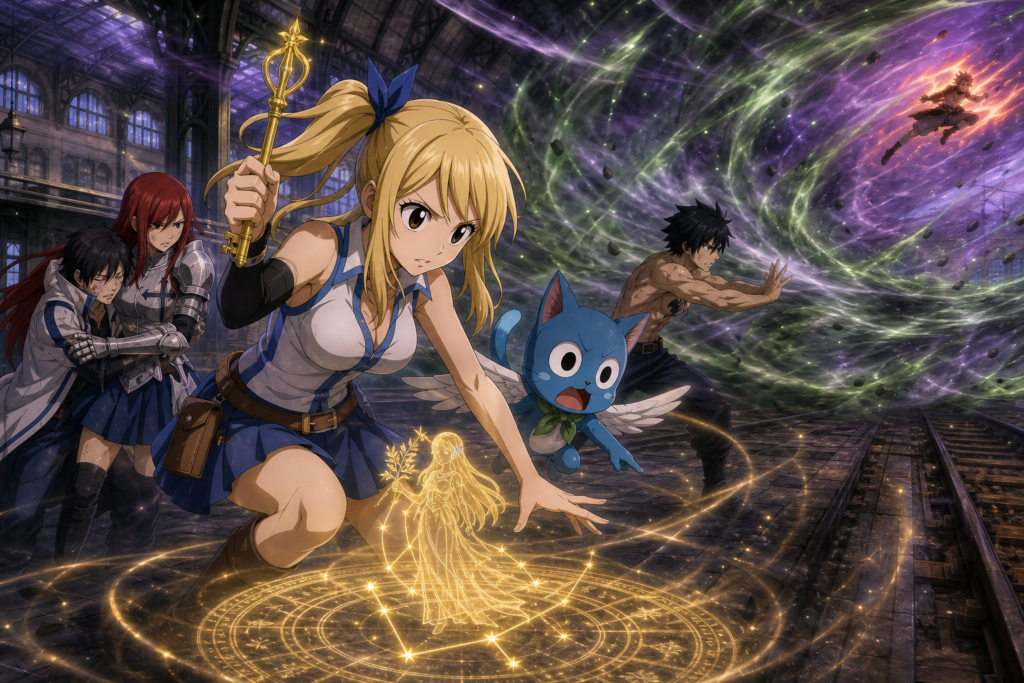
Bottom line: Episode 7 is where Fairy Tail stops treating teamwork as a cute group photo and starts treating it as a chain of decisions. Erza cannot simply punch through Erigor’s Wind Wall. Natsu cannot burn every problem. Lucy does not need to become the strongest person in the station to save everybody in it. Happy remembers the one tool that changes the map, Virgo digs under the barrier, and the guild carries an injured enemy out with them. That last part matters. Their magic gets them free. Their conduct tells us who they are.
Receipt Box
- Episode: 7
- English title: Flame and Wind
- Japanese title: 炎と風
- Romanization: Honō to Kaze
- Japanese broadcast: November 23, 2009
- Series era: Fairy Tail (2009–2013)
- Story arc: Eisenwald
- Episode type: Manga canon
- Manga material: Chapters 16 through 18 are the commonly documented adaptation range
- Official watch route: Crunchyroll
- Original Japanese leads in this episode: Tetsuya Kakihara as Natsu, Aya Hirano as Lucy, Rie Kugimiya as Happy, Yūichi Nakamura as Gray, Sayaka Ōhara as Erza
- Continuity boundary: The episode advances the Wind Wall escape and begins Natsu’s confrontation with Erigor. The actual resolution belongs to Episode 8.
RaeRae's verdict
I like this episode because the answer is not hidden inside a bigger explosion. The episode has fire. It has wind. It has Erza looking like she might interrogate the station itself if the walls do not start cooperating. Yet the escape comes from memory, a key, and a Celestial Spirit whose useful skill is digging.
That is Fairy Tail at its best. Power matters, but power is wider than combat rank. Lucy’s contract magic can change the shape of a battlefield. Happy’s attention can rescue a whole team. Virgo’s labor can defeat a barrier that brute force cannot. Natsu’s most important choice is not the punch he throws. It is refusing to leave Kageyama behind after Eisenwald treats him as disposable.
The episode is also messy in a productive way. Erza orders people around because time is running out. Gray talks about life and death while the enemy is bleeding. Lucy and Happy still argue like two people who have not figured out how much they need each other. Nobody pauses for a clean speech about values. Their values show up in what they do while panicking.
The station has become a weapon
Oshibana Station is no longer just a location. Erigor’s Wind Wall turns public infrastructure into a cage. Railways are supposed to connect towns and move ordinary people. Eisenwald flips that purpose. Movement becomes confinement, and the station becomes part of an assassination plan aimed at the Guild Masters meeting in Clover Town.
That is why the Wind Wall works as more than a magic obstacle. It separates power from responsibility. Erigor can leave while other people absorb the danger he created. His guild members hold the station. Civilians are trapped inside the fallout. His own people become pieces he can spend.
Fairy Tail has a reputation for wrecking buildings, so the show could easily play the station damage as another joke. Episode 7 does something more useful. It asks whether these wizards can move through a public crisis without copying the enemy’s disregard for human life. They are loud. They break things. They also refuse to accept that an injured enemy should be abandoned because saving him is inconvenient.
Erza learns that command is not control
Erza enters this arc as the person everybody obeys. Natsu and Gray stop fighting when she appears. Lucy reads the room and understands that disobeying Erza could become its own survival problem. That authority is real, but Episode 7 puts a limit on it.
Erza cannot order the Wind Wall to disappear. She cannot force Kageyama to undo it after he is attacked. She can hit harder, threaten louder, and keep the mission moving, but command does not give her total control over conditions.
This is an important correction to the way strong women are sometimes written in action anime. The lazy version makes a woman impressive by letting her dominate every room without cost. Erza is more interesting because her strength has a bill. She has already used serious magic, she is carrying responsibility for the team, and her vision begins to blur while she drives after Natsu. The body keeps the receipt even when the leader refuses to slow down.
My reading is that Erza’s leadership works here because she does not need to be the answer to every problem. Gray brings information. Happy remembers Virgo. Lucy performs the summon. Natsu and Happy pursue Erigor. Erza remains the leader, but leadership becomes coordination instead of ownership.
Eisenwald tells on itself
Kageyama is not innocent. He participates in Eisenwald’s plan, fights Natsu, and helps create the crisis. The episode does not need to erase that responsibility to show that Karacka’s attack is wrong.
Eisenwald’s leadership treats Kageyama as a loose end. The order to silence him exposes the guild’s idea of loyalty: useful until inconvenient. That is not family. That is labor disposal with a matching uniform.
Natsu’s anger lands because he recognizes the betrayal before Kageyama fully processes it. He asks whether Kageyama was Karacka’s comrade. Natsu is not giving Kageyama a moral pardon. He is judging Karacka for accepting a structure where a teammate can be stabbed the second management gets nervous.
There is a workplace lens here, and it is not subtle. Bad organizations often demand loyalty downward while refusing it upward. Workers are told to sacrifice for the group, but the group will not sacrifice to protect them. Eisenwald turns that logic into literal violence.
Fairy Tail is chaotic and frequently irresponsible, but its members understand that belonging creates duties. That difference is why Natsu takes Kageyama with them. An enemy can remain accountable and still be a person worth saving. Apparently this should not be a radical position, yet here we are.
Lucy does not need a combat win to change the battle
Lucy is still new. She is surrounded by people whose magic looks louder than hers. Erza has armor and force. Gray can build ice in seconds. Natsu is a walking fire hazard with abandonment issues. It would be easy for the series to make Lucy stand in the corner and narrate how powerful everybody else is.
Instead, Episode 7 lets her magic solve the problem that direct attack cannot solve.
The plan is not instant. Natsu first thinks about using the Celestial Spirit World as a route. Lucy explains why that does not work. A gate opens through a Celestial Spirit Mage, contracts matter, and humans cannot simply use the Spirit World like a hallway because they feel creative. The scene gives her expertise weight. She is not being negative. She is identifying the limits of her own system.
Then Happy remembers Virgo’s key.
The comedy works because the answer has been sitting in his possession while everyone suffers. Lucy has every right to look at him like she is considering a second crisis. But the joke does not cancel Happy’s contribution. He remembers that Virgo can dig. The team does not have to break the wall if they can change the route.
That is a real tactical insight. Barriers depend on assumptions. Erigor controls the exits and the air around the station. He does not control every path through the ground. Virgo’s Diver ability attacks the boundary of the spell instead of competing with its strength.
Lucy then summons Virgo before they have settled a formal long-term contract. The timing is awkward, but the interaction still establishes consent. They agree to discuss the contract later. Virgo asks how Lucy wants to be addressed, and Lucy accepts “Princess.” The scene is funny, yet it also separates Lucy from Everlue’s ownership mindset. A Celestial Spirit is not a disposable tool. Terms, preferences, and relationship still matter.
Happy earns his place without throwing a punch
Happy’s role is easy to underestimate because the show uses him for punch lines, transportation, and faces that say what the audience is thinking. Episode 7 shows why that would be a mistake.
Happy carries Virgo’s key because she asked him to give it to Lucy. He remembers her digging ability. He identifies the route under the Wind Wall. Then he uses Aera to carry Natsu toward Erigor.
That is logistics, memory, and mobility in one small blue package.
Fairy Tail’s power system often rewards the person who wins the visible fight, but teams survive because someone tracks resources and moves the right person to the right place. Happy does both. He does not become less important because his magic is support magic. If anything, the episode proves that support can decide who even gets to participate in the next fight.
The writing also gives Lucy and Happy an early version of their long-term rhythm. They bicker, correct each other, and recover quickly. Their relationship is not built on polished emotional speeches. It is built on surviving Natsu’s decisions together and developing a shared language of disbelief.
Gray's life-and-death line deserves attention
After Kageyama wakes, he assumes Fairy Tail kept him alive to use him. That is the only logic his guild has taught him to expect. Gray responds that if Kageyama wants to die, he can say so, but not everything has to be decided by life and death.
That line matters more after we learn Gray’s history. Even at this early point, he is already surrounded by a story that keeps treating sacrifice as the cleanest answer. Ur’s choice, Lyon’s obsession with Deliora, and Gray’s own later self-destructive plans all live inside that pattern.
I am not pretending Episode 7 stops and explains all of that. It does not. This is later-informed interpretation. The line is still useful because it shows the contradiction already inside Gray. He can tell another person that survival does not have to be transactional while struggling to apply that belief to himself.
That is foreshadowing through character habit, not prophecy. Gray can see the bad logic clearly when somebody else uses it.
Fire versus wind is not finished yet
The title promises Flame and Wind, but Episode 7 wisely does not finish the contest. Natsu and Happy catch Erigor, and the fight begins. Erigor’s wind gives him control of distance, movement, and the air around Natsu’s attacks. Natsu has force and instinct, but fire cannot win simply because the protagonist is angry.
Episode 8 will complete the tactical answer. Episode 7’s job is to establish the mismatch. Erigor believes his wind places him above Natsu’s flame. The framing lets him control the space while Natsu fights uphill.
That boundary matters because episode summaries love stealing credit from the next episode. I am not doing that. Here, Natsu reaches Erigor, exchanges blows, and faces a serious wind advantage. The comeback belongs to the next file.
Adaptation and performance notes
The anime packages material commonly mapped to manga Chapters 16 through 18 into a station-escape episode that ends on the fire-versus-wind confrontation. That structure creates a clean television hinge. The first half solves confinement. The final movement launches pursuit and stops before the battle resolves.
The adaptation leans on spatial contrast. Inside Oshibana, the cast is crowded, blocked, and forced to cooperate. Outside, Erigor moves through open air while Natsu approaches as a small burst of flame. The shift makes escape feel like progress without pretending the danger is over.
The Japanese cast also helps separate panic from purpose. Aya Hirano gives Lucy the quick switches this material needs: practical explanation, irritation with Happy, then focused action once Virgo becomes the answer. Rie Kugimiya lets Happy’s comic realization stay funny without making his contribution feel accidental. Sayaka Ōhara keeps Erza’s orders firm even as physical strain starts to show. Tetsuya Kakihara pushes Natsu’s anger at Kageyama’s betrayal differently from his excitement about fighting Erigor. One is moral disgust. The other is competitive heat.
Those performance observations describe the choices audible in the Japanese track across this sequence. They are not claims about actor intent.
What Episode 7 changes
Lucy is no longer only the newest member watching the veterans work. Her knowledge and contract magic create the escape route.
Happy is no longer only Natsu’s ride. He becomes the person who remembers the missing resource and connects it to the physical problem.
Erza’s leadership becomes more credible because the episode gives it limits. She coordinates a solution she cannot produce alone.
Natsu shows that his guild loyalty is an ethic, not merely a Fairy Tail logo. He refuses Eisenwald’s idea that an injured teammate becomes trash.
Kageyama sees an enemy guild offer him the basic human regard his own guild withheld. That does not settle his accountability, but it changes the moral map.
Final verdict
Episode 7 wins because the clever answer belongs to the whole team. Happy remembers. Lucy understands the magic. Virgo changes the terrain. Erza keeps the mission organized. Gray challenges Kageyama’s death logic. Natsu carries the injured man out and then races toward Erigor.
Nobody solves the crisis alone, and the show does not need to pretend they like one another equally yet.
That is the early Fairy Tail promise in its most useful form. Family is not a speech you give after the fight. It is the decision not to leave somebody inside the wall, even when saving them costs time and they have not earned your affection.
Sources and continuity
- Crunchyroll Episode 7 listing for the official English title, release date, Japanese audio availability and synopsis.
- TV Tokyo home-media archive for the Japanese title and episode placement.
- Kodansha K MANGA Fairy Tail edition for the manga continuity used in adaptation tracing.