
The Scroll’s Secret: No Peeking Allowed!
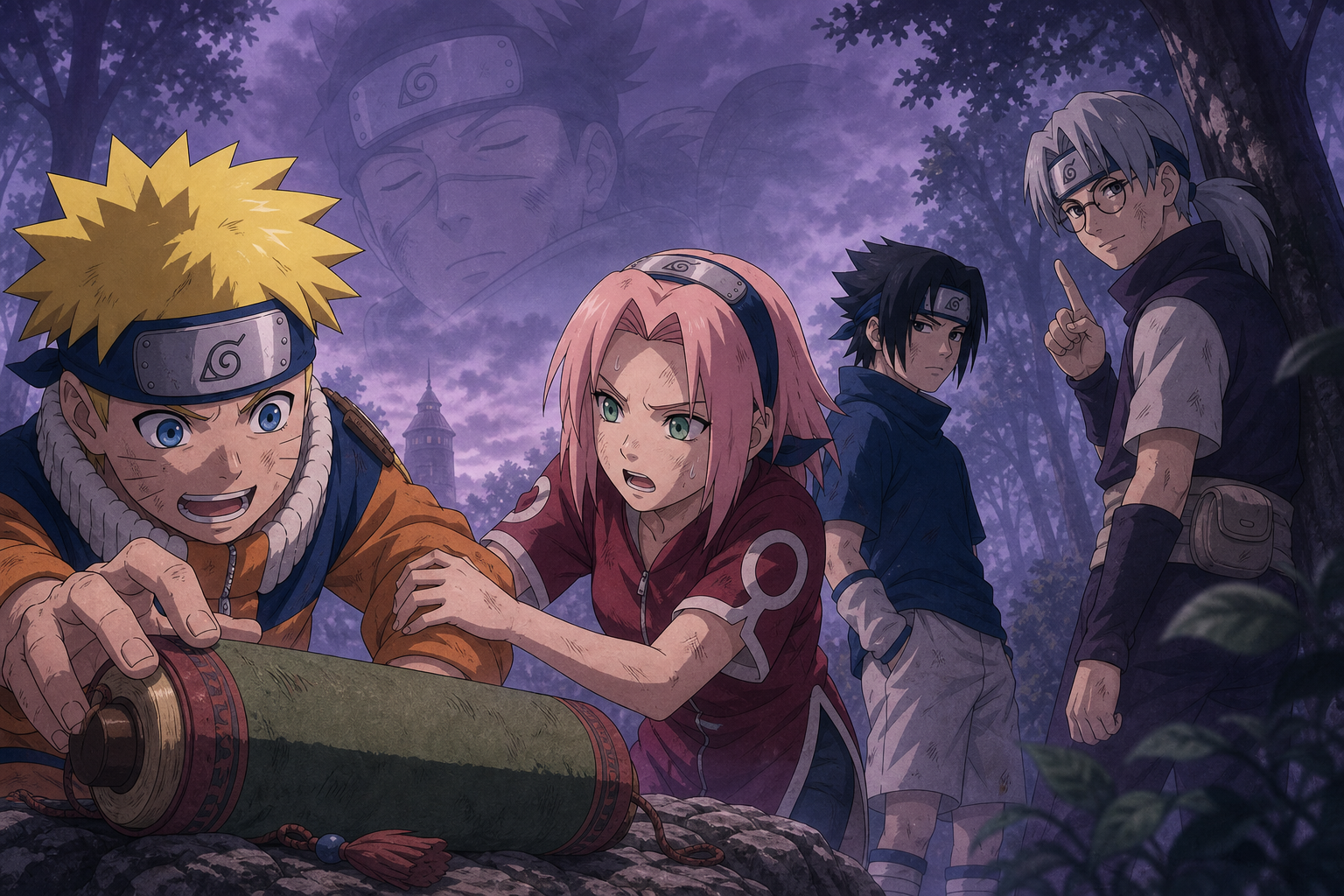
Four days into a five-day exam, Naruto proposes counterfeiting the missing scroll. It is ridiculous, practical desperation until he decides the best way to copy a forbidden object is to open it.
Episode 35 makes a sealed scroll more dangerous than another giant animal because temptation is the actual test. Team 7 is wounded, late and missing the Heaven Scroll. Naruto’s counterfeit plan sounds like a shortcut, but it also exposes a rule system that demands obedience without explaining the mechanism behind punishment.
Kabuto arrives with exactly the information they need and the calm of somebody who has failed this exam enough times to know its corners. Helpful? Yes. Suspicious? Also yes. Naruto is not wrong to accept help. The audience is supposed to notice how perfectly timed it is.
Team 7 gets a rest, not a reset
Naruto, Sasuke and Sakura survive the Sound attack, but survival costs time. The exam is already on its fourth day. They have roughly one day left to obtain the matching Heaven Scroll and reach the tower.
Their bodies carry the previous episodes forward. Sasuke has the curse mark. Sakura is injured after defending the team. Naruto is recovering from Orochimaru suppressing the Nine-Tails’ chakra. A timer does not pause because the children were attacked by an adult invader the exam staff failed to remove.
That is the hidden cruelty of standardized competition. Every team receives the same deadline on paper, then radically different disasters are treated as personal performance. Team 7’s delay becomes their problem even though part of it came from a security breach.
Naruto’s counterfeit plan is not as stupid as it sounds
Naruto proposes copying the Heaven Scroll from the Earth Scroll they already possess. Counterfeiting exam material is against the spirit and probably the rules. It also shows lateral thinking under pressure.
He understands the required output: arrive with both scroll types. He lacks one input and asks whether appearance can substitute for acquisition. That is the same rule-bending intelligence that helped him use shadow clones creatively. The weak point is information. He does not know what the sealed object contains.
Sakura recognizes the danger before Naruto finishes converting curiosity into action. Her intervention is not the boring girl stopping fun. She is the teammate protecting the group from an unknown mechanism after four days of evidence that hidden rules can hurt them.
Do not open the scroll is a safety rule without informed consent
The examiners instructed teams not to open their scrolls before reaching the tower. They did not explain that opening one prematurely triggers a summoning technique and incapacitates the offenders. The rule therefore tests obedience through concealed punishment.
Secrecy has a tactical purpose. If every participant knew the exact mechanism, some would try to disable or exploit it. That does not make the ethical structure clean. Adults hand children booby-trapped documents, send them into a lethal forest and call unexplained compliance judgment.
A second Leaf team opens its scroll and pays the price, proving the warning is not decorative. Their failure becomes information for viewers while Team 7 narrowly avoids the same outcome. The exam learns nothing from the children it knocks unconscious. It simply removes them.
The scroll is a contract with enforcement inside it
Scrolls throughout Naruto can store objects, techniques and summoned entities. Here, the document is not merely a message. It contains enforcement. The rule and the penalty occupy the same physical artifact.
That design turns literacy into risk. A scroll normally invites reading, yet this one punishes the reader for treating it like information. The correct behavior is ritual obedience: carry it sealed to the proper place, then let authorized adults reveal its function.
A cultural reading can connect that structure to formal seals, examination rituals and institutional trust without pretending one scroll explains Japan. The story uses a familiar respect for controlled knowledge, then makes the control visibly coercive.
Kabuto arrives as a helpful answer shaped like a question
Kabuto Yakushi stops Team 7 from opening the scroll and explains enough to keep them conscious. He appears experienced, polite and unusually informed. He has taken the Chūnin Exams multiple times, which gives his knowledge a plausible source.
He also arrives exactly when Team 7 needs guidance and later offers to travel with them. The scene does not require viewers to declare him evil on sight. It asks them to hold two facts together: his help is real, and the convenience deserves attention.
Kabuto understands how to lower defenses. He does not demand authority. He supplies useful information, speaks gently and lets Team 7 choose the alliance. Trust built through accurate help is stronger than trust demanded through rank.
Sasuke’s suspicion is professional, not antisocial decoration
Sasuke has just been targeted by Orochimaru and attacked by Sound subordinates. A knowledgeable stranger appearing beside the team should trigger caution. His suspicion is not proof that he always knows the answer. It is an appropriate response to the pattern around him.
Naruto tends to judge immediate behavior. Kabuto helps, so Naruto can treat him as helpful. Sasuke judges motive and timing. Sakura weighs information and group safety. Team 7’s best decisions emerge when those different instincts correct one another.
The problem is that exhaustion degrades every judgment system. Suspicion can become paranoia. Gratitude can become gullibility. Fear can become paralysis. The exam does not only test techniques. It forces cognition to operate after sleep loss, injury and trauma.
The tower is close enough to increase danger
Approaching the destination does not make the route safe. Other teams know the tower is the convergence point for successful competitors. Scroll holders become concentrated targets.
Kabuto warns that movement near the tower requires strategy, then offers his experience. This is useful battlefield knowledge. It also positions him inside Team 7’s route, exactly where observation of Sasuke becomes easiest.
The episode understands a basic mission truth: extraction is part of success. Obtaining an object does not complete the job if the team cannot deliver it. Team 7 still lacks the second scroll, and every remaining hour increases pressure to accept risk.
Knowledge is power, but access is political
Kabuto’s advantage is not a larger fireball. It is accumulated information. He knows competitors, rules, geography and patterns. The ninja info cards shown earlier established his identity as a person who collects and organizes intelligence.
That skill has institutional value because hidden villages run on asymmetrical knowledge. Missions, bloodlines, alliances and weaknesses become currency. Children are taught to protect information before they are taught whether the institution protecting it deserves trust.
Episode 35 makes the contradiction cute through Naruto’s curiosity, then sharp through the unconscious team. Wanting to know is not morally wrong. In this system, unauthorized knowledge can still punish the seeker.
Exam scarcity creates a market for risky decisions
The Heaven and Earth Scroll system manufactures scarcity on purpose. Half the teams begin without what they need, so advancement requires exchange, theft or combat. The institution does not merely observe conflict. It creates the resource conditions that make conflict rational.
Naruto’s counterfeit plan is therefore a response to an artificial market. If the missing item can be reproduced, the scarcity loses power. The sealed mechanism protects the exam’s control over that market by punishing unauthorized access before competitors can inspect how the resource works.
Hidden villages repeat this structure outside the forest. Intelligence, techniques and mission access are restricted, then people are ranked by how effectively they navigate the restrictions. Kabuto thrives because he treats information collection as infrastructure. Team 7 is learning that a ninja who knows the system can be as dangerous and valuable as one who breaks trees.
The quiet episode is doing recovery work
After Orochimaru, the Sound attack and Gaara’s execution scene, Episode 35 reduces the physical scale. That is not the story running out of action. The quieter rhythm lets injuries, time pressure and suspicion become visible again.
The scroll provides a small object for the camera to organize tension around. Naruto’s hand moving toward the seal can carry more suspense than another giant technique because viewers understand that one touch may disable everybody. Sakura’s interruption becomes action without requiring a new fight.
Kabuto’s entrance also benefits from restraint. If he arrived during chaos, his information would look like rescue spectacle. Entering a conversation allows him to seem reasonable. The direction gives manipulation room to breathe like ordinary helpfulness.
Confucian duty collides with rule skepticism
A Confucian lens gives legitimate rules value when they support ordered relationships and responsible conduct. Sakura honors the instruction because the team accepted the exam’s structure. Her restraint protects collective welfare rather than personal curiosity.
The adults’ duty runs in the other direction. Authority should be exercised with care, competence and moral example. Concealed incapacitation inside a death-permitted forest raises a fair question about whether institutional order is serving the children or merely demanding submission.
Naruto’s rule-breaking impulse therefore contains both danger and critique. He can be reckless. He also refuses to treat authority as automatically wise. The healthier team response is neither blind obedience nor blind defiance. It is shared judgment with consequences visible.
Attachment and urgency make shortcuts seductive
Naruto wants the team to pass. That attachment narrows his attention toward the missing result and away from the sealed mechanism. Pressure makes the shortcut feel necessary because failure has become emotionally unbearable.
A Buddhist reading does not condemn wanting success. It examines how clinging distorts perception. Naruto begins treating the scroll as an obstacle to be forced rather than an unknown object to be understood.
Sakura interrupts that momentum. Kabuto adds information. Sasuke adds suspicion. The episode’s healthier answer is relational: one person’s urgency is held by other people until judgment returns.
Japanese performance keeps suspicion conversational
Junko Takeuchi gives Naruto’s plan enough conviction that it feels like a solution to him, not a joke performed for us. Chie Nakamura makes Sakura’s alarm practical rather than shrill. Noriaki Sugiyama keeps Sasuke’s distrust inside his controlled observation.
Nobutoshi Canna performs Kabuto in the original Japanese anime. The character’s usefulness works because the delivery does not announce a villain entrance. Calm information can feel safer than dramatic charisma, which is exactly why it earns access.
The episode uses the other team’s collapse as a parallel warning rather than making Team 7 learn through identical punishment. Editing lets viewers see the consequence while Naruto remains one broken seal away from it.
What changes after Episode 35
Team 7 keeps its Earth Scroll sealed, avoids incapacitation and gains Kabuto as a temporary guide. The scroll stops being simple quest inventory and becomes evidence that exam rules can contain active techniques.
Kabuto moves closer to Sasuke while preserving a helpful public identity. Team 7’s deadline remains active, so the alliance is not abstract. They need information and support now, which makes skepticism expensive.
The episode also reframes intelligence. Naruto generates unconventional options. Sakura protects the team from reckless implementation. Sasuke reads interpersonal risk. Kabuto owns procedural knowledge. No single version is enough.
RaeRae’s verdict
Naruto almost gets the team knocked unconscious because he treats a sealed scroll like a craft project. I laughed, but the adults put the trap there and explained none of it, so my side-eye has multiple destinations.
Kabuto saves them with accurate information. That does not prove safety. It proves that the best infiltrator is the person whose help you genuinely needed.
Fandom misreadings I am rejecting
“Naruto’s idea proves he is stupid.” Counterfeiting is lateral thinking. Opening an unknown sealed tool is the reckless part.
“Sakura only nags him.” She prevents a hidden penalty from disabling the entire team.
“Kabuto’s help is fake because his motive is suspicious.” The information is useful and the intervention is real. Manipulation works better when help has value.
“The failed team deserved elimination for breaking a rule.” They violated instructions. That does not make concealed incapacitation in a lethal forest ethically neutral.
“Sasuke is paranoid.” Orochimaru just targeted his body through deception and subordinates. Suspicion is warranted even when he lacks complete proof.
Receipts and official routes
Episode number, title and official synopsis: Naruto Official Site. Japanese broadcast title and synopsis: TV Tokyo. Streaming availability varies by region; use the official options linked from the episode directory.