
Fairy Tail Episode 4: Dear Kaby
Lucy reads the evidence Everlue wanted destroyed.
RaeRae Reacts • Fairy Tail Episode 4
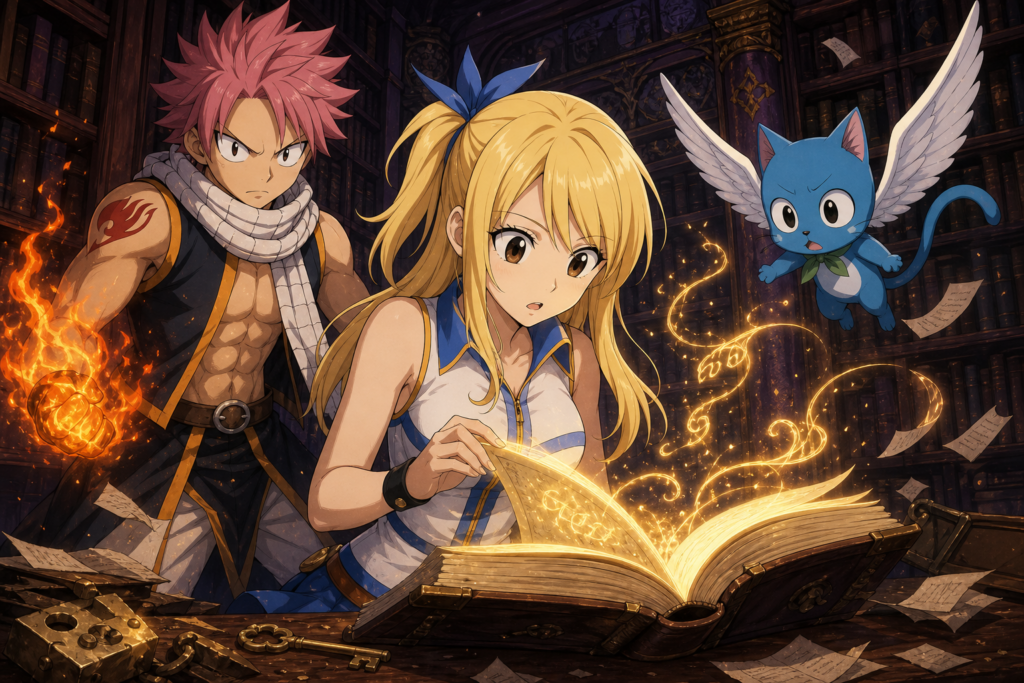
Bottom line: Lucy solves this job because she knows how to read. Natsu can punch through Everlue’s defenses. Happy can keep the team moving. Neither skill answers the question at the center of Daybreak: what does a reader owe a writer whose work was made under coercion? Episode 4 gives that answer to Lucy, and it is the first hard proof that her literary brain is not a cute side hobby. It is team power.
The receipt box
- Episode: 4
- English title: Dear Kaby
- Japanese home-video title: DEAR KABY~親愛なるカービィへ~
- Original Japanese broadcast: November 2, 2009
- Story position: The conclusion of the Everlue mansion job begun in Episode 3
- Manga anchor: Chapter 9, “Dear Kaby,” by Hiro Mashima
- Official watch route: Crunchyroll
- RaeRae’s verdict: Lucy earns her place on this team by refusing to confuse obedience with judgment.
Episode 3 set up a suspicious contract. Episode 4 explains why it smelled funny. Kaby hired Fairy Tail to destroy Daybreak, a book written by Kemu Zaleon. Everlue had forced Zaleon to write a story that made Everlue its hero. Then he tried to control the evidence after the fact. That is not patronage. That is a rich man buying a creator’s labor, identity and silence in one ugly package.
Lucy catches what everybody else misses because she treats the book as more than the object named in the contract. She reads it. She notices that its surface is not its whole meaning. The official episode description itself frames the answer as a secret inside Daybreak, produced through Zaleon’s magic. Lucy refuses to destroy the book and takes it back to Kaby.
That refusal matters. Fairy Tail accepted a destruction job. Lucy discovers that completing it literally would finish Everlue’s attempt to erase what Zaleon left behind. She does not suddenly become anti-client or anti-contract. She becomes the only person in the room willing to ask whether the assignment was built on missing information.
Yes, ma’am. The newest guild member has been employed for five minutes and is already doing the ethical review nobody else put on the form.
Lucy's reading is the winning move
Anime loves to tell us a smart girl is smart, then hands the real solution to the loudest man with the largest attack. Fairy Tail does not do that here. Natsu’s strength is useful. Happy’s mobility is useful. Lucy’s interpretation resolves the actual job.
That distinction is the episode’s creative spine. A fight can stop Everlue from grabbing the book. It cannot explain what the book means, why Kaby wanted it destroyed or what Zaleon preserved inside it. Lucy has to connect the commission, the author’s coercion, the hidden work and the client’s grief. She reads the object and the people around it.
This is also the first clean demonstration of what Lucy brings to the core trio. She is a Celestial Spirit wizard, but her value is not limited to keys. She is a reader and an aspiring writer. Those identities shape how she recognizes authorship, intent and evidence. The show is not decorating her with literary interests. It is using those interests as problem-solving equipment.
That matters for the team’s chemistry. Natsu often meets a locked system by breaking the lock. Happy notices practical details and keeps the action moving. Lucy pauses long enough to understand what the system was hiding. None of those approaches has to replace the others. The team works because the three skills overlap without becoming identical.
Everlue wanted a résumé, not a story
Everlue’s offense is bigger than being vain. He coerced Kemu Zaleon into writing a book that cast Everlue as the hero. He did not merely commission flattering art. He used wealth and power to force a creator’s name and labor into service of his public image.
That is why the episode’s book puzzle has teeth. Daybreak is not only a magical prop. It is contested evidence. Everlue wants the authority of authorship without respecting the author. He wants a story to certify his greatness because his own conduct cannot do the job.
The industry lens is sitting right there. People with money have always tried to buy favorable stories, control access and punish work that stops flattering them. Episode 4 makes that struggle literal and accessible. A patron can pay for a book. That payment does not automatically grant moral ownership over the writer’s meaning, history or dignity.
RaeRae inference: this is why Lucy’s decision feels stronger than a standard treasure recovery. She does not treat Daybreak as property whose meaning begins and ends with whoever currently holds it. She treats it as testimony. Once she understands that, destruction is no longer neutral compliance.
The episode also refuses the easy version of censorship. Everlue is not frightened by a public political manifesto. He is frightened by the survival of a truth he tried to control. That is how suppression often works. The powerful person does not need every reader to believe the lie. He needs the inconvenient record gone.
Kaby's contract was built out of grief
Kaby’s request is not honest in the clean business sense. He asks the guild to destroy a book without giving the team the full emotional and historical reason. That withheld context puts Lucy, Natsu and Happy in a job whose real stakes they cannot judge at the start.
Still, the episode does not make Kaby and Everlue equivalent. Everlue coerces a writer and tries to suppress the result. Kaby acts from grief and incomplete understanding. One uses power to control another person’s work. The other hires people to destroy an object tied to pain he cannot yet read correctly.
Accountability needs that distinction. Kaby’s grief explains the contract. It does not make the missing information harmless. Lucy could have completed the assignment exactly as stated and erased the thing Kaby most needed to receive. The guild’s success depends on her willingness to look beyond the client’s words without treating the client as disposable.
Returning the book gives Kaby knowledge. It does not undo Zaleon’s coercion or death. This is where a weaker recap would tie a lavender bow around the moment and call everybody healed. No. The truth changes what Kaby can understand. It cannot refund the years, restore the writer or make Everlue’s abuse disappear.
That consequence is what keeps the ending from becoming cheap inspiration. The book survives. The meaning survives. The creator does not.
A contract is not a moral permission slip
Fairy Tail is a workplace, even when its paperwork is buried under property damage and shouting. Episode 4 asks a useful labor question: when the instructions are incomplete, is perfect obedience still good work?
Lucy’s answer is no. Professional judgment is not the enemy of service. It is part of service. The team was hired to solve Kaby’s problem, but Kaby misidentified the solution because he did not yet understand the book. Destroying it would have satisfied the sentence on the request while failing the person who wrote it.
That does not mean wizards should rewrite every client’s wishes based on vibes. Lucy has evidence. The coercive commission is real. The hidden content is real. Everlue’s effort to stop the truth from leaving his mansion is real. Her refusal grows from what she learns, not from a main-character speech about following her heart.
This is the standard the episode sets for Fairy Tail at its best. The guild should not be a vending machine for force. Its members need enough judgment to understand what their magic is doing in somebody else’s life.
Natsu helps make that possible because he does not demand that Lucy stay in the narrow lane of “new girl with keys.” The episode lets her interpretation drive the outcome while he handles the physical danger. That is an important early relationship beat. Trust is not only rescuing someone. Sometimes it is allowing her expertise to decide what the rescue means.
Celestial Spirits, ownership and an ugly boss
Everlue’s use of Celestial Spirit magic adds another labor problem to an episode already full of them. The story places a contracted spirit inside the household of a man who treats people and art as extensions of his appetite. That context matters more than a quick joke about a strange servant.
At this point in the anime, viewers are still learning what spirit contracts mean and how keys move between wizards. Episode 4 should not be forced to carry every later rule backward. What it can show clearly is a contrast in treatment. Lucy approaches spirits as partners with names and personalities. Everlue’s household turns service into another display of possession.
That contrast will matter across the series, but it already tells us something about Lucy. Her magic requires relationship. A key opens a gate; it does not excuse the wizard from responsibility for what happens on either side of it.
The comedy around Everlue is broad because Fairy Tail likes its villains ridiculous before it reminds us they can still hurt people. His vanity, taste and self-importance are jokes. The coercion is not. The episode works when viewers can laugh at the man’s delusion without losing track of the power that let him impose it on a writer.
What the adaptation has to carry
This episode closes a story spread across two television installments. That structure gives the anime a specific challenge. Episode 3 has to make the contract, mansion and infiltration entertaining before the audience knows the complete truth. Episode 4 has to convert those adventure pieces into a literary and ethical answer without feeling like a lecture stapled onto a fight.
The adaptation’s strongest choice is keeping Lucy at the center of the reveal. The moving image can sell Natsu’s action and Happy’s aerial energy with ease. Reading is harder to dramatize. The episode has to make attention feel active: Lucy handling the book, recognizing the secret and changing the team’s goal.
The visual contrast helps. Everlue’s mansion is built to display ownership. Shelves, locked rooms and guarded space tell us that objects belong to the person powerful enough to hold them. The book’s hidden meaning breaks that fantasy. Everlue owns a mansion and possessed the commission. He never secured the final word.
The Japanese title keeps “DEAR KABY” in Roman letters before the Japanese address to Kaby. That choice points viewers toward the book’s recipient and away from Everlue’s preferred starring role. The English title preserves the same clean emphasis. The episode is not named for the mansion, the fight or the rich man. It is named for the message that survives him.
I am not assigning episode-specific direction, storyboard or animation credits without the primary end roll. That boundary is better than dressing a guess in production language. What the finished episode places onscreen is enough for the central claim: Lucy’s act of interpretation is staged as the resolution, not a footnote after Natsu wins.
What Episode 4 changes
Lucy began the series chasing the idea of Fairy Tail. Episode 1 made her judge the guild by conduct. Episode 2 made her pay rent and enter the working life behind the fantasy. Episodes 3 and 4 give her a mission where her own knowledge changes the result.
That progression is good character construction. She is not accepted because the story declares her special. She becomes useful in a way that only she can be useful. Her literary ambition, which another show might save for a diary gag, becomes the skill that protects Zaleon’s work from final erasure.
Natsu also gains definition. His refusal to worship status makes him a natural enemy for Everlue, but the episode does not pretend punching vanity is the full answer. He needs Lucy’s reading. Happy needs it too. The team’s first proper job teaches all three that power is not one thing.
For the series, this episode establishes a pattern worth watching. Magic can preserve memory, hide intent and carry a person’s will beyond direct speech. That does not make every artifact sacred or every creator correct. It means stories are actions with consequences, especially when powerful people decide who gets to write them.
RaeRae's final take
Episode 4 is where Lucy stops looking like the audience’s tour guide and starts looking like an essential Fairy Tail wizard. Her keys matter. Her courage matters. Her reading matters just as much.
The episode’s best move is refusing to separate intelligence from action. Lucy does not stand in the back and explain what the fighters accomplished. She changes what accomplishment means. Destroying Daybreak would have been a successful job and a moral failure. Returning it to Kaby is the harder answer because it gives him the truth without pretending truth can reverse loss.
Everlue wanted a book that called him a hero. What survives instead is evidence of the person he tried to control. That is not a tidy victory. It is a useful one.