
RAERAE REACTS · EPISODE 20
Evangelion Episode 20: Weaving a Story 2
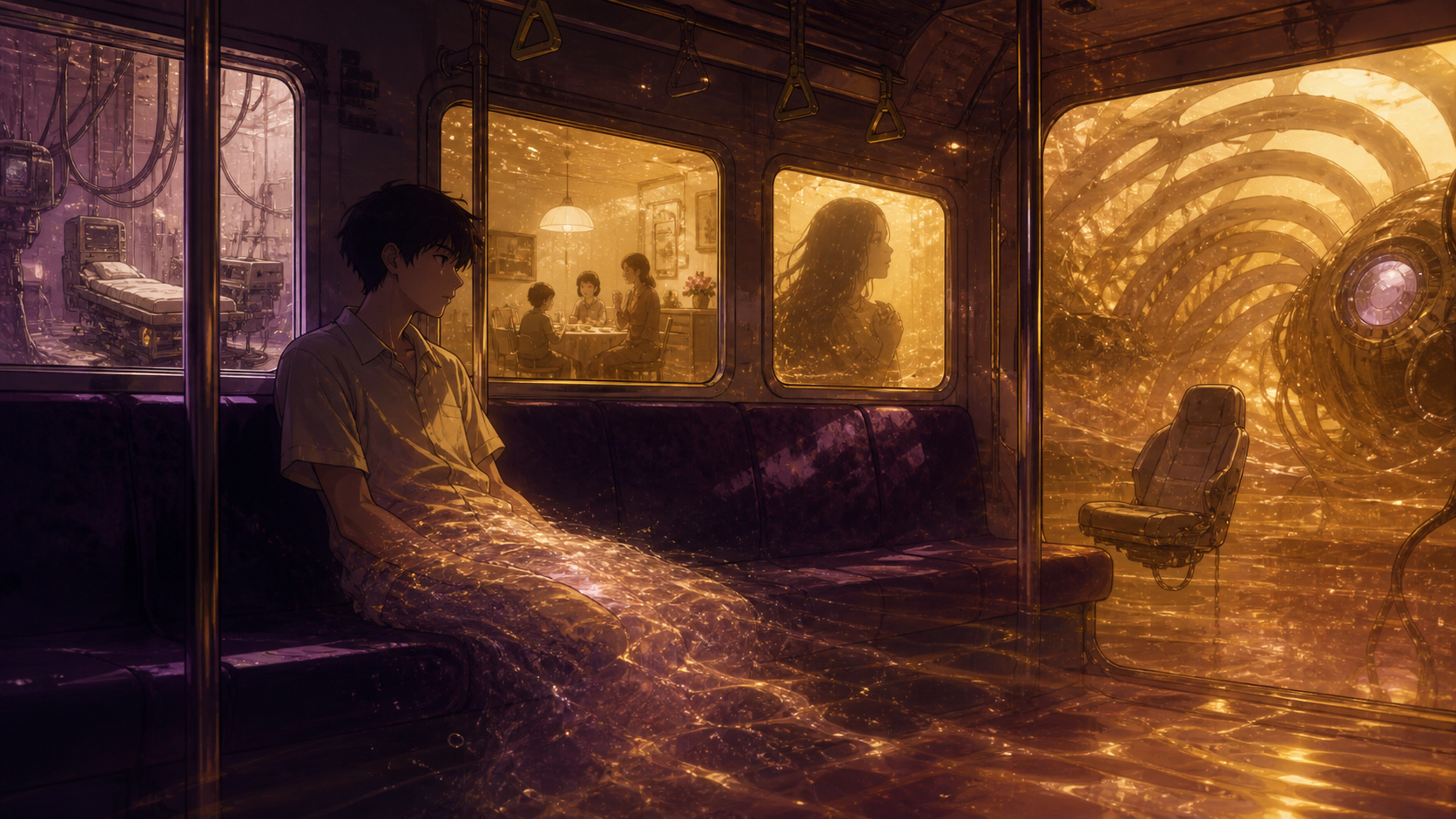
Shinji won the battle and vanished into Unit-01. NERV calls his dissolved body a recovery problem, but the episode treats the disappearance as a question: if pain ends when the self loses its borders, why return to a body that can be hurt?
BOTTOM LINE
NERV saved humanity by letting Unit-01 awaken, and now nobody knows whether Shinji belongs to himself
Episode 20 begins after the victory pose has rotted. Unit-01 ate Zeruel’s S² engine, gained a permanent power source, and absorbed Shinji into the entry plug. His synchronization reached four hundred percent. The machine did not merely respond to him. The boundary between pilot and Eva collapsed until Shinji’s body dissolved into LCL.
Ritsuko frames the crisis as a salvage operation. Misato refuses that language because Shinji is not cargo. Their conflict exposes NERV’s oldest habit: technical vocabulary turns human damage into a manageable process. A missing child becomes a pattern in liquid, a failed reconstruction, and a deadline. The words help scientists work. The words can also protect adults from admitting that their program consumed another pilot.
Inside Unit-01, Shinji encounters a world without solid borders. Memories, desire, fear, and other people’s voices move through him. The space offers relief from the body that carries pain. Returning requires choosing separation, hunger, shame, and the possibility of rejection. Shinji comes back because one memory of connection gives physical life more value than painless disappearance.
FOUR HUNDRED PERCENT
Synchronization stops being teamwork when the pilot can no longer leave the machine
NERV has celebrated higher synchronization throughout the series. Better scores meant stronger performance, faster response, and greater usefulness. Episode 20 reveals the danger hidden inside that metric. Perfect connection does not create perfect control. Connection without boundaries can erase the person making the connection possible.
Shinji’s plug suit remains behind as the clearest evidence of absence. Clothing normally marks the shape and identity of a body. Here the suit floats empty while the person has become liquid data inside an Eva. Misato sees a child missing. Ritsuko sees measurable components still present. Both observations are true, but only one keeps the moral emergency visible.
The four-hundred-percent result also destroys the fantasy that NERV understands its own technology. Staff members can measure synchronization, track LCL composition, and reproduce an earlier recovery procedure. Measurement creates confidence without mastery. The Eva program rests on biology, souls, and maternal bonds that the official language keeps disguising as engineering.
Gendo appears less surprised than everyone else because Yui’s disappearance established the precedent. That knowledge makes his silence worse. Shinji entered Unit-01 without being told that total absorption was possible. A risk hidden from the pilot cannot be part of informed consent, no matter how many forms NERV places in front of a child.
THE SALVAGE OPERATION
Ritsuko repeats a procedure that failed to return Yui and calls repetition a plan
The recovery operation follows work first attempted after Yui Ikari vanished during a contact experiment. Ritsuko knows the history. Gendo knows the history. Misato learns enough to realize the adults have buried another foundational disaster. NERV is not improvising around a new accident. The organization is reenacting an old accident with Yui’s son.
Ritsuko’s focus is understandable. Scientific procedure gives her something to do while grief and uncertainty threaten the room. She calculates, directs, and tries to reconstruct Shinji’s ego boundary. Competence becomes her shield. The shield also lets her avoid saying that Unit-01 contains a human history she has helped conceal.
Misato refuses distance because Shinji lives in her home, eats at her table, and has cried in front of her. She pounds on the entry plug and demands that he return. Her desperation cannot alter the science, but the emotional claim matters. Shinji is not only a pilot assigned to Operations. He belongs to relationships outside NERV’s ownership.
The tension between the women is not emotion versus reason. Misato has rational grounds to distrust a procedure tied to an undisclosed failure. Ritsuko has emotional reasons for clinging to the professional identity inherited from her mother. Both women bring feeling and logic. NERV’s culture labels only one form of speech scientific enough to command the room.
THE FAILED RECONSTRUCTION
A human body cannot be rebuilt by force when the person inside has not chosen a border
The salvage process attempts to restore Shinji’s physical form by recreating the conditions that define him as separate. The machinery can assemble biological material. The process cannot order a self to exist. Shinji’s return depends on desire, memory, and attachment rather than technical pressure alone.
That limitation points toward Human Instrumentality. If an ego boundary can dissolve, individuality is not presented as a permanent fact. Individuality becomes an active shape maintained through relationships and self-recognition. A body is more than tissue. A body is the place where a person says “I” and accepts the distance between that “I” and everyone else.
NERV wants the result without respecting the choice. The organization needs Shinji reconstructed because Unit-01 remains operationally vital. Misato wants him back because she loves him. Those motives overlap without becoming equal. Love asks for return while recognizing a person. Operational need asks for function to resume.
The failed procedure terrifies Misato because effort, expertise, and urgency prove insufficient. She cannot rescue Shinji by commanding harder. For once, the adult must wait for the child to decide whether the world deserves another chance.
INSIDE UNIT-01
Shinji meets a world where every person can enter his mind and nobody can touch him
Shinji’s internal sequence mixes memory, fantasy, voices, and bodily desire. The images do not follow ordinary time because his separate physical perspective has dissolved. Other people appear as parts of his consciousness and as independent presences he cannot fully understand. The scene makes intimacy feel both comforting and invasive.
He thinks about Misato, Rei, and Asuka through a teenage mind shaped by longing and shame. Evangelion does not clean that desire into innocent romance. Shinji wants care, physical closeness, approval, and escape from loneliness. He also fears the demands attached to being known. The same people who might comfort him can reject him.
The oral-stage language in the episode title points toward hunger, feeding, dependency, and the earliest relationship between infant and caregiver. Unit-01 has just eaten an Angel. Shinji floats inside the Eva associated with his mother. The machine feeds, contains, and threatens to keep him. Protection and consumption occupy the same maternal image.
Life inside Unit-01 offers a return to total dependence where no independent body must choose or act. That promise explains why dissolution can feel safe. Shinji has spent the series punished for decisions and blamed for hesitation. Without a border, responsibility becomes impossible. So does genuine connection.
THE BODY
Pain requires separation, but so do consent and love
Evangelion treats the body as a difficult boundary rather than a simple prison. A body can be injured, sexualized, disciplined, and forced into an entry plug. Shinji has many reasons to distrust embodiment. The body also allows him to say no, leave a room, hold another person, and recognize that someone else is not an extension of himself.
Dissolution removes loneliness by removing the person who feels lonely. That solution will return later on a global scale. Episode 20 tests the idea privately first. Shinji can remain inside a painless merger or return to a world where relationships require distance and risk.
The episode does not argue that pain is noble. Shinji does not return because suffering builds character. He returns because physical separation makes chosen connection possible. A painless existence without consent is not healing. A relationship matters because two separate people can approach each other and can also refuse.
THE MEMORY THAT PULLS HIM BACK
Shinji returns through a remembered body, not a command from headquarters
A memory of his mother and the sensation of another human presence give Shinji a route back. The sequence links birth, touch, and recognition. He does not reappear because Gendo orders him or Ritsuko’s equipment finally dominates the process. The machinery creates conditions. Shinji’s attachment completes the return.
His body reforms from LCL, naked and vulnerable. The image resembles birth because the episode treats reconstruction as a second arrival into separation. Shinji has to become a person again before he can become a pilot, son, or friend. NERV may immediately assign those roles. The return happens before the roles.
Misato’s relief confirms the difference between recovery and replacement. NERV could find another pilot. Misato wanted this child. Her response is messy, physical, and personal. That specificity is what the institutional language kept losing.
Shinji’s choice to return does not settle his relationship with Unit-01. He now knows the Eva can absorb him and preserve him without a body. The machine saved his life by erasing the border that made the life recognizable. Trust becomes even less possible after rescue.
MISATO AND KAJI
Adult intimacy sits beside a child’s reconstruction because every character is trying to defeat isolation
Misato and Kaji reconnect physically after the crisis. Their scene is not a reward attached to Shinji’s return. The adults use sex, memory, and familiar touch to manage fear. Like Shinji, they want closeness and fear what closeness reveals.
Kaji understands that Misato’s toughness protects old wounds. Misato understands that Kaji may disappear into work he refuses to explain. Their intimacy contains affection and avoidance at the same time. Bodies can create contact without solving secrecy.
The parallel prevents Shinji’s struggle from being dismissed as adolescent confusion. Adults also seek merger, use other people as shelter, and retreat when vulnerability becomes dangerous. Age provides vocabulary and experience. Age does not eliminate the hedgehog’s dilemma.
SEELE AND GENDO
Unit-01’s new power advances the plan while making the planners afraid
SEELE recognizes that Unit-01 now possesses an S² engine and no longer depends on external power. The achievement moves Evangelion closer to godhood. The committee wanted controlled evolution. Unit-01 reached the next stage through an act of hunger nobody authorized.
Gendo appears satisfied because the awakening aligns with his private scenario. His confidence separates him from SEELE and confirms that the factions do not share one ending. Humanity’s supposed salvation is already a struggle over who controls the conditions.
Shinji’s disappearance becomes a strategic development to them, not a child’s crisis. That perspective shows why personal stories and cosmic plans cannot be separated in Evangelion. The people designing Instrumentality talk about humanity while repeatedly ignoring individual humans in front of them.
WHAT THE EPISODE GETS RIGHT
Recovery is not merely putting a body back where adults need the body to work
Episode 20 makes Shinji’s return depend on selfhood rather than machinery alone. That choice gives psychological reality to the science-fiction premise. NERV can manipulate LCL and synchronization. NERV cannot manufacture a reason to live.
The episode also connects personal trauma to the larger mythology without turning the character work into a lore lecture. Yui’s disappearance, Unit-01’s soul, and Instrumentality become understandable through Misato’s fear and Shinji’s choice. Cosmic information matters because the information changes what relationships mean.
Most importantly, the episode refuses to call dissolution peace. Relief without boundaries can become annihilation. The story recognizes why escape feels attractive while preserving the value of a separate self.
WHAT COULD BE BETTER
The sexual imagery asks important questions while sometimes reducing women to Shinji’s psychic material
Misato, Rei, and Asuka appear inside Shinji’s internal world through his desire. The perspective is honest to his adolescence, but the women risk becoming surfaces for his need. The episode could more clearly distinguish his projections from their independent selves.
Ritsuko’s role also stays close to exposition. Her connection to Yui’s failed salvage operation and Naoko’s legacy deserves more emotional space. She knows the procedure carries family history, yet professionalism seals most of the reaction away.
The density is intentional, though the rapid movement between psychology, biology, sex, and conspiracy can make the episode feel like an outline for later revelations. The emotional spine remains clear: Shinji must decide whether to exist separately.
RAERAE’S VERDICT
Shinji comes back because connection requires someone separate enough to connect
“Weaving a Story 2” slows the action after Unit-01’s savage victory and reveals the cost hidden inside synchronization. Shinji did not simply faint. He crossed the boundary between person and Eva until his body stopped holding him.
NERV tries to recover an asset. Misato tries to recover Shinji. Unit-01 holds the difference. The machine contains his mother, his dissolved self, and power stolen from an Angel. Nobody can honestly call Unit-01 equipment after this episode.
Shinji returns to pain, uncertainty, and a father who still sees him as useful. The choice is not motivational. The world has not improved enough to deserve him. One remembered connection is enough to make separation preferable to disappearance. That is smaller than hope and more believable.