
RAERAE REACTS · EPISODE 19
Evangelion Episode 19: Introjection
Shinji walks away from NERV because Gendo used his body without consent. He returns only after seeing who pays when the system loses its child labor, and Unit-01 answers by becoming something nobody in headquarters can control.
BOTTOM LINE
Shinji returns by choice, but NERV still has no right to call that choice proof the system works
Episode 19 gives Shinji the exit he has threatened to take since the beginning. After watching Unit-01 crush Toji’s entry plug under Dummy Plug control, he refuses to pilot and leaves NERV. The decision is not childish sulking. His employer, commander, and father used his body as a seat for violence while stripping away his agency. Walking out is the healthiest response available.
Zeruel attacks before Shinji can escape the reach of the institution. Asuka is defeated. Rei carries an N² weapon into a suicidal charge. NERV runs out of pilots who can stop the Angel. Shinji watches the people around him absorb the consequences and returns to Unit-01. The return is emotionally powerful because he chooses to protect them. The return is also structurally ugly because a child’s compassion becomes the resource NERV depends on after failing to earn his trust.
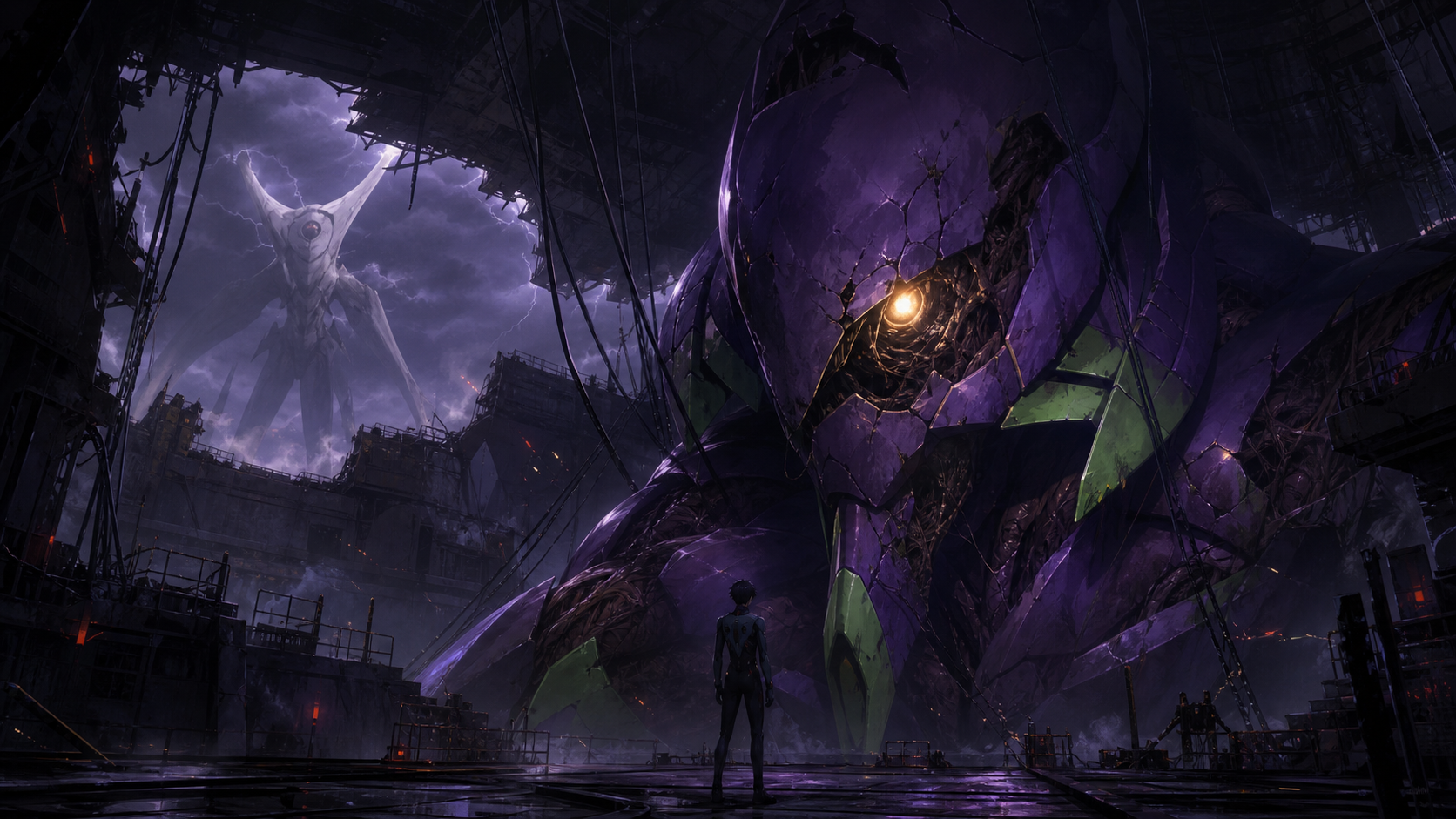
Then Unit-01 wakes up hungry. The Eva fights past its power limit, tears Zeruel apart, and eats the Angel’s S² engine. The program stops looking like humanity controlling a weapon. The weapon looks like a living body using NERV, Shinji, and the Angel to complete itself. Every adult who believed the Eva could be contained has to watch the machine feed.
SHINJI QUITS
Refusing unsafe work is not betrayal when the institution betrayed the worker first
Shinji’s confrontation with Gendo matters because he finally names a boundary. He will not continue piloting after the Dummy Plug attack. Gendo responds with the emotional temperature of a manager replacing equipment. He accepts Shinji’s resignation because he believes the Dummy system and Rei can preserve operations. The cold response confirms Shinji’s fear: NERV values his function more than his person.
Most stories about young heroes frame departure as selfishness. The hero is reminded that special power creates special duty, then returns after learning to stop thinking about personal pain. Evangelion refuses that clean lesson. Shinji has legitimate reasons to leave. He was deceived about Toji, immobilized in the cockpit, and forced to witness Unit-01 destroy his friend. Nobody offers accountability before asking what comes next.
The train platform turns resignation into something ordinary. Shinji carries a bag and waits like any person leaving a bad job or broken home. That normal image exposes the absurdity NERV tries to hide. A fourteen-year-old should be allowed to board a train. The crisis exists because adults built planetary defense around children whose refusal was always possible.
Gendo assumes Shinji can be replaced because command culture treats relationships as interchangeable inputs. Rei can pilot. The Dummy Plug can imitate a signal. Another compatible child can be selected. What Gendo misses is that Unit-01 has its own relationship with Shinji. The machine is not neutral hardware waiting for whichever approved operator sits down.
ZERUEL
The strongest Angel walks through defenses built by adults and reaches children first
Zeruel’s arrival is brutally efficient. The Angel tears through Tokyo-3’s layers with none of the hesitation that gave NERV time in earlier battles. Armor, weapons, and geography fail. Headquarters has invested enormous resources in walls and command systems, but the final defense still depends on Asuka and Rei entering machines that damage them.
Asuka attacks because fighting is the identity she has left. Her defeat lands harder after recent failures because Zeruel does not merely overpower Unit-02. The Angel exposes how little her training can guarantee. Asuka built self-worth around being the best pilot, yet a stronger enemy erases that distinction in minutes. NERV offers no emotional structure for a child whose assigned excellence stops producing victory.
Rei’s decision is quieter and more alarming. She takes an N² mine and charges Zeruel at close range, accepting the possibility of death as if self-erasure were another operational technique. The plan fails. The explosion damages her and leaves the Angel standing. NERV has taught Rei that being useful can mean disappearing completely.
The contrast between Asuka and Rei is sharp. Asuka fights to prove she exists. Rei risks death because she has been taught her existence can be substituted. Both routes serve NERV. The organization benefits whether a child seeks validation through battle or treats life as expendable inventory.
KAJI’S GARDEN
Kaji does not order Shinji back. He explains what will be lost if nobody acts
Kaji’s conversation with Shinji is one of the episode’s most important choices. He does not defend Gendo. He does not pretend NERV treated Shinji fairly. He talks about his watermelons, the people he cares about, and the fact that only Shinji can decide what to do. That respect gives Shinji more agency than the formal command structure ever has.
The garden matters because Kaji has created life beside an organization preparing for apocalypse. Watermelons are small, slow, and unnecessary to NERV’s mission. Caring for them proves survival means more than preventing extinction. A world saved only as an abstract population count would not explain why anyone should fight. Kaji gives Shinji something specific: people and ordinary futures worth protecting.
His argument still carries pressure. When one child is genuinely the only person who can stop a catastrophe, freedom becomes painfully narrow. Kaji recognizes that pressure rather than disguising pressure as duty. He does not say Shinji owes NERV. He says Shinji must live with whichever decision he makes. Honest pressure is not freedom, but honesty gives the choice moral weight.
Shinji returns because his care for others survives his anger. That return should not be used to absolve NERV. Exploitative systems often survive because good people cannot tolerate watching innocent people suffer. Compassion fills the hole left by institutional failure, and leaders later point to the rescue as proof the structure was justified.
THE RETURN
Shinji chooses Unit-01 after seeing Rei and Asuka pay for his absence
When Shinji reaches headquarters, he does not ask Gendo to repair their relationship. He demands to pilot. The line has force because Shinji speaks from his own decision rather than obedience. He knows the danger, knows Gendo may use him again, and enters anyway. Agency does not require a comfortable choice. Agency requires that the decision belongs to the person carrying the cost.
Gendo’s acceptance remains transactional. He needs Unit-01 active. Father and son temporarily want the same operational result, but their reasons remain opposed. Shinji wants to protect people. Gendo wants the scenario to continue. Cooperation does not equal reconciliation.
The launch places Shinji back inside the body that betrayed his command one episode earlier. That return would be impossible without denial, courage, or both. Unit-01 is simultaneously his weapon, his mother’s hidden presence, his prison, and the only force capable of stopping Zeruel. Evangelion refuses to let one object hold a single emotional meaning.
Shinji fights with urgency we have rarely seen. He attacks because the decision is his, and that difference changes his posture. Yet conviction cannot solve every technical limit. Unit-01 runs out of power at the worst moment, turning the battle back into the old truth: a child’s will is trapped inside systems designed by adults.
UNIT-01 AWAKENS
The Eva continues after the battery dies because Unit-01 was never only a machine
When the timer reaches zero, NERV expects Unit-01 to stop. The Eva moves anyway. That moment breaks the central promise of the program. Headquarters claimed Evas were controlled weapons with measurable limits. Unit-01 proves the limit belonged to the restraint system, not the organism underneath.
The regeneration of Unit-01’s arm makes the awakening feel biological rather than mechanical. The Eva does not wait for repairs or spare parts. Unit-01 uses Angel flesh and its own hidden capacity to rebuild. Ritsuko’s explanations can no longer keep the audience at a safe technical distance. The boundary between Eva and Angel has collapsed in front of the staff.
Then Unit-01 eats Zeruel. The act is not elegant, heroic, or human. The Eva tears into the Angel and consumes the S² engine like an animal reclaiming a missing organ. NERV wanted infinite power. Unit-01 acquires infinite power through hunger, not engineering. Gendo’s project advances, but control shrinks at the same moment.
Shinji’s relationship to the feeding remains deliberately unstable. He called for the Eva to move. Unit-01 answered beyond the shape of his request. That difference mirrors Episode 18 in reverse. The Dummy Plug moved Unit-01 against Shinji’s conscience. Now Unit-01 moves beyond Shinji’s conscious control to save him. Losing control can produce rescue and terror in the same scene.
THE TITLE
Introjection is what happens when the outside world is swallowed before the self can examine what entered
Introjection describes taking external ideas, values, or people into the self without fully processing them. Shinji has spent the series swallowing other people’s demands. He pilots because Misato needs him, Gendo orders him, classmates praise him, and strangers would die if he refused. Episode 19 asks whether his return is a chosen value or another demand absorbed so deeply that pressure now sounds like his own voice.
The answer is not simple. Shinji genuinely wants to protect people. That desire belongs to him. The surrounding system has also trained him to measure worth through usefulness. A person can choose courage while carrying beliefs planted by coercion. Evangelion respects that contradiction instead of pretending one triumphant launch heals the damage.
Unit-01 performs a literal introjection by eating Zeruel’s S² engine. The Eva takes the Angel’s power inside and becomes something new. Shinji internalizes responsibility. Unit-01 internalizes an enemy organ. Both transformations solve the immediate crisis while creating a larger threat nobody fully understands.
WHAT THE EPISODE GETS RIGHT
A heroic return can be brave and still reveal an abusive system
Episode 19 delivers the emotional satisfaction of Shinji returning without rewriting his reasons for leaving. Gendo remains wrong. NERV remains unsafe. Toji remains injured. Shinji’s decision gains power because the episode does not force forgiveness into the scene.
The story also understands that institutions often depend on the conscience of people they mistreat. Shinji returns because he cannot watch Rei, Asuka, Misato, and the city die. NERV benefits from qualities the organization does not protect: empathy, loyalty, and moral imagination. Gendo treats those qualities as predictable inputs.
Unit-01’s awakening prevents the episode from ending as simple empowerment. Shinji acts, but the machine exceeds him. Victory opens another layer of danger. That refusal of clean triumph is why Evangelion’s action still feels unsettling decades later.
WHAT COULD BE BETTER
Asuka and Rei absorb enormous damage while the episode centers Shinji’s decision
The structure needs their defeats to prove the crisis, but both girls become evidence in Shinji’s moral journey. Asuka’s collapse and Rei’s suicidal attack deserve more interior attention. Their choices come from long histories of conditioning, not merely tactical desperation.
Kaji’s conversation is respectful, yet his claim that Shinji alone can act risks reinforcing the chosen-child trap. NERV created a defense structure with no humane redundancy. The episode could press harder on why every adult accepts that failure as reality rather than scandal.
Even so, the compressed focus gives the episode momentum. Every scene moves Shinji from refusal toward a return that feels chosen and compromised. The missing perspectives remain costs, not fatal flaws.
RAERAE’S VERDICT
Shinji returns to save people. Unit-01 wakes to feed
“Introjection” is the series at full power because every victory carries a warning. Shinji refuses Gendo, leaves NERV, and returns without forgiving the institution. He chooses people over pride, but the choice does not make the adults right.
Zeruel destroys the illusion that NERV’s defenses are sufficient. Unit-01 destroys the illusion that NERV controls the Evas. The episode closes with humanity alive because a living weapon consumed an Angel and claimed power beyond its leash.
Shinji wanted Unit-01 to move. The Eva moved for reasons larger than Shinji understands. That answer saves headquarters and should terrify everybody inside. NERV spent years building a god-shaped weapon. Episode 19 shows the weapon becoming hungry enough to finish the design itself.