
RAERAE REACTS · EPISODE 18
Evangelion Episode 18: Ambivalence
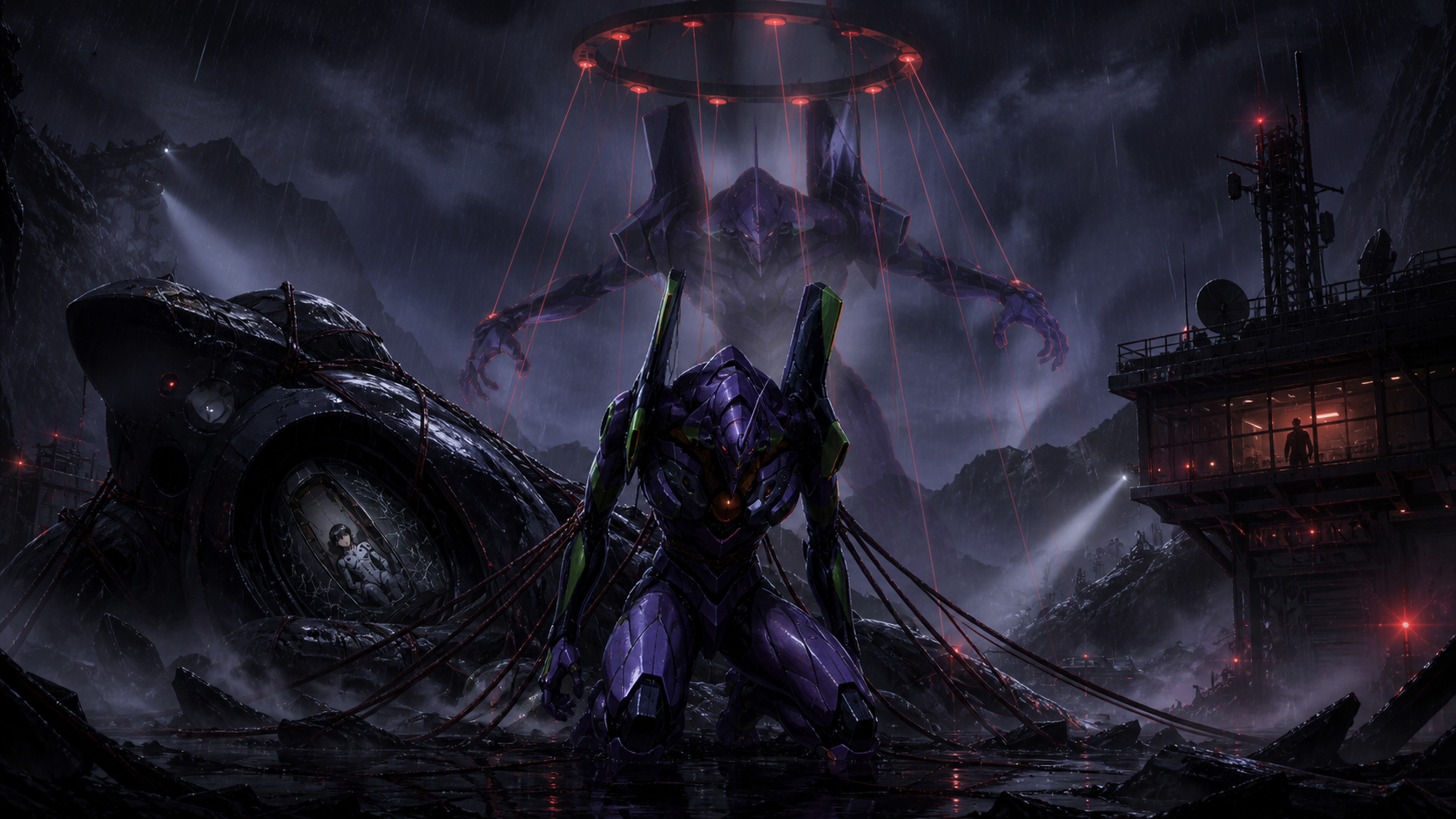
Shinji refuses to kill another pilot. Gendo answers by taking away his control, making Unit-01 destroy Unit-03, and forcing a child to witness what obedience looks like when consent becomes inconvenient.
BOTTOM LINE
NERV does not lose control of Unit-01. NERV chooses control over Shinji
Episode 18 is where every polite lie about the pilot program collapses. Toji enters Unit-03 because NERV traded support for his sister against his willingness to serve. Bardiel infects the Eva, headquarters labels the machine an Angel, and Shinji refuses to attack because another child remains trapped inside. His refusal is the first morally clear decision in the battle. Gendo treats that clarity as a malfunction and activates the Dummy Plug.
Unit-01 then tears Unit-03 apart while Shinji screams from inside the cockpit. The violence is not frightening only because one Eva crushes another. The real horror comes from a father proving that his son’s body can be retained while his judgment is discarded. Shinji becomes a conscious passenger inside his own weapon. Gendo gets the result NERV wants, and the system calls the operation successful until Shinji sees who occupied the entry plug.
“Ambivalence” is often remembered for the gore, but the episode is really about institutional definitions of responsibility. Gendo will argue that destroying Unit-03 saved lives. Shinji will know that Toji’s life counted too. Both facts can exist. The adult failure began before the battle, when NERV recruited Toji, hid his identity from Shinji, rushed an activation test, and built a control system designed to override the pilot whenever a child’s conscience interfered with command.
THE FOURTH CHILD
Toji walks into Unit-03 carrying a lunch he never gets to eat
Toji’s final ordinary moments make the disaster unbearable. Hikari prepares lunch for him, still hoping care might become a confession. Toji cannot meet that hope because his day has already been claimed by NERV. The episode keeps the lunch close enough to the activation test that viewers feel two possible lives touching. One path contains school, awkward affection, and a sister recovering. The other path contains a plug suit, classified orders, and an Eva infected before Toji can understand what piloting means.
Toji is not reckless. He looks afraid, and fear is the correct response. His earlier toughness never meant he was ready for neural synchronization or combat. NERV selected him because he could connect to an Eva, not because he understood the job. Compatibility becomes the institution’s excuse to skip preparation. A usable body is treated as a qualified person.
The adults also deny him the basic dignity of informed risk. Ritsuko and the technical staff know Unit-03 crossed dangerous conditions during transport. The activation still proceeds. Nobody gives Toji a meaningful chance to reassess after new uncertainty appears. Consent should be renewed when the danger changes. NERV treats the signature as permanent access.
Bardiel’s infection removes Toji’s control before he can make a single choice as a pilot. That detail matters. He does not fail a mission or ignore an order. The system places him inside compromised equipment, then prepares to destroy the machine around him. Toji becomes both hostage and target because adults built a process where a child is the least protected component.
THE BATTLE
Shinji sees a person where headquarters sees a contaminated asset
When Unit-03 attacks, Shinji understands one fact that headquarters tries to turn into background noise: a pilot remains inside. He refuses to fight because killing the Angel may also kill that person. The refusal is not cowardice. Shinji has fought Angels while terrified, injured, and furious. Here he draws a moral line. A command cannot erase the human being attached to the target.
Gendo responds as if Shinji has created the crisis. The framing is dishonest. NERV created the crisis through secrecy and rushed procedure. Shinji merely refuses to solve the adults’ failure by crushing another child. His hesitation exposes the part of command culture that depends on soldiers accepting narrowed definitions. Headquarters wants him to see “target.” Shinji keeps seeing “pilot.”
The episode does not offer an easy tactical answer. Unit-03 is dangerous, and allowing Bardiel to reach headquarters could kill many people. That pressure is real. A stronger institution would have planned rescue contingencies, disclosed pilot identity, and established options beyond immediate destruction. NERV instead relies on the Dummy Plug, a technology whose purpose is not rescue. The device exists to make the Eva obey when the child will not.
Shinji’s moral decision therefore collides with a system specifically engineered to bypass morality. The battle is not child versus Angel. The battle is a child’s conscience versus an organization that considers conscience an unreliable control surface.
THE DUMMY PLUG
Gendo calls automation when his son refuses to become an executioner
The Dummy Plug transforms Unit-01 from Shinji’s difficult extension into a predator he cannot stop. Every earlier synchronization scene taught viewers that pilot and Eva share pain, impulse, and identity. Episode 18 corrupts that connection. Shinji remains physically linked enough to witness the attack, yet authority over movement belongs to a simulated pilot signal. NERV keeps his suffering and removes his agency.
That arrangement reveals the Dummy Plug’s true politics. Automation is often sold as neutral efficiency, but somebody decides what the automated system is allowed to do. Gendo authorizes the target. The Dummy Plug carries out his choice without hesitation. Machines do not remove human responsibility. Machines can hide responsibility behind procedure and speed.
Unit-01’s brutality makes the lie impossible to ignore. The Eva does not simply disable Unit-03. Unit-01 breaks limbs, tears armor, and crushes the entry plug in its hand. Gendo watches the destruction with the calm of someone who has converted murder into an operational step. The staff reacts with horror, but nobody stops the system. Their shock becomes morally thin because they helped build and maintain the chain that makes the attack possible.
Shinji’s screams create a second layer of violence. He is forced to experience complicity without choice. Gendo can later say Shinji did not perform the attack, but Shinji’s body occupied the cockpit and his eyes watched Unit-01 move. Trauma does not care about the technical distinction. The Dummy Plug protects command from disobedience while leaving the human pilot to carry the memory.
THE ADULTS
Misato arrives too late because honesty was delayed until honesty lost power
Misato wanted to tell Shinji that Toji had been selected. Wanting is not the same as telling. Her delay means Shinji enters battle without the information most likely to shape his choice. Headquarters knows the identity inside Unit-03. Shinji does not. That imbalance lets Gendo frame the situation as an abstract tactical problem until the damage is complete.
Misato’s absence during the key decision is narratively convenient and morally precise. She often acts as the adult who tries to protect the children within NERV, yet the institution can continue without her. Personal kindness cannot repair a structure that concentrates final authority in Gendo. Misato may comfort Shinji after a disaster. She cannot undo a command system built to overrule him.
Ritsuko understands more about the Dummy Plug than most of the staff. Her technical knowledge does not produce ethical resistance. Evangelion keeps showing how expertise can become obedience when a professional defines responsibility too narrowly. Ritsuko can explain how the system works. She avoids asking whether the system should exist. Competence becomes dangerous when competence is separated from refusal.
The bridge crew looks sickened as Unit-01 destroys Unit-03. Their reactions matter because they are not monsters. Ordinary people can participate in monstrous outcomes while feeling bad about them. Horror after the order does not replace resistance before or during the order. The episode refuses to let discomfort count as innocence.
THE FATHER
Gendo saves the city and destroys any remaining claim to Shinji’s trust
Gendo’s defenders can point to the immediate threat. Bardiel controlled an Eva and moved toward NERV. Waiting could have caused mass casualties. The tactical urgency is real, which makes the episode stronger. Gendo does not choose between a good option and an evil option. He chooses the fastest option inside a crisis his own organization helped create.
His failure lies in everything he refuses to value alongside victory. He does not attempt to preserve Toji’s life with equal urgency. He does not prepare Shinji with the truth. He does not acknowledge the psychological damage of forcing his son to witness the attack. Gendo counts external casualties and treats internal casualties as fuel.
The father-son relationship cannot recover through a simple apology because Gendo reveals a permanent hierarchy. NERV’s mission comes first. Shinji’s consent, friendship, and mental survival come later. Yui’s connection to Unit-01 complicates Gendo’s motives, but complexity does not erase the harm. He uses the machine tied to Shinji’s mother to override their child.
That is why the episode’s title fits. Ambivalence is not indecision in the shallow sense. Shinji can want humanity protected and refuse to kill a trapped pilot. Misato can care about Shinji and still serve NERV. Gendo can believe his mission saves the world and still abuse his son. Conflicting feelings do not cancel consequences.
THE ENTRY PLUG
The reveal is cruel because Shinji learns the truth after his knowledge can no longer matter
When the damaged entry plug is exposed, Shinji sees Toji. The timing completes NERV’s betrayal. If Shinji had known earlier, his refusal would have carried a name and a face. By hiding Toji’s identity, the adults prevented informed resistance. They reveal the truth only after action has become irreversible.
Shinji’s shock is not only grief for Toji. He realizes every adult around him knew more than he did. Misato knew Toji was selected. Gendo knew who occupied Unit-03. The staff processed the activation. His friends and commanders allowed him to enter battle against a classmate while treating ignorance as operational necessity. Trust dies through coordination.
The visual of Toji’s bloodied body also destroys the comforting boundary between school and NERV. Shinji cannot return to class and pretend piloting is a separate job. The institution has reached into his classroom, selected his friend, and returned that friend broken. Tokyo-3’s children were never outside the war. The school was part of the supply chain.
WHAT THE EPISODE GETS RIGHT
A necessary outcome does not excuse the system that manufactured the choice
Evangelion refuses the cheap argument that saving more lives automatically cleans every decision leading to the rescue. Stopping Bardiel may have been necessary in the final moment. That does not absolve NERV for recruiting Toji, withholding information, ignoring transport risk, and creating an override that preserves mission success by sacrificing pilot agency.
The episode also understands that automation can intensify violence rather than make violence objective. The Dummy Plug acts without fear, empathy, or hesitation, but those missing qualities are not proof of fairness. They are the reason the attack becomes excessive. Human restraint looked inefficient to Gendo because restraint recognized a life that command wanted removed from the calculation.
Most importantly, Shinji’s refusal is treated as morally serious. The story does not mock him for weakness. His decision creates tactical danger, yet his objection remains correct: another person is inside the target. Mature responsibility requires holding that fact alongside the threat, not erasing the person to make the order easier.
WHAT COULD BE BETTER
Toji deserves more interior space before the story turns his suffering into Shinji’s breaking point
The episode gives Toji tenderness and fear, but his perspective still recedes once Unit-03 activates. His pain becomes the event that radicalizes Shinji. That structure is powerful and also limiting. Toji has reasons, relationships, and anger of his own. More time inside his experience of the entry plug would make the violence belong to him before the aftermath belongs to Shinji.
Hikari’s lunch similarly becomes a symbol the audience understands while she remains outside the event. Her ignorance is part of the tragedy, but one later beat showing the abandoned meal or her waiting would keep Toji’s school life present during the battle. The episode prioritizes command-room horror. A small return to Hikari could make the cost feel even wider.
The battle’s tactical alternatives are also left vague. That ambiguity supports the moral conflict, but the adults use urgency as their defense. Showing one rescue option rejected for speed would place responsibility even more clearly. NERV already has cages, restraints, ejection systems, and enormous technical resources. The absence of a visible attempt tells us plenty, though the episode could press harder.
RAERAE’S VERDICT
The Angel infects Unit-03. NERV turns that infection into a lesson about obedience
“Ambivalence” is one of Evangelion’s strongest episodes because the physical horror and social horror are the same event. Bardiel takes Toji’s Eva. Gendo takes Shinji’s Eva. Both boys lose control of machines that are supposed to respond to them, and the adults preserve the program by treating each child as replaceable.
Shinji’s refusal is the closest thing to heroism in the episode. He sees the trapped pilot when everybody else sees a target. Gendo wins the battle by removing that human recognition from the controls. Unit-01 saves headquarters, but the victory proves NERV cannot be trusted with the children who make victory possible.
The final reveal does not surprise Shinji with random tragedy. The reveal shows him the full architecture of the lie. Toji was selected, used, endangered, and nearly killed while adults managed Shinji’s ignorance. The next conflict cannot be solved by asking Shinji to calm down. His anger is evidence that his conscience survived the Dummy Plug.