
Gendo Ikari
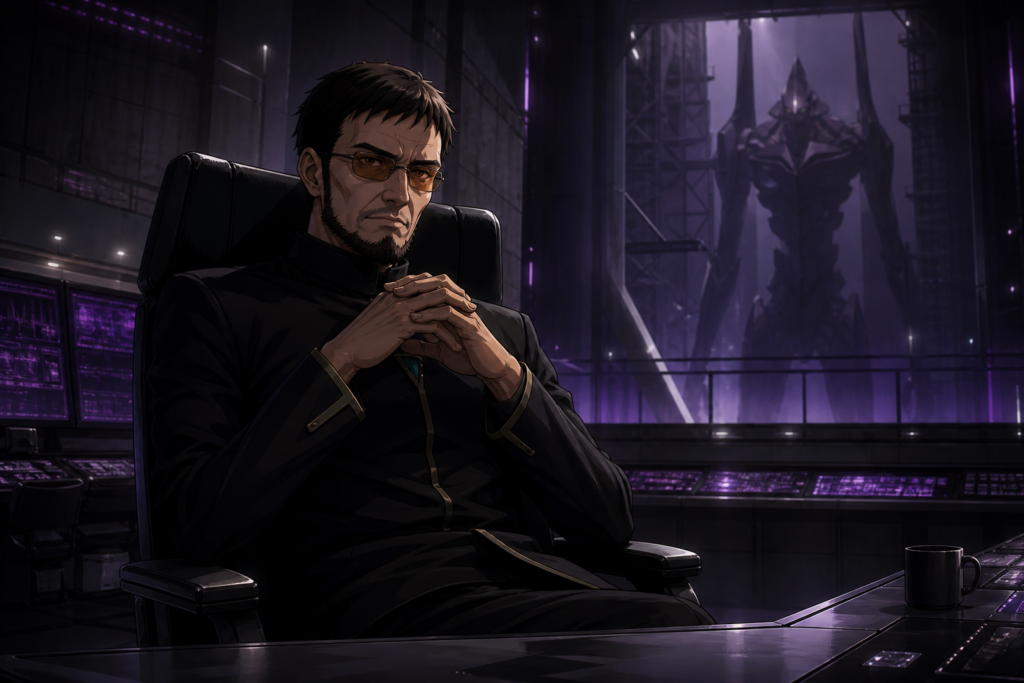
CVM Sekai Character File · Evangelion
Gendo can organize humanity’s survival plan, manipulate secret councils, and command living gods. He cannot risk an honest conversation with his son.
Character File
NERV commander, Shinji’s father, and architect of a private Instrumentality plan.
Fumihiko Tachiki
GEHIRN, NERV, and a collapsing alliance with SEELE.
Bottom Line
Gendo turns grief into public infrastructure and calls the result necessity.
Gendo Ikari is not frightening because he never feels. Gendo is frightening because one feeling becomes more important than everybody else’s right to live. After Yui disappears into Evangelion Unit-01, he builds his career, family relationships, scientific program, and Instrumentality plan around reaching her again. The goal sounds romantic only when the bodies used along the way remain offscreen.
Shinji, Rei, Ritsuko, Naoko, Fuyutsuki, Misato, and NERV’s entire workforce enter Gendo’s system as tools with different permissions. He rarely needs to shout because budgets, clearances, laboratories, weapons, and emergency rules already speak for him. His cruelty is administrative. A command arrives in a calm voice, and another person absorbs the moral cost.
Before NERV
Gendo Rokubungi becomes Gendo Ikari and builds a life around Yui.
Gendo enters the history under the surname Rokubungi. His early reputation suggests an abrasive, isolated man who knows how to survive conflict without forming many bonds. Meeting Yui changes his direction. He takes her surname, enters the world surrounding SEELE’s research, and gains access to people and institutions that will shape humanity after Second Impact.
The marriage matters because Yui is not merely an excuse added after the damage. Gendo loves her. Evangelion refuses the comforting belief that love automatically improves the person who feels love. Gendo’s attachment narrows his moral world until reunion with Yui outranks everyone outside that desire, including the child they created together.
Yui’s contact experiment with Unit-01 leaves her soul inside the Evangelion. Gendo responds by sending Shinji away and moving deeper into the project. The abandonment is often framed as cold strategy, but later material reveals fear beneath the strategy. Gendo expects intimacy to create pain, so he prevents closeness before another person can reject him. Shinji inherits the same defense without receiving the power that makes Gendo’s version dangerous.
Father and Commander
He summons Shinji when the machine needs a pilot.
The first episode establishes their relationship with brutal efficiency. Gendo does not ask about Shinji’s life, apologize for years of absence, or explain why a fourteen-year-old must enter an Evangelion. He presents the emergency and expects compliance. When Shinji refuses, injured Rei becomes visible as the alternative. The arrangement turns another child’s suffering into pressure before Shinji understands the organization.
Gendo praises Shinji rarely and withholds information constantly. The pattern keeps Shinji hungry for approval while ensuring that approval remains useful. Gendo does not need to invent Shinji’s insecurity. He created the conditions that feed insecurity, then benefits when the boy returns to the cockpit searching for proof that he matters.
The Dummy Plug attack on Unit-03 exposes the limit of their contract. Shinji refuses to attack because a human pilot remains trapped inside. Gendo removes Shinji’s control and makes Unit-01 destroy the infected Eva through an artificial pilot system. The decision may protect NERV from an Angel, but the method teaches Shinji that consent ends whenever obedience becomes inconvenient.
Rei, Naoko, and Ritsuko
Gendo repeatedly converts women’s attachment into access.
Rei receives a tenderness that Gendo denies Shinji, yet tenderness does not make their relationship safe. Rei’s body and identity exist inside his plan for reunion with Yui. He protects her when she remains necessary, stores replacement bodies beneath headquarters, and assumes that a lifetime of controlled dependence will guarantee obedience at the final moment.
Naoko Akagi and Ritsuko Akagi provide the scientific intelligence behind the Magi, Evangelion research, and NERV’s technical authority. Gendo forms intimate relationships with both women across generations. The pattern is not incidental office gossip. Access to his approval becomes tangled with professional power, secrecy, grief, and the desire to feel chosen. Ritsuko eventually realizes that technical importance never made her irreplaceable.
Gendo’s system works because every person sees a different sliver of his plan. Rei sees selective warmth. Ritsuko sees professional trust and private attention. Fuyutsuki sees historical purpose. SEELE sees a useful commander. Shinji sees a father who might finally look at him. Nobody receives enough truth to give meaningful consent.
NERV and SEELE
Gendo serves the conspiracy while preparing to steal the ending.
NERV publicly defends humanity from Angels. SEELE supports that defense because the battles, Eva development, Dead Sea Scrolls, and Human Instrumentality Project belong to a longer agenda. Gendo accepts SEELE’s resources while pursuing a version of Instrumentality centered on Yui. Both sides treat human extinction and reconstruction as administrative outcomes. Their disagreement concerns control, not the public’s right to choose.
Gendo’s composure gives the impression that he understands every event. Several crises exceed his calculations, and Unit-01 repeatedly acts according to Yui’s will rather than his command. His authority depends on appearing closest to the truth, even when the living weapon behind the glass has an agenda he cannot fully control.
The End of Evangelion
Rei’s refusal destroys the future Gendo treated as guaranteed.
During The End of Evangelion, Gendo attempts to begin his version of Instrumentality through Rei, Adam, and Lilith. He speaks as if the final procedure belongs to him. Rei removes his hand, rejects his control, and chooses Shinji as the person whose desire will shape the event.
The rejection matters because Gendo considered Rei a vessel rather than a person capable of judgment. Her refusal is not a technical failure. Gendo loses because somebody he raised as replaceable develops a self.
His final confrontation with Yui, Shinji, and Kaworu reveals the fear beneath his distance. Gendo believed closeness would hurt Shinji, but withdrawal guaranteed a different wound. Unit-01 bites him in half inside the Instrumentality sequence. The image makes his life’s logic physical: the mother, machine, and project he used to avoid human vulnerability become the form of judgment.
Rebuild Continuity
The later films finally make father and son share the same room emotionally.
Rebuild preserves Gendo’s manipulation while expanding his isolation, technological reach, and willingness to remake reality. The later continuity gives him more explicit power and a more direct final confrontation with Shinji. Their conflict cannot end through a stronger robot because the real fight concerns two people who use distance to survive rejection.
Evangelion: 3.0+1.0 Thrice Upon a Time allows Gendo to speak about childhood solitude, Yui, loss, and the resemblance between himself and Shinji. Explanation does not erase the worlds he damaged. The scene matters because Gendo finally participates in the kind of conversation he avoided across the franchise. Shinji listens without surrendering his own future to his father’s grief.
The Rebuild ending gives Gendo a different final movement from the original film. He can recognize Shinji, release part of his control, and accept that reunion cannot require everyone else to remain trapped inside his refusal to mourn.
Key Relationships
Shinji Ikari
Son, pilot, emotional mirror, and the person Gendo avoids because fatherhood can expose failure.
Yui Ikari
Wife, Unit-01’s resident soul, and the center of the reunion plan that consumes Gendo’s moral world.
Rei Ayanami
Created vessel, dependent child, and the person whose final refusal proves that control never erased agency.
Ritsuko Akagi
Chief scientist, lover, and another brilliant woman whose attachment Gendo turns into institutional labor.
Kozo Fuyutsuki
Deputy commander, witness to Yui’s history, and one of the few adults who understands much of Gendo’s private direction.
SEELE
Patrons, conspirators, and eventual enemies competing to decide whose Instrumentality becomes humanity’s ending.
Voice Performance
Fumihiko Tachiki makes power sound settled before the room agrees.
Tachiki gives Gendo a low, controlled Japanese voice that rarely spends extra energy. The performance suits a commander whose authority lives in the system around him. Small breaks in control therefore matter. Fear, urgency, anger, and longing become visible because the baseline remains so restrained.
Across the original anime, The End of Evangelion, and Rebuild, Tachiki preserves the same guarded authority while allowing age, desperation, and eventual confession to change the weight behind Gendo’s sentences. The voice helps the franchise reveal a frightened man without making fear an excuse for what the commander does.
Research Routes
Facts, interpretation, and fan argument need different receipts.
Franchise research consulted EvaGeeks’ Gendo Ikari reference, MechaBay’s Gendo character file, and episode discussions from Lost in the Movies. CVM Sekai uses those sources as research material, checks precise release and credit claims against official or licensed sources, and writes an independent editorial analysis.
Continue with the Episodes 1–26 directory, the Evangelion Movies hub, or the main Evangelion hub.