
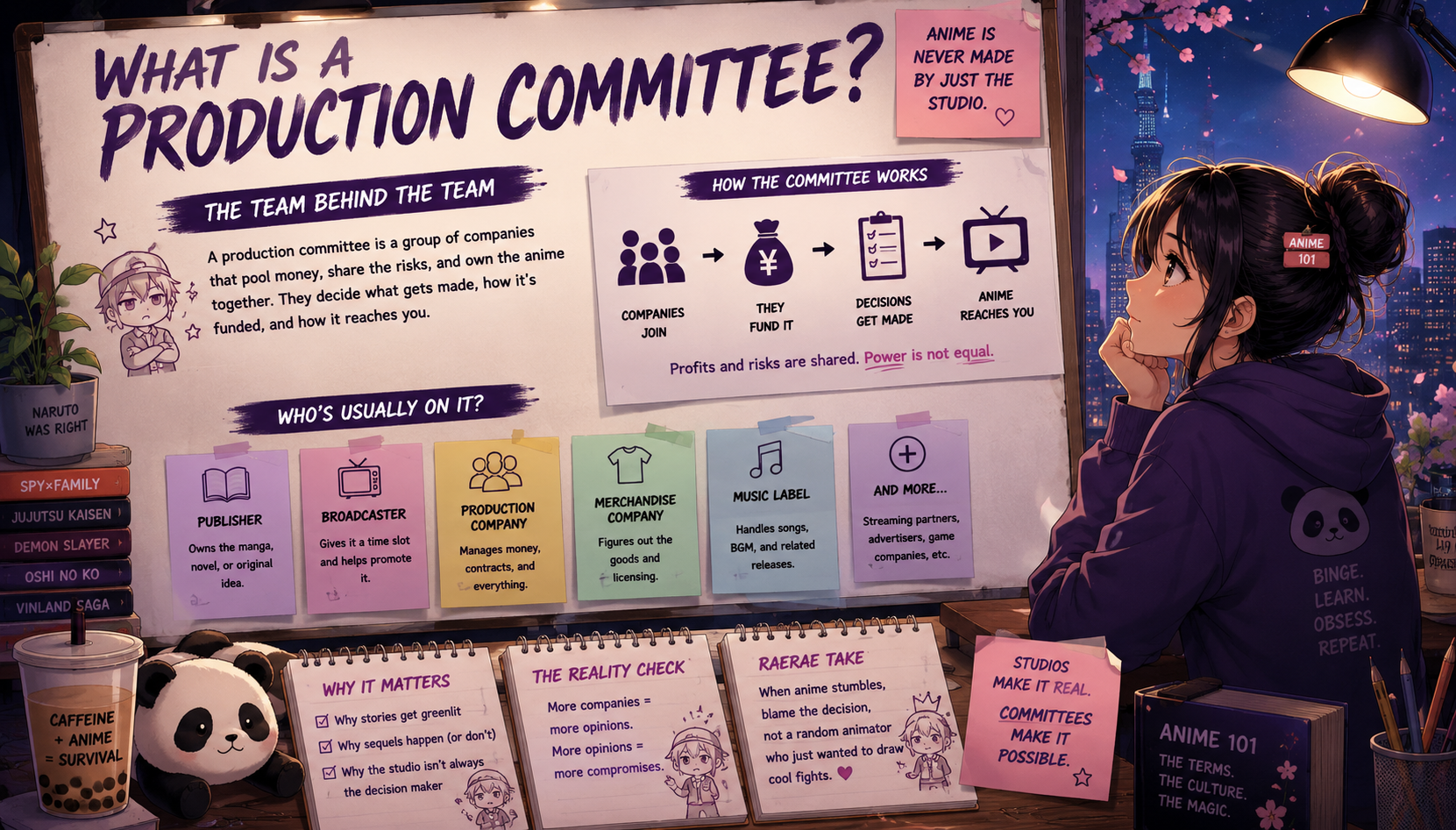
What Is a Japanese Anime Production Committee?
The studio animated the show, so the studio must own it, control the episode count, approve the sequel, sell the merchandise, and collect all the money. Right? Usually, no. Japanese anime can sit inside a much larger business structure that viewers barely see.
- What a production committee actually is
- Why Japan uses production committees
- Who usually sits on the committee
- Where the animation studio fits
- How the money moves
- Who owns the anime and its rights
- Does every member have equal power?
- What committees have to do with sequels
- Why merchandise and music matter
- How streaming changes the system
- Does a hit mean the animators get rich?
- Is the system only Japanese?
- Common production committee myths
- Why fans should care
- Sources and deeper reading
1. What is a Japanese anime production committee?
A Japanese anime production committee, commonly referred to in Japanese credits as a 製作委員会 (seisaku iinkai), is a group formed around a particular project. Instead of one company necessarily financing the entire anime and controlling every commercial function, several businesses can participate in the project together.
The exact structure varies. One committee might include a publisher that owns or manages the original manga property, a television broadcaster, a music company, a video distributor, and a merchandise company. Another might include a streaming company, game publisher, advertising agency, film distributor, or the animation studio itself.
The Japan Fair Trade Commission described two major ordering patterns in its animation-industry study: a conventional model in which a television station orders the production, and a committee model in which a production committee orders the principal animation contractor. In that survey, the committee model was already described as predominant.
That variability is important because fandom loves simple charts. Anime business structures occasionally respond by being allergic to simplicity.
↑ Return to top2. Why does Japan use production committees?
Anime can be expensive to produce, and success is never guaranteed. A publisher might believe an adaptation will increase manga or light-novel sales. A music company may see an opportunity for opening themes, ending themes, soundtracks, character songs, and live events. A merchandise company may see figures, apparel, collectibles, collaborations, and licensing. A broadcaster wants programming. A distributor wants content it can sell or license.
Those companies do not necessarily want the same thing from the anime, but they can all benefit if the project succeeds. Pooling investment allows several companies to participate instead of forcing one company to shoulder every cost and every risk.
This is one reason thinking of anime solely as “a television show made by a studio” can miss half the picture. The animation is the thing we see. The business around it may stretch into many other markets.
3. Who usually sits on a production committee?
There is no required membership list. Production committees are assembled around the commercial needs of a specific project, so the companies involved can change from anime to anime.
Credits can give clues about the companies involved, but a list of corporate names does not automatically tell you the full contract, investment ratios, voting rules, or internal negotiations.
In other words: credits are receipts. Credits are not psychic powers.
↑ Return to top4. The animation studio and the production committee are not the same thing
This might be the most useful thing on the entire page.
The studio is generally associated with the physical production of the animation: animation staff, production management, layouts, key animation, in-between work, compositing, backgrounds, episode production, and the countless other pieces required to turn a project into moving images.
The production committee sits on the business side of the project. It can organize financing, rights, commercialization, licensing, distribution, and other project-level interests.
Sometimes the animation studio is also a committee investor. When that happens, the studio may participate in rights and downstream revenue in ways that a studio working only as a production contractor may not.
The Japan Fair Trade Commission found that, in its surveyed committee-system arrangements, copyright generally did not belong to the principal animation production company when that company had not invested in the production committee.
The two Japanese words that make this even more confusing
Anime credits can distinguish between 製作 and 制作. Both can end up romanized as seisaku, which is extremely helpful if your personal goal is suffering.
As a practical reading rule, 製作 often points toward the producing, financing, planning, and business side of a project, while 制作 often points toward the actual creation or production work. The distinction is useful, but credits and corporate practices can vary, so I would treat it as context rather than an eternal law of the universe.
5. Follow the money: how the committee structure works
The simplest version looks like this: companies join the project, contribute investment or commercial resources, the project hires or works with the animation production side, the anime gets produced, and the resulting property can then generate money through several channels.
Real projects can be much more complicated than this diagram. Different companies may be responsible for different commercial “windows,” and contracts determine how rights, fees, and revenue are handled.
The JFTC’s animation-industry survey specifically discussed secondary-use revenue and the role of a “contact company” that can license secondary uses on behalf of rights holders. It also described revenue being distributed among committee investors.
That matters because an anime’s economic life does not end when the episode airs. The characters can keep earning money through uses that may have almost nothing to do with the original television broadcast.
↑ Return to topPanda Slayer Academy gets an anime
Imagine CVM Sekai’s definitely-real-and-absolutely-not-made-up mega-hit Panda Slayer Academy gets approved for animation.
Every participant wants the anime to succeed. They may still define success differently.
6. Who actually owns the anime?
The answer fans usually want is one company name. The answer they often get is “read the contracts.”
Copyright and exploitation rights can depend on the specific project structure. The committee may control major rights, different participants may hold or administer different uses, and the animation studio’s position can depend heavily on whether it invested in the committee and what its contracts provide.
The JFTC has explicitly warned against assuming the answer is simple. Its survey noted that copyright ownership can be unclear in specific cases and emphasized the need for parties to discuss who owns copyright and the consideration attached to transferring rights.
| Right / Business Area | Possible Interested Party | Why It Matters |
|---|---|---|
| Broadcast | Broadcaster / committee partner | Controls or participates in television use of the anime. |
| Streaming | Distributor / platform / licensing partner | Determines where and under what deal the anime reaches streaming audiences. |
| Home Video | Video distributor / committee partner | Handles Blu-ray, DVD, collector editions, and related sales. |
| Music | Music label / publisher / rights company | Opening themes, endings, soundtracks, character songs, and related uses. |
| Merchandise | Merchandise company / licensor | Figures, apparel, collectibles, collaborations, and licensed goods. |
| Overseas Licensing | Distributor / committee rights manager | International streaming, TV, home video, merchandise, and other licensing. |
That table is illustrative, not a universal rights chart. The actual allocation changes by production.
Which is inconvenient, because “Anime Business Structure Depends on the Contract” is not nearly as satisfying a headline as “STUDIO STOLE EVERYTHING.”
↑ Return to top7. Does every production committee member have equal power?
Do not assume that “five companies are on the committee” means five companies each own twenty percent and vote like a very polite corporate democracy.
Investment levels can differ. Contractual rights can differ. One company may take a leading organizational role. Another may control an especially valuable licensing area. Another might have strong influence because it controls the underlying source property. Another may have a smaller economic position.
Without seeing a project’s agreements, we should be careful about declaring which committee member had the final word on a particular decision.
This becomes especially important when fandom tries to identify a villain after a controversial adaptation choice. Sometimes reporting, interviews, or credits give us evidence. Sometimes people are pointing at the most famous company logo and filling in the rest with vibes.
↑ Return to top8. If the anime was popular, why is there no Season 2?
Because “popular” is not a sequel contract.
A continuation can require the relevant companies to decide that another production makes commercial sense, secure financing, line up rights, find production capacity, coordinate schedules, and determine how the next installment fits the larger property strategy.
The manga publisher may be thrilled because book sales exploded. The merchandise company may have had mediocre results. The animation studio may be booked. A key director may be unavailable. The committee structure might change. A streaming partner may want something different. Source material may not be ready. The project may still be profitable but lose priority to another opportunity.
None of those possibilities should be asserted about a specific anime without evidence. The point is that sequel approval exists inside a larger business and production system.
This is also why “Studio X refuses to make Season 2” can be wildly misleading. The studio may not own the rights to independently greenlight another season in the first place.
↑ Return to top9. Why do music and merchandise companies care so much about anime?
Because an anime is not only an episode file.
A character can become a figure. An opening theme can become a hit song. Voice actors can perform character music. The property can generate pop-up shops, collaboration cafés, clothing, stationery, mobile-game events, concerts, exhibitions, home-video editions, and licensing deals.
This helps explain why anime sometimes feels designed as the center of a multimedia campaign. In many cases, the animated series really is one piece of a broader property strategy.
That does not mean the creative work is fake or cynical. Art and commerce can occupy the same building. They have been doing that for a very long time.
↑ Return to top10. How did streaming change the production committee system?
Streaming made international audiences more financially important and created new ways to finance, license, distribute, and monetize anime. Platforms can license finished works, secure exclusivity, participate financially in projects, or become part of a larger production arrangement.
At the same time, the committee model did not simply vanish because Netflix, Crunchyroll, and other platforms arrived. Japan’s existing production, publishing, broadcasting, music, licensing, and merchandise businesses still have their own interests.
Modern anime can therefore combine old and new structures. A television anime may still use Japanese broadcast scheduling while reaching much of its global audience through streaming. International licensing revenue may matter far more than it did decades ago, while domestic publishing or merchandise businesses still remain important.
The Association of Japanese Animations’ annual industry reports are useful precisely because the anime business now spans multiple markets and revenue categories rather than one simple television metric.
↑ Return to top11. If an anime becomes a giant hit, do the animators get rich?
Not automatically.
This is one of the most uncomfortable consequences of understanding the production structure. Revenue attached to an anime property and compensation paid to the people physically creating the animation are not the same bucket of money.
Animators and production workers may be employees, contractors, freelancers, subcontractors, or part of companies working under production agreements. Their compensation depends on those employment and contractual relationships. Unless a studio or creator has participation rights that provide additional revenue, commercial success elsewhere in the property does not magically convert into a royalty check for every person who drew a frame.
The JFTC has repeatedly examined transaction conditions in anime production. Its 2009 survey documented multi-layer subcontracting, complaints about low production costs, problems with written orders, and dissatisfaction around copyright and secondary-use profits. More recently, the JFTC again examined transaction conditions affecting creators at film and anime production sites.
This is also why I would separate two conversations that fandom frequently smashes together: whether an anime property made money, and whether animation workers were compensated fairly. Those are related questions. They are not identical questions.
↑ Return to top12. Is the production committee system only used in Japan?
The broader idea of multiple companies financing, producing, distributing, and exploiting a piece of entertainment is absolutely not unique to Japan. Film, television, and animation industries around the world use co-productions, investors, broadcasters, studios, distributors, rights holders, and financing partnerships.
This article, however, is specifically about the Japanese anime production committee model and the way that system appears in Japan’s anime industry.
I would not automatically describe the financing structure behind Chinese donghua, Korean animation, an American animated series, or a French animated film as a “Japanese-style production committee” just because several companies participated.
Different industries have different legal structures, financing traditions, labor systems, broadcasting environments, state policies, distribution systems, and terminology.
13. Common Japanese anime production committee myths
14. Why should anime fans care who sits in a corporate committee?
Because once you understand the committee, a lot of anime news stops looking like random chaos.
You become more cautious when someone says a studio “refused” to make another season. You know that animating the show does not automatically mean owning the sequel rights. You understand why a publisher, music company, broadcaster, distributor, and merchandise company might all care about the same anime for completely different reasons.
You also start reading commercial success differently. Instead of asking only whether the television ratings or Blu-rays were good, you look at the larger property: source-material sales, music, merchandise, streaming, games, theatrical revenue, international licensing, and whatever else was relevant to that particular project.
And when an adaptation makes a controversial decision, understanding the structure does not tell us who made that decision. It tells us why we should stop pretending the most recognizable studio logo automatically answers the question.
That is the real value of this boring business vocabulary. It makes fandom criticism more accurate.
Stop yelling at the first logo you recognize
I get why fandom does it. The studio name is right there. MAPPA, Toei, Bones, Ufotable, Pierrot, whoever. We know the studio. We see the studio attached to the anime. Something happens that we hate, and the studio gets dragged into court by Twitter within six minutes.
Sometimes criticism of a studio is completely justified. The problem is the jump from “this studio animated the anime” to “this studio controlled every business and creative decision surrounding the anime.”
Those are not the same claim.
If we have an interview saying a director made the call, great. If credits and reporting identify a producer’s role, great. If documented production problems explain what happened, great. Bring the receipts.
What I do not want is to manufacture certainty because the real answer requires understanding a corporate structure nobody put in the opening credits with cute little arrows.
Knowing how production committees work actually makes me more willing to criticize anime, not less. I can separate the story decision, the animation work, the production schedule, the rights holders, and the business model instead of throwing everything into one bucket marked “STUDIO DID IT.”
Context does not kill the rant. Context tells me where to aim it.
15. Sources and deeper reading
Production committee arrangements vary by project, so this guide explains the general system without pretending one corporate structure applies to every anime. The sources below are useful starting points for the business, copyright, production, and industry claims discussed above.
- Japan Fair Trade Commission: Fact-finding Survey on Animation Industry · Industry structure, committee-system ordering, subcontracting, production costs, copyright, and secondary-use revenue.
- Japan Fair Trade Commission: Animation Industry Survey Overview · English overview of the JFTC findings.
- Japan Fair Trade Commission: Trading Environment for Creators at Film and Anime Production Sites · More recent JFTC work examining creator transaction conditions.
- Association of Japanese Animations: Anime Industry Data · Annual Japanese animation industry reports and English summary editions.
- Japan Ministry of Economy, Trade and Industry: Creative Industries · Government material on Japan’s creative industries and content business.