
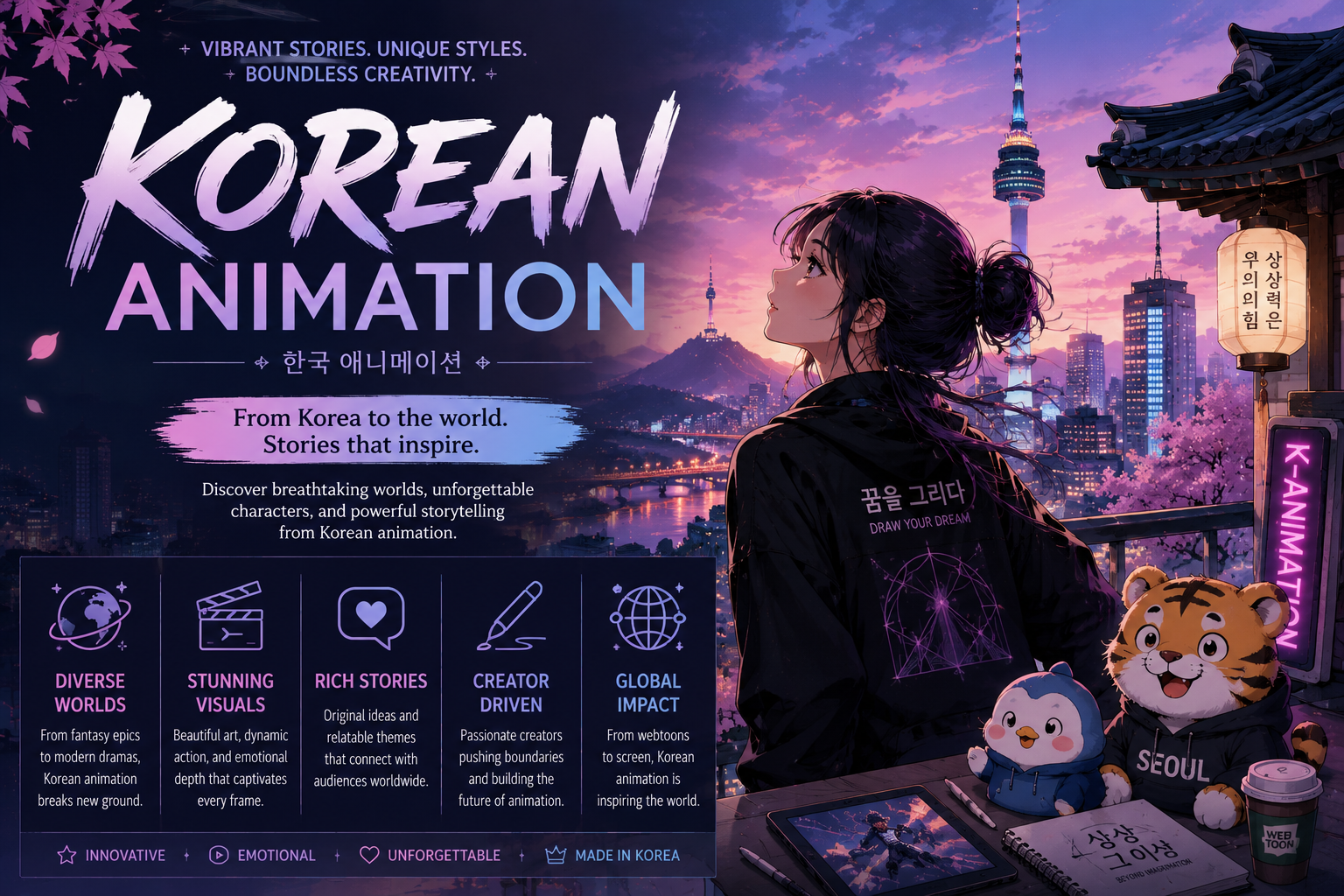
Korean Animation
Korean animation is not one style, one age group, or a side note attached to Japanese anime. South Korea has spent decades animating work for overseas studios while building its own theatrical films, television series, children’s characters, adult dramas, web productions, and stories shaped by Korean history, cities, families, labor, education, and social pressure.
CVM Sekai does not have finished Korean series or film coverage on this shelf yet. The lack of reviews does not mean the medium lacks history. This hub begins with the industry and the people behind the work, then the library will grow as individual titles receive proper pages.
What counts as Korean animation?
Korean animation usually means animated work created in South Korea or led by Korean creators and production companies. The category includes hand-drawn films, computer animation, stop motion, television cartoons, internet releases, educational programming, advertising, music videos, independent shorts, adult animation, and projects adapted from Korean comics, webtoons, novels, games, folklore, or original scripts. National labels can help readers find a production history, but a passport does not create a single visual style.
The Korean word aeni comes from “animation,” much as the Japanese word anime does. English-language fandom sometimes uses aeni as a tidy regional label, especially when comparing Korean and Japanese productions. Real production histories are messier. A Korean studio may animate part of an American or Japanese show without owning the characters. A Korean property may use talent, financing, distribution, or postproduction from several countries. A streaming platform may market a Korean source story without explaining where the animation was actually produced. The credit list matters more than assumptions based on character design.
Korean animation also overlaps with manhwa and webtoons, but the terms are not interchangeable. Manhwa is Korean comics. Webtoon describes a digital publishing format and industry that became especially important in South Korea. Animation is a different medium with movement, timing, voice performance, sound, editing, layout, and production needs that a comic page does not have. An adaptation can keep the title and characters while rebuilding the story for a completely different rhythm.
From early theatrical experiments to a modern animation industry
Korean animation developed through war, political change, imported media, advertising, television, cinema, and a national economy that transformed at extraordinary speed. Early animated advertising and short-form work helped establish techniques and training. Feature production became an important milestone in the 1960s, with Hong Gil-dong from 1967 often identified as South Korea’s first animated feature. The film drew on a familiar Korean folk hero, which already showed one path the medium could take: using animation to carry local characters into modern popular culture.
The following decades did not create a simple march from one national classic to another. The industry worked under limited budgets, censorship, imported competition, changing broadcast needs, and an uneven domestic market. Some productions leaned toward children’s adventure or science fiction. Others borrowed visual language familiar from overseas animation. Korean audiences could enjoy foreign work while local creators struggled to secure the financing, distribution, and long production schedules needed for ambitious original films.
Television expanded the demand for animation, but demand did not always mean ownership. South Korean studios became deeply involved in subcontracted work for foreign series and films. That work trained artists, supported companies, and made Korea part of the global animation supply chain. The same structure could also keep Korean workers far from the final ownership, marketing, and cultural recognition attached to the finished show. A viewer might know every character on screen while never learning which Korean studio handled layouts, key animation, in-betweening, cleanup, coloring, backgrounds, or digital production.
Original Korean properties grew through television, educational media, theatrical films, and character brands. Children’s animation became especially visible because recurring characters could move across broadcasts, merchandise, live events, public campaigns, and international licensing. Pororo the Little Penguin became a major example of a Korean preschool property that traveled widely. Robocar Poli and Tayo the Little Bus followed different concepts while showing how strongly Korean studios could compete in global children’s media.
You may have watched Korean animation labor without realizing it
International animation has never been as nationally sealed as marketing makes the finished product appear. American broadcasters, Japanese production committees, European companies, and global entertainment firms have all relied on work crossing borders. South Korean studios became important partners in that system. Outsourcing could mean anything from a narrow production stage to substantial episode work, depending on the contract and era.
That history deserves two thoughts at the same time. Korean subcontracting helped build technical skill, employment, studio capacity, and international relationships. Subcontracting also placed many artists inside a hierarchy where another company owned the property, controlled the public identity, and collected the strongest recognition. Calling the work “outsourced” should describe a business arrangement, not erase the artists who made the images move.
The same tension still appears across global animation. Fans often credit or blame one famous studio as if one building created every frame. Production credits reveal chains of partner studios, freelancers, supervisors, overseas teams, compositors, and service companies. Korean animation history is one of the clearest reasons to stop treating animation labor as invisible once the opening logo disappears.
Korean animation can carry stories that subcontracting never had room to tell
Original Korean films and series have used animation for children’s comedy, fantasy, folklore, social criticism, family drama, horror, science fiction, and adult stories. Leafie, A Hen into the Wild reached a large theatrical audience with a story that looks gentle from a distance and becomes much sharper when the characters confront captivity, parenthood, sacrifice, and freedom. The film did not need to imitate the tone of a Hollywood family movie to prove that Korean theatrical animation could connect with a broad audience.
Independent and adult animation followed other roads. Director Yeon Sang-ho used animated films such as The King of Pigs and The Fake to examine violence, class, bullying, religion, desperation, and institutions that protect themselves before protecting vulnerable people. Those films are not children’s cartoons wearing darker colors. Animation gives their anger a controlled visual form and lets the story push beyond what audiences may expect from commercial Korean screen entertainment.
Korean animation also sits beside an enormous webtoon and web-novel ecosystem. Successful digital stories create obvious adaptation opportunities, but popularity does not guarantee a good animated version. Vertical-scroll pacing, internal narration, chapter hooks, detailed artwork, and long publication runs must be translated into episodes with budgets, movement, voices, music, and stopping points. The adaptation has to become animation instead of treating the original panels as a storyboard that needs minor motion.
Folklore offers another large field. Korean legends contain mountain spirits, goblins, fox spirits, ghosts, shamans, underworld journeys, household gods, heroic figures, and regional traditions that can support comedy, horror, romance, historical fantasy, or children’s adventure. A Korean setting should be more than a palace roof placed behind generic characters. Clothing, language, food, architecture, social rank, religion, family obligation, geography, colonial history, division, industrialization, and city life all change what a story means.
Series, films, shorts, web animation, and character worlds
Korean television animation includes preschool programming, action series, comedy, educational work, and projects designed for licensing across many markets. Theatrical animation has a harder financial path because films require years of labor and must compete for screens, marketing, and audience attention. Independent shorts can take formal risks that a long commercial production cannot afford. Online distribution creates another route, especially for creators who want to test an idea without waiting for a traditional broadcaster.
Character animation deserves attention without pretending every character brand is a narrative franchise. A mascot can become culturally important through short episodes, stickers, merchandise, public transportation campaigns, games, and daily visibility. Story depth and cultural reach are different measurements. Korean media companies have learned how effectively a simple character can cross platforms, age groups, and national borders.
Music and animation also meet in Korean entertainment through animated music videos, virtual performers, game cinematics, promotional shorts, and fictional idol worlds. K-pop’s global reach makes the crossover easy to notice, but animation should not be reduced to an accessory for music marketing. The best collaborations use design, movement, and editing to add a new layer to the song or fictional world.
Weekly or seasonal series can build characters over time, from preschool favorites to action, comedy, fantasy, and educational programming.
Feature animation asks studios to sustain years of labor before the audience decides whether the finished story can find a place in cinemas.
Online shorts, independent releases, adaptations, virtual characters, and platform projects expand who can publish and how viewers discover the work.
The Korean Animation library starts here
CVM Sekai does not have finished Korean animation reviews, series hubs, Reacts, or Rants ready to display yet. I am leaving those shelves empty instead of filling the page with unrelated Japanese anime, Korean live-action dramas, or promotional placeholders. When a Korean animated film or series receives full coverage, the page will use that post’s featured image as the card image and link directly to the finished hub or review.
No fake “coming soon” cards
The first real card will appear after the first real Korean animation page is researched, written, illustrated, categorized, published, and checked live. Until then, this section explains the standard instead of pretending a queue is a library.
Browse the Animation LibraryWhere to keep learning
The Korean Film Council’s Korean Film Biz Zone provides industry information and coverage of Korean cinema. The Korean Film Archive preserves and presents Korean film history. The Korea Creative Content Agency publishes information and reports about Korea’s content industries, including animation and character businesses. Credits on individual films and series remain essential because international co-production and subcontracting can make nationality more complicated than a marketing label.
Korean animation should not have to borrow anime’s name to be worth finding
Korean artists have already spent decades inside global animation. The frustrating part is that viewers often discover the labor only after somebody points at the credits and says, “Korea helped make that.” Original Korean animation deserves attention before another country’s brand makes the work feel safe or familiar.
The honest starting point is not pretending CVM Sekai already has a giant Korean library. The honest starting point is building the map, learning the production history, and giving each future film or series enough space to be judged as its own work. Korean animation is not an empty category waiting for content. My coverage is the part that still needs to catch up.