
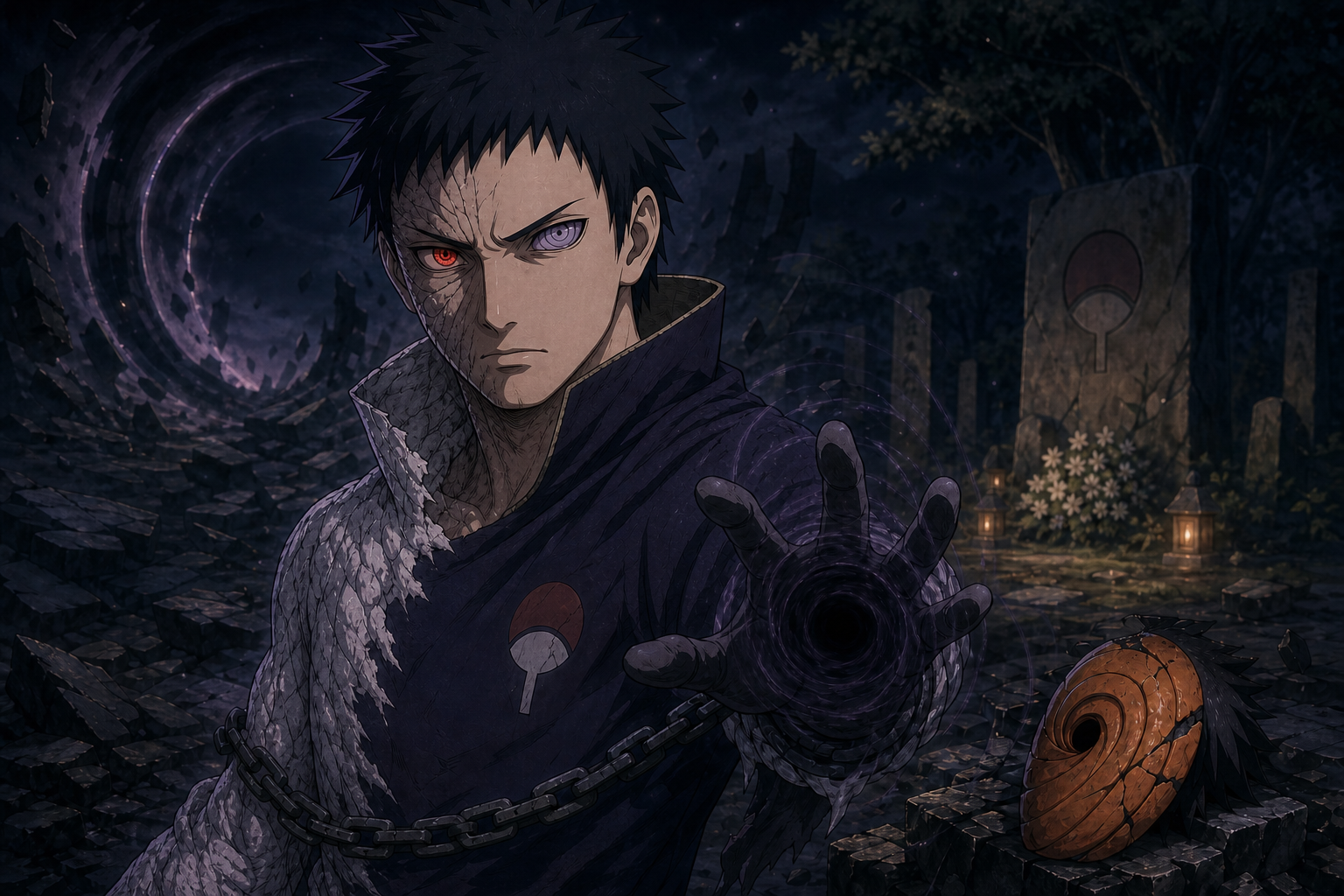
Naruto character dossier
Obito Uchiha
The boy who taught Kakashi that comrades matter later builds a world war to prove that bonds are lies. Obito’s file matters because both lives belong to one person, and neither manipulation nor late courage can erase the choices between them.
Who Obito is when every mask comes off
Obito Uchiha is a former Leaf shinobi from Team Minato, Kakashi Hatake’s childhood teammate, Rin Nohara’s friend, and one of the principal architects of the Fourth Shinobi World War. He operates as Tobi, impersonates Madara Uchiha, controls the hidden machinery of Akatsuki, attacks Konoha with the Nine-Tails, and pursues Infinite Tsukuyomi.
He is also the child whose belief about comrades becomes Kakashi’s most important moral inheritance. “Those who abandon their comrades are worse than trash” survives long after Konoha records Obito as dead. Kakashi teaches the principle to Team 7. Naruto lives it. The adult Obito then has to fight a generation shaped by his own younger conviction.
That loop is the point. Naruto does not ask whether the innocent child and the criminal adult are technically the same person. The series asks what happened between them, who pushed, what Obito chose, and whether the earlier self can remain morally relevant without becoming an excuse.
A lonely Uchiha who is late because he keeps helping people
Young Obito is not the clan prodigy. He struggles beside Kakashi’s precision, arrives late, cries easily, and dreams of becoming Hokage. He wants the village to see him. He also stops to help older residents even when that guarantees another lecture about lateness.
The behavior matters because it establishes his original ethics as practice, not a slogan. He inconveniences himself for people with less power. He wants recognition, but he keeps choosing care before applause. Naruto later mirrors the loud dream and emotional transparency, while Obito becomes obsessed with proving that Naruto will eventually break as he did.
His place in the Uchiha clan is comparatively lonely. The story gives him clan identity without a detailed household support system. Fans often invent complete parental histories to fill the silence. The honest record is that Obito seeks belonging through Team Minato, the village dream, and Rin’s belief in him.
Team Minato: rivalry, affection, and the family he actually uses
Minato Namikaze leads Obito, Kakashi Hatake, and Rin Nohara. Kakashi is gifted, rule-bound, and wounded by his father’s disgrace. Obito is emotional, inconsistent, and furious that mission procedure can outrank a living teammate. Rin mediates, heals, and believes in both boys without existing merely as their prize.
Obito’s rivalry with Kakashi contains envy and admiration. He wants to surpass him, but he also refuses to abandon him. Kakashi’s left eye is injured during the rescue of Rin. Obito’s Sharingan awakens from the desire to protect his friend. Their best teamwork arrives when competition becomes coordination.
Rin sees the Hokage dream before the village does. Obito loves her. That love is real. Love is not ownership. The distinction becomes crucial because adult Obito builds an ideology around a world where the dead Rin can exist without asking what the living Rin would think of the bodies used to create it.
Kannabi Bridge: the hero everyone thinks died
During the Third Shinobi World War, Rin is captured. Kakashi prioritizes the mission. Obito rejects the choice and goes after her. His argument about comrades changes Kakashi’s mind, and the two rescue Rin together.
A collapsing cave crushes the right half of Obito’s body beneath a boulder after he protects Kakashi. Believing death is near, he gives Kakashi his left Sharingan as a late jōnin-promotion gift and asks him to protect Rin. The gift creates Kakashi of the Sharingan and turns Obito into a name on Konoha’s memorial stone.
The sacrifice is genuine. Obito does not plan a future identity. He gives away an eye because he believes his friend will live while he will not. Later crimes should not retroactively make the child fake. Earlier heroism should not pre-pay forgiveness for later crimes.
Madara rescues a child, then builds a cage around the rescue
Madara Uchiha finds Obito and keeps him alive underground. Synthetic Hashirama tissue and a white-Zetsu-derived body rebuild the crushed right side. Obito undergoes painful rehabilitation because he wants to return to Kakashi and Rin.
Madara does not win him through one speech. He isolates him, controls information, introduces the Moon’s Eye Plan, surrounds him with beings tied to Madara’s will, and waits for reality to deliver a wound. The rescue creates dependency. Obito’s damaged body becomes proof that Madara alone understands the hidden machinery of the world.
Later revelation makes the manipulation even uglier. Madara arranges the circumstances around Rin becoming the Three-Tails jinchūriki and the event that pushes her into Kakashi’s Lightning Blade. He does not invent Obito’s love. He turns that love into the trigger for a planned collapse.
Rin’s death is the rupture, not a permission slip
Obito reaches the battlefield and sees Kakashi’s arm through Rin’s chest. The missing context is that the Hidden Mist turned Rin into the Three-Tails jinchūriki and intended her return to destroy Konoha. Rin chooses to die on Kakashi’s Lightning Blade rather than become the weapon.
Obito does not know the full mechanism in that instant. He sees the person he loves dead by the hand of the friend charged with protecting her. His Mangekyō Sharingan awakens. He massacres the Mist shinobi through Kamui and Wood Release, then decides the existing world is false.
Rin is not the sole cause of the adult Obito. She is the emotional center of a collapse Madara has prepared. Obito’s grief attaches to war, clan loneliness, bodily trauma, isolation, and a philosophy handed to him by an elder who needs a successor. Saying “he did it all for a girl” is sexist toward Rin and intellectually lazy about Obito.
Rin’s agency also matters. She sacrifices herself to protect Konoha. Obito’s Infinite Tsukuyomi plan would replace everybody’s agency with a dream selected by force. He invokes her while violating the value demonstrated by her last choice.
Tobi, “Madara,” and the work each mask performs
The orange spiral mask
The spiral converges on the single eye used for Kamui and turns his face into an architecture of distance. Opponents see a hole, not the survivor behind it. The mask is practical protection and identity control.
Tobi the fool
The childish Tobi persona lowers suspicion inside Akatsuki. He jokes, complains and performs incompetence while observing people who believe he ranks beneath them. The comedy is weaponized social camouflage, giving Obito room to collect information while stronger personalities dismiss him as harmless noise.
Madara Uchiha
Claiming Madara’s name lets Obito borrow history, terror, and authority. The lie works because the shinobi world already believes old hatred can return. Obito can negotiate with Kage and manipulate Sasuke from behind a reputation he did not earn.
The unmasked Obito
When Naruto’s Rasengan breaks the mask, the reveal restores consequence to a face Kakashi remembers. The war stops being a distant villain’s plan. The enemy is the teammate whose ideals shaped the people opposing him.
The crime ledger: what Obito actually does
Obito controls the Nine-Tails and attacks Konoha on the night of Naruto’s birth. Minato and Kushina die. Naruto becomes a jinchūriki and orphan. The village carries mass casualties and fear that later falls on a child who had no choice in the attack.
He influences events in Amegakure, cultivates Nagato’s despair, and later takes control of the criminal Akatsuki structure from the shadows. He helps weaponize members, jinchūriki hunts, tailed-beast extraction, and international instability. The victims are not symbolic. Hosts die. Families lose people. villages lose military balances.
He participates in the Uchiha clan massacre alongside Itachi. The exact division of killings varies across manga, anime, novels, and adaptation presentation, so a profile should not pretend every medium gives one identical room-by-room record. The central fact remains: Obito assists the extermination and gains Sharingan from the dead.
He manipulates the Fourth Mizukage Yagura, contributing to the Hidden Mist’s brutal rule. He recruits and uses Sasuke’s grief, saves him when useful, points him at Danzō and the Kage system, and treats revenge as fuel for the Moon’s Eye Plan.
At the Five Kage Summit, he declares the Fourth Shinobi World War after the Kage reject his demand. He leads White Zetsu forces, deploys reanimated jinchūriki through stolen Rinnegan power, revives the Ten-Tails, and drives casualties across the Allied Shinobi Forces.
This is why “Rin made him evil” fails. One death does not directly perform decades of operations. Obito creates organizations, logistics, alliances, false identities, intelligence networks, and battle plans. He is emotionally broken and operationally deliberate.
The Fourth Shinobi World War and the body that becomes a battlefield
Obito fights Naruto, Kakashi, Guy, and Killer B while controlling tailed-beast hosts and using Kamui to become almost untouchable. Kakashi eventually recognizes that both Mangekyō abilities share a dimension. The discovery turns an emotional connection into a tactical weakness.
Obito and Kakashi fight inside Kamui’s space. Their adult blows are intercut with childhood sparring, making every strike carry two timelines. Kakashi wants to protect the memory of the boy by killing the current man. Obito wants Kakashi to admit that the old ideals were childish.
Obito becomes the Ten-Tails jinchūriki. The transformation nearly erases his identity, but memories of Team Minato let him pull himself together. The irony is brutal. He uses the bonds he denies to control the power meant to erase reality.
As jinchūriki, he gains Six Paths power, Truth-Seeking Balls, flight, extreme regeneration, vast chakra, barriers, and destructive force. He also loses reliable access to Kamui’s intangibility while holding the Ten-Tails. Senjutsu becomes essential to damaging him. Power increases while tactical freedom changes.
Naruto and the alliance pull the tailed-beast chakra out of him through collective will. Naruto reaches the place where Obito still imagines being Hokage. The defeat is not a gentle therapy session. The sacrifice is a battlefield intervention after thousands of people resist the world Obito tries to impose.
Naruto is the argument Obito cannot kill
Naruto resembles young Obito loudly enough that the series makes the comparison explicit. Both are late bloomers who want to become Hokage, value comrades, and seek recognition. Obito treats Naruto as a test subject. If Naruto breaks, then Obito’s own collapse becomes proof about reality rather than a personal choice.
He targets Naruto’s bonds, mocks hope, and uses Neji’s death to argue that promises fail. Naruto grieves and continues. The Allied Shinobi Forces keep choosing one another. Obito’s philosophy loses because people experience pain without accepting his conclusion.
Naruto does not prove that trauma is easy to overcome. He proves that Obito’s answer is not inevitable. Support, inherited teaching, honest confrontation, and collective action give Naruto alternatives that Obito lacked or rejected. The contrast should produce compassion and accountability at the same time.
Turning back does not turn the casualty count backward
After losing the Ten-Tails, Obito begins to act against Madara. He attempts to use Rinne Rebirth, resists Black Zetsu’s control, helps protect Naruto, and works with Kakashi and Sakura inside Kaguya’s dimensions.
Madara extracts what he needs and continues the plan. Black Zetsu reveals deeper manipulation tied to Kaguya. Obito finally understands that even the borrowed identity and world-ending mission were tools inside somebody else’s longer project.
He dies shielding Naruto and Kakashi from Kaguya’s All-Killing Ash Bones. The protection echoes Kannabi Bridge: Obito places his body between danger and his comrades. After death, his chakra reaches Kakashi and temporarily grants both Mangekyō Sharingan, allowing Kakashi to fight with a complete Susanoo during the final battle.
The final help is real. So are the dead. Naruto calls Obito’s childhood dream worthy because Naruto is addressing the human possibility that returned, not issuing a legal pardon for the war. Fans can honor the last choice without calling the entire life redeemed and clean.
Abilities, mechanics, forms, and limits
Sharingan
Obito awakens the two-tomoe Sharingan while rescuing Rin. His left eye goes to Kakashi. The right remains with him and later develops Mangekyō after Rin’s death. Sharingan perception supports genjutsu, prediction, and control over powerful targets including the Nine-Tails.
Kamui
Obito’s right-eye Kamui sends his body or targets into a linked pocket dimension. Partial transfer creates the appearance of intangibility because attacked body parts exist elsewhere. He must become tangible to physically interact and cannot maintain continuous phasing without limits. Kakashi’s left-eye Kamui operates at range and shares the same dimension, creating the key counter.
Hashirama tissue and Wood Release
Synthetic tissue repairs the crushed right side, increases resilience, reduces some Mangekyō costs and enables Wood Release. The body is reconstructed rather than naturally identical to Hashirama’s, and every later power discussion has to remember the medical violence and borrowed biology underneath the upgrade.
Fire Release, chains, barriers, and tools
Obito retains Uchiha Fire Release, uses chains during the Nine-Tails attack, deploys barriers and sealing methods, and fights with black receivers and the gunbai in later operations. Identity changes do not replace his underlying shinobi training.
Rinnegan
After Nagato’s death, Obito implants one Rinnegan in his left socket. He says handling even one eye is a severe burden. The Rinnegan supports control of the reanimated jinchūriki and the Outer Path, but it is not his natural dōjutsu.
Ten-Tails jinchūriki
The form grants immense Six Paths power, regeneration, flight, Truth-Seeking Balls, chakra arms, barriers, and control of the Divine Tree. Senjutsu can bypass key defenses. Holding the Ten-Tails changes his access to Kamui intangibility.
Limits
Kamui requires timing and has a continuous-use threshold. Materializing to attack creates openings. Shared dimensional access gives Kakashi a counter. The Rinnegan strains him. Ten-Tails power threatens his identity. Seals, senjutsu, coordinated pressure, and chakra extraction can defeat forms that ordinary attacks cannot.
Relationship and accountability atlas
Kakashi Hatake
Rival, teammate, eye recipient, witness, and opponent. Kakashi lives by Obito’s rule while carrying guilt for Rin. Obito tries to make that guilt prove the world is false. Their Kamui duel is grief turned into hand-to-hand argument.
Rin Nohara
Friend, medic, believer, and love. Rin’s death breaks Obito’s remaining trust, but her agency contradicts the forced dream he builds in her name. She is a person, not a reward waiting in heaven.
Minato Namikaze
Teacher and later enemy. Obito attacks Minato’s family, controls the Nine-Tails, causes Minato and Kushina’s deaths, and leaves their child carrying the beast. Minato’s failure to recognize him immediately becomes another scar, not an excuse.
Madara Uchiha
Rescuer, body architect, groomer, ideological teacher, and exploiter. Madara engineers the trigger and uses Obito as a continuation device. Obito also deceives Madara, delays surrendering agency, and pursues his own version of the plan.
Naruto Uzumaki
Naruto is the younger self who refuses Obito’s conclusion. Obito attacks his birth, childhood, friends, village, and world. Naruto still insists that the old dream reveals a choice the adult can make again.
Nagato and Konan
Obito exploits Amegakure’s grief, cultivates Akatsuki’s violent transformation, and later pursues Nagato’s Rinnegan. Konan rejects him after Nagato’s death and nearly kills him with a trap built from years of preparation.
Itachi and Sasuke
Obito assists Itachi during the massacre and later turns Sasuke’s grief into political fuel. He offers selected truths, conceals his own interests, and points Sasuke toward targets that serve the larger plan.
Black Zetsu
Obito treats Black Zetsu as an instrument until the instrument takes his body and reveals allegiance to Kaguya. The manipulator discovers that he was managed inside an older scheme, turning bodily control into a final lesson about the methods he used on others.
Design chronology: goggles, scars, spirals, and borrowed eyes
Child Obito wears goggles before awakening the Sharingan. The choice marks desire and inadequacy at once: an Uchiha protecting eyes that have not yet become the clan power he wants.
After the boulder, the anatomical right side of his face and body carries severe scarring and white-Zetsu reconstruction. His right eye is the Sharingan he keeps. His left eye changes by period: empty or concealed after gifting the original, later holding Nagato’s Rinnegan.
The orange spiral mask centers one eye and visually mimics Kamui’s vortex. Later masks and war clothing shift the false-Madara identity toward greater severity. The fan, chains, black robe, and hidden face borrow Uchiha authority while preventing personal accountability.
Unmasking restores asymmetry. One face holds child injury, artificial repair, stolen power and adult choice. The design refuses a clean separation between victim and perpetrator, because the damaged child remains visible inside the adult who keeps manufacturing damage for everyone else.
What Obito means in Naruto
Personal: grief becomes ideology when the self cannot bear contingency
Obito cannot accept that Rin’s death was a terrible event inside reality. He decides reality itself is counterfeit. The belief protects him from helpless grief by converting loss into a mission with total control.
Interpersonal: love without the other person’s agency becomes possession
He says he wants a world where Rin exists. The plan forces everybody into dreams. Rin’s own final choice protects others at the cost of herself. Obito honors her image while violating her demonstrated ethics.
Political: Infinite Tsukuyomi is authoritarianism dressed as mercy
The plan promises an end to pain, conflict and disappointment. Nobody consents. One ruler decides that private dreams are better than public reality. Peace without freedom becomes permanent confinement, and mercy becomes an authoritarian label pasted over the removal of every other person’s future.
Confucian lens: role failure travels through relationships
Teachers, teammates, village leaders, and clan structures all carry duties. Madara abuses the elder role. Konoha fails to protect and inform children sent into war. Obito then abandons duties to comrades and community while claiming a universal rescue.
Buddhist lens: attachment and aversion create the prison
Obito clings to Rin’s image and rejects a world where loss exists. Infinite Tsukuyomi literalizes attachment as a dream cocoon. This is an interpretive lens, not a claim that Naruto offers formal Buddhist instruction.
Creative lens: the villain loses to his own old dialogue
Kakashi passes Obito’s words to Naruto. Naruto returns them to Obito through action. The story makes moral language outlive the speaker and become evidence against the life he later chooses.
The original Japanese performances
Wataru Takagi is the primary original Japanese voice of adult Obito and the masked identities. Sōsuke Komori voices the child in Kakashi Gaiden and several earlier game appearances, while Megumi Han later performs younger Obito in expanded anime material.
The production uses casting to separate age and performed identity while keeping the adult criminal tied to one recognizable vocal presence. The casting record supports the separation among childhood, performed identity and adult criminal authority. Finer claims about pitch, breath or comic timing belong only beside specific Japanese-audio scenes, so the analysis stays with what the credited performances and visible character work establish.
Manga, anime expansion, novels, films, OVAs, and games
The manga establishes Team Minato, Kannabi Bridge, the eye gift, Madara’s rescue, Rin’s death, the masked operations, Nine-Tails attack, Akatsuki manipulation, Kage Summit declaration, war, Ten-Tails transformation, defeat, final resistance, and death.
Naruto Shippuden expands childhood, training, Team Minato missions, Akatsuki history, and several connective events. Those additions can deepen character chronology but should be labeled when they are anime-original or anime-expanded.
Licensed novels provide additional perspectives around Itachi, Akatsuki, and the postwar world. Films and OVAs may use alternate timelines, cameos, or promotional premises. Road to Ninja operates through an alternate-world setup. Games such as the Ultimate Ninja and Storm series make Obito, Tobi, masks, Kamui, and jinchūriki forms playable. A game move list is not a substitute for manga mechanics.
Eight fandom misreads that break the Obito file
1. “He started a war over a girl.”
Rin’s death is the rupture. Madara’s grooming, war trauma, bodily reconstruction, clan loneliness, ideology and Obito’s long operational choices build what follows. Reducing the fall to one girl strips the story of the system that prepared a grieving child for exploitation.
2. “Madara made him do everything.”
Madara engineers and manipulates. Obito still plans, recruits, murders, lies, controls beasts and declares war. Grooming explains how his choices become imaginable, but accountability remains necessary because he repeatedly converts the lesson into harm for strangers.
3. “Obito was always evil.”
The child is genuinely generous and brave. Treating that goodness as fake destroys the story’s argument about corruption and choice. Tragedy requires a real moral starting point, otherwise the adult villain is merely revealing a nature he always possessed.
4. “His final sacrifice erases the war.”
No. The sacrifice saves lives and matters. The casualty ledger remains, along with the political machinery, manipulated followers and grieving families left behind. A meaningful final choice can change how a life ends without rewriting everything that life caused.
5. “Rin would have wanted the dream world.”
Rin chooses death to protect other people. Nothing supports forced global imprisonment as her wish. Obito turns his memory of her into permission for a system that removes the agency she used in her defining decision.
6. “Kamui has no limits.”
Timing, materialization, continuous-use limits, shared dimensional access, chakra and form restrictions create counters. Kamui remains extraordinary, but the fights work because opponents can study the rhythm, coordinate attacks and exploit the moment when defense requires physical contact.
7. “Tobi and Obito are separate personalities.”
Tobi is a performed identity and camouflage. White Zetsu influence affects mannerisms in some adaptation readings, but Obito controls the operation. Treating the persona as a separate innocent mind lets the strategist disappear behind his own theater.
8. “Naruto forgives him, so the story acquits him.”
Naruto recognizes the abandoned Hokage dream and accepts late help. Recognition is not a court ruling that nobody was harmed. Their connection restores Obito’s capacity to choose differently while the war around them keeps the cost of earlier choices visible.
Consequence ledger
What happens to him
Obito endures war deployment, crushing injury, isolation, body reconstruction, grooming, Rin’s death and years inside false identities. Those harms explain why an older manipulator can reach him, but they never require the specific empire of coercion he later constructs.
What he gives
Obito gives Kakashi a Sharingan, leaves behind a moral rule, protects his team at Kannabi Bridge and provides final help against Kaguya. The gifts matter because they keep saving people long after he betrays the values attached to them.
What he takes
Obito takes lives in Konoha, helps shape the Uchiha massacre, destroys jinchūriki futures, destabilizes villages, expands Akatsuki’s victim list and drives wartime casualties. The scale prevents a private grief story from swallowing the public record.
What he builds
Obito builds the masked-Madara myth, Akatsuki’s hidden command structure, Project Tsuki no Me operations and the Fourth Shinobi World War. Each structure extends his power through other people, making organization as important to his threat as Kamui.
What defeats him
Collective resistance, Kakashi’s shared Kamui, Naruto’s refusal to break and the return of Obito’s earlier conviction defeat him. No single speech performs the work alone, because military pressure and moral recognition arrive together.
What survives
Kakashi, Naruto, the comrade-first rule and saved lives in the final battle survive Obito. An unresolved argument about accountability after manipulation survives too, which is why the character remains worth discussing beyond a simple redemption label.
Final verdict: Obito is responsible because his choices still matter
Obito’s story becomes meaningless when readers flatten him in either direction. Pure victimhood deletes agency, while pure monstrosity deletes the brave child whose values later become the evidence Naruto uses against him.
If Madara’s grooming explains everything so completely that Obito has no agency, then his crimes are not choices and his return means nothing. If the crimes prove he was always rotten, then the child at Kannabi Bridge is fake and the tragedy disappears.
The harder reading holds the whole life. Obito is harmed, manipulated, loved, jealous, courageous, grieving, intelligent, cruel, theatrical, cowardly, and finally brave again. He makes victims while remaining a victim of older men and older systems. Naruto reaches him because the person who once valued comrades never vanished completely. Naruto also has to defeat him because that buried person does not stop the adult from building a world-sized cage.
His final protection of Naruto and Kakashi is not small. Neither is the war. RaeRae’s answer is simple: give the last act its flowers, give the dead their receipts, and never confuse understanding a fall with pretending nobody hit the ground.
Sources and canon boundary
Manga chronology controls this profile. Anime expansions, databook material, novels, games, films, and alternate identities are labeled instead of being blended into one false continuity.
Primary franchise references: Naruto Official and VIZ Media Naruto. CVM Sekai’s conclusions about Obito’s manipulation, agency, masks, Kamui, Rin, the Fourth Shinobi World War, accountability, and final choices are editorial analysis, not invented creator quotations.