
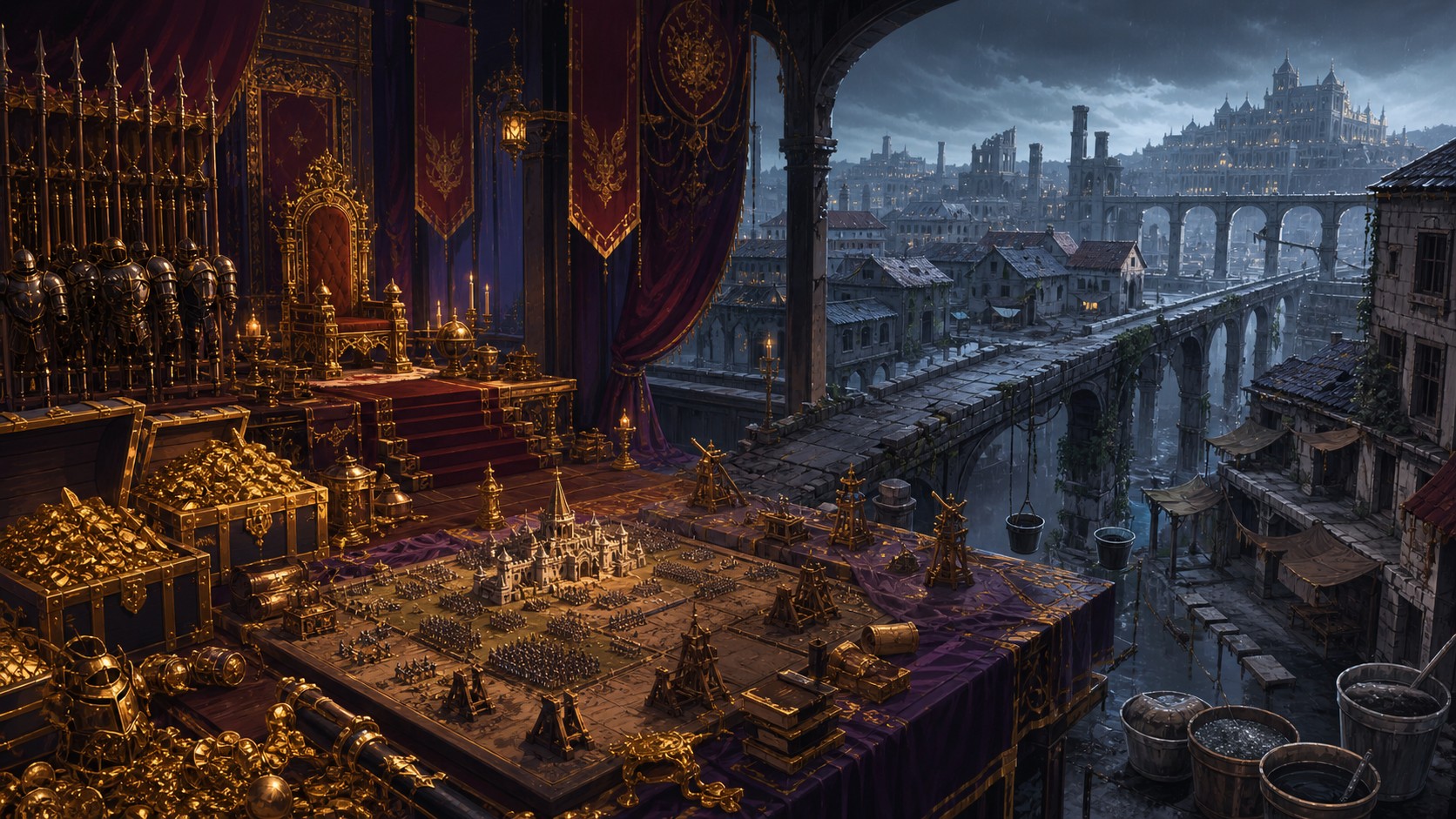
Fantasy Kingdoms Can Fund Every War Except Public Services
A dragon lands, an empire mobilizes, and suddenly every treasury has gold for armor, airships, mercenaries, and one glowing weapon the size of a courthouse. Ask who pays to keep the courthouse standing, however, and the kingdom develops selective amnesia.
Bottom line first: fantasy kingdom budgets do not behave like economies. They behave like royal purses that become full whenever the plot wants a war and empty whenever ordinary people need a road, clinic, school, sewer, bridge, or safe place to sleep. The problem goes beyond missing paperwork. A kingdom that can feed ten thousand soldiers for months has farmers, warehouses, transport routes, cooks, accountants, inspectors, and a tax system somewhere. When none of those people or systems exist outside battle scenes, war stops feeling expensive. Civilian neglect starts looking like wallpaper instead of a political choice.
Anime loves the visual language of government. Viewers get castles, council chambers, military uniforms, noble seals, border forts, merchant districts, and speeches about protecting the realm. Those images tell fans that a state exists. Then the story treats the state like a vending machine reserved for generals. Pull the invasion lever and horses, rations, steel, and replacement troops fall out. Pull the clean-water lever and everyone stares at the peasant who had the nerve to ask.
War money does not appear because a king looked worried
A war budget is a claim on the same labor and materials that civilians need. Iron forged into armor cannot reinforce a bridge. Grain packed for an army cannot feed a district during a bad harvest. Horses assigned to cavalry cannot haul medicine. A royal order can change who receives those goods, but a royal order cannot create unlimited wheat, timber, skilled labor, or time. Fantasy stories often understand scarcity when heroes need a rare crystal. The same stories forget scarcity when an empire equips another army after losing three armies last Tuesday.
Real governments raise money through taxes, fees, borrowing, control of land and resources, forced labor, tribute, or seizure. Each method changes the society. Taxes can fund common services, but unfair taxes also fuel revolt. Borrowing can spread the cost across years, but debt gives lenders influence. Tribute enriches a capital while draining the provinces. Forced labor builds walls quickly while leaving farms unattended and families furious. When a story shows the palace spending without showing who surrenders money, crops, or labor, the kingdom loses its social shape.
Public budgets also reveal priorities. A ruler who repairs irrigation before ordering a gold statue is making a political statement. A council that keeps frontier clinics open while cutting court banquets is making another. Budgets turn speeches about duty into measurable choices. Fantasy rulers often receive moral credit because they sound kind in a throne room. A believable kingdom would test kindness against the ledger, the granary, the wage list, and the neighborhoods that keep flooding because the palace funded banners instead of drains.
What the trope gets right
Not every adventure needs a municipal finance subplot. Stories compress the boring machinery between a decision and its result. Viewers rarely need to watch three episodes of procurement officers comparing boot contracts before the army marches. Royal treasuries also work as symbols. A jeweled palace tells us that power has collected wealth. A starving village below that palace can show inequality in one clean image. Compression becomes useful when the missing steps are still implied by consequences.
War can also force governments to move faster than normal. An invasion gives leaders a clear enemy, visible deadlines, and political permission to spend. Citizens may accept emergency taxes or rationing when survival is at stake. Private workshops may shift to military production. Merchants may extend credit because victory protects their trade. Anime gets something honest from the sudden coordination: fear can align institutions that usually argue.
The mistake arrives when emergency capacity becomes magical capacity. If the state can organize food, transport, medical tents, engineers, and communication for an army, the state already possesses tools that could serve civilians. Refusing to use those tools during peace is not proof that public services are impossible. Refusal is a choice about whose life counts. A story becomes sharper when someone notices that the military road reaches the fort while the village road disappears in mud.
Amestris knows exactly where the money went
Fullmetal Alchemist offers one of anime’s clearest answers because Amestris is built as a military state. Rail lines, research, command offices, regional headquarters, and State Alchemist salaries do not float outside politics. The country directs talent and infrastructure toward military control. State Alchemists receive resources, status, and legal authority because their work serves the state. Civilian benefits exist, but the institution’s deepest purpose is extraction and violence.
That structure makes the horror believable. Amestris does not simply have bad leaders hiding in an otherwise neutral castle. Central Command organizes knowledge, careers, territory, and public trust around a national project. Researchers chase grants and rank. Soldiers follow chains of command. Towns depend on the same government that threatens them. The conspiracy works because the machinery already reaches everywhere. Money matters even when no character opens a budget book.
The lesson for weaker fantasy settings is simple: connect spectacular power to ordinary administration. Who trains the alchemists, mages, knights, or monster hunters? Who pays them? Who owns discoveries made with public money? Which town loses a doctor when the capital recruits every healer? A magic system gains weight when magical careers sit inside schools, licensing rules, patronage networks, and public obligations.
One Piece turns tribute into geography
One Piece repeatedly shows that wealth moves upward while danger moves downward. The World Government, allied monarchies, nobles, pirates, and local rulers all demand payment in different forms. Tribute is not a decorative fact. Tribute helps explain why protected centers sparkle while neglected islands struggle. A remote community can face hunger, corrupt officials, and pirates at the same time because protection follows political value, not need.
Alabasta and Dressrosa make public suffering part of the struggle for legitimacy. Water, food, land, safety, information, and trust become political weapons. A ruler cannot hold a kingdom together through a good heart alone. Citizens need reasons to believe that institutions distribute burdens fairly. When false information or manipulated scarcity destroys that belief, rebellion becomes easier because the public budget is also a public story about who belongs.
The series stays exaggerated, but the exaggeration points somewhere real. Capitals collect taxes and symbols of loyalty. Peripheral regions supply labor, crops, minerals, or strategic space. Powerful people describe extraction as protection. Fans can understand the injustice because the geography tells the truth: luxury sits close to authority, and damage sits far enough away to ignore.
Building a nation is more interesting than receiving one
That Time I Got Reincarnated as a Slime works as a useful contrast because Tempest spends time on roads, trade, housing, diplomacy, production, skilled migration, and public safety. The nation grows through relationships and systems, not only through Rimuru’s power. Craftspeople matter. Merchants matter. Food production matters. Agreements with neighbors matter. Viewers can see why citizens choose to stay and why rivals care about the country’s expansion.
Tempest still solves plenty of problems through overwhelming ability, and the series sometimes makes growth look easier than any government deserves. Even so, the visible work gives prosperity a cause. A road connects markets and armies. A festival attracts guests while advertising legitimacy. Housing skilled newcomers expands capacity. Diplomacy protects trade. Those decisions make state-building part of the fantasy rather than an interruption between fights.
A believable public budget does not require spreadsheets on screen. Cause and effect can carry the load. Show the new bridge cutting travel time. Show the clinic running short because healers were drafted. Show a tax collector explaining why wartime rates remain after peace. Show a mayor choosing between a wall and a well. One concrete tradeoff can do more worldbuilding than twenty flags behind a throne.
Revenue: Taxes, tariffs, mines, land rents, tribute, guild fees, debt and magical resources should create winners, losers and limits. Revenue also reveals who owns productive land, who can avoid payment and whose labor supports the royal spectacle.
Spending: Armies compete with roads, schools, clinics, food reserves, sanitation, housing, courts and disaster recovery. Every emergency appropriation therefore carries an opportunity cost that ordinary residents feel long after the victory parade ends.
Administration: Clerks, inspectors, local councils, auditors, engineers and messengers turn royal promises into actual service. A generous king without capable administration produces speeches, missing supplies and a capital full of people waiting outside closed offices.
Trust: People accept burdens when rules look fair. Corruption, secrecy and unequal protection turn a budget crisis into a legitimacy crisis. Citizens notice when nobles keep exemptions while farmers finance walls that protect only wealthy districts.
Maintenance is where fantasy governments confess
Stories adore construction because a new wall or palace photographs well. Maintenance has no coronation scene. Roofs need repair before rain. Canals need dredging before crops fail. Wells need testing before sickness spreads. Roads need drainage before wagons sink. Records need copying before a fire erases land ownership. The quiet work of upkeep shows whether a government plans for citizens to remain alive after the current ruler’s speech.
Maintenance also exposes class. Wealthy districts can hire private guards, doctors, tutors, and water carriers when public systems fail. Poor districts absorb the failure directly. A broken bridge becomes a missed market day. A closed clinic becomes a funeral. A damaged school becomes a generation of workers locked out of skilled jobs. Fantasy backgrounds often display this inequality without letting characters name the policy that produced the view.
Attack on Titan turns walls into both infrastructure and social order. The walls promise collective safety, but their rings also organize status, access, and sacrifice. Military branches receive different prestige and resources. Interior residents experience danger differently from people near the edge. The setting works because protection has geography. The question is never only whether the wall stands. The harder question asks who lives closest to the breach and who gets to pretend the breach belongs to somebody else.
War spending leaves a bill after the villain dies
A defeated enemy does not restore burned farms, missing workers, ruined bridges, displaced families, contaminated water, or public credit. Soldiers return needing wages, treatment, and work. Widows and orphans need support. Refugees need homes. Merchants need safe roads. Courts must decide property claims when records and owners are gone. The victory parade is usually the cheapest part of victory.
Fantasy endings skip these costs because reconstruction complicates clean triumph. Yet reconstruction can deepen the ending without turning the story into homework. A hero who can defeat a tyrant may still fail to build a fair tax system. Former rebels may disagree about land. Veterans may resent civilians who escaped the front. Provinces may refuse to fund the capital that abandoned them. Peace becomes a new political struggle, not a soft epilogue pasted over smoke.
Military spending also creates interests that survive the emergency. Contractors want new orders. Officers want commands. Nobles who profited from supply deals want the border to stay tense. Taxes introduced for one campaign can become permanent. A fantasy kingdom that returns to normal overnight wastes the most revealing question in the genre: normal for whom?
How to make the kingdom believable without killing the adventure
Start with one visible source of revenue. Maybe the crown owns mana mines. Maybe port tariffs finance the navy. Maybe noble estates owe soldiers instead of cash. Maybe guild licenses pay for monster patrols. Then attach a cost. Mining poisons a river. Tariffs raise food prices. Military service drains farms. Guild fees lock poor adventurers out of legal work. A single connected system gives characters something concrete to argue about.
Next, give public services owners and opponents. A healer’s college may want rural clinics while court mages want research towers. Merchants may support roads but resist inspections. Farmers may accept irrigation taxes while opposing palace debt. Local councils may know what a province needs better than the capital, yet local elites can steal too. Politics becomes believable when every proposal has a constituency, a price, and someone capable of blocking payment.
Finally, let budgets leave marks on scenes. Soldiers wearing mismatched armor reveal procurement failure. A clean public bath reveals sanitation investment. A half-built bridge reveals corruption or a collapsed tax base. A crowded classroom reveals population growth that planning missed. A ration card reveals scarcity and administration at the same time. None of those details require a lecture. Each detail tells fans that the world continues working when the protagonist walks off screen.
The ledger belongs in the story
Fantasy kingdoms keep treating public finance like a spell that activates whenever royalty shouts “mobilize.” That shortcut makes war look easier than clean water and makes rulers seem kinder than their choices deserve. Money, labor, land, and magic always come from somewhere. A serious world lets fans see the transfer.
The better fantasy is not a kingdom where every budget balances and every official behaves. The better fantasy is a kingdom where failure has a route. Taxes leave a village. Grain enters a warehouse. A contract enriches a cousin. A clinic closes. A regiment marches. Once that route becomes visible, viewers can judge the throne by more than speeches and uniforms.
So yes, let the dragon attack. Let the capital light every tower and roll out the impossible weapon. Then show the neighborhood whose aqueduct repair disappeared from the ledger to pay for the ammunition. The missing service was never an unfortunate background detail. The missing service was the policy.
Taxes are not background decoration
Tax scenes usually arrive as proof that a villain is cruel. An official kicks over a market stall, demands a bag of coins, and leaves before the audience asks what the payment funds. That shorthand works for tyranny, but taxes can reveal much more than greed. A fair tax system tells citizens what they owe, when they owe it, and what protection or service follows. An abusive system changes rates without warning, charges the powerless more than the connected, and punishes anyone who requests an account.
Anime kingdoms often assign tax collection to nobles, guilds, or local officials without asking how much reaches the capital. That gap is where corruption becomes a structure rather than a personality flaw. A governor can report a poor harvest while collecting a rich one. A merchant can buy an exemption and shift the burden onto street vendors. A noble can promise soldiers instead of cash, then send untrained farmers with bad equipment. Fans do not need a full tax code, but viewers should know whether the kingdom collects money, goods, labor, or loyalty.
Tax design also explains why people move. A port with predictable tariffs attracts merchants. A frontier town with land grants attracts settlers. A capital that exempts nobles while taxing food drives workers into debt. A monster-hunting guild that takes a fair cut may feel safer than a lord who takes half the harvest and provides no patrol. Population movement becomes a response to policy instead of a convenient way to fill a tavern.
Magic should make the budget stranger, not erase the budget
Magic can lower some costs, but magic creates new bottlenecks. Teleportation may cut travel time while making licensed teleporters essential to national security. Healing magic may reduce deaths while creating arguments over access, training, and payment. Enchanted tools may increase harvests while placing farmers under contracts with the mage guild that owns the enchantment. A fantasy economy becomes interesting when magic moves scarcity instead of deleting scarcity.
Consider a kingdom with mages who can repair stone in minutes. Bridges would become cheaper to fix, yet the state still needs trained mages, inspection schedules, travel arrangements, and a way to decide which bridge receives help first. A remote village may wait because the capital pays higher fees. A corrupt minister may report repairs that never happened. A war may pull every stone mage to the border. Magic changes the labor market, but citizens still live with allocation.
The same logic applies to enchanted weapons. A sword that can cut a fortress wall should alter defense budgets, insurance, city planning, and diplomacy. Castles may become ceremonial while underground shelters become practical. States may regulate rare materials or recruit artificers from abroad. If the only consequence is a brighter duel, the weapon belongs to the animation budget rather than the kingdom’s budget.
Procurement can create villains without another dark lord
Armies and public agencies rarely make everything they use. Governments buy grain, timber, uniforms, wagons, medicine, and construction work from suppliers. Contracts create opportunities for competence, favoritism, and theft. A well-connected merchant can sell rotten food at premium prices. A general can choose a cousin’s weak armor. A contractor can build a bridge with cheap stone, collect payment, and vanish before the first flood.
Those failures produce conflict that heroes cannot solve by punching the largest person in the room. Evidence matters. Records matter. Witnesses matter. A clerk who kept duplicate ledgers may become more dangerous to a corrupt minister than a swordsman. A guild may protect a whistleblower because honest contracts serve its members. A provincial mayor may hide missing funds to keep the capital from taking control. Public finance gives political stories pressure without requiring another ancient prophecy.
Procurement also lets writers show why cheap choices become expensive. Bad boots slow an army. Weak roofs collapse during winter. A bargain water system spreads disease. Maintenance contracts that never receive funding leave expensive machines useless. The kingdom may celebrate saving money this year while paying triple next year. Fans recognize that kind of stupidity because real institutions practice the same trick with impressive confidence.
Public services decide who gets to be a hero
Schools, clinics, roads, and sanitation sound ordinary until a story follows the person denied access. A talented child cannot enter the magic academy because the nearest school never taught reading. A wounded farmer cannot reach a healer because the bridge failed. A young woman joins a dangerous guild because public work offers no wage. A veteran becomes a bandit because demobilization meant handing over a sword and walking home to burned land.
Those outcomes shape the hero pool. Elite academies produce elite protagonists because the state invested in elite children. Remote villages produce self-taught fighters because formal systems never arrived. Noble officers inherit command because military education costs money and requires connections. When a series calls those outcomes talent or destiny, the story hides the public choices that sorted people long before the tournament began.
Better worldbuilding does not need to remove gifted heroes. Better worldbuilding asks who had the chance to discover a gift. A scholarship can become a political fight. A rural clinic can spot magical ability early. A public road can bring teachers to places the capital forgot. A corrupt entrance exam can keep commoners out while pretending the result measures merit. Services do more than keep people alive. Services decide whose potential becomes visible.
A budget crisis should change relationships
When revenue falls, characters should feel more than a line about an empty treasury. Officers may go unpaid and sell protection. Teachers may leave for wealthy households. Healers may charge cash because the ministry stopped reimbursing clinics. Provinces may keep taxes locally. Allies may demand trade concessions before lending money. A ruler who once commanded obedience may discover that loyalty had a payroll.
Inflation can turn a victory into anger. If the crown creates more coin or spends too much money chasing too few goods, prices rise. Soldiers return with wages that buy less bread. Merchants hoard supplies. Citizens blame foreigners, mages, nobles, or one another. A demagogue can turn a technical failure into a social weapon. The budget crisis becomes personal because every market trip repeats the argument.
Debt can do the same. Borrowing is not automatically foolish. A kingdom may borrow to rebuild a port that will expand trade, or to survive a famine that would otherwise kill taxpayers and workers. Trouble begins when debt hides court luxury, funds unwinnable wars, or gives lenders control over public policy. A fantasy bank, merchant league, temple treasury, or dragon hoard can carry that leverage. Gold always comes with a relationship attached.
Fans can handle the truth about the treasury
Writers sometimes fear that institutions will cool the emotion. The opposite happens when systems sharpen the stakes. A burned village hurts more when viewers know the grain reserve was sold. A mutiny makes more sense when wages have been missing for months. A revolution gains shape when rebels disagree over taxes, land, and services after sharing one enemy. Specific pressure creates specific anger.
Public finance also gives decent rulers room to fail honestly. A queen may want universal clinics and discover that trained healers are scarce. A council may choose a road that helps the most people while leaving one isolated town furious. A new government may inherit debt, damaged records, and officials loyal to the old regime. Good intentions meet capacity. That collision makes leadership dramatic without pretending cruelty is the only source of political conflict.
The kingdom does not need to become a policy seminar. The kingdom only needs memory. Spending on war should leave fewer resources elsewhere. Neglect should damage someone. Investment should change daily life. Taxes should create expectations. Corruption should leave records, beneficiaries, and victims. Once those links hold, the fantasy gains a pulse that survives beyond the battlefield.