
Mavis Vermillion
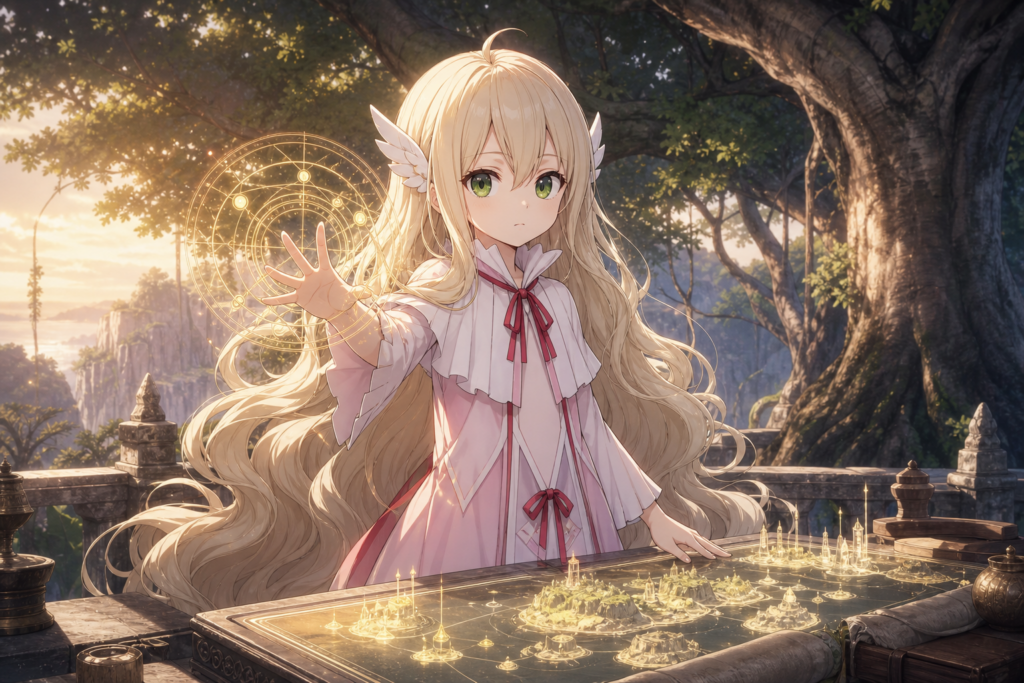
Fairy Tail Character Profile
Mavis creates Fairy Tail because she believes loneliness should not be permanent. Then generations of guild members inherit the secrets buried beneath that dream.
Mavis Vermillion creates Fairy Tail because she believes loneliness should not be a permanent condition. Then Fairy Tail spends generations living inside secrets she helped create. Both facts matter. Mavis is an orphaned servant, a brilliant reader, an illusionist, a battlefield strategist and the guild’s First Master. She helps Yuri Dreyar, Precht Gaebolg and Warrod Sequen become more than treasure hunters. Together they build a guild around adventure, loyalty and chosen family.
She also learns unfinished Law from Zeref, suffers Ankhseram’s curse, loses ordinary physical aging, becomes trapped inside a life-and-death contradiction and is eventually preserved beneath Fairy Tail as Lumen Histoire, later called Fairy Heart. Her body becomes a guild secret and a magical resource. Her relationship with Zeref produces love, catastrophe and a child whose existence neither parent raises. Her strategic genius saves people. Her secrecy makes later people carry dangers they do not understand. Mavis is not a perfect fairy founder. She is a traumatized young leader whose dream becomes an institution larger than her wisdom. That is why she matters.
Who Mavis Vermillion is
Mavis Vermillion is the co-founder and First Master of Fairy Tail. She grows up on Tenrou Island, becomes connected to Yuri Dreyar, Precht Gaebolg and Warrod Sequen, and helps establish the guild in Magnolia. Her strengths include illusion magic, tactical analysis and magic tied to Fairy Tail’s founding legacy. Fairy Law judges enemies, Fairy Glitter concentrates force, and Fairy Sphere turns collective bonds into protection. Their histories, conditions and costs are not interchangeable.
Her Japanese performer is Mamiko Noto. This profile keeps Japanese performance scope only. Mavis’s childlike physical appearance follows the arrest of her physical aging after Ankhseram’s curse. The series frames that body as the home of a strategist and guild master, not permission to sexualize her or dismiss her authority. TV Tokyo and Kodansha provide her official Fairy Tail Zero origin and cast credit, but their public pages do not expose a stable full vital sheet or a directly indexed exact main-manga debut entry. Her height and a fan-database chapter number stay out of the fact grid because tidy is not the same as verified.
Red Lizard: a child treated as labor
Mavis loses her parents young and works for the Red Lizard guild on Tenrou Island. TV Tokyo’s official Fairy Tail Zero page identifies her as an orphan forced into menial labor there. Kodansha’s official announcement describes her as a servant mistreated by the guild master and his daughter, Zera. That history matters because Fairy Tail’s later family ideal begins with a child learning what a guild should not be. Red Lizard has the formal shape of a magical community. Red Lizard never gives Mavis safety, dignity or mutual obligation. Rank protects the powerful child while the orphan works.
The contrast makes Fairy Tail an institutional answer, not merely a fun business idea. Mavis wants a guild where belonging does not depend on birth, money or usefulness to an abusive master. That dream is radical because it comes from somebody who has already seen family language used without care.
Zera and the grief Mavis cannot process directly
Zera begins as the guild master’s privileged daughter and treats Mavis badly. When Red Lizard is attacked, Mavis tries to save her. The girls become friends inside Mavis’s experience of the aftermath. The crucial canon boundary is that Zera dies during the destruction. The companion who remains with Mavis for years is an illusion Mavis creates without consciously accepting what happened. That does not make the friendship emotionally fake. The illusion makes the coping mechanism magical.
Mavis is a lonely child who survives catastrophe. Her mind gives grief a face she can continue speaking to. The illusion protects her until relationship with other people makes denial harder to sustain. A Buddhist lens makes this especially painful. Attachment is not presented as simple selfishness. Mavis clings because the truth would return her to total isolation. The illusion ends when she can finally move through grief rather than build a permanent world around avoiding it. Zera still changes her. The fact that one body is gone does not make the relationship meaningless.
Yuri, Precht and Warrod arrive
Seven years after Red Lizard’s destruction, treasure hunters Yuri Dreyar, Precht Gaebolg and Warrod Sequen arrive on Tenrou Island seeking the Tenrou Jade. TV Tokyo’s official character page identifies the group and the treasure-hunting context. Mavis initially meets adults driven by acquisition. She brings knowledge, strategy and a different understanding of the island. The relationship changes all four people. Yuri is bold and stubborn. Precht is serious and technically minded. Warrod provides steadiness. Mavis is physically the youngest-looking person in the group and often the sharpest strategist.
The creative lesson is simple: authority is not always located in the biggest body. That becomes a recurring Fairy Tail value. Lucy can read what fighters miss. Levy can rewrite a barrier. Wendy can heal damage strength cannot punch away. Mavis establishes the pattern early.
The Tenrou Jade and unfinished Law
The Tenrou conflict escalates beyond a treasure hunt. Mavis learns and attempts an unfinished form of Law to save Yuri from the danger connected to the Tenrou Jade. The act succeeds in protecting him. The unfinished spell also triggers the condition that arrests her aging and begins the curse’s life-and-death consequences. This is not a lesson that saving somebody was morally wrong. The consequence becomes a lesson about power learned without full preparation.
Mavis uses magic beyond safe mastery because the immediate danger is real. Heroic urgency and technical risk collide. Action stories often celebrate the person who reaches for forbidden power and worries about the bill later. Mavis becomes the bill. Her body stops aging. Her relationship to life becomes deadly. The child who wanted companionship can harm living beings more severely when she values life most. That is an exceptionally cruel curse structure.
Ankhseram's curse: love becomes dangerous
Ankhseram’s curse creates a contradiction. The more the cursed person values life, the more lethal the death effect becomes. Emotional detachment can reduce immediate danger, but detachment destroys the relationships that make life meaningful. Mavis and Zeref carry versions of the same curse. The curse should not be reduced to a romantic metaphor. The curse kills people and living things. Its mechanics create ethical and physical danger. The symbolism still matters.
Mavis builds a guild because she values connection. The curse makes connection hazardous. Zeref has lived so long that despair and mass consequence reshape his morality. Their shared condition creates recognition and temptation. They understand each other in a way few others can. Understanding is not safety.
Founding Fairy Tail
Mavis, Yuri, Precht and Warrod establish Fairy Tail. The guild becomes a legal magical institution, workplace and chosen family. Mavis serves as First Master. Her strategic intelligence helps the guild survive early conflict and establish a reputation. The founding ideal is not perfect harmony. The founding ideal is shared adventure with responsibility. The name Fairy Tail points toward an unanswered question: do fairies have tails, and does their existence create an endless mystery? That playful uncertainty becomes a philosophy. The guild pursues what cannot be fully known. RaeRae’s side-eye is that an institution built around endless mystery should maybe have developed better documentation for the basement superweapon. Wonder is beautiful. Governance still needs records.
First Master and battlefield strategist
Mavis becomes famous for strategy. She reads movement, opponent psychology and battlefield structure quickly. Her small body and gentle design contrast with the scale of authority others grant her. That contrast should not turn her into a magical child mascot. Leadership comes through analysis and trust. Her illusion magic also reinforces the theme. Strategy depends on controlling information. Illusions change what opponents believe is present, which changes what they choose.
The ethical boundary is consent and consequence. Deceiving an enemy during battle is not identical to withholding life-changing truth from allies. Mavis’s story becomes more complicated when a useful tactical habit enters institutional leadership. The person who survives through secret knowledge can begin believing secrecy is protection. Makarov later inherits a similar flaw. Fairy Tail’s family culture passes down warmth and information bottlenecks together.
Fairy Law, Fairy Glitter and Fairy Sphere
Fairy Tail’s Three Great Fairy Magics must remain distinct. Fairy Law targets those the caster sincerely recognizes as enemies. Its moral filter makes the caster’s judgment part of the spell. Fairy Glitter concentrates enormous magical power into a focused attack. Mavis later entrusts access to Cana Alberona, but the grant does not make Cana equal to Mavis in experience or capacity. Fairy Sphere creates a protective state through collective bonds and magical power. On Tenrou Island, it saves the guild group from Acnologia while suspending them outside ordinary time for seven years. All three spells connect power to relationship. Law asks who counts as enemy. Glitter asks who can carry entrusted force. Sphere asks whether collective bond can become shelter. None is consequence-free.
Zeref: recognition, love and catastrophic consequence
Mavis meets Zeref and learns from him. Their shared curse creates recognition. They can discuss death, isolation and the danger of valuing life from inside the same impossible structure. They also fall in love. The relationship should not be romanticized into “only love could kill them.” Their closeness activates deadly consequences. Mavis becomes unresponsive after Zeref’s kiss and is returned to Fairy Tail. Zeref’s suffering explains his desperation. Their shared curse does not excuse the civilizations, experiments and lives damaged by his later plans.
Mavis’s compassion explains why she connects with him. Her strategic brilliance does not make every secret that follows wise. The relationship produces August, whom the main manga identifies as their son. The story reveals the parentage late and leaves the ordinary biology and care history deliberately obscured by curse, suspended life and Precht’s intervention. What is not obscure is the result: August grows without being raised or recognized by either parent.
The moral boundary is already clear: August grows without being raised by either parent and carries the consequence of a relationship whose adults are trapped in curse, secrecy and catastrophe. He is not merely a twist proving their love was real. He is a person who pays for it.
Precht, the preserved body and Lumen Histoire
Precht attempts to preserve and restore Mavis after she becomes unresponsive. Her body is sealed beneath Fairy Tail and connected to a vast magical source hidden under the name Lumen Histoire. Later, the truth is framed as Fairy Heart. The preservation begins in grief and loyalty. Lumen Histoire becomes an institutional secret with world-level stakes. Mavis’s body is no longer treated only as her body. Her preserved body becomes power, asset, secret and target.
That raises a consent problem the franchise should not glide past. Precht wants to save her. The result turns her suspended existence into infrastructure. Fairy Tail’s masters inherit knowledge that ordinary members do not have. Those members still face attacks caused by the secret. Protection without disclosure redistributes risk downward. The smallest-looking founder becomes the largest hidden battery in the building. Sir, that is not a normal basement situation.
Tenrou Island and the guild she can still see
Mavis remains connected to Tenrou Island and Fairy Tail after her physical preservation. Her presence during the Tenrou conflict guides the guild and contributes to Fairy Sphere. The seven-year suspension saves the group from Acnologia. Fairy Sphere also removes them from the lives of people outside the barrier. Macao becomes Fourth Master. Romeo grows up. Fairy Tail declines financially and politically. Mavis’s miracle therefore carries unequal time. The protected members survive. The outside guild lives the absence. This does not make Fairy Sphere a bad choice under imminent destruction. The seven-year absence makes survival consequential. Fairy Tail is often strongest when it lets a miracle save the body without pretending the world stopped charging interest.
Grand Magic Games and tactical return
Mavis supports Fairy Tail during the Grand Magic Games era through strategy and founder authority. The tournament gives her another chance to read teams, opponents and public stakes. Her appearance also reconnects the modern guild with its origin. The current members experience her as a legendary founder and a present personality. She can be playful, competitive and sharply analytical. The contrast prevents her from becoming a stained-glass saint. Founders are dangerous when institutions remember only the slogan and forget the person. Mavis is more useful when she can be admired and questioned.
Tartaros, dissolution and the inherited secret
The Tartaros crisis exposes Fairy Tail to threats tied to Zeref’s demons, Face and continent-scale magical risk. Makarov dissolves the guild afterward in part because he believes separation can protect members from the dangers connected to Fairy Heart and Alvarez. The decision mirrors Mavis’s institutional pattern. Leaders hold the secret. Members carry the consequence. Makarov’s motive is protection. The result scatters the guild and creates emotional and practical instability. Mavis is not solely responsible for his decision. Her hidden body and power are part of the structure that makes the threat possible. Founding choices survive founders. That is why accountability cannot stop at intent.
Alvarez and Fairy Heart
The Alvarez Empire seeks Fairy Heart because Mavis’s preserved condition offers extraordinary magical power. Zeref wants that power inside a larger plan involving time, history and the world he believes should be remade. Mavis becomes strategist, target and source. The war reveals how completely her personhood has been entangled with utility. Allies need her knowledge. Enemies want her power. Founders and descendants project meaning onto her body. She still makes choices.
The final conflict with Zeref cannot be reduced to romance defeating evil. Their curses, decisions and mutual recognition reach a conclusion through love and death, but the war’s casualties do not become background decoration for a tragic couple. Personal suffering explains large decisions. That intimacy does not make large consequences private.
August and the child outside the founding myth
August is the son of Mavis and Zeref. His existence complicates both characters. Mavis builds an institution around family while her own child grows without being raised by her. Zeref pursues world-shaping plans while failing to recognize the relationship in time to create ordinary care. Neither parent’s circumstance makes August unreal. He becomes powerful, loyal and emotionally shaped by absence. The revelation involving parental love is not only a plot twist. August’s loneliness indicts the adults’ hidden history. Family can be chosen. Biology can still create responsibility. Fairy Tail’s found-family theme becomes less sentimental when the story admits those duties can conflict.
Mavis and the people behind the founding myth
Zera: Zera is Mavis’s childhood friend and the grief-created companion who helps her survive isolation. Zera’s physical death and emotional reality remain distinct. The illusion protects Mavis until friendship with living people makes the loss possible to face.
Yuri Dreyar: Yuri begins as a treasure hunter and becomes a founding partner. Mavis saves him through an unfinished casting of Law, and his survival becomes tied to the beginning of her curse. Their bond joins adventure, consequence and the first version of Fairy Tail.
Precht Gaebolg: Precht is a founding partner, Second Master and the man who preserves Mavis’s body. His loyalty produces both attempted rescue and dangerous institutional secrecy before he becomes Hades. Devotion without consent turns the founder into a resource hidden beneath the guild.
Warrod Sequen: Warrod is a founding partner whose later life as a Wizard Saint shows one path away from guild leadership and toward wider service. His survival gives the founding story an elder who can remember Mavis as a person rather than a sealed source of power.
Zeref Dragneel: Zeref is teacher, cursed counterpart, lover and source of catastrophic consequence. Mutual recognition gives both characters relief from isolation, but love does not erase responsibility for the deaths and institutions built around their choices.
August: August is the son whose life makes secrecy and absent parenthood personal. Mavis and Zeref create a child without building a family capable of seeing him. His immense power cannot replace the recognition withheld throughout his life.
Makarov Dreyar: Makarov descends from the founding generation and repeatedly leads the guild. He inherits Mavis’s family ideal alongside her habit of protecting people through hidden burdens. His leadership keeps the dream alive while repeating parts of the secrecy beneath it.
Cana Alberona: Cana is the mage Mavis entrusts with Fairy Glitter. The grant makes Cana responsible for dangerous inherited power, not a replacement for the founder. Their connection shows how a legacy can be shared through judgment instead of bloodline or worship.
Mavis’s illusion magic can shape perception with exceptional sophistication, while her strategic strengths include analysis, prediction, information control and coordination across a large battlefield. Illusions do not automatically change physical reality, strategy depends on accurate information, and even a brilliant plan can impose costs on people who were never consulted.
- The Three Great Fairy Magics have distinct requirements and effects.
- Ankhseram’s curse makes emotional connection physically dangerous.
- Her preserved body and Fairy Heart state create vulnerability to exploitation.
Mavis is not omniscient. The story sometimes presents her plans with near-mythic authority, but her own life proves that intelligence does not make anyone ethically complete. Strategy remains a tool whose value depends on consent, context and the people expected to carry the cost.
Japanese performance and adaptation
TV Tokyo’s official cast page credits Mamiko Noto as Mavis. The role requires a childlike physical presentation without reducing Mavis’s authority. Warmth, curiosity, grief, strategic command and curse-driven terror must belong to one person. TV Tokyo’s public cast material confirms the performer but does not provide a scene-by-scene acting interview. The profile therefore credits Noto without pretending a written plot summary can tell us the exact breath, pitch or timing of a performance.
The Fairy Tail Zero adaptation gives Mavis’s origin a dedicated visual and performance frame. Official TV Tokyo pages identify her Red Lizard labor, Zera, the treasure hunters and the x686 adventure. The adaptation separates the dedicated Fairy Tail Zero origin material from later main-series revelations. Anime-expanded connective scenes are useful adaptation choices, not retroactive manga panels. Mavis has supplementary franchise visibility through animated specials, games and promotional material, but those appearances do not replace her Zero and main-manga chronology. This biography does not use an uncredited cameo to manufacture a separate canon event.
Design evolution: the founder who does not look like a monument
Mavis is drawn with extremely long pale-blonde hair, green eyes and wing-shaped ornaments at the sides of her head. The ornaments echo the guild’s fairy question without turning her into a literal fairy species. Her founder-era dress is modest, light and easy to read beside the heavier silhouettes of Yuri, Precht and Warrod. Her bare feet are part of the established design. They can communicate the isolated child of Tenrou Island and the almost spectral First Master, but fandom art has a responsibility not to turn that detail into fetish material. The biography needs her face, hands, ornaments and strategic magic. The series does not need the camera crawling across a childlike body.
Later appearances change context more than identity. As an apparition, tactical adviser and preserved source of Fairy Heart, Mavis can look visually unchanged while the audience learns that decades of institutional history have accumulated around her. That is the point. Her body appears frozen. Her consequences are not.
Succession and the problem with founder worship
Mavis is Fairy Tail’s First Master. Precht succeeds her as Second Master, and Makarov later becomes the Third. The guild continues through later numbered masters, but Mavis remains the founder members invoke when they need origin, legitimacy or a reminder of the guild’s ideals. That kind of founder memory can be useful. Founder reverence can also become a permission slip. If every current decision is described as “what the founder wanted,” living members lose the right to question what the institution has become.
Mavis is more interesting than a logo because her own life resists easy worship. She designed a home for lonely people and participated in dangerous secrecy. She developed brilliant battlefield plans and underestimated the long political life of hidden power. She loved deeply and left August carrying absence he did not choose. Fairy Tail honors her best when it keeps the family ideal and improves the governance. Copying every founder mistake would be a cult, not a legacy.
The ending, Mio and what the story refuses to call a clean reset
The main manga’s ending gives Mavis and Zeref look-alikes named Mio and Alios a brief encounter. The scene suggests reincarnation or another-life possibility without turning the entire war into a dream. The people killed, displaced or used by the original pair’s choices do not disappear because two familiar faces receive a gentler meeting. That coda works as grace, not acquittal. Fairy Tail often believes people are more than the worst thing they have done. The story is less consistent about showing who pays while the guild reaches that better possibility. Mavis’s profile has to keep the ledger open. Compassion for the cursed girl and accountability for the founder belong in the same paragraph.
Fairy Tail: 100 Years Quest boundary
Mavis’s founding legacy, Fairy Heart history and relationship to the guild remain part of the world inherited by Fairy Tail: 100 Years Quest. She is not a current Dragon God quest member, and this profile does not assign her fresh strategic victories because a sequel-era problem resembles something she once handled. The sequel matters most here as consequence. Natsu, Lucy, Gray, Erza, Wendy and the wider guild travel under a name Mavis helped build. Their loyalty, secrecy, risk-taking and chosen-family habits carry her institutional DNA even when she is not standing in the room. Legacy is not screen time. Legacy is what other people have to live with after the founder leaves.
Final verdict
Mavis Vermillion creates Fairy Tail because a bad guild taught her what belonging should not be. That is beautiful. She also helps create a system where dangerous truth is concentrated among a few masters and her own body becomes hidden infrastructure. That is not beautiful. Her story is strongest when both remain visible. Zera shows how grief can create a world a lonely child needs. Yuri, Precht and Warrod show how new relationship can make truth survivable. Fairy Tail shows how a dream can become a home. Zeref shows how shared pain can produce recognition without safety. August shows how adult catastrophe becomes a child’s inheritance. Mavis is a brilliant founder. She is not a flawless one. The guild should inherit her belief that lonely people deserve family. The guild should not inherit the belief that love gives leaders permission to hide every burden in the basement.
Source ledger and clean boundaries
- TV Tokyo official Fairy Tail Zero character page: TV Tokyo: Fairy Tail character archive
- TV Tokyo official Fairy Tail Zero story page: TV Tokyo: Fairy Tail story archive
- TV Tokyo official cast page, Mamiko Noto as Mavis: TV Tokyo: original Fairy Tail staff and cast
- Kodansha official Fairy Tail Zero announcement and premise: Kodansha: Fairy Tail Zero announcement
- Kodansha Fairy Tail series catalog: Kodansha: Fairy Tail series
- Primary chronology and magic context: Hiro Mashima, Fairy Tail Zero and Fairy Tail, volumes 1 through 63.
Public official pages do not expose a stable full vital sheet, a directly indexed exact main-manga debut, every illusion or Fairy Magic spell’s licensed first-use name, or an indexed explanation of every biological detail around August’s birth. Those details are omitted or bounded instead of imported from fan databases.
Primary receipts and continuity shelf
TV Tokyo’s Fairy Tail Zero character page documents Mavis, Zera, Yuri, Precht and Warrod. The official Zero story page establishes the Tenrou origin, while TV Tokyo’s official cast page credits Mamiko Noto. Kodansha’s official Fairy Tail Zero announcement and licensed volumes ground the founding chronology; later Alvarez and Fairy Heart claims follow Mashima’s main manga rather than a wiki compression.