
RaeRae Rants · Inherited Power and Opportunity File
Bloodline Power Makes Anime Meritocracy a Lie
An exam cannot measure effort fairly when one child inherits the weapon, the teacher, the family archive, the political name, and a private road to the finish line.
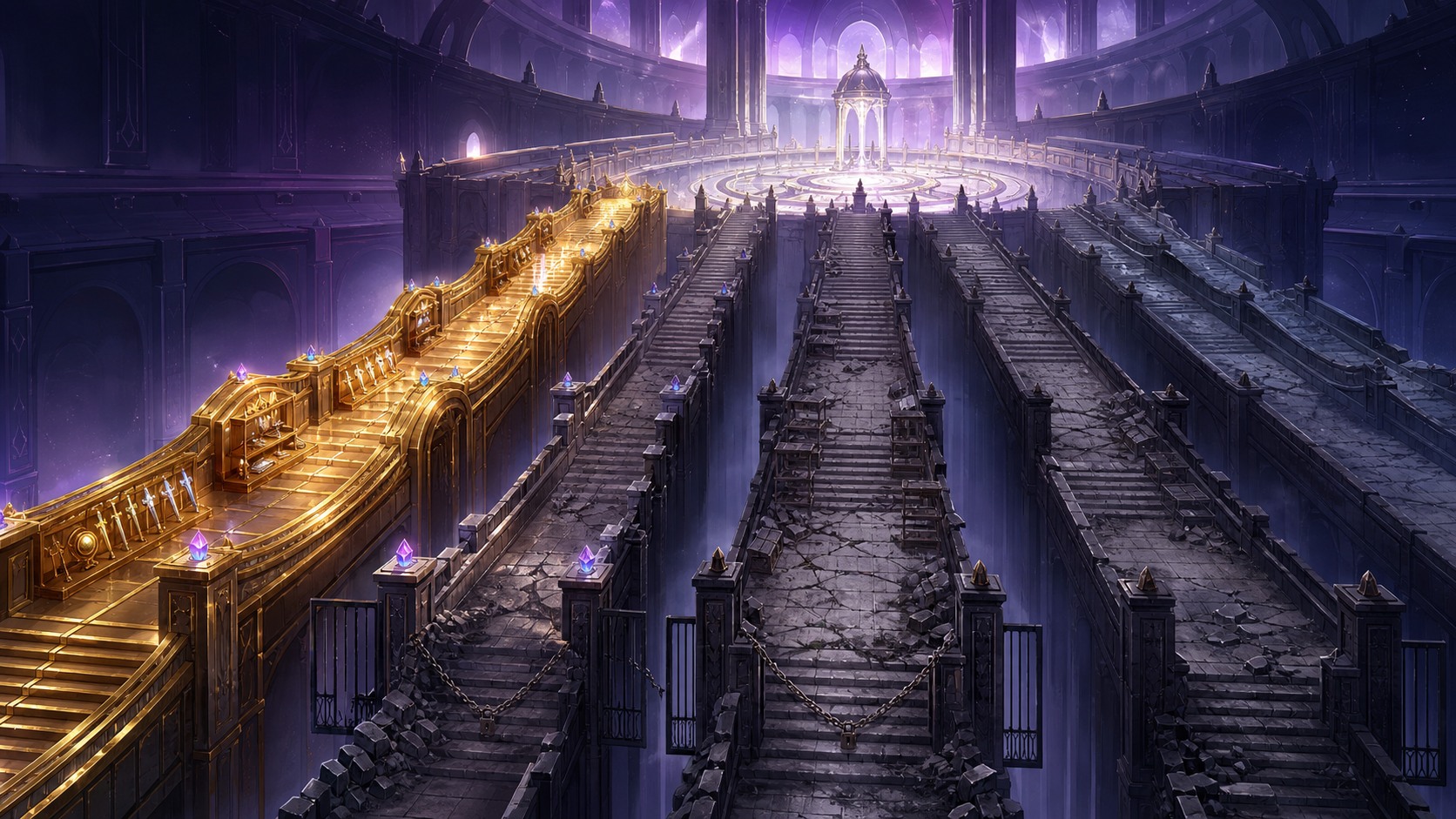
The golden lane and the locked gate
A magical academy invites every child to the same examination hall. Officials explain the rules, praise discipline, and promise that rank reflects talent. One student arrives with an inherited technique refined across ten generations, private tutors who trained the exam format, equipment forged for the family body, and a surname the judges recognize. Another student reaches the starting line after working nights, hiding an unregistered ability, borrowing damaged gear, and teaching themselves from public scraps. Both receive the same clock. The academy calls the result objective.
The problem is not that inheritance exists. Bodies, families, histories, and resources shape every person. Fantasy makes those differences visible through eyes, blood, magic capacity, spiritual pressure, physical traits, contracts, and clan techniques. The problem begins when the story builds an entire hierarchy around inherited advantage and still repeats that success proves individual worth. The winner may have trained brutally. Training does not erase the elevator waiting at the winner’s front door.
Meritocracy sounds fair because people want effort to matter. Effort should matter. Skill should matter. Discipline, judgment, creativity, courage, and cooperation should matter. A serious system must also measure access. Who received time to train? Who survived childhood without interruption? Who learned the rules before the exam? Who could fail safely? Who inherited a body the institution already understands? Who entered under a name that teachers treat as future leadership?
What inherited power gets right
Bloodline systems can make fantasy worlds feel historical. Power does not appear from nowhere. Families protect knowledge, monopolize tools, arrange marriages, guard techniques, pass trauma, and build political identities around what their bodies can do. Such systems explain why magic changes law, inheritance, warfare, property, education, and family structure. A rare ability should affect more than fight choreography.
Inheritance also creates strong character conflict. A child may love the family and hate the role assigned by the family. A technique can carry pride and violence together. A noble heir may receive access while losing privacy. A clan marked as dangerous may possess real power and face collective suspicion. A sibling without the expected trait may become invisible inside a household built around succession. Those pressures turn power into a social relationship rather than a colorful attack.
Anime also understands that inherited advantage does not guarantee emotional safety. Wealthy, noble, or powerful children can face coercion, abuse, isolation, arranged duty, and impossible expectations. Privilege and harm can coexist. One child may receive every training resource while being denied the right to choose a life. Another child may envy the resources without seeing the cage. Good stories refuse to flatten either experience.
The trope works best when characters use inheritance differently from the people before them. A family technique can become protective instead of dominant. An heir can share knowledge the clan hoarded. A child can expose the crimes hidden behind a respected name. Such choices show agency inside history. Agency becomes meaningful because the inheritance remains real rather than disappearing after one speech.
Where meritocracy becomes a lie
The lie begins when an institution rewards inherited power and calls the reward proof of virtue. A combat exam favors destructive output, so families bred or trained for combat dominate. A hero ranking rewards visibility, so wealthy agencies buy equipment, media access, and internships. A military academy values techniques useful to the state, so children with healing, domestic, sensory, or support abilities receive lower status even when society depends on them. The metric does not discover merit. The metric defines merit around the people already positioned to win.
Neutral language hides design choices. Officials say every candidate faced the same opponent, obstacle, written test, or time limit. The same obstacle tests different realities. A flying student crosses a chasm. A student with money buys legal equipment. A clan child recognizes the technique because relatives documented it. A disabled student encounters an arena built without accommodation. Equal treatment becomes a method for preserving inequality when the task ignores relevant differences.
Connections also disappear from the score. Elite students receive recommendations, apprenticeships, secret training, introductions, and second chances. Teachers interpret their mistakes as pressure or potential. Poor and stigmatized students receive suspicion. Their mistakes confirm risk. One group inherits a network that converts ability into opportunity. The other group must be extraordinary before anybody considers investment.
Success then rewrites the starting point. The winner remembers long hours and concludes that work created the result. The work was real. The inherited teacher, library, nutrition, housing, safety, equipment, recovery time, and political protection were also real. Privilege rarely feels like a moving walkway when the person on the walkway is still running.
The secretly exceptional underdog protects the system from criticism
Anime loves an underdog who appears ordinary and later reveals a rare bloodline, sealed entity, legendary parent, chosen destiny, unique body, ancient reincarnation, or power no teacher understood. The reveal creates excitement because viewers reinterpret every earlier struggle. The reveal can also betray the social argument. A story promises that an excluded child can rise through persistence, then explains the rise through a deeper form of inherited exception.
The character still works hard, but the institution learns nothing. Ordinary children without secret greatness remain where they started. The message shifts from “the system misjudges people” to “the system failed to identify one valuable asset.” Inclusion becomes better talent detection rather than a challenge to the hierarchy. The school does not need to respect every student. The school needs a more accurate scanner for hidden legends.
Secret exception also makes poverty and exclusion feel temporary. The audience waits for proof that the mocked child deserves respect. Real fairness would ask why respect required proof. A child should not need cosmic ancestry to receive food, schooling, medical care, protection, and a teacher willing to explain the lesson. Basic dignity cannot depend on the final power reveal.
The strongest underdog story lets ordinary limits remain ordinary. Progress may come through teamwork, public resources, patient instruction, adaptive tools, specialization, and institutions willing to change the task. Victory may mean a useful role rather than dominance. Such stories are harder because the solution cannot hide inside the protagonist’s body.
Anime case files show different versions of inherited advantage
Naruto condemns clan pain while depending on clan power
Naruto builds an entire political world around clans, inherited techniques, jinchūriki policy, famous teachers, family names, and village institutions. The series clearly understands that birth shapes danger and opportunity. The Hyūga organize family status through bodies and sealing practices. The Uchiha become a political category whose inherited ability attracts fear, surveillance, exploitation, and massacre. Lesser-known families pass specialized techniques that create immediate value within the shinobi economy.
The story also celebrates effort, especially through characters such as Rock Lee. Lee’s discipline exposes how narrow the academy’s definition of talent can be. Yet the wider plot keeps returning to inherited reserves, legendary teachers, reincarnated conflict, parental legacy, and bloodline abilities that scale beyond ordinary training. Naruto’s achievement includes enormous work and relational growth. The story weakens its own underdog promise when destiny keeps explaining why this excluded child could reach a level unavailable to nearly everyone else.
A believable village would stop pretending the academy is a neutral ladder. Training, missions, medical support, and leadership selection would account for clan resources. Families that monopolize techniques would face public obligations. Children without combat bloodlines would receive funded specialization and safe routes into civic roles. The village cannot call itself unified while private dynasties control essential knowledge.
My Hero Academia turns inherited bodies into an employment market
Quirks make inequality physical and visible. Some children receive abilities that fit hero licensing, advertising, rescue, combat, mobility, or institutional prestige. Other abilities appear frightening, inconvenient, weak, stigmatized, or difficult to control. Families transmit traits, social expectations, and sometimes deliberate breeding goals. Schools then test applicants through exercises shaped around particular kinds of power.
U.A. offers training and support, but the entrance system reveals the problem. A robot-heavy practical test rewards direct combat or obvious rescue capacity. Recommendation pathways give already-connected students another entrance. Support equipment can expand access, yet access to design expertise depends on placement within the institution. The system discovers excellent individuals while leaving the definition of excellence largely intact.
A fairer hero society would evaluate rescue judgment, communication, ethics, planning, teamwork, support design, community trust, and noncombat crisis work through several routes. Quirk counseling would receive public investment before a child becomes dangerous. Families would not own the future value of a child’s body. Hero employment could stop treating media popularity as evidence of public service.
Jujutsu Kaisen knows the clans are rotten and still needs their techniques
Jujutsu society organizes status through inherited techniques, clan politics, secret knowledge, conservative leadership, and bodies evaluated for usefulness. Children become succession problems before becoming people. A powerful technique can raise status while increasing control over marriage, training, and duty. A child without the expected inheritance may face contempt even when their physical skill exceeds the institution’s standards.
The story’s anger toward the clans is one of its strongest social instincts. Personal rebellion, however, cannot replace institutional design. Destroying or humiliating one household does not create transparent training, democratic oversight, mental health support, survivor care, or a public system for cursed threats. Rare techniques remain strategically necessary, which encourages leaders to rebuild hierarchy around the next useful body.
A better jujutsu structure would treat inherited knowledge as a regulated public safety resource rather than private family property. Technique records, risk research, protective tools, and training methods would belong to accountable institutions with safeguards. Children could refuse clan authority without losing access to education or protection. No family should control the only manual for a danger affecting everyone.
Black Clover makes class inequality visible, then lets exceptional magic do the climbing
Black Clover openly contrasts nobles, royals, commoners, and peasants. Mana capacity, education, equipment, social networks, and institutional respect follow class. Elite characters may work hard, but the kingdom treats inherited capacity as proof that the ruling class deserves authority. Commoners face ridicule before evaluation, while nobles receive assumptions of competence before performance.
Asta challenges that order through a body and power outside the normal mana system. His persistence matters, and the story repeatedly values squads built from people dismissed by respectable institutions. The danger is familiar: one extraordinary exception can prove that the hierarchy is flexible while most people remain excluded. A kingdom does not become fair because one peasant receives a seat near power.
Structural change would require public magic education, rural investment, transparent selection, limits on hereditary office, and recognition for work that does not produce tournament spectacle. The Magic Knights should not be the only imaginable ladder. A society needs healers, builders, teachers, researchers, farmers, administrators, and local defenders whose value does not depend on impressing a captain in one exam.
The real social structure under the magic is opportunity hoarding
Real societies do not transmit fire eyes or infinite mana, but families transmit money, housing, health, education, location, language, professional networks, cultural knowledge, confidence around institutions, and protection from failure. The OECD describes “sticky floors” that limit upward mobility and “sticky ceilings” associated with opportunity hoarding at the top. The fantasy bloodline makes that inheritance impossible to ignore, then many stories act as though the final exam removed every advantage.
Social origin can shape which occupations appear possible, which mistakes become survivable, and which authorities assume competence. The International Labour Organization recognizes discrimination based on social origin as a barrier that can impair equality of opportunity and treatment in employment. Anime versions often literalize social origin through visible marks, surnames, magical capacity, species, districts, or family techniques. The symbolism becomes powerful when the story follows the consequences beyond school rivalry.
Meritocracy survives because winners can point to genuine effort. Most privileged people do work. The political question is not whether they worked. The question is why comparable work produces different returns, why some people receive preparation before the contest, and why the winners gain authority to declare the contest fair. Acknowledging advantage does not erase achievement. Acknowledging advantage prevents achievement from becoming a moral weapon against everyone who started behind the gate.
Institutions also prefer merit language because merit protects legitimacy. A school can defend hierarchy by publishing scores. A company can defend recruitment through interviews. A village can defend leadership through combat rank. Numbers and tests create the appearance of neutrality even when powerful groups designed the criteria, funded the preparation, and defined which abilities count.
Why anime schools preserve inherited advantage
Schools often promise to turn talent into public service, but many fictional academies function as sorting machines. They identify students whose existing traits fit institutional needs, intensify those traits, and place the graduates into the same hierarchy. A clan’s private investment becomes public rank. The school receives credit for excellence that arrived partly assembled.
Teachers may notice inequality and still reproduce it through attention. Exceptional students receive difficult assignments, mentorship, and access to secrets. Struggling students receive basic repetition or public humiliation. The gap grows because instruction follows demonstrated performance. Early advantage attracts more resources, which produces later performance, which justifies more resources. The cycle looks natural by graduation.
Competitive formats make the cycle entertaining. Tournaments reveal techniques, settle rivalries, and create clean rankings. Education requires different questions. Who improved relative to available support? Who helps others learn? Who makes sound decisions under pressure? Who understands limits? Who can perform essential work that the spectacle ignores? A school that only identifies the strongest fighter is not educating a society. The school is scouting weapons.
Risk also falls unequally. Wealthy or connected students can recover from injury, failed exams, damaged equipment, and public embarrassment. Poor students may lose housing, employment, family support, or the only available opportunity. One failure has different consequences. A fair system cannot treat risk tolerance as pure courage when some families provide a net and others provide a cliff.
How the power system could become more believable and better
First, the story should map resources before ranking outcomes. Schools can identify prior training, family instruction, equipment access, health, disability, language, work obligations, and exposure to the tested skill. The purpose is not to punish prepared students. The purpose is to stop interpreting preparation as innate moral superiority. Assessment can measure growth, judgment, and potential alongside current output.
Second, public training must be genuinely public. Libraries, technique archives, safe practice facilities, meals, housing, healthcare, equipment, transportation, and tutoring reduce the amount of future rank purchased through family wealth. Rare family knowledge may require privacy or safety controls, but knowledge essential to public survival cannot remain hereditary property forever. Regulation, compensation, and shared research can protect families without allowing monopoly.
Third, several routes should lead to valued work. Combat, rescue, support, research, healing, logistics, teaching, diplomacy, intelligence, construction, and community care require different strengths. One tournament cannot evaluate every role. Students should move between tracks without carrying permanent shame. A person who cannot win a duel may still prevent the disaster that makes the duel necessary.
Fourth, leadership needs separation from inherited power. The strongest technique does not prove political judgment. Noble birth does not prove public consent. A family’s historical service does not create permanent ownership of office. Transparent selection, term limits, civilian oversight, conflict rules, and accessible records matter even in a magical state. Extraordinary power increases the need for accountability because ordinary citizens cannot balance the threat privately.
Fifth, accommodations should be treated as design rather than charity. Adaptive equipment, alternative demonstrations, protected training, communication access, and flexible timelines do not lower standards when the standard concerns actual job performance. An irrelevant barrier only measures who matches the institution’s preferred body. Good design reveals ability that bad design hides.
Finally, stories should let average people matter without discovering secret greatness. Public systems become credible when ordinary workers can build stable lives, influence decisions, and contribute through supported skill. A fair society cannot require every excluded child to become legendary before the audience believes exclusion was wrong.
The tunnel toward a fairer test
The complaint begins at the starting gate. One lane glows with inherited tools while another lane starts behind chains, yet the judge holds one clock and calls the race equal. The vision is not a world where talent disappears or every outcome becomes identical. The vision is a world honest enough to distinguish effort, inheritance, support, risk, and institutional choice.
The journey can remain exciting. A tournament can reveal how the arena favors certain bodies. A noble student can recognize that private training shaped the victory and choose to open the archive. An underdog can demand better public instruction instead of merely earning admission to the elite club. Teachers can fight over whether growth matters more than raw output. Families can resist reforms that threaten status. Political conflict grows because equality changes ownership.
Fans would still receive rivalries, breakthroughs, secret techniques, and impossible fights. The consequences would reach farther. A victory could force the school to redesign an exam. A support student’s invention could expose how many candidates were misclassified. A village budget could become as important as a clan feud because resources decide which children survive long enough to train. Worldbuilding would finally match the social weight assigned to blood.
The ending should not announce that hard work defeats privilege. Hard work exists on every lane. The ending should show which gates opened, which families surrendered monopoly, which students gained real options, and which hierarchies survived under new language. Fairness is not a speech given by the winner. Fairness is the redesigned road the next child actually receives.
Final take
Bloodline power can create brilliant fantasy. Inherited techniques carry history, identity, danger, love, trauma, and political meaning inside the body. The trope becomes dishonest when the institution rewards that inheritance and then calls the ranking merit. Equal rules cannot erase unequal preparation, unequal safety, unequal networks, or a test designed around elite abilities.
Let the heir work hard. Let the underdog rise. Then keep the golden lane visible. Ask who built the stairs, who locked the other gates, who owns the training archive, and why the winner’s family keeps choosing the judges. One exceptional child crossing the gap does not prove the bridge exists.