
RaeRae Rants · Accountability and Repair File
Anime Redemption Arcs Keep Skipping the Repair
Feeling bad is a beginning. Joining the heroes is a plot development. Neither choice repairs the homes, bodies, careers, families, and public trust somebody already broke.
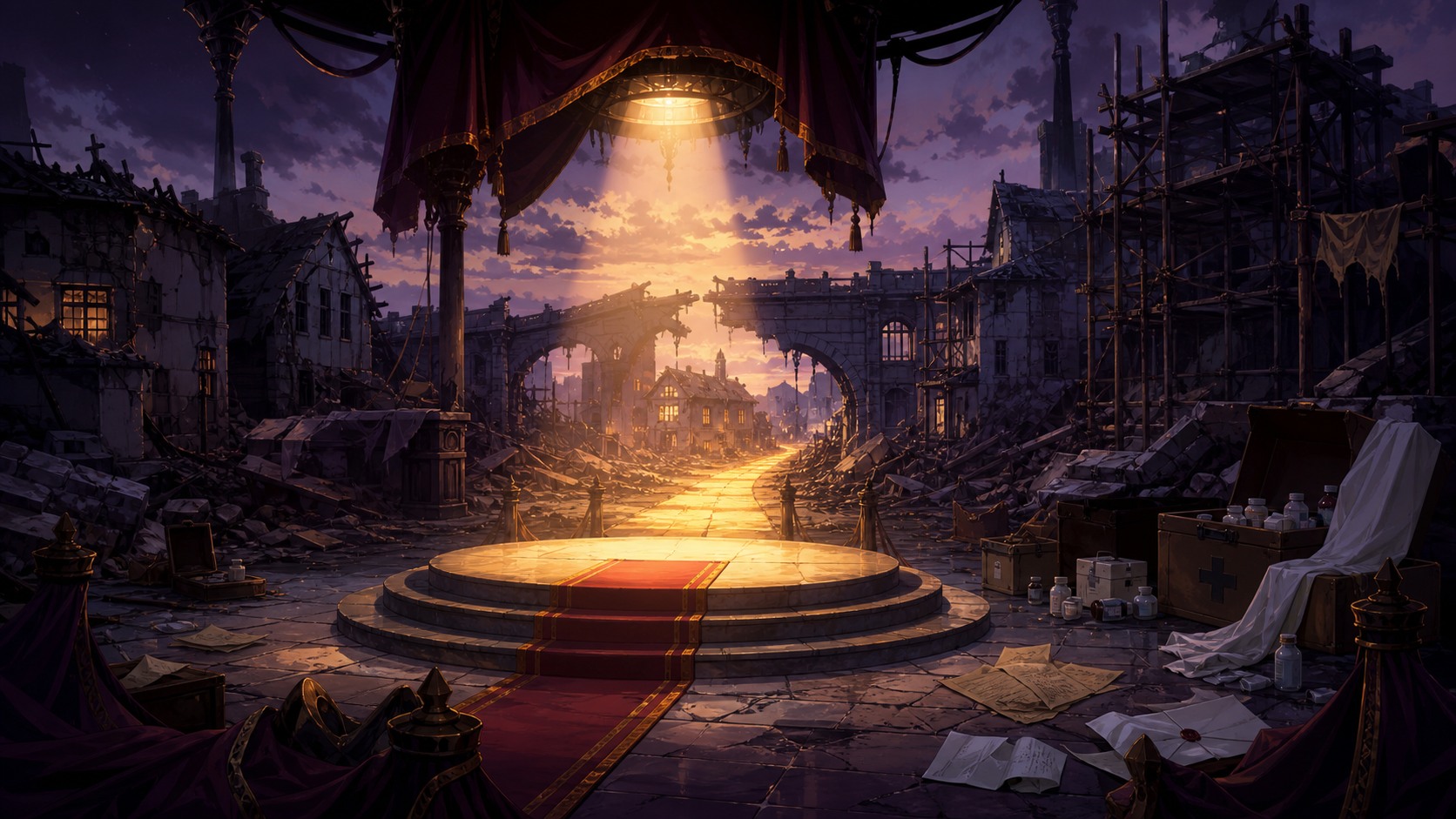
The empty podium and the broken street
A city stages a ceremony after the war. The former enemy stands beneath a bright light, admits that the heroes were right, and receives a cautious nod from the protagonist. Behind the plaza, apartments remain cracked open. Families still search for missing relatives. Medical teams ration supplies. People who lost work, homes, mobility, and years of safety have not received compensation, records, testimony, or a public explanation. The story points the camera toward the podium because one apology fits inside a scene. Repair would require the entire society to keep working after the credits.
My complaint is not that damaged people can never change. Stories need the possibility of change because permanent moral categories flatten human behavior into team colors. A child soldier can leave the army. A cult member can reject the leader. A rival can recognize the cruelty built into the competition. A violent adult can stop causing harm and accept limits. The problem begins when the narrative treats the decision to change as payment for the harm. A new direction does not settle an old debt.
Redemption is centered on the person who caused harm. What do they understand now? Which side will they choose? Can they live with themselves? Reparations are centered on the people and communities who carry the consequences. What was taken? What can be restored? Which losses cannot be restored? Who decides what meaningful repair looks like? Which institutions enabled the harm? How will anybody prevent the same structure from producing another offender?
What the redemption trope gets right
Anime often understands that people are not identical to their worst action. That distinction matters, especially in stories built around childhood indoctrination, state violence, poverty, abuse, military recruitment, discrimination, and inherited conflict. A character may choose terrible methods inside a system that trained violence as the only available language. Holding the character responsible does not require pretending the system played no role. Strong redemption arcs let personal agency and structural pressure exist together.
The trope also understands that stopping present harm has value before every question about the past can be answered. A villain who lowers the weapon during a crisis saves lives. A commander who releases prisoners changes immediate conditions. A spy who reveals the plan may prevent a massacre. Nobody should refuse useful action merely because the actor cannot repair everything in one night. Stories become dishonest only when emergency cooperation transforms into complete moral clearance without another stage.
Anime can show how relationships interrupt ideology. Gaara encounters someone who recognizes his loneliness without accepting his violence. Vegeta lives among people his old worldview classified as weak or disposable. Scar travels with people whose lives complicate the revenge logic sustaining him. Those relationships create evidence that another self is possible. Connection becomes a door out of the identity built by empire, family, weapon programs, or fear.
Such arcs can also protect viewers from the idea that punishment produces the only serious response to wrongdoing. Prison, exile, execution, and defeat may stop immediate danger while leaving victims unsupported and institutions untouched. The United Nations framework for restorative justice describes a process concerned with harm, needs, responsibility, and participation by affected parties. Change becomes more demanding than suffering a sentence. The person who caused harm must face what happened and take action toward repair when the people harmed want that process.
Where redemption becomes a shortcut
The shortcut appears when a story confuses narrative usefulness with moral repair. The former enemy becomes necessary during the final battle, so cooperation buys forgiveness. Combat competence turns into currency. A powerful person can destroy a laboratory, block one attack, or sacrifice energy against a greater villain and receive a faster route back into society than an ordinary offender who has no spectacular power to offer. The message becomes ugly: exceptional talent can pay debts that victims never agreed to price.
Another shortcut uses suffering as automatic accountability. The offender loses an arm, a title, a loved one, or a final fight. The narrative frames that pain as cosmic balance even when the victim receives nothing. Consequences matter, but pain alone is not repair. A broken body does not rebuild a burned neighborhood. Shame does not replace testimony. Exile does not compensate a family. Death may remove future risk while permanently avoiding the work of truth, restitution, and institutional exposure.
Stories also let the protagonist forgive on behalf of everybody. The hero experienced one part of the conflict and possesses emotional authority within the plot, but the hero does not own every victim’s claim. One handshake cannot represent civilians, subordinates, former prisoners, bereaved families, or communities the camera never named. Central characters become moral shortcuts because audiences already care about their response. The unknown citizen with a destroyed shop receives no close-up, so consent becomes narratively invisible.
Time skips finish the laundering. A caption announces that the former villain now helps rebuild, advises the government, trains young heroes, or lives quietly at the edge of town. Viewers receive the result without seeing the negotiation. Who allowed access to power? Which victims objected? What oversight exists? Which facts entered the public record? Quiet usefulness can be meaningful, but secrecy often protects reputation more effectively than it repairs harm.
Victims are not character witnesses for somebody else’s growth
Fiction repeatedly assigns victims the job of proving that redemption worked. The injured character smiles. The surviving sibling accepts the apology. The former captive says that hatred will only continue the cycle. Such choices can be valid for an individual, but stories often present forgiveness as evidence of maturity and refusal as evidence that the victim remains trapped. That framing turns emotional labor into another obligation created by the original harm.
A victim may want distance, restitution, public truth, legal accountability, private acknowledgment, community protection, or no contact at all. Several victims of the same act may want different outcomes. Restorative processes require voluntary participation because forced reconciliation reproduces control. Nobody owes a meeting, a hug, a speech, or access to their healing. The person seeking redemption must accept that change does not create a right to be witnessed by the people harmed.
Anime often treats anger as a temporary stage on the road toward forgiveness. Anger can also be information. Anger identifies violated boundaries, unequal power, missing truth, and institutions demanding peace before justice becomes inconvenient. A story can let anger soften without declaring that softness morally superior. A victim who refuses reunion may understand the offender perfectly and still decide that understanding changes nothing about access.
The public has needs that differ from private forgiveness. A family can forgive while a court, school, agency, guild, village, or military still owes investigation and reform. A person can refuse forgiveness while supporting a sentence that protects rights and allows rehabilitation. Private emotion should not become the entire justice system. The scale of the response must match the scale of the harm.
Four anime case files show four different repair problems
Gaara shows why changed leadership needs public memory
Gaara’s movement from feared weapon to Kazekage works because the story gives him sustained responsibility rather than one apology. He protects the village, risks his life, builds alliances, and changes how he relates to other people. The arc earns emotional force through continued conduct. The missing piece is public reckoning with the village that turned a child into a weapon, isolated him, lied to him, and authorized attempts on his life. Gaara’s service repairs part of the relationship, while the institution receives a cleaner redemption than the child it abused.
A fuller version would preserve his achievement and expose the state record. Who designed the jinchūriki policy? Which officials approved the assassination orders? What support reaches other children shaped by the same system? Gaara should not have to repay the village for surviving what the village did to him. His later violence still requires accountability, but the account has entries on both sides.
Vegeta proves that domestic belonging is not public restitution
Vegeta changes across decades of story through attachment, rivalry, parenthood, humiliation, sacrifice, and repeated choices to defend a planet he once treated as disposable. The long timeline makes his new identity believable. Domestic love shows that he can value lives beyond power. Domestic love cannot represent the populations destroyed during his service to conquest, and the series rarely stays with that scale because cosmic restoration and comedic normalcy move faster.
Dragon Ball’s resurrection mechanics complicate ordinary ideas about irreversible harm, but restored bodies do not erase terror, displacement, domination, or the offender’s responsibility. A better account would ask what Vegeta remembers, what records exist, and whether his protection of Earth connects to any broader acknowledgment of imperial violence. Bulma’s acceptance proves a relationship. Bulma cannot pardon a galaxy.
Scar makes repair part of the political ending
Scar begins with vengeance aimed through a racialized war and state extermination. He kills people connected to the military system and also harms individuals whose personal responsibility varies. Fullmetal Alchemist gives his later choices more weight because he does not simply join the heroes and receive applause. His knowledge, body, religion, grief, and political position become part of stopping another national atrocity. The ending also points toward rebuilding Ishval, returning land, changing policy, and preserving truth about state crimes.
The story remains imperfect because major reform still depends on sympathetic people gaining power inside the same military structure. Victims cannot rely forever on benevolent officers. Scar’s arc works better than many because personal change meets institutional questions. Repair becomes larger than whether one protagonist feels comfortable standing beside him.
Orochimaru reveals the danger of usefulness without public accountability
Orochimaru conducted human experimentation, manipulated children, violated bodies, attacked villages, killed leaders, and built networks around coercion. Later usefulness, surveillance, and comedic distance soften the narrative position without matching the scale of the harm. Knowledge makes Orochimaru valuable. Value creates protection. The arrangement resembles real systems that preserve abusive experts because leaders want access to their skills.
Containment and monitoring may be part of a response when someone remains extraordinarily dangerous. Monitoring cannot substitute for truth, victim participation, institutional exposure, and limits on future authority. A laboratory does not become acceptable because friendly guards watch the door. The children created or controlled by the system deserve independent advocates, records, healthcare, identity rights, and the power to refuse the person who claims authorship over their lives.
Why culture rewards visible remorse more than slow repair
Visible remorse is emotionally efficient. A bowed head, broken voice, discarded weapon, or final sacrifice gives audiences a readable sign that the character understands. Repair is slower and often bureaucratic. Meetings, compensation systems, testimony archives, medical support, land return, labor, oversight, and legal reform do not fit as easily into an action climax. The medium can depict those processes, but production schedules and genre expectations reward the moment that lands before the credits.
Celebrity culture strengthens the shortcut. Public figures often regain status through a well-staged apology, temporary absence, charitable appearance, or successful comeback. The public watches performance because performance is available. Private repair may remain invisible, while missing repair can also hide behind claims of privacy. Anime redemption arcs borrow that familiar structure. A convincing display becomes evidence, and renewed popularity becomes a vote that victims should stop objecting.
Meritocratic stories add another pressure. When the offender possesses rare power, knowledge, or strategic value, society treats accountability as waste. Leaders say the character can do more good in service than in punishment. Such reasoning may support alternatives to imprisonment, but service chosen by authorities is not automatically repair defined by victims. Valuable people should not receive a separate moral economy where talent purchases silence.
Many cultures also protect hierarchy through reconciliation. Families, schools, workplaces, guilds, and governments may urge injured people to preserve unity, respect elders, avoid public shame, or focus on the future. Harmony can matter. Harmony imposed by the powerful becomes reputation management. A story should ask who benefits from closing the case before the record is complete.
Institutions love one forgiven villain because the system avoids the witness stand
A former villain can carry blame for an entire structure. The village points to one rogue scientist. The military condemns one commander. The hero agency removes one abusive celebrity. The school expels one dangerous student. Once that person apologizes, dies, or switches sides, the institution presents the crisis as resolved. The larger organization avoids explaining recruitment, funding, oversight, incentives, ignored complaints, and the people who protected the conduct.
Redemption can therefore become institutional laundering. The offender receives a moving personal arc while the system receives continuity. Viewers focus on whether the individual deserves another chance and stop asking why so many similar harms were possible. A serious story follows the paperwork upward. Who knew? Who benefited? Which rules made abuse normal? Which whistleblowers were punished? Which victims still depend on the same institution for food, schooling, medical care, citizenship, or safety?
Institutions also recruit redeemed offenders as symbols. The former villain becomes proof that the system is compassionate, effective, or reformed. Their image appears at ceremonies while less useful offenders remain excluded and victims remain unsupported. Symbolic inclusion can open doors, but token redemption is not structural change. A government cannot appoint one survivor, display one reformed enemy, and call the architecture repaired.
Public trust requires more than a secret agreement between powerful characters. Records, independent review, enforceable limits, resources for victims, and measurable reforms create evidence that the response will survive a change in leadership. Without those structures, redemption depends on personal relationships. Personal relationships are exactly what allowed many fictional institutions to avoid rules in the first place.
What believable repair requires
First comes truth. The person who caused harm must name actions clearly without hiding inside passive language, tragic destiny, childhood pain, orders, or good intentions. Context matters because prevention depends on causes. Context cannot erase agency. The institution must also release what it knew, what it authorized, and what it concealed. A complete account belongs to the people who carried consequences, not only to historians after every official retires.
Second comes safety. Repair cannot demand renewed access to victims. Limits may include removal from office, restrictions on weapons or authority, supervised work, independent monitoring, geographic boundaries, treatment, and transparent review. The exact response depends on risk and rights. A redeemed person may deserve humane treatment and a future without deserving the same power they once abused.
Third comes material response. Homes require rebuilding. Medical injuries require care. Lost income, land, education, records, and property require restitution or compensation when restoration is possible. Memorials and apologies matter, but symbolic gestures become insulting when governments fund ceremonies before wheelchairs, housing, counseling, or family support. Repair has a budget because harm had material consequences.
Fourth comes victim choice. Some people may want dialogue. Others may submit written questions, request information through representatives, demand public findings, or refuse participation. No single victim represents everyone. Children need independent advocates. Communities need accessible processes rather than one invitation delivered after the decision has already been made.
Fifth comes changed structure. Recruitment rules, school policy, military command, scientific oversight, detention conditions, labor systems, media incentives, and leadership succession may all require reform. The offender can contribute evidence and resources, but institutions cannot outsource reform to the person they once enabled. Prevention belongs to the system that claims authority.
Finally comes time without guaranteed applause. Repair may continue for years. Victims may never forgive. Public trust may remain limited. The redeemed character must keep doing the work without treating acceptance as wages owed. A changed life is valuable even when reconciliation never arrives. That uncertainty makes the arc harder and more believable.
The tunnel from remorse to repair
The complaint starts at the podium because anime keeps placing the emotional climax where accountability should begin. The vision beyond that spotlight is not a joyless court transcript replacing character drama. The better story follows the changed person into the street behind the ceremony. Fans see the first meeting where victims disagree, the first record that exposes respected officials, the first restriction that the former villain accepts without bargaining, and the first repair project that continues after attention moves elsewhere.
The journey should preserve everything redemption arcs do well. Let enemies become allies during the emergency. Let relationships challenge ideology. Let shame become understanding instead of self-destruction. Let a former weapon discover ordinary attachment. Then refuse to end there. The next conflict can come from the cost of truth, the politics of compensation, the fear of surrendering power, the temptation to hide ugly records, and the difference between being forgiven by a friend and being accountable to a public.
Such a story also gives victims more than reaction shots. One person may accept an apology and demand restitution. Another may refuse contact while supporting reform. A community may split over whether the offender can serve. Survivors may disagree about memorials, trials, secrecy, and reintegration. Those conflicts are not obstacles to a clean ending. Those conflicts are the social reality the original harm created.
Redemption then becomes a path rather than a certificate. Every new choice supplies evidence, and no single choice closes the account. The character can build a meaningful future while carrying restrictions, obligations, and unresolved relationships. Hope remains possible without pretending that hope refunds the past.
Final take
Anime does not need to abandon redemption arcs. Anime needs to stop treating redemption as a private feeling that automatically settles a public debt. Remorse matters. Changed conduct matters. Emergency heroism matters. Those developments answer whether somebody can become different. Reparations answer whether the people harmed receive truth, safety, material support, choice, and a system less prepared to repeat the same damage.
The final image should not be the forgiven offender standing in clean light while the broken city blurs behind them. Keep the city in focus. Show the clinic, the hearing, the rebuilt bridge, the restricted office, the released archive, the family that declined the meeting, and the argument over what remains unpaid. The character may still deserve a future. The future does not become proof that everybody else received justice.
Sources and further reading
- United Nations Office on Drugs and Crime, Handbook on Restorative Justice Programmes
- United Nations Economic and Social Council, Basic Principles on the Use of Restorative Justice Programmes in Criminal Matters
- United Nations, Declaration of Basic Principles of Justice for Victims of Crime and Abuse of Power
- Office of Juvenile Justice and Delinquency Prevention, Balanced and Restorative Justice Practice: Accountability