
Panther Lily
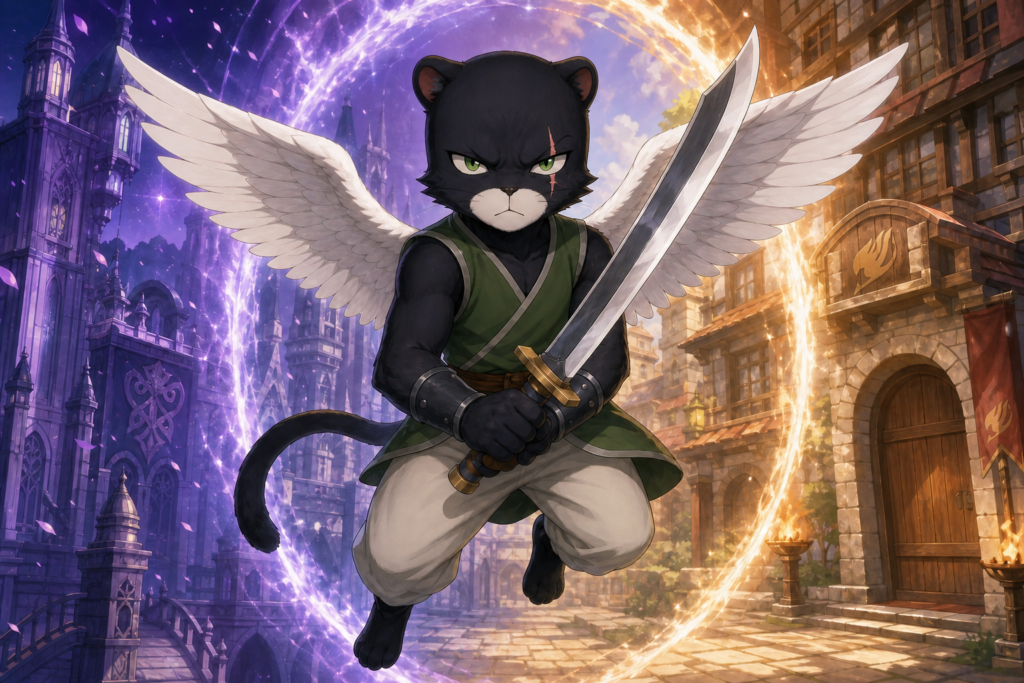
CVM Sekai character profile
Bottom line
Panther Lily is not the black cat Gajeel finally earns after being less awful. He is an adult soldier who looks at the kingdom he served, recognizes that obedience has become harm and walks away with his judgment intact.
That distinction matters because Fairy Tail loves pairing Dragon Slayers with Exceeds. The pattern can make Lily look like a missing accessory on Gajeel’s character sheet. He is much more interesting than that. Lily has military rank, a history with Mystogan, a political relationship to Edolas and a moral crisis before Gajeel ever calls him partner.
Gajeel does not give Lily a life. They choose each other after meeting as enemies. Lily’s Earth-land body also becomes a test for the audience. In Edolas, he is a large, imposing panther warrior. In Earth-land, he usually appears as a small Exceed. The body changes. His adulthood does not. His combat training does not. His authority does not. If somebody can respect him only when he is tall enough to look intimidating, the problem is not his form.
Panther Lily’s real story is about ethical loyalty. First he serves a crown. Then he learns that service without judgment can make a good soldier useful to a bad policy. Fairy Tail gives him another community, but the point is not that he swaps one uniform for a better logo. The point is that he chooses people over a chain of command and keeps the right to question his new family too.
Canon boundaries and the record that matters
Panther Lily is an Exceed from Edolas, a former captain in the Edolas Royal Army, a Fairy Tail mage, and Gajeel Redfox’s chosen partner. His magic is Aera, his Earth-land combat form is limited, and trained swordsmanship remains central to how he fights. Hiroki Tōchi performs the Japanese role. His primary continuity runs through Hiro Mashima’s Fairy Tail manga, the television adaptation, and the Fairy Tail: 100 Years Quest sequel manga.
Official TV Tokyo cast pages credit Hiroki Tōchi as Panther Lily. His licensed manga debut is Chapter 171, during Edolas, and his television debut is Episode 80. He serves as a captain in the Edolas Royal Army; English renderings of the exact division title vary, so this profile keeps the stable rank and institution instead of declaring one localized unit label universal. His blue Fairy Tail guild mark is carried on his back after he joins the guild.
Lily is a Fairy Tail member in his own right. “Gajeel’s partner” describes a relationship. The relationship does not reduce his guild status to somebody else’s equipment slot.
Design: one adult, two body states
Panther Lily’s Edolas form is a large, muscular black panther warrior. His compact Earth-land form is a small black Exceed with a white muzzle, green eyes and a scar over his left eye. Both are Lily.
The smaller body creates comedy because the visual gap is dramatic. The writing works only if the joke stays attached to scale, not adulthood. Lily keeps his measured speech, tactical awareness and soldier’s habits. He can look like he belongs beside Happy and still carry himself like the person most likely to ask whether anybody made an actual plan.
His scar helps preserve identity across forms. So do the stern eyes, dark fur and sword. Clothing shifts with setting and adaptation design, but practical warrior shapes fit him better than ornamental armor. Lily does not need a crown, cape stack and sixteen spikes to communicate experience. His posture already did the paperwork.
The body change also opens a cultural reading. People often assign authority through size, age cues and visual masculinity. Edolas Lily receives instant soldier status because he looks imposing. Compact Lily risks being treated as cute before he is treated as competent. The story keeps letting him correct that assumption with conduct.
Edolas service: loyalty becomes a moral problem
Lily begins inside the Edolas military structure. He is not introduced as a wandering rebel waiting for the right friendship speech. He has rank, duty and a record of service.
That matters because his eventual break is not easy rebellion. Institutions teach soldiers to treat obedience as virtue, especially when the crown defines national survival as the goal. Edolas faces a magic shortage. The regime turns that crisis into permission to extract magic from other lives and worlds.
The need is real. The policy is still wrong. Lily’s story refuses the convenient idea that a good motive cleans a harmful system. Protecting Edolas cannot justify converting Earth-land people into magical fuel. Once the state asks soldiers to stop seeing targets as people, loyalty has crossed into complicity.
This is where a Confucian lens earns its keep. Duty is relational, not blind. A subordinate owes service, but a ruler also owes moral governance. When the ruler abandons right conduct, obedient enforcement does not magically become righteous. Lily’s virtue appears when he recognizes that duty to life outranks duty to a command.
He does not leave because responsibility suddenly feels annoying. He leaves because the institution has broken the ethical relationship that made service meaningful.
Mystogan: the child behind the prince
Lily’s history with Mystogan begins before the Earth-land guild knows who the masked mage is. He encounters the injured Edolas prince and protects him.
That act makes their relationship more than soldier and royal. Lily responds to a vulnerable child before responding to a title. Later political conflict places that personal loyalty beside the policies of Faust’s rule.
Mystogan’s identity also complicates the easy “betray the kingdom” label. Lily is not rejecting Edolas itself. He is rejecting a harmful use of Edolas power while remaining connected to people from that world. A nation and its government are not the same object. Patriotism does not require moral amnesia.
Their bond helps explain why Lily can imagine service outside the existing chain of command. He has already seen that legitimate care may require protecting someone from the structure supposedly built to protect them.
Gajeel: respect begins before friendship
Panther Lily and Gajeel meet as opponents during the Edolas conflict. This is not a soft introduction. They read each other through combat.
Gajeel has spent much of his life measuring people by strength. Lily has spent his life evaluating threats, orders and resolve. Their fight gives each man evidence the other cannot fake. Gajeel sees discipline and nerve. Lily sees an enemy who is not fighting for conquest but for people he has chosen.
That does not mean one battle completes trust. The battle creates recognition. Their later partnership works because neither needs the other to become harmless. Gajeel remains abrasive. Lily remains willing to challenge him. They can share a rough style without making domination the relationship’s foundation.
Most important, Lily chooses. He is not assigned to Gajeel by a cosmic Dragon Slayer matching service. Gajeel wants an Exceed partner after seeing Natsu and Wendy with Happy and Carla, but wanting does not create ownership. Lily’s consent is what makes the bond real.
The pairing also strengthens Gajeel’s accountability arc. Lily understands what it means to serve the wrong side and then change conduct. He does not need Gajeel to pretend Phantom Lord never happened. He can judge the man by what he does after the truth.
Earth-land: displacement is not a personality reset
When Lily moves to Earth-land, the environment changes what form he can sustain. His usual body becomes compact, while the larger combat state is temporary.
The transformation creates a practical loss. Reach, endurance and ordinary movement change. A soldier accustomed to one body has to recalibrate weapon use, transport and public perception.
Yet Fairy Tail receives him as a person, not a failed version of an Edolas warrior. That reception matters. Displacement stories often demand gratitude from the newcomer while treating assimilation as the price of safety. Lily joins without surrendering his history or pretending Edolas meant nothing.
The Buddhist lens here is impermanence, not decorative mysticism. Form changes. Status changes. Home changes. Lily suffers less when he does not confuse one physical form with the whole self. He adapts without declaring the earlier body fake or the new body lesser.
That is a stronger lesson than “small can be strong.” The point is not that compact Lily proves himself exceptional enough to overcome an inferior body. The point is that dignity was never supposed to depend on size.
Aera, swordsmanship and the limits of force
Like other Exceeds, Panther Lily uses Aera to produce wings and fly. Flight gives him mobility, transport value and access to vertical battle space. Flight does not erase fatigue or make every rescue physically possible.
His swordsmanship predates Fairy Tail. That is important because his combat identity does not come from copying Gajeel. Lily brings an established discipline into the partnership.
The larger combat form restores much of his Edolas scale for a limited period. That creates tactical choice. He cannot treat maximum size as a permanent default. He has to decide when reach and force justify the cost.
His Edolas weapon is commonly localized as Bustermarm, while later licensed material identifies the replacement blade as the Musica Sword. Bustermarm does not remain a permanent loadout after the Edolas conflict. The public official catalogs do not publish a weapon index or a stable second-by-second transformation timer, so this profile keeps the demonstrated limit precise without manufacturing a number: his larger Earth-land combat state lasts only a short interval and cannot function as his permanent body. His reliable ability profile is trained blade work, Aera flight, temporary battle-form reach and strength, battlefield reading and the nerve to confront stronger opponents when protection requires it.
His greatest limit is not weakness. His greatest limit comes from remaining one fighter inside collective battles. He can carry, intercept and defend. He cannot solve every threat because he owns a large sword and excellent posture.
Tenrou Island: partnership under guild stakes
Tenrou Island places Lily inside Fairy Tail’s S-Class trial environment and then inside the Grimoire Heart attack. His presence confirms that he is not visiting the guild until Edolas feelings settle. He is participating in guild life and guild danger.
The arc also tests his partnership with Gajeel away from the circumstances that created it. A relationship formed during one crisis becomes durable only when it survives ordinary choices and new crises.
Lily’s battle contributions should stay precise. Support, transport and teamwork matter without being inflated into solo victories. Then Acnologia arrives and the Tenrou group disappears for seven years.
For Lily, that disappearance adds another displacement. He has already crossed worlds and rebuilt home. Now the new home loses time around him. The series does not linger equally on every character’s adjustment, but the structural cost remains.
Grand Magic Games, Eclipse and later guild battles
The Grand Magic Games period places Fairy Tail’s returned members in a changed social landscape. Lily supports a guild rebuilding reputation after seven years of absence. His value is not limited to tournament spectacle. He is part of the team infrastructure around Gajeel and the wider guild.
Eclipse-era, Tartaros and other later conflicts require exact scene attribution. This profile will not turn every shot of Lily holding a sword into a named victory. What matters is the pattern: he repeatedly acts as a mobile defender, partner and experienced combatant while keeping his own judgment.
The adaptation sometimes expands connective action or gives supporting characters extra beats. Those scenes can enrich the anime profile when labeled. They cannot be smuggled into the manga chronology because the animation looked cool.
Magic Council service: choosing another institution with open eyes
After Fairy Tail disbands, Gajeel, Levy and Panther Lily work within the Magic Council’s enforcement structure. That decision carries special weight for Lily. He has already served one state institution that turned crisis into abusive policy. Entering another authority structure is not evidence that he learned nothing. Entering the Council can show that he refuses the lazy conclusion that all institutions are automatically corrupt and only private loyalty matters.
The key is judgment. Lily does not owe obedience to a badge. He brings experience of institutional failure into the work. Alongside Gajeel and Levy, he uses investigation and enforcement skills against threats beyond guild brawls.
This period also changes the trio. Levy contributes language, research and analytical magic. Gajeel brings infiltration experience and force. Lily brings soldier discipline and an external view of both men. He is not the chaperone. He is a teammate with reasons to care whether authority remains accountable.
Alvarez and Gajeel’s apparent loss
The Alvarez war pushes Gajeel and Lily into battles involving enemies with unfamiliar bodies and magic. Their confrontation around Bloodman brings Gajeel close to apparent death.
Lily’s response matters because partnership has become family. He does not exist only to make Gajeel’s sacrifice look sadder. He has his own fear, helplessness and history of losing worlds.
The scene also tests Gajeel’s growth. The former Phantom Lord enforcer now risks himself for others. Lily can recognize that change without turning sacrifice into moral payment. Dying dramatically is not the only proof that Gajeel became better. Living responsibly has been the harder work.
When the war shifts and survival becomes possible, consequence does not vanish. The people who believed they were losing Gajeel experienced that loss in real time.
Relationship atlas
Gajeel Redfox: Opponent, respected fighter, chosen partner and brother in rebuilt loyalty. Lily supports Gajeel without becoming his approval stamp. Their bond works because correction can coexist with affection.
Mystogan: The injured prince Lily protects and the person who connects his military history to a more ethical vision of Edolas. Their relationship proves Lily’s duty was always capable of reaching beyond orders.
Carla: An adult Exceed peer with foresight, Extalia history and a guarded personality. Lily offers another model of Exceed adulthood shaped by military service rather than prophecy and maternal secrecy.
Happy: Fellow Exceed and Fairy Tail mage. Happy’s humor and emotional openness contrast with Lily’s restraint, but neither is a lesser adult because of temperament.
Levy McGarden: Council-period teammate and part of Gajeel’s closest circle. Levy’s analysis and Lily’s tactical experience give the group more than brute force.
Faust and the Edolas military: Former sovereign and chain of command. Lily’s break establishes that honorable service can require refusing the institution that once defined honor.
Fairy Tail: Chosen guild and new home. Fairy Tail accepts his past without asking him to stop being an Edolas soldier in memory, training or culture.
Adaptation and Japanese performance
The anime has to make Lily’s two body states feel like one adult identity. Design continuity, eye scar, speech rhythm, posture and sword handling do much of that work. If the compact form is directed only for cuteness, the character loses political and military weight.
Hiroki Tōchi voices Panther Lily in Japanese, as confirmed by TV Tokyo’s official cast pages for the 2014 and Final Series productions. Those pages establish the performer but do not document scene-level choices in pitch, breath or timing. This profile therefore analyzes the adaptation challenge that can be verified from the writing and design: Edolas command scenes, compact-form comedy and later war material must preserve one adult identity across two silhouettes. The profile does not turn an unreviewed vocal impression into a fact.
Films, OVAs and games belong on a labeled media shelf only when official rosters confirm Lily’s appearance. Promotional group art is not a biography receipt.
100 Years Quest: present without invented centrality
Panther Lily remains part of Gajeel’s circle and Fairy Tail’s wider guild-side cast in 100 Years Quest. Published sequel material does not place him on Team Natsu’s central Dragon God mission. His appropriate sequel coverage is therefore the guild-side presence and relationship continuity the story actually gives him, not a fabricated command role in battles happening elsewhere.
What does not belong is invented Dragon God importance because he is capable and popular. The sequel follows a specific mission team. Lily can matter in guild-side events without secretly steering the quest.
Proportional coverage is respect. Proportional coverage lets supporting characters be specific instead of making everybody the hidden MVP of the same arc.
Final verdict
Panther Lily’s strongest quality is not loyalty by itself. Villains have loyal soldiers too. His strength is ethical loyalty: the ability to serve, judge, refuse and choose again.
He protects Mystogan before politics can tell him what the child is worth. He leaves a military structure when its survival policy treats other people as fuel. He meets Gajeel in combat and chooses partnership without surrendering independence. He enters Fairy Tail as a member, not a collectible. Later Council service shows that rejecting one institution does not require abandoning public responsibility forever.
And the compact body? That is where the audience gets tested. Lily should not need a towering combat form before we grant him adulthood, dignity or authority. The big sword is helpful, though. Some people apparently need visual aids.
Panther Lily is a soldier who learns that belonging should sharpen conscience, not replace it. Fairy Tail becomes home because it gives him room to keep choosing, including the choice to tell his partner when he is acting foolish. That is not mascot work. That is family with standards.
Source ledger and publication boundaries
- TV Tokyo official final-series and 2014 staff/cast pages: Hiroki Tōchi credit.
- TV Tokyo official `Best Partner` episode page: Tenrou-era Lily cast context.
- Kodansha official Fairy Tail and Fairy Tail: 100 Years Quest catalogs.
- Primary narrative record: Hiro Mashima’s Fairy Tail volumes 1 through 63 and published sequel volumes.
Publication boundaries: no unsourced age or measurements; no uncertain military unit presented as settled translation; no merger of compact and combat forms into two characters; no infantilizing the compact body; no claim that Gajeel owns or earns Lily; no unsupported sword names or transformation duration; no team victory reassigned to Lily; no English-dub performer; and no anime-original, film, OVA, game or sequel inflation without official receipts.