
Juvia Lockser
CVM Sekai character profile
Bottom line
Juvia Lockser is not a Gray Fullbuster reaction GIF with water powers. She enters Fairy Tail as an adult combatant for Phantom Lord, helps attack another guild and has to earn the community she later calls home. She is also a technically dangerous water mage whose body can become water, whose weather follows her emotional isolation and whose choices in Tenrou, Tartaros and Alvarez carry consequences far beyond a running romance gag.
The series gets both things right and wrong. The series is right that meeting Gray becomes a turning point. He is the first person who makes her notice a sky without the rain that has followed her for years. The adaptation is wrong whenever it treats that emotional awakening as permission to flatten her entire inner life into pursuit, jealousy and imaginary marriage paperwork.
Juvia’s strongest story is not “a sad woman finds a man.” Her stronger story follows a woman raised inside rejection who learns that belonging cannot be forced, love cannot be owed, and loyalty becomes real only when responsibility survives the fantasy. That profile has more water in it than the shipping jokes ever noticed.
Who Juvia Lockser is
Her name is Juvia Lockser, written ジュビア・ロクサー in Japanese. She is a human water mage, a former member of Phantom Lord’s Element 4 and later a Fairy Tail mage.
Television Tokyo’s official character material identifies Mai Nakahara as her Japanese performer. Public official character pages do not provide a reliable canonical birthday, height or weight, so those numbers stay out instead of arriving from a fan database.
Her manga introduction belongs to the Phantom Lord conflict in Kodansha’s Volume 7. The public K MANGA search record used here does not expose a clean character-indexed debut page, so this biography does not manufacture an exact chapter number. Television Tokyo’s official DVD archive places the Phantom Lord television opening at Episode 21 and the character-focused turning point at Episode 25, “A Flower Blooms in the Rain.” The official 100 Years Quest news archive later selected Episode 25 as Juvia’s spotlight episode. That is useful editorial evidence about how the franchise frames her entrance.
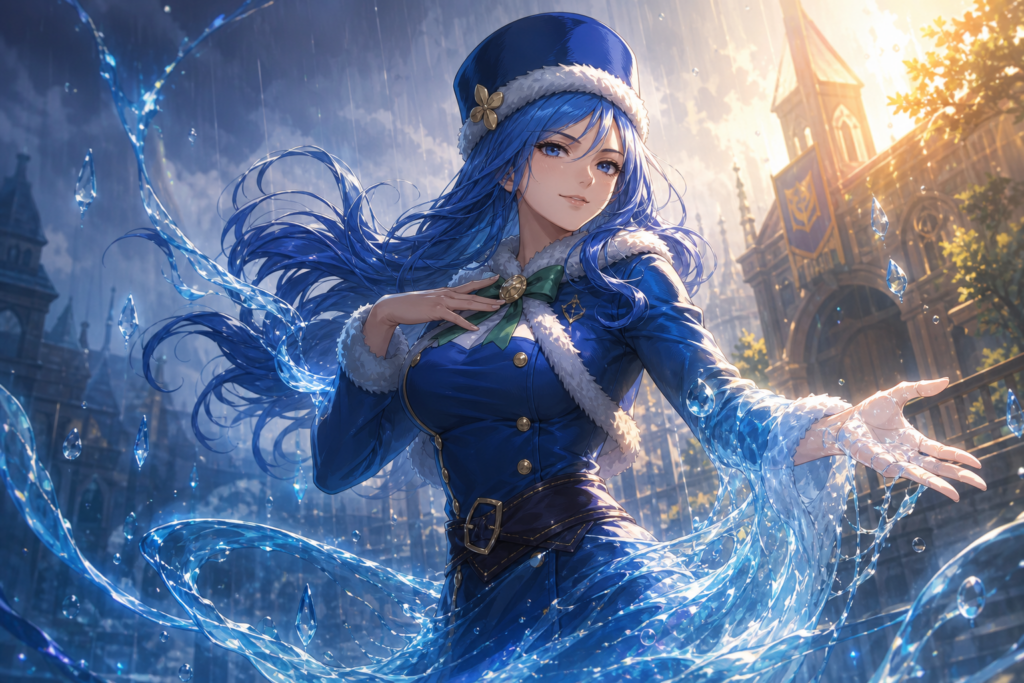
Juvia’s familiar design uses long blue hair, blue eyes, a blue coat or dress, fur trim and a hat associated with her early appearance. Her design evolves across guild life, tournaments, travel and later arcs. The rain motif is character language, not an excuse to make every image a wet-shirt contest. She is an adult woman, but “adult” does not mean the camera gets to confuse magic with consent.
Rain follows her before anybody asks why
Juvia’s early life is tied to persistent rain. Other children and potential partners reject her because the weather around her makes ordinary life miserable. The joke writes itself quickly: gloomy girl, gloomy weather, people run away.
The consequence is slower. When a person’s emotions alter the environment, everybody around her starts treating the symptom as a moral offense. Juvia learns that sadness does not stay private and that other people resent her for failing to perform sunshine.
That history helps explain why Phantom Lord’s hard hierarchy appeals to her. Element 4 gives her rank, function and a place where overwhelming water magic is useful. The rank does not make Phantom Lord healthy. The role makes the institution legible to someone who has spent years being told her presence ruins the room. Useful is not the same as loved. Juvia has to learn the difference.
Phantom Lord gives her status and makes her responsible
Phantom Lord attacks Fairy Tail, damages its hall and targets Lucy as part of a larger plan. Juvia participates as an elite mage. That is the accountability floor.
She is not an innocent bystander who happened to wear the wrong guild mark. She acts for an organization using intimidation, abduction and collective punishment. Her later kindness does not make those choices disappear.
Fairy Tail’s redemption pattern works best when changed conduct matters more than sad backstory. Juvia is defeated, leaves Phantom Lord’s structure and repeatedly chooses Fairy Tail’s people under pressure. The guild eventually accepts her because of what she does after the attack, not because attraction to Gray produces an automatic moral receipt. That distinction also protects Gray. He does not owe romance as payment for inspiring reform.
Gray changes the weather, not her criminal record
Gray fights Juvia during Phantom Lord. His ice magic counters and interacts with her water. More important to Juvia, the rain clears and she sees a blue sky.
The emotional force is easy to understand. A person associated with bad weather experiences environmental relief during an encounter with someone who does not treat her existence as a curse.
The series turns that relief into immediate attraction and then pushes it into obsession comedy. Some of the jokes land because Juvia’s imagination is dramatic enough to establish its own zoning laws. Some do not. Following somebody, treating other women as rivals and narrating a relationship before consent are not healthy because violins and chibi faces appear.
RaeRae’s read is simple: trauma explains intensity. Trauma does not create ownership. Juvia becomes more compelling when the story lets her care about Gray while also building relationships, missions and ethical choices that would still matter if he left the page.
Joining Fairy Tail requires conduct
Juvia does not simply walk from one uniform into another and call the issue settled. She approaches Fairy Tail after Phantom Lord falls and has to establish loyalty inside a guild she helped attack.
The Battle of Fairy Tail gives her an early test. Freed’s rules force guild members into conflict. Juvia chooses self-sacrifice rather than seriously harm Cana.
That act matters because it reverses Phantom Lord’s logic. Phantom Lord used members as weapons in a guild war. Juvia now refuses to preserve herself by treating a guildmate as expendable. One sacrifice does not complete redemption. The sacrifice establishes direction.
Later missions, shared danger and ordinary guild life do more repair than a speech could. Fairy Tail becomes the place where rain is part of Juvia’s history rather than the admission price for tolerating her.
Water Body is defense, threat and metaphor
Juvia can turn her body into water. Ordinary physical attacks may pass through or lose effectiveness depending on the magical conditions. She can shape water into cutting, binding, crushing and spiraling attacks. Water Lock can trap a target in a mass of water and create drowning pressure. Water Slicer turns fluid into a cutting threat. Water Nebula and related techniques use rotation and force rather than treating water as a decorative ribbon.
Her magic can also change with temperature and emotion. That does not mean every feeling unlocks a new move on demand. Strong emotion can alter output, judgment and presentation without deleting magical cost or counterplay.
Water Body has limits. Magic can strike magic. Restraints, anti-magic effects, elemental interactions, surprise and exhaustion matter. The ability is not permanent intangibility, and it does not make injury fake.
Her Unison Raid with Gray is especially useful because ice and water become coordinated technique. The move communicates relationship through timing. The move should not be used as proof that romantic destiny made two spell systems compatible. They train, observe and trust each other. Chemistry is not a substitute for craft.
Lucy is not a romantic obstacle
Juvia initially imagines Lucy as a rival for Gray’s attention. The series uses that misunderstanding for comedy. Lucy has not agreed to participate in Juvia’s private triangle. She is not responsible for regulating Juvia’s insecurity, and her friendship with Gray does not become suspicious because another woman narrates it that way.
Their relationship improves because Juvia gains actual experience with Lucy. Lucy is a teammate, strategist, writer and Celestial Spirit mage with her own life. She helps rescue guildmates and carries losses that have nothing to do with Gray. Juvia can become Lucy’s friend without requiring Lucy to shrink so the ship can feel safe. The same rule applies to every woman Juvia imagines as competition. The joke can reveal anxiety. The joke cannot define the other woman.
Tenrou Island turns forced connection into chosen empathy
Juvia participates in the Tenrou Island period and the conflict with Grimoire Heart. Her encounter with Meredy becomes one of her most important non-Gray relationships.
Meredy uses a sensory-link technique that connects lives and pain. The fight turns emotional attachment into a weapon: harm to one person can reach another.
Juvia responds fiercely when Gray is included in that system, but the encounter grows beyond possessiveness. She recognizes Meredy’s grief, rage and attachment to Ultear. Meredy stops being a faceless enemy and becomes another young woman whose love has been organized around loss. That does not erase combat responsibility on either side. Shared pain changes what ending the fight can mean.
Their later friendship matters because empathy becomes conduct. Juvia does not merely announce that she understands. She works beside Meredy when Tartaros forces both women into another decision shaped by death.
The seven-year Fairy Sphere gap then removes Juvia and the Tenrou group from ordinary time. They return physically unchanged to a guild and world that have moved forward. Juvia’s belonging survives, but survival carries displacement.
The Grand Magic Games remember she can fight
Juvia competes as part of Fairy Tail’s tournament effort and later works in coordinated battles. The Grand Magic Games are useful because public reputation becomes labor. Fairy Tail needs points, spectacle and visible competence to repair its standing. Juvia contributes as a water mage rather than a romantic commentator.
Her teamwork with Gray can be tactically strong while their personal rhythms remain unequal. Juvia is direct about desire. Gray is guarded, embarrassed and often unclear. The answer is not to treat her persistence as consent or his discomfort as secret permission. The answer is time, conduct and explicit reciprocity.
The tournament also exposes an industry issue around adaptation. Women fighters can receive elaborate magic and still be framed through bodies, costumes and humiliation more aggressively than male peers. Juvia’s water is visually flexible; direction decides whether that flexibility communicates control or simply supplies another excuse for exposure.
Tartaros gives Juvia a choice with no clean outcome
During Tartaros, Juvia and Meredy confront Keyes, the necromancer whose magic is tied to Silver Fullbuster’s continued movement. Destroying Keyes helps stop an enemy and breaks that necromantic control. Destroying Keyes also ends the condition keeping Silver’s body active.
Juvia acts without Gray present to approve the choice. That is what makes the decision morally serious. She cannot ask the person most affected, and delay has battlefield costs. When she later tells Gray, the scene should not be flattened into “Juvia killed his father” or “Silver wanted it, so nobody was hurt.”
Keyes is responsible for the necromancy. Silver’s situation and wishes matter. Juvia still carries the burden of being the person who acted. Gray’s grief remains his. Their relationship survives because truth and pain are allowed into the room. This is Juvia at her best: not perfect, not passive and not hiding behind love as an excuse.
Living with Gray does not make her his wife
After Fairy Tail disbands, Juvia and Gray live and train together for part of the missing year. The arrangement creates domestic intimacy and greater combat coordination. Domestic intimacy does not create a marriage by proximity.
Gray later disappears as part of his infiltration of Avatar. His mission has a strategic purpose. Juvia experiences abandonment and uncertainty because she does not receive the information. Both facts belong.
Secret operations can be necessary. People left behind still bear the consequence. Fairy Tail regularly excuses secrecy by revealing a noble plan later. Juvia’s illness, distress and search do not become silly because Gray was working undercover. Gray is not malicious. He is also not exempt from the interpersonal bill.
Alvarez makes mutual sacrifice literal
Invel’s Ice Lock forces Gray and Juvia into conflict by manipulating their bodies and attachments. The mechanism weaponizes love and removes ordinary consent. Both try to sacrifice themselves rather than kill the other.
Juvia then uses water magic to transfer blood to Gray after injuring herself. Wendy’s later medical intervention matters to survival. The sequence is not proof that romance should require death. The sequence proves that both characters have learned to treat self-destruction as a love language, and the story needs to challenge that habit instead of framing it as the final form of devotion. Juvia’s choice is powerful. The choice is also alarming.
Gray’s later grief and rage show reciprocity more clearly than earlier comedy, but emotional recognition arrives through another near-funeral. Fairy Tail loves making people understand their feelings at the edge of death. RaeRae would like this guild to discover conversation before the body count starts invoicing everybody. Mutual love does not make mutual suicide healthy.
Gray and Juvia need reciprocity, consent and separate identities
Gray becomes more openly protective and emotionally responsive over time. Juvia remains direct about wanting a future with him. Later material makes his feelings and self-worth part of the relationship question. The responsible wording is not “Gray was always secretly hers.”
Attraction and attachment become increasingly reciprocal through shared history, trust, grief and repeated choice. The formal relationship label remains bounded by the latest licensed material rather than fandom shorthand.
Juvia also needs a life that is not suspended until Gray feels worthy. His self-improvement cannot become another way of making her wait without agency. Her competence, friendships and guild role remain meaningful regardless of when the romance reaches a formal label. Love can be central without becoming total.
Spoilers: 100 Years Quest tests the guild after control
Juvia remains with Fairy Tail while the core team travels on the 100 Years Quest. The White Mage’s control pulls guild members into conflict during the Aldoron material.
Kodansha’s official Volume 7 description frames the aftermath clearly: Fairy Tail members fight Diabolos and one another while under the White Mage’s spell, then rejoin the larger battle as control breaks.
Juvia’s encounter with Gray during that period matters because he has to face a controlled person he loves without treating her as an enemy by choice. Later conversation about becoming someone worthy of her gives Gray a more explicit internal relationship to their future. That statement is growth. The statement is not a contract Juvia signed.
Her later sequel role remains proportional. Juvia contributes to guild defense and relationship material, but she is not physically present for every Dragon God operation on Guiltina. Popularity does not teleport her into battles she never attends. Any family-facing or pregnancy interpretation must follow explicit licensed text. Fandom hope, cover art and comedy are not medical records.
Gajeel is a mirror from the institution they left
Juvia and Gajeel both come from Phantom Lord and later join Fairy Tail. Their paths make a useful comparison. Neither gets absolution through recruitment. Both need repeated conduct. Gajeel’s harm to Levy and Shadow Gear is more personally foregrounded. Juvia’s participation in the guild attack is easier for the story to soften because her Gray fixation quickly takes over screen time.
That difference is an adaptation choice, not proof that one record vanished. Their shared origin can support mutual understanding without making them a matched redemption set. Juvia builds repair through protection, teamwork and truth-telling. Gajeel’s accountability follows his own victims and relationships.
Fairy Tail gives her a sky, but she has to live under it
The rain clearing after Gray is a beautiful image. The image becomes dangerous when the metaphor implies one man controls Juvia’s weather forever. Fairy Tail gives her more than romance. Fairy Tail gives her Cana, Lucy, Erza, Meredy, missions, rivals, ordinary meals and a guild mark tied to chosen responsibility.
Belonging changes the emotional climate because many relationships hold it. That is the stronger cultural reading too. Juvia begins inside a rigid institution where rank defines usefulness. She moves into a disorderly guild where relationship carries more weight than formal hierarchy. Neither structure is automatically virtuous. Fairy Tail earns its value when people stop each other from becoming tools.
Juvia stops being only the rain woman when the guild lets her be accountable, funny, frightening, caring and wrong without exile.
Mai Nakahara has to separate sincerity from the gag machine
Mai Nakahara is Juvia’s official Japanese performer. Television Tokyo’s cast records and later franchise material preserve that credit. The official credit is clear; scene-specific pitch, breath and timing claims remain outside this page where the available official material does not document them.
The performance challenge is still visible in the writing. Juvia moves between formal third-person self-reference, battle authority, romantic fantasy, grief and moral decision. If every mode receives the same exaggerated delivery, the character becomes a sketch. If the serious scenes ignore the comic history, she sounds like a replacement.
Direction must also decide when the joke ends. A reaction cut can frame jealousy as absurd. Staying on distress too long can turn discomfort into spectacle. Tartaros and Alvarez require room for silence, consequence and another person’s pain. Comedy is part of Juvia. Comedy is not diplomatic immunity for weak framing.
Relationship atlas
Gray Fullbuster: Opponent, emotional turning point, teammate and increasingly reciprocal love interest. His gradual feelings matter; her persistence does not equal consent; their shared self-sacrifice needs critique rather than romantic worship.
Lucy Heartfilia: Imagined rival who becomes a friend and teammate. Lucy keeps her own agency and is not responsible for Juvia’s private triangle.
Meredy: Enemy linked through pain who becomes a friend and Tartaros partner. Their relationship turns empathy into later conduct, giving both women a bond defined by choices after conflict rather than a single dramatic encounter.
Gajeel Redfox: Former Phantom Lord peer and parallel institutional defector. Each carries a separate accountability record, so their shared origin supports comparison without making either person responsible for the other’s repair.
Silver Fullbuster: The person whose necromantic condition makes Juvia’s Keyes decision personally devastating. His wishes matter, but they do not remove her moral burden or Gray’s grief.
Cana Alberona: An early Fairy Tail loyalty test during the Battle of Fairy Tail. Juvia’s refusal to preserve herself through serious harm establishes changed direction.
Fairy Tail: Chosen institution where she earns trust after attacking it. The guild is not valuable because it forgets. The guild becomes valuable when changed conduct become a life.
Media and continuity shelf
The main biography follows Hiro Mashima’s 63-volume manga and the licensed 100 Years Quest sequel by Mashima and Atsuo Ueda. Television episodes, anime-original arcs, films, OVAs and games remain labeled by medium.
Juvia appears in franchise games and supplementary animation, but playable skills, costumes and comedy scenarios do not define manga canon. Background or roster presence is not inflated into a major film, OVA or game role. Japanese performer: Mai Nakahara only. No English-dub discussion unless RaeRae requests it.
Final verdict
Juvia Lockser is a redemption story the series keeps trying to squeeze into a romance gag. She did harm for Phantom Lord. She changes institutions. She protects people she once would have treated as enemies. She chooses against Keyes without hiding from Gray afterward. She survives control, grief and the dangerous habit of treating death as proof of love.
Gray matters deeply. He is not the only reason she matters. The rain stops when Juvia first sees another possibility. Growing up means learning that clear weather cannot depend on one person standing nearby. Love can share the sky. Love does not own the sky.
Source ledger and clean boundaries
- Kodansha Volume 7 and Phantom Lord premise: Kodansha: Fairy Tail Volume 7 archive
- Television Tokyo official DVD archive: TV Tokyo: Fairy Tail home-media episode archive
- Television Tokyo main character/cast pages: TV Tokyo: original Fairy Tail character archive and TV Tokyo: original Fairy Tail staff and cast
- Official Juvia spotlight selection, including Episodes 25, 111, 220 and 307: Official 100 Years Quest cast news
- Kodansha 100 Years Quest Volume 7: Kodansha: Fairy Tail 100 Years Quest Volume 7
- Official 100 Years Quest series/cast: Official Fairy Tail 100 Years Quest site
Public official pages do not expose reliable age and vital statistics, a clean K MANGA character-indexed debut, a separate young Japanese performer or a complete OVA and game roster. Those details stay bounded instead of being imported from fan databases and dressed up as certainty.