
Gajeel Redfox
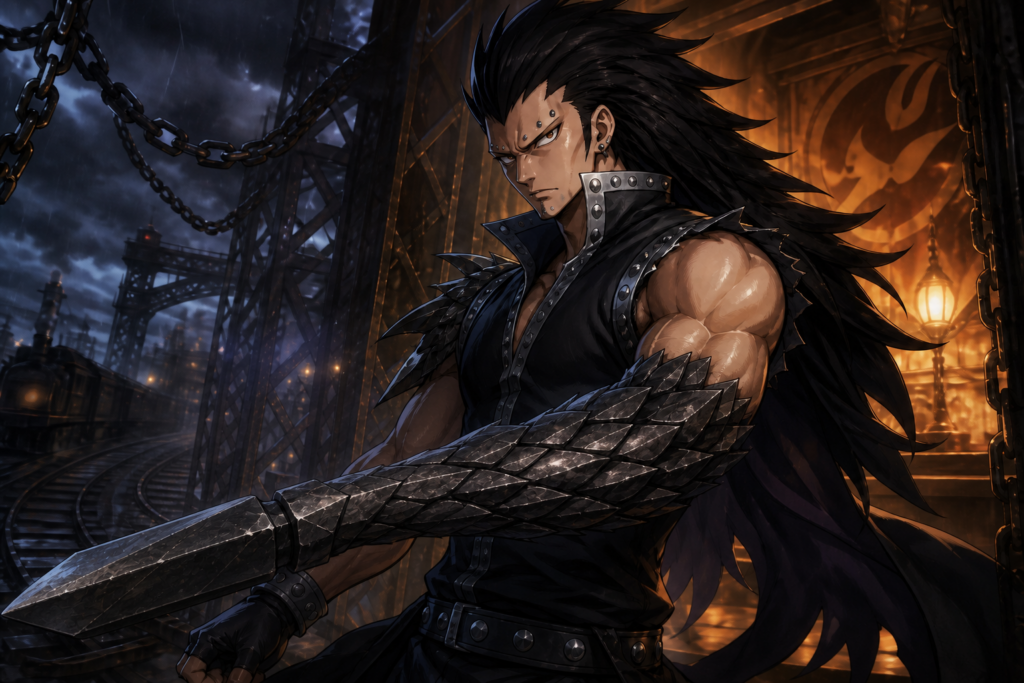
CVM Sekai character profile
Bottom line
Gajeel Redfox is one of Fairy Tail’s best redemption stories because the story gives him something harder than regret: proximity to the people he hurt. He cannot move to a new town, acquire a softer haircut and introduce himself as misunderstood. Gajeel attacks Fairy Tail as Phantom Lord’s Iron Dragon Slayer. He beats Levy McGarden, Jet and Droy and displays their injured bodies as a threat. He later joins Fairy Tail, where Levy remains a full person with memory, friends, fear and choices. Their eventual love matters because it develops after the harm, not because romance magically turns the harm into foreplay. That line is nonnegotiable.
Gajeel earns belonging through repeated conduct: standing against Laxus, spying on Raven Tail, protecting guildmates, partnering with Panther Lily, serving the Magic Council, fighting through Tartaros and Alvarez and learning to imagine a future built around responsibility rather than domination. Redemption does not mean the audience forgets the tree. Redemption means Gajeel becomes somebody who never wants another person left on it.
Who Gajeel Redfox is
His name is Gajeel Redfox, written ガジル・レッドフォックス in Japanese. He is a human Iron Dragon Slayer raised by the dragon Metalicana. He begins the main story as a Phantom Lord elite and later becomes a Fairy Tail mage.
Television Tokyo’s official character page identifies him as an Iron Dragon Slayer who can turn his body into iron weapons and consume iron to recover power. The same official cast record credits Wataru Hatano as his Japanese performer.
Public official pages do not provide a stable canonical birthday, height or weight, so those numbers stay out. The Dragon Slayer timeline also requires explanation rather than a cute age box: Gajeel belongs to the first generation raised directly by dragons and shares the X777 disappearance mystery later tied to the dragons’ plan and the Eclipse displacement.
His story debut belongs to Kodansha’s Volume 7 and the opening of the Phantom Lord war. Television Tokyo’s official DVD archive places that anime arc at Episode 21, “Phantom Lord,” and later franchise curation selects Episodes 27, 254, 255 and 303 as Gajeel-focused viewing. The public licensed pages used here do not expose a directly indexed exact debut chapter. A fandom database does not get to pose as a receipt because the number looks plausible.
Gajeel’s core design uses long, spiked black hair, red eyes, dark clothing and multiple facial piercings. The metal studs are identity details, not random decoration. His Fairy Tail mark is associated with his left arm in the established design record. Iron appears as transformed body or shaped weapon, not as an invented dragon-head gauntlet.
Metalicana teaches strength, then disappears
Metalicana raises Gajeel and teaches Iron Dragon Slayer magic before disappearing on July 7, X777 alongside the other dragons connected to Natsu, Wendy, Sting and Rogue. The disappearance leaves skill without explanation.
That pattern matters across the first-generation Dragon Slayers. Adults prepare children for danger, hide inside a plan the children cannot understand and let them experience abandonment as a necessary cost. The later reveal explains strategy. The reveal does not refund the childhood.
Gajeel responds differently from Natsu and Wendy. Natsu turns the search into an open mission. Wendy’s grief remains visible. Gajeel hardens, joins a guild that rewards force and learns to treat vulnerability as a target before anyone can use his own. That is interpretation, not an excuse. Plenty of abandoned children do not crucify anybody.
Phantom Lord makes brutality into a job description
Phantom Lord is not merely Fairy Tail with worse branding. Its war against Fairy Tail uses intimidation, abduction and institutional force. Gajeel participates enthusiastically. He attacks Shadow Gear, severely injures Levy, Jet and Droy and leaves them displayed as a message. He fights Natsu during the guild assault and treats pain as proof of rank.
The violence against Levy must remain explicit because later romance creates pressure to soften it. The series sometimes uses time, comedy and Gajeel’s changed behavior to move the audience forward. A complete profile can move forward without lying backward.
Levy is not the woman who fixed him by being kind enough. Gajeel is responsible for changing his conduct. Makarov creates an opportunity. Fairy Tail members decide how much proximity they can tolerate. Levy decides what contact, trust and affection she is willing to build. Those are separate agencies.
Makarov offers probation, not absolution
After Phantom Lord falls, Makarov allows Gajeel into Fairy Tail. The choice is controversial because it should be. A guild master has duties to rehabilitation and to the people already harmed.
Makarov’s wager is that Gajeel needs a structure capable of demanding better conduct. That can be compassionate. Admission also creates risk for Levy and Shadow Gear, who should not be required to become the rehabilitation program. Fairy Tail’s chosen-family ethic works only if membership includes responsibility. “We accept everybody” sounds warm until acceptance exposes victims to an unaccountable aggressor.
Gajeel’s early isolation inside the guild reflects that tension. People do not trust him because he has not earned trust. Laxus attacks him. Levy and Shadow Gear retain their own responses. Gajeel absorbs hostility without treating it as permission to return to Phantom Lord behavior. That is the beginning of repair. Repair is not the end.
The Battle of Fairy Tail provides the first public evidence
During Laxus’s internal coup, Gajeel fights beside Natsu and Fairy Tail rather than using the chaos to settle old scores. He takes attacks, protects guild interests and chooses the institution that still does not fully trust him.
One battle cannot erase Shadow Gear. One battle can establish direction under pressure. This distinction matters because redemption stories often confuse suffering with repair. Gajeel getting hit does not compensate Levy. Pain is not currency. What matters is the decision he makes while being hit: he protects people and refuses the power structure Laxus is trying to impose.
Later, his secret work against Raven Tail extends the same pattern. Makarov uses Gajeel as an inside source against Ivan’s guild. The assignment depends on his ability to occupy suspicious space and accept that some Fairy Tail members may read his distance as betrayal. Secrecy has a cost. Gajeel chooses it for the guild rather than using secrecy to dominate the guild.
Iron Dragon Slayer magic turns the body into industry
Gajeel can consume iron to restore magical power and reinforce his body. He can transform limbs into iron clubs, swords, lances and other shaped weapons. Iron scales increase defense and close-range danger. His roar projects iron fragments and force. Exact English spell names vary across licensed releases, so function comes first and translation second.
The important system is clear: 1. Iron is fuel. 2. His body becomes material and weapon. 3. Shape answers tactical need. 4. magic depletion, poor access to iron, stronger magic and Dragon Slayer motion sickness create limits.
Gajeel’s power is not generic metal telekinesis. The body is the forge. That makes the magic culturally and structurally useful. Phantom Lord treats bodies as tools in a guild war. Gajeel literally weaponizes his body. Fairy Tail’s better influence is not making him less dangerous. Fairy Tail changes who controls the weapon and what obligations follow from using it.
During the Grand Magic Games, he gains an Iron Shadow Dragon mode after interacting with Rogue’s shadow power. The combination adds mobility and altered attack properties. The combination is a situational power development, not proof that Gajeel can consume every element safely. Dragon Force and later transformations remain bounded where the public licensed pages do not expose exact triggers.
Edolas gives him Panther Lily, not a mascot
Gajeel’s Edolas story leads to Panther Lily, an Exceed warrior who becomes his partner. Lily is not a reward pet handed to the gruff man so he can match Natsu and Wendy.
He is an experienced soldier with judgment, loyalties and a body changed by travel between worlds. He challenges Gajeel, fights beside him and becomes a stabilizing conscience.
Their partnership matters because Gajeel wants an Exceed companion before he understands the person who will fill that role. The comedy begins with desire for the category. The relationship succeeds because he learns the individual.
Lily is not Happy in darker colors. He brings military experience, restraint and the ability to tell Gajeel when the tough-guy routine is wasting everybody’s time. Chosen brotherhood is a better label than ownership.
Levy is not a prize for successful rehabilitation
Levy’s relationship with Gajeel must begin at the tree because the story began it there. She is a victim of his Phantom Lord violence. She is also a script mage, Shadow Gear’s leader, a reader, strategist, Council worker and person whose later choices belong to her.
Their trust grows through missions, Tenrou Island, Council service, Tartaros and Alvarez. Levy can forgive, desire and build a future without becoming evidence that the original attack was secretly romantic. The ethical rule is simple: later consent does not travel backward in time.
Gajeel’s changed behavior includes protection, attention and vulnerability. Levy’s agency includes anger, caution, professional partnership and eventual affection. Neither person should be reduced to a redemption function for the other.
Shadow Gear also remains part of the relationship map. Jet and Droy were harmed too. Their reduced later prominence does not remove them from Gajeel’s accountability record. Romance is not a pardon signed by one victim on behalf of the whole group.
Tenrou Island makes partnership operational
Gajeel and Levy work together during the Tenrou Island period and Grimoire Heart conflict. Their coordination makes trust visible through action. Levy’s script magic and analysis complement Gajeel’s close-range force. Gajeel protects her, but “protector” should not swallow her contribution.
Fairy Sphere then preserves the Tenrou group for seven years after Acnologia’s attack. Gajeel returns to a changed world with the others. The time gap disrupts guild standing, relationships and ordinary adulthood. Fairy Tail often turns the return into momentum toward the Grand Magic Games. The personal cost remains: seven years passed for everybody else.
Gajeel’s redemption therefore develops through an unusual clock. The people around him experience calendar time he does not. Trust still depends on conduct, not simply elapsed years.
The Grand Magic Games test Dragon Slayer hierarchy
Gajeel competes for Fairy Tail and faces Rogue, a younger Dragon Slayer whose magic and future possibilities mirror parts of his own. The tournament invites ranking. First generation versus later generation. Iron versus shadow. Natsu versus everybody because apparently a bracket cannot survive his personality.
Gajeel’s role is larger than power scaling. He discovers the dragon graveyard beneath the arena after Natsu removes him from the team fight. That accidental discovery connects the public spectacle above ground to buried Dragon Slayer history below it. The image is almost too clean. Fiore celebrates magical combat while literally standing over bodies from an older war. Gajeel, the man whose own body becomes industrial weaponry, finds the archive nobody wanted the tournament audience to see.
Magic Council service is work, not a clean slate
After Fairy Tail disbands, Gajeel, Levy and Panther Lily work with the Magic Council’s enforcement structure. This period matters because it moves Gajeel from guild loyalty into public responsibility. He is no longer only protecting people he knows.
The official record used here does not expose a stable translated unit name, so Gajeel and Levy are described as serving in a Magic Council enforcement role instead of receiving invented bureaucratic precision. The Fairy Tail: Rhodonite book expands Gajeel’s material as official spinoff continuity rather than a hidden chapter of the main manga. Council service also deepens Levy’s independence. They are colleagues. She is not tagging along behind her former attacker.
Tartaros makes air a shared resource
During Tartaros, Gajeel fights Torafuzar in a poisoned underwater environment. The battle turns his normal material advantage into a survival problem. Iron cannot solve a lack of breathable air by itself.
Levy provides air through her magic and direct intervention. The scene is often remembered through romantic intimacy. The tactical reality matters too: she understands the condition, creates what the team lacks and keeps Gajeel able to fight. That is partnership, not a damsel delivering oxygen to the important man.
Television Tokyo’s official franchise curation selects Episodes 254, “Air,” and 255, “Steel,” for Gajeel. The pairing itself supports the reading: Levy’s air and Gajeel’s iron are sequential necessities. Neither wins the whole operation alone.
Alvarez lets him say what fear was hiding
Gajeel’s fight with Bloodman brings him close to death. Believing he may not return, he speaks openly to Levy about the future he wanted. The moment matters because Gajeel’s earlier identity is built around invulnerability, appetite and mockery. He now admits attachment, regret and desire for a life beyond battle.
His apparent death is interrupted by the larger spatial disruption of the battlefield. Survival does not make the confession fake. The chronology still distinguishes intended farewell, apparent loss and actual survival.
Fairy Tail sometimes treats a near-death confession as relationship completion. A near-death confession is not relationship completion. Surviving creates the harder assignment: live according to what you said.
The later fight against Acnologia again requires Dragon Slayer coordination and the wider cast’s Fairy Sphere plan. Gajeel is essential without being the single solution. Collective victory is not less impressive because nobody gets sole ownership.
Spoilers: 100 Years Quest turns suspicion into useful judgment
While the core team travels, Touka joins Fairy Tail. The official Touka profile says Gajeel finds her behavior suspicious. That skepticism is character growth when it comes from observation rather than territorial hostility. The former infiltrator recognizes inconsistencies inside a guild he once entered under suspicion.
The White Mage’s control later turns guild members against one another during the Aldoron conflict. Kodansha’s official Volume 7 description confirms that Fairy Tail members fight Diabolos and each other under that spell before rejoining the battle.
Gajeel receives giant-scale support during the Aldoron operation and contributes against the Dragon God’s enormous body and God Seed forces. The intervention is teamwork, not a permanent new size ability.
Later sequel material develops Gajeel and Levy’s family future. Visible cues and explicit dialogue can be reported. Fandom assumptions do not become obstetric records. Gajeel remains important at the guild. He is not physically present for every Guiltina mission, and this page does not pretend otherwise.
Natsu is rival, witness and institutional test
Natsu and Gajeel share Dragon Slayer history and competitive aggression. Natsu defeats him during Phantom Lord, later fights beside him and continues treating rivalry as a language of trust.
That trust matters because Natsu saw the original enemy clearly. He does not need to deny what Gajeel did in order to recognize changed conduct. Their fights also reveal different masculinity scripts. Natsu externalizes emotion through action and noise. Gajeel builds armor around feeling until danger forces honesty.
Neither model is automatically mature. Fairy Tail improves both men when it gives them people who refuse to let combat replace communication forever.
Juvia is a parallel, not a matching redemption coupon
Juvia and Gajeel both leave Phantom Lord for Fairy Tail. Their paths are not identical. Gajeel’s violence against Shadow Gear is directly foregrounded and later intersects with Levy. Juvia’s guild-war responsibility is often buried under Gray comedy. Both require accountability. Neither can excuse the other.
Their shared past can produce understanding without turning them into a packaged pair of reformed villains. Redemption is specific to harm, victims and later conduct.
Wataru Hatano has to make vulnerability sound earned
Wataru Hatano is Gajeel’s official Japanese performer in Television Tokyo’s cast record. This profile does not invent claims about vocal pitch, breath or timing without a controlled Japanese-audio review.
The adaptation challenge is still clear. Gajeel moves between menace, deadpan comedy, terrible singing, rivalry, tactical command and private fear. If every line receives the same growl, vulnerability sounds pasted on. If later warmth removes the threat entirely, Phantom Lord becomes unbelievable.
The performance needs continuity. The man confessing fear in Alvarez is the same man who used fear against Levy. Changed purpose, not erased capacity, makes the arc land.
Direction carries accountability too. Flashbacks to Shadow Gear lose moral clarity when they aestheticize the injuries. Romantic scenes cannot cut the original harm into a cute montage. Comedy can show growth without laundering violence.
Relationship atlas
Levy McGarden: Victim, teammate, Council colleague and eventual partner. Her consent and independent competence remain central. Later love does not retroactively romanticize Phantom Lord.
Panther Lily: Exceed warrior, chosen brother and conscience. He is a partner with judgment, not a mascot or accessory. Lily can support Gajeel while still questioning his choices, which keeps their bond mutual.
Shadow Gear: Levy, Jet and Droy remain the living accountability measure for Gajeel’s first major act. Repair cannot be reduced to one romance.
Makarov Dreyar: Guild master who offers probation and institutional opportunity. His compassion creates duties to both Gajeel and existing members, because welcome without safeguards would push the cost of rehabilitation onto the people already harmed.
Natsu Dragneel: Rival, fellow first-generation Dragon Slayer and witness to Gajeel’s movement from enemy force to trusted guild combatant. Their rivalry becomes useful when competition supports the guild instead of replacing honest communication.
Metalicana: Dragon father and teacher. Later explanation matters, but abandonment grief remains real. Metalicana’s strategy can be necessary within the dragon plan without erasing what the child experienced.
Juvia Lockser: Former Phantom Lord peer with a separate redemption record. Similar movement between guilds does not make their harms interchangeable, and each character must answer for conduct the other did not cause.
Rogue Cheney: Younger Dragon Slayer mirror whose shadow power changes Gajeel’s combat options and whose future possibilities sharpen the generational comparison. Rogue shows how inherited power can become partnership without making either fighter the other’s accessory.
Media and continuity shelf
The main biography follows Hiro Mashima’s 63-volume manga and the licensed 100 Years Quest sequel by Mashima and Atsuo Ueda. Anime-original arcs, films, OVAs and games remain labeled by medium. The official Rhodonite spinoff expands Gajeel’s story as spinoff material. Game skills, costumes and original scenarios do not define manga canon. Japanese performer: Wataru Hatano only. No English-dub discussion unless RaeRae requests it.
Final verdict
Gajeel Redfox is not redeemed because Fairy Tail likes him now. He is redeemed, to the degree the word can apply, because he keeps choosing behavior that contradicts the man Phantom Lord rewarded.
He protects the guild he attacked. He accepts suspicion. He works beside Levy without demanding that she erase the tree. He lets Panther Lily correct him. He serves outside the guild. He learns to imagine fatherhood and future responsibility instead of measuring life only through the next fight. The iron does not disappear.
The iron changes shape. That is why his magic fits the story. Gajeel does not become soft enough to be safe. He becomes responsible enough to decide what the weapon is for.
Source ledger and clean boundaries
- Television Tokyo official character guide and Gajeel magic summary: TV Tokyo: original Fairy Tail character archive
- Television Tokyo official Japanese cast: TV Tokyo: original Fairy Tail staff and cast
- Television Tokyo official DVD archive, Phantom Lord opening: TV Tokyo: Fairy Tail home-media episode archive
- Kodansha Volume 7 and Phantom Lord premise: Kodansha: Fairy Tail Volume 7 archive
- Official Gajeel spotlight selection, Episodes 27, 254, 255 and 303: Official 100 Years Quest cast news
- Official Touka profile and Gajeel suspicion: Official 100 Years Quest Touka profile
- Kodansha 100 Years Quest Volume 7: Kodansha: Fairy Tail 100 Years Quest Volume 7
- Kodansha official spinoff ledger including Rhodonite: Kodansha: Fairy Tail series and spinoff catalog
- K MANGA Chapter 210, “Stupid Gajeel,” as a licensed later-character receipt: K MANGA: Fairy Tail Chapter 255
Public official pages do not expose stable age and vital statistics, a directly indexed exact debut chapter, a separate young Japanese performer or a complete OVA and game roster. Those details stay bounded instead of being imported from fan databases and dressed up as certainty.