
Lisanna Strauss
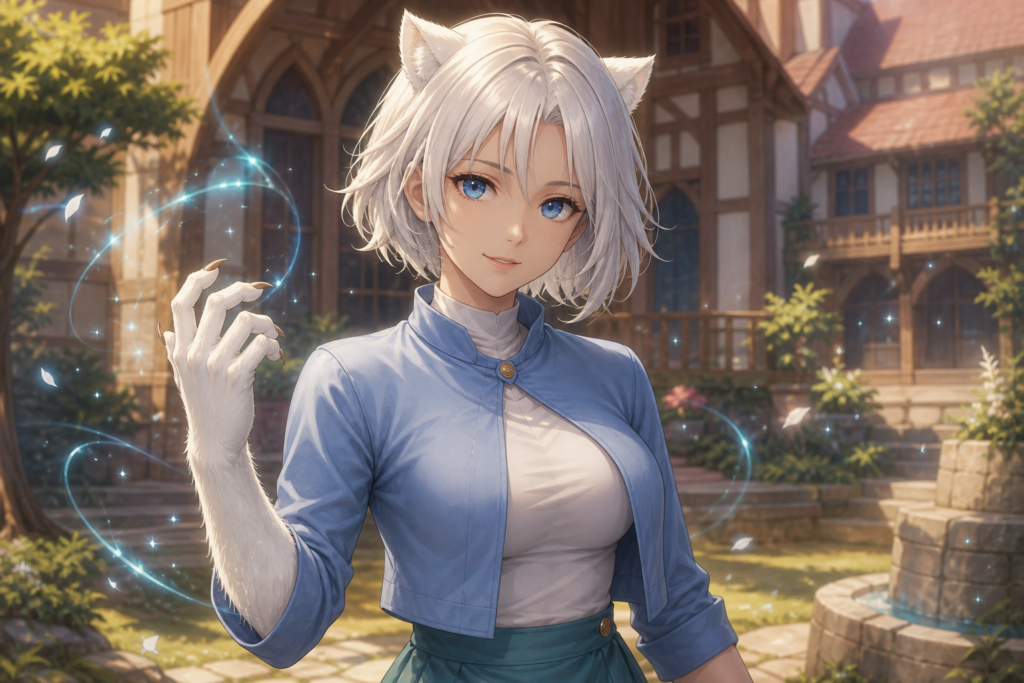
CVM Sekai character profile
Bottom line
Lisanna Strauss survives. That does not mean the story gives everybody their old life back. Earth-land Mirajane and Elfman spend years believing their younger sister is dead. Elfman builds his entire relationship with Beast Soul around the belief that his uncontrolled transformation killed her. Lisanna wakes in Edolas, enters a family grieving its own Lisanna and learns to live inside another person’s absence.
Then reverse Anima sends her home. That is a miracle. The return is also another separation. Lisanna’s best material is not the childhood joke that she and Natsu might someday play house. Her best material is the way survival complicates identity, grief and belonging across two worlds. She is loved by two versions of a family. She cannot remain physically present for both. The series sometimes treats her return like a reset button. Her actual story is much better than that. Survival changes the facts. Survival does not refund the time.
Who Lisanna Strauss is
Lisanna Strauss is a Fairy Tail mage, the younger sister of Mirajane and Elfman Strauss and a Take Over user whose specialty is Animal Soul. Her magic transforms parts or all of her body with animal traits. Compared with Mirajane’s demonic Satan Soul and Elfman’s power-focused Beast Soul, Lisanna’s forms emphasize movement, senses and adaptation. The three siblings share a magical family without becoming copies of one another.
Her Japanese performer is Harumi Sakurai. This profile keeps Japanese performance scope only. Public official pages reviewed for this package do not provide a stable full vital sheet or a directly indexed exact manga debut entry. Unsourced age, height and first-chapter numbers do not belong in a reference box simply because other websites repeat them.
Canon gives Lisanna a more important identity sequence: Fairy Tail child and Strauss sibling. Natsu and Happy’s friend. Believed dead in Earth-land. Displaced survivor in Edolas. Returned guild member. Fighter inside a family that has changed while loving her.
The Strauss siblings choose solidarity
The Strauss family’s magic begins with rejection. Mirajane’s transformed arm frightens their village. People interpret the unfamiliar body as proof that she is possessed or monstrous. Lisanna and Elfman respond by learning Take Over too. That choice is not background decoration. Learning Take Over is an act of solidarity. They do not demand that Mirajane hide the thing that makes the village uncomfortable. They enter the same category with her. If she is going to carry visible difference, she will not carry it alone.
The choice also gives Lisanna agency in the family’s origin. She is not merely the sweet younger sister whose later loss motivates stronger characters. She helps define what the Strauss siblings become. Makarov and Fairy Tail provide the language the village refused to use. Mirajane’s arm is Take Over magic. Magic can be trained. Power has consequences, but the person is not morally identical to the form.
That reframing is creative and cultural. Communities often turn bodily difference into moral suspicion. Fairy Tail’s answer is not that every frightening power is automatically safe. The stronger answer is that safety comes through knowledge, consent, training and accountability, not exile. Lisanna learns that lesson early. Her later life proves how much identity still depends on other people recognizing who you are.
Natsu, Happy and childhood future-play
Lisanna is close to Natsu as a child. She helps him care for the egg that eventually hatches Happy. The scenes connect the three through play, responsibility and imagined family. Lisanna teases Natsu about a future together. The material is affectionate. The childhood joke is not a binding marriage contract written by two children next to a giant egg.
Fandom often turns those scenes into a romance scoreboard, especially when comparing Lisanna with Lucy. That approach flattens all three women and misunderstands childhood imagination. Children play at future roles. They test language about family. They borrow the structure of adulthood before they understand what it will mean. Lisanna’s teasing tells us she feels safe imagining a future with Natsu and Happy. Their childhood closeness does not establish an exclusive adult relationship that later women violate by existing.
Happy’s connection with Lisanna deserves its own weight. She helps care for him before anyone knows what kind of creature will emerge. Her affection participates in his chosen-family origin. Natsu becomes Happy’s primary partner. That does not make Lisanna’s care irrelevant. The relationship is small, early and meaningful. The relationship does not need a shipping war to matter.
The accident: what Earth-land believes
Elfman attempts a full-body Beast Soul transformation and loses control. Lisanna disappears during the accident. Mirajane and Elfman believe she dies. The phrase “believed dead” matters. From their perspective, they have evidence of a catastrophic magical loss, an absent body and no reason to imagine another world has taken her. Their grief is not foolish because the audience later receives supernatural information they did not have.
Elfman believes his body killed his sister. Mirajane loses both Lisanna and her trust in the combat identity she once performed publicly. The surviving siblings reorganize their lives around absence. Lisanna’s disappearance therefore changes more than a family count. The apparent death changes how two Take Over mages relate to power. The story’s later reveal cannot erase that causal history. If a person grieves for years and then learns the loved one survived elsewhere, the grief was still lived time. The nervous system does not issue store credit.
Edolas: survival inside another girl's place
Anima transports Lisanna to Edolas. There, she encounters Edolas versions of Mirajane and Elfman who have lost their own Lisanna. They recognize that the Earth-land girl is not literally their sister. They accept her anyway. That choice is tender and ethically complicated. Lisanna survives because another family makes room for her. She also lives inside a place opened by somebody else’s death. The Edolas siblings do not simply confuse two identical girls. Their relationship carries mutual knowledge, grief and substitution.
The word “substitution” can sound cruel, but pretending it is not present would be crueler. The bond becomes real precisely because the people involved know identity cannot be copied perfectly. Lisanna is not Edolas Lisanna. She is also not emotionally untouched by living as part of that household. This is where a Confucian family lens becomes useful. Family role is relational. Sisterhood is not only blood or private feeling. Family membership grows through repeated care, obligation, recognition and life inside a household. Earth-land Lisanna enters an existing role, but the relationship becomes more than performance because the family participates knowingly.
A Buddhist lens adds another layer. The self is not a sealed object unchanged by circumstance. Lisanna remains herself while being shaped by another world, another family’s grief and years of adaptation. She does not become fake because she changes.
Kodansha's Edolas frame and the reveal boundary
Kodansha’s official Volume 21 summary sends Natsu’s group into Edolas to find the vanished guild and notes that they encounter a long-lost member of the original guild. That summary supports the reveal frame without collapsing its chronology. Before Edolas, Earth-land characters believe Lisanna is dead. During the arc, the audience learns she survived. Her siblings learn the truth only when the worlds’ crisis brings those lives together.
The reveal should be written in that order. A bad summary says, “Elfman thought he killed Lisanna, but actually he did not.” That makes years of character development sound like a silly misunderstanding. A responsible summary says, “Elfman lost control, Lisanna was pulled into Edolas, and everyone in Earth-land lived under the reasonable belief that she died.” Facts arrive at different times. Consequences begin before complete knowledge.
Reverse Anima and the second family she loses
Reverse Anima sends displaced beings from Edolas back to Earth-land. Lisanna returns to Mirajane, Elfman and Fairy Tail. The reunion is one of the series’ clearest emotional rewards. The siblings who built their adult identities around her absence can touch her, hear her and know she survived. But return creates another loss. Edolas Mirajane and Elfman lose the sister who had become part of their household. Lisanna loses the family that sheltered her in another world. The story’s camera follows the Earth-land reunion, so the joy receives more space than the second separation.
That does not make the second family less real. Creative structure determines whose grief receives the soundtrack. RaeRae’s inference is that Lisanna’s Edolas bond is one of the arc’s richest consequences precisely because it exists beyond the main world’s happy ending. The portal closes. The relationship does not become counterfeit.
Returning home is not returning to the same home
Lisanna returns to Fairy Tail, but the guild has changed. Mirajane has become the warm public face behind the bar rather than the combative teenager Lisanna remembers. Elfman has rebuilt full Beast Soul control through the Phantom Lord crisis. Natsu has grown into a central guild fighter. Happy has his own personality, history and partnership.
Everybody loves her. Nobody has waited in emotional storage. Reintegration is therefore work. Lisanna has to enter relationships that continued without her. Her siblings have to welcome a living woman rather than recover the exact child they lost. The guild has to make room for her Edolas years even when its members did not witness them.
The story often moves quickly through that adjustment. A complete character profile should name it. Belonging after displacement is not a single hug. Reintegration means learning how to live among people whose memories of you stopped at a different age.
Tenrou Island: immediate danger after return
Lisanna rejoins guild life and soon becomes involved in the Tenrou Island period. That timing matters. She has barely returned from one world-level displacement before the S-Class trial and Grimoire Heart attack place the guild in another crisis. Her interactions with Lucy and the confrontation involving Kain Hikaru belong to the arc’s ensemble structure. The final publication should keep exact battle attribution tied to the published volume instead of making Lisanna the sole finisher in a group sequence.
The relationship with Lucy is especially important because fandom often positions them as rivals for Natsu. Canon gives them cooperation. Lucy is not the woman who stole Lisanna’s place. Lisanna did not own an adult relationship with Natsu. Both are Fairy Tail members with their own histories and agency. Their Tenrou material becomes more interesting when we stop asking which woman wins a man and start asking how they protect one another inside a guild under attack. That is less dramatic than a triangle. Cooperation is also what the story actually gives us.
Seven years suspended in Fairy Sphere
Fairy Sphere saves the Tenrou group from Acnologia and suspends them outside ordinary time for seven years. Lisanna loses more time. First Anima removes her from Earth-land. Then Fairy Sphere removes her from the years following Tenrou. The second displacement is shared with her guild, but it still continues the central pattern of her life: survival arrives through missing time.
When the group returns, Fairy Tail has declined. Romeo has grown. Macao has served as master. The outside world has kept moving. Lisanna’s body does not show seven ordinary years of aging. Her social world carries them. This is why her profile cannot be reduced to “she came back.” She repeatedly returns to places altered by absence.
Grand Magic Games era: support without invented rank
Lisanna supports Fairy Tail after the Tenrou group’s return and during the period surrounding the Grand Magic Games. She is not a central tournament-team star. A complete biography should not promote background presence into membership on a team roster she does not hold. Her importance is domestic, relational and defensive. She belongs to the guild’s restored community. That is not the same as being the person whose victory changes the scoreboard.
Anime and manga fandom often treat screen time as a moral ranking. A character who does not receive a major fight is declared useless. That standard confuses combat allocation with personhood. Lisanna does not need to defeat a headline opponent to justify surviving.
Tartaros: captivity and the Strauss body problem
The Tartaros conflict again puts the Strauss siblings inside a story about bodies, transformation and control. Lisanna is captured and confined during the enemy’s operation. The larger assault seeks to neutralize Fairy Tail and exploit powers connected to demonic transformation, especially Mirajane’s Take Over potential. The profile should preserve the laboratory and escape sequence at ensemble scale. Lisanna participates in survival and resistance. The profile should not assign every finishing blow to her or transform captivity into proof that she lacks agency.
Being captured is something an enemy does to a person. Captivity is not a character flaw. The siblings’ shared presence also matters. Mirajane’s body was once treated as demonic by frightened villagers. Tartaros turns demonic bodies into a military and technological system. The private stigma of childhood becomes an institutional threat. Lisanna’s early choice to learn Take Over so Mirajane would not stand alone gains new weight here. The family is still facing a world that wants to classify bodies as tools or monsters.
Alvarez: one defender in a mass war
Lisanna participates in Fairy Tail’s defense during the Alvarez invasion. The war is a large ensemble. Her role should be described at the scale the panels support: guild member, Animal Soul user, sibling and defender. She is not a hidden commander. She does not need an invented solo victory. Her presence completes a family transformation. The child exiled by a village, the brother who feared his beast form and the sister displaced into another world now stand inside the legal guild defending Fiore. That symbolic arc is strong enough without borrowing another character’s battle receipt.
Animal Soul: mechanics and limits
Lisanna uses Take Over to gain animal traits and forms. Partial transformations can alter selected parts of her body, giving her specialized movement, senses or physical features. Fuller transformations change more of her body and can support combat or mobility through the chosen animal’s attributes. The magic’s practical strengths include:
- Mobility and rapid repositioning.
- Sensory adaptation.
- Physical traits suited to a specific environment or opponent.
- Partial transformation that can preserve flexibility.
- Full forms that change her overall movement and attack profile.
Its limits include magical stamina, the properties of the selected animal, exposure during transformation and matchup dependence. Animal traits do not grant universal superiority. A fast form may lack power. A powerful form may sacrifice flexibility. Anime-original forms must be labeled as anime-original. A profile should not place every animated transformation into one manga-canon spell list and call that completeness. Completeness means continuity is clear, not that every noun is dumped into a box.
Lisanna in *100 Years Quest*
Lisanna does not join the traveling 100 Years Quest team. She remains part of Fairy Tail at home. During the Aldoron conflict, the White Mage’s control causes guild members to fight one another. The official Episode 10 summary states that Lucy confronts Mirajane’s group while Gray faces the Raijinshū and Natsu faces Gajeel. Lisanna belongs to the Strauss-side ensemble around Lucy.
The moment matters because control again interrupts family and guild consent. Lisanna, Elfman and Mirajane are placed against a person who should be an ally. The profile should keep that role proportional. Lisanna does not become a Dragon God specialist or a major Diabolos rival because she appears during the arc. Later sequel presence should be included only where a published chapter or official episode gives her a concrete action.
The official sequel’s Volume 8 summary also returns Natsu’s team to Edolas and their old friends. That does not automatically place Earth-land Lisanna in the traveling party. The sequel confirms that the world where she once lived remains part of the franchise’s active geography. Her Edolas history therefore remains relevant even when she is not physically present in that return.
Relationship atlas
Mirajane Strauss
Mirajane is Lisanna’s older sister and the first reason she chooses to learn Take Over. Their reunion restores physical presence without returning the years each lived without the other, so love must meet the changed people grief produced.
Elfman Strauss
Elfman is Lisanna’s brother and childhood training partner whose lost control shapes years of guilt. Her survival changes the facts behind that guilt without erasing the accident or the recovery he built under a false but reasonable belief.
Edolas Mirajane and Elfman
Edolas Mirajane and Elfman become a second family through shared grief and knowingly imperfect substitution. The bond remains real after Lisanna returns to Earth-land because years of household care cannot become counterfeit simply because the portal closes.
Natsu Dragneel
Natsu is Lisanna’s close childhood friend and partner in caring for Happy’s egg. Their affectionate future-play shows genuine closeness without creating a fixed adult romance or a permanent claim that later friendships are supposed to violate.
Happy
Happy is Lisanna’s chosen-family connection rooted in care that begins before his hatching. Her role in that early family matters without competing with Natsu’s primary partnership, allowing affection to exist without turning care into ownership.
Lucy Heartfilia
Lucy is Lisanna’s guildmate and Tenrou ally, not an intruder in a childhood promise. Their actual cooperation should replace fandom’s invented rivalry because the women share danger and community without treating Natsu as property to be awarded.
Fairy Tail
Fairy Tail is Lisanna’s home, witness and reintegration community after years of presumed death. The guild welcomes her back, but collective love cannot make return psychologically instant or freeze everyone at the emotional age they had when she vanished.
Japanese performance and adaptation
TV Tokyo’s official 2014/2015 cast page credits Harumi Sakurai as Lisanna. Lisanna’s adaptation depends heavily on contrast. Childhood warmth, the silence around presumed death, the unfamiliarity of Edolas and the intensity of reunion all ask the Japanese performance to carry different kinds of recognition. Performance analysis stays tied to exact Japanese scenes instead of inventing episode-specific vocal technique without direct viewing evidence.
Adaptation also affects the amount of childhood Natsu material, transformation variety and the emotional duration of reunions. Any anime-only form or expanded scene must be labeled rather than silently treated as manga canon. Official films, OVAs, games and spinoffs should be listed only when Lisanna’s actual presence is confirmed through a roster, credit or licensed work. Franchise branding is not a receipt.
Final verdict
Lisanna Strauss is not Fairy Tail’s almost-girlfriend. She is its displaced daughter. Her childhood with Natsu and Happy is affectionate, but it is not the most important thing about her. Her life connects bodily stigma, sibling solidarity, magical accident, parallel-world identity, chosen family and the emotional cost of returning home after everybody has changed. She survives Elfman’s lost control because Anima takes her.
She survives Edolas because another grieving family recognizes the difference and loves her anyway. She returns because reverse Anima moves her again. Every rescue costs time, place or relationship. That is the consequence Fairy Tail’s happiest framing can sometimes rush past. Lisanna’s survival does not undo Mirajane’s grief. Her survival does not make Elfman’s recovery unnecessary. Lisanna’s return does not turn Edolas Mirajane and Elfman into placeholders. Lisanna’s childhood history does not make Lucy a rival.
Her return gives all of those relationships a harder task. They must love the person who returned instead of demanding the exact girl who left. That is not a reset. That is reintegration.
Source ledger and clean boundaries
- TV Tokyo official 2014/2015 cast page, including Harumi Sakurai as Lisanna
- TV Tokyo official character portal
- Kodansha Fairy Tail series catalog
- Kodansha Fairy Tail Volume 21 and its official Edolas/long-lost-member summary
- Kodansha Fairy Tail Volume 23 and its official Edolas ending summary
- Kodansha Fairy Tail: 100 Years Quest: series catalog and Volume 8 Edolas summary
- Official 100 Years Quest Episode 10 story page
- Primary chronology and magic context: Hiro Mashima, Fairy Tail, volumes 1 through 63. Sequel claims are limited to published 100 Years Quest material and the official pages above.
Public official pages reviewed here do not expose a stable full vital sheet, a directly indexed exact manga debut, every Animal Soul form’s licensed first-use name or a complete Lisanna film/OVA/game roster. Those details are omitted or bounded instead of imported from fan databases.