
Elfman Strauss
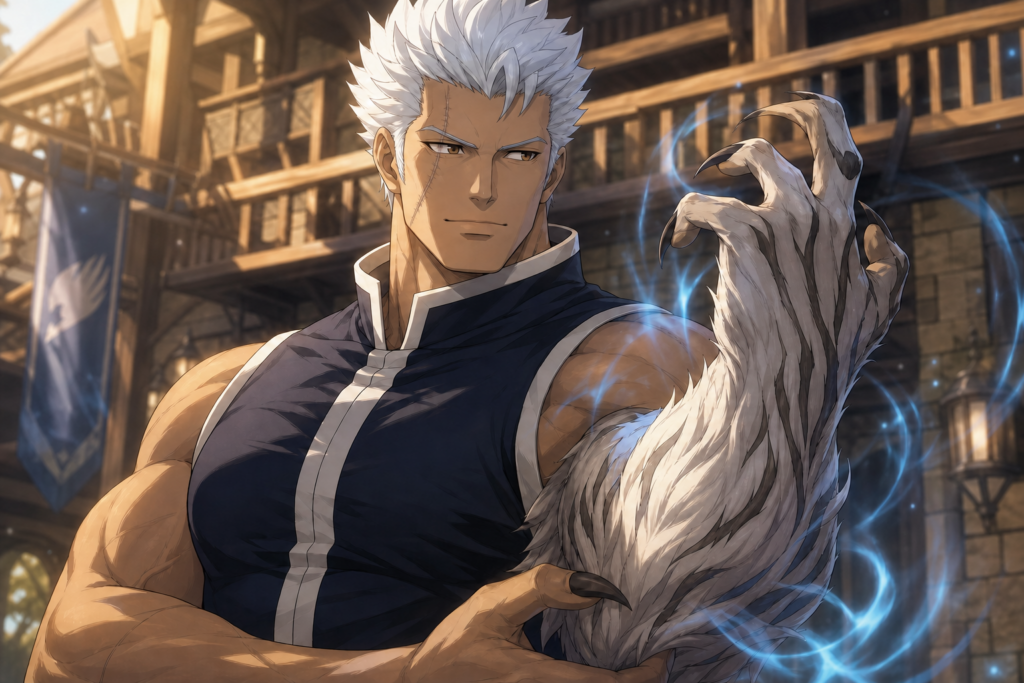
CVM Sekai character profile
Bottom line
Elfman Strauss says “man” so often that subtitles should charge him rent. But his story is not a simple joke about masculinity. Elfman uses the word as a courage ritual. He says it when he wants to be brave, when he wants someone else to stand up and when he is trying to force his own fear into a shape he can manage. Sometimes the habit is funny. Sometimes it is exhausting. Sometimes it exposes exactly how frightened he is.
The strongest Elfman scenes do not prove he has become the loudest man in the room. They prove he can act while carrying guilt, fear and the knowledge that his own body once became dangerous to the people he loved. His Take Over magic makes that conflict physical. Beast Soul lets him borrow the power and form of monsters. Beast Soul also means control is never an abstract character trait. If Elfman loses control, another person can pay the price.
That is why Lisanna’s apparent death, Sol’s psychological attack, the Bacchus match and Seilah’s Macro belong in the same profile. They all ask one question: Can Elfman trust his strength without pretending strength is harmless?
Who Elfman Strauss is
Elfman Strauss is a Fairy Tail mage, a Take Over specialist and the middle Strauss sibling. Mirajane is his older sister. Lisanna is his younger sister. His signature branch of Take Over is Beast Soul. He can transform parts of his body or assume fuller beast forms after acquiring and controlling those forms. The magic grants physical power, durability and specialized traits. Beast Soul is not limitless monster cosplay. Control, magical reserves, the properties of a chosen form and the opponent’s strategy all matter.
His Japanese performer is Hiroki Yasumoto. This profile keeps Japanese performance scope only. Public official pages reviewed for this package do not expose a stable full vital sheet or a directly indexed exact manga debut entry. This profile leaves unsourced age, height and first-chapter numbers outside the record. The facts canon does emphasize are stronger anyway: Elfman is a sibling, a guild member, a survivor of magical loss of control and a fighter who rebuilds trust in his own body.
The Strauss siblings learn difference together
Mirajane’s childhood transformation frightens their village. People interpret the demonic arm as possession and treat her as a threat. Elfman and Lisanna do not solve that fear by asking Mirajane to become less strange. They learn Take Over magic too. That choice is the foundation of Elfman’s identity. The siblings make magical difference into something shared. Mirajane is not the family’s monster while the other two remain normal. They become a Take Over family.
There is a cultural lesson here about stigma. A community sees a frightening body and decides the body carries moral danger. Makarov and Fairy Tail give the Strauss siblings a different language. The transformation is magic. Magic can be trained, limited and used responsibly. The person is not identical to the fear other people project onto the form.
Elfman’s magic therefore begins as solidarity before it becomes combat. That matters because his later fear is not only “I might lose a fight.” The deeper fear is, “I might become the danger our family once insisted we were not.”
Lisanna's apparent death and the body he cannot trust
The central trauma in Elfman’s life begins when he attempts a full-body Beast Soul transformation and loses control. Lisanna appears to die during the accident. Later, the Edolas story reveals that she was pulled through Anima and survived in another world. That truth changes what physically happened. Lisanna’s survival does not erase what Elfman experienced.
For years, he believes his uncontrolled body killed his younger sister. That belief reshapes how he uses magic. Partial transformation is not merely a technique preference. Restraint is a safety strategy. If full Beast Soul once turned him into a threat, limiting the transformation feels like responsibility. The story should be careful here. Elfman is accountable for attempting power he could not control. He is not helped by endless self-punishment. Accountability asks what he learns and how he changes his conduct. Shame says he is permanently identical to his worst loss of control.
Those are not the same thing. A Buddhist lens makes the difference useful. Clinging to a fixed identity, whether “strong man” or “monster who killed his sister,” traps Elfman inside a story that cannot respond to new action. Healing does not mean forgetting the event. Accountability means he is not required to become the event forever.
Phantom Lord: Sol attacks the wound, not just the fighter
During the Phantom Lord conflict, Sol targets Elfman’s memories and guilt. That makes the battle more than a matchup between earth magic and Beast Soul. Sol weaponizes the belief that Elfman is dangerous to his family. Elfman must decide whether protecting Mirajane requires avoiding his power or controlling it. He regains the ability to use a full Beast Soul and defeats Sol.
The victory is important. The victory is not a magical cure. One successful transformation does not retroactively erase years of guilt. The win gives Elfman new evidence about himself. He can carry fear, use the power and return to himself. Control becomes something practiced rather than something he either permanently has or permanently lacks. That is a healthier model of recovery than a tidy “he faced his fear and was fixed” reading. Trauma is rude. Trauma does not leave because a fight scene had excellent music.
Mirajane: the sister he protects and must let protect him
Elfman is intensely protective of Mirajane. The instinct makes emotional sense. She is his older sister, fellow Take Over mage and one of the people most harmed by Lisanna’s apparent death. He wants to keep more loss away from her. But Mirajane is also stronger, more experienced and capable of choosing her own risks. The relationship works when protection is mutual. Elfman can stand between Mirajane and an immediate threat. He cannot turn her into a fragile symbol whose only job is to motivate his courage.
Mirajane’s return to Satan Soul during the Battle of Fairy Tail reinforces that point. Freed’s attack on Elfman helps trigger her combat return. Elfman is not the only sibling who protects. His danger mobilizes her power too. Their family story resists a neat gender hierarchy. Elfman talks loudly about manhood. Mirajane can flatten a battlefield. Lisanna often understands both of them better than they understand themselves.
The joke is not that Elfman fails to be a real man because his sister is stronger. The better joke is that Fairy Tail keeps letting him announce a rule the women around him have already outgrown.
Battle of Fairy Tail and Evergreen
Elfman’s connection with Evergreen begins in hostile conditions. Evergreen willingly participates in Laxus’s Battle of Fairy Tail plan. She petrifies guildmates and helps turn Magnolia into a coercive contest. Her later affection, teamwork and growth do not rewrite that beginning. Elfman opposes her as part of defending the guild. Their relationship develops later through shared missions, the Tenrou Island S-Class trial and increasingly suggestive personal moments. The story treats them as romantically interested without providing a clean, universally confirmed final marriage state in the material used for this package.
That boundary protects both characters. Evergreen is not a prize awarded because Elfman won a fight. Elfman is not proof that Evergreen’s earlier conduct was secretly flirting. They become more interesting when later trust is understood as later trust. Accountability does not forbid romance. Romance requires chronology.
Oración Seis, Edolas and the difference between return and reset
Elfman continues as a supporting Fairy Tail combatant through the Oración Seis period and the expanding conflict around legal and dark guilds. His importance is practical rather than central. A complete profile should record participation without inventing a solo arc where the series gives him a team role. Edolas changes the Strauss family’s factual history.
Lisanna is alive. She survived through Anima, lived with the Edolas versions of her family and eventually returns to Earth-land when reverse Anima sends the displaced beings back. Her return is joyful. Her return does not mean nobody suffered. Earth-land Mirajane and Elfman lived through years of grief. Edolas Lisanna lived with another family and knowingly accepted their love while carrying the truth of her own identity. The Edolas Strauss family experiences its own loss when she leaves.
Elfman’s guilt receives new information: he did not physically kill Lisanna. His body still lost control. He still lived for years believing it caused her death. The reveal changes blame. The truth does not delete trauma.
Tenrou Island: partnership, limits and seven missing years
Elfman participates in the S-Class promotion trial with Evergreen as his partner. The pairing turns their developing connection into tactical cooperation. They face danger together, including the wider Grimoire Heart assault and the conflict involving Rustyrose. The key point is not that romance makes them stronger. The stronger point is that both must coordinate under pressure after beginning their history on opposite sides of coercion.
Tenrou also places Elfman inside Fairy Sphere’s seven-year suspension. He returns without ordinary aging while people outside the island have lived through Fairy Tail’s decline. Like the rest of the Tenrou group, he benefits from the magic that saved them and inherits the consequences of absence he did not consciously choose. That distinction matters in his family story. Lisanna returns from one impossible absence. Then the siblings are caught in another. Fairy Tail loves a reunion, but it keeps making people pay for the missing time.
Grand Magic Games: Bacchus and strategic endurance
Kodansha’s official Volume 33 summary identifies Elfman’s match with Bacchus as a major tournament beat. Bacchus is associated with exceptional martial ability and a past competitive link to Erza. Elfman enters the match as an apparent mismatch. He does not win by suddenly becoming the cleaner martial artist. He turns endurance and defense into a strategy.
Elfman’s transformation lets him absorb punishment while Bacchus’s own offense creates accumulating cost. The win reframes his body. Earlier, strength without control endangered Lisanna. Here, controlled transformation and pain tolerance protect the guild’s tournament position. That is real growth. The match is not proof that Elfman has limitless durability. Endurance is contextual. A strategy that works against one opponent’s aggressive style does not make him immune to magical exhaustion, coercion or a different kind of attack.
The fight also complicates his masculinity language. He wins through patience and tactical suffering, not domination. The loudest thing about the match is not his slogan. The important feat is his willingness to hold a plan while getting hurt.
Tartaros and Seilah: coercion returns the old fear
Seilah’s Macro is one of the most important attacks in Elfman’s story because it targets agency. She uses coercive power to control bodies and commands Elfman into actions that endanger his own guild. A bomb is planted, and the threat turns him into a delivery system against his home. That is not random battlefield humiliation.
Elfman’s deepest fear is that his body can harm family while his conscious will cannot stop it. Lisanna’s accident begins that fear through lost magical control. Seilah reproduces it through external control. The moral responsibility belongs with the coercer. Elfman’s earlier accident involved his own decision to attempt a transformation beyond his control. Seilah’s Macro removes his consent. Treating both events as the same kind of guilt would blame a victim for being weaponized.
The story’s response also keeps the Strauss siblings connected. Mirajane’s battle with Seilah and her use of Take Over against demonic power belong to the same family history. Elfman is not saved because masculinity finally wins. He is saved through family, resistance and another Take Over mage understanding what bodily violation means. Tartaros therefore deepens his arc instead of simply repeating it. The first crisis asks whether he can control his power. The later crisis asks what accountability means when control is stolen.
Alvarez: support without invented glory
Elfman participates in Fairy Tail’s defense during the Alvarez war. His role is supportive and combat-capable, shaped by the same priorities that define him elsewhere: protect family, protect guild and keep standing when stronger forces push through Fiore. The profile should not promote every panel into a decisive battle or assign him an opponent from memory without a direct volume receipt. Alvarez contains a large ensemble, layered interruptions and shared victories. Accuracy matters more than making every supporting character look like a secret war finisher.
Elfman’s value does not depend on stealing somebody else’s receipt. His presence matters because the Strauss siblings fight as part of the guild they once entered as frightened outsiders. The family accused of monstrosity becomes part of Fiore’s defense against an empire. That is enough meaning. We do not need to invent a crown.
Beast Soul: mechanics, uses and limits
Elfman’s Take Over magic allows him to assume attributes and forms associated with beasts he has taken over. Partial transformation gives him focused access to a limb or trait. Beast Arm is the clearest recurring expression: one arm becomes larger and gains the strength or properties of a beast form. Full Beast Soul changes more of the body and can provide much greater power. The tradeoff is not only magical energy. Control matters. His history shows several practical limits:
- A form can exceed his ability to control it.
- Full transformation carries greater physical and psychological stakes than a partial limb.
- Magical exhaustion limits how long or how often power can be sustained.
- Durability does not cancel pain or internal damage.
- A strong form can still lose to coercion, strategy, superior magic or an unfavorable matchup.
- Acquiring a form and safely using it are not the same achievement.
Individual Beast Soul forms and localized techniques are named only where a published volume or official episode supplies the wording. A long spell list with mixed fan translations is not a factual floor. That phrasing is a formatting accident.
Elfman in *100 Years Quest*
Elfman does not join Natsu, Lucy, Happy, Gray, Erza, Wendy and Carla as part of the traveling 100 Years Quest team. He remains connected to the guild at home. During the Aldoron conflict, the White Mage’s control causes Fairy Tail members to fight one another. The official Episode 10 summary states that Lucy confronts Mirajane’s group while Gray faces the Raijinshū and Natsu faces Gajeel. Elfman belongs to the Strauss-side conflict around Lucy, but the profile should keep the emphasis where the official material places it instead of pretending he leads the whole operation.
This sequel beat matters because bodily control returns again. Elfman’s history already asks what happens when strength escapes consent. Whiteout places the guild inside another conflict where members act under someone else’s control. The repetition should not be read as proof that Elfman alone carries the theme. The conflict shows the sequel using a guild-wide violation that lands differently on characters with different histories.
Later sequel appearances should remain proportional. Do not invent a Dragon God victory, Diabolos rivalry or traveling-party importance he does not have. Sometimes the honest sentence is: Elfman remains part of the guild’s defense while the core quest team carries the central mission.
Relationship atlas
Mirajane Strauss
Mirajane is Elfman’s older sister, fellow Take Over mage and mutual protector. His instinct to shield her is loving, but her greater combat power and independent agency must remain visible so protection never becomes permission to control her choices.
Lisanna Strauss
Lisanna is Elfman’s younger sister and the center of his deepest guilt after the Beast Soul accident. Her survival corrects the factual belief that he killed her without erasing the lost control or the years that belief shaped him.
Evergreen
Evergreen is a former opponent, later Tenrou partner and canonically suggestive romantic interest. Their growing trust becomes meaningful only in chronological order, without romanticizing her Battle of Fairy Tail conduct or overstating an unconfirmed final relationship status.
Natsu and Fairy Tail
Natsu and the Fairy Tail guild challenge, tease and rely on Elfman across ordinary work and major crises. The community gives him a place where courage can be practiced through accountable action instead of proved by never feeling fear.
Bacchus
Bacchus is a major tournament opponent rather than a lifelong rival invented from one important match. Their contest reveals Elfman’s tactical endurance and matchup thinking because he wins through a painful plan instead of pretending raw force solves everything.
Seilah
Seilah is the enemy whose Macro weaponizes Elfman’s body against his home and family. Their conflict separates coerced action from chosen responsibility, placing moral blame on the person who removes agency rather than the person whose body becomes the weapon.
Japanese performance and adaptation
TV Tokyo’s official 2014/2015 cast page credits Hiroki Yasumoto as Elfman. The casting supports the character’s broad public presence: Elfman is meant to sound physically confident and immediately recognizable. Performance analysis stays tied to exact Japanese scenes instead of inventing episode-specific vocal technique without direct viewing evidence. Adaptation matters most where visual and sound direction shape the gap between comedy and trauma. Repeated “man” declarations can land as a running gag. The same voice and body become vulnerable when Sol attacks his memory or Seilah removes his agency. A responsible episode-level analysis should describe those choices rather than assuming the manga and anime create identical emphasis. Official films, OVAs, games and spinoffs should appear only when Elfman’s actual role is confirmed through a roster, credit or licensed work. Franchise presence is not character presence.
Final verdict
Elfman Strauss is not interesting because he says “man” a lot. He is interesting because the slogan is a door into fear. He wants courage to be a rule he can repeat until his body obeys. His life keeps teaching him something harder. Courage is not the absence of danger, guilt or vulnerability. Courage becomes responsible action under those conditions.
Lisanna’s apparent death teaches him that power without control can destroy trust. Phantom Lord teaches him that fear does not have to own the next decision. Bacchus teaches him that endurance can be strategic rather than performative. Seilah teaches the story to distinguish losing control from having consent stolen. And Evergreen teaches him, eventually, that relationships are built after accountability, not used to erase it.
Elfman’s masculinity is strongest when it stops being a ranking system. He does not need to be stronger than Mirajane, tougher than every opponent or fearless forever. He needs to know what his power can do, accept its limits and keep choosing care. That is a better definition of manhood than the slogan. Responsible care is also harder.
Source ledger and clean boundaries
- TV Tokyo official 2014/2015 staff and cast page, including Hiroki Yasumoto as Elfman
- TV Tokyo official character portal
- Kodansha Fairy Tail series catalog
- Kodansha Fairy Tail Volume 33 and its official Elfman/Bacchus summary
- Kodansha Fairy Tail: 100 Years Quest catalog
- Official 100 Years Quest Episode 10 story page
- Primary chronology and magic context: Hiro Mashima, Fairy Tail, volumes 1 through 63. Sequel claims are limited to published 100 Years Quest material and the official story page above.
Public official pages reviewed here do not expose a stable full vital sheet, a directly indexed exact manga debut, every Beast Soul form’s licensed first-use name or a complete Elfman film/OVA/game roster. Those details are omitted or bounded instead of imported from fan databases.