
Makarov Dreyar
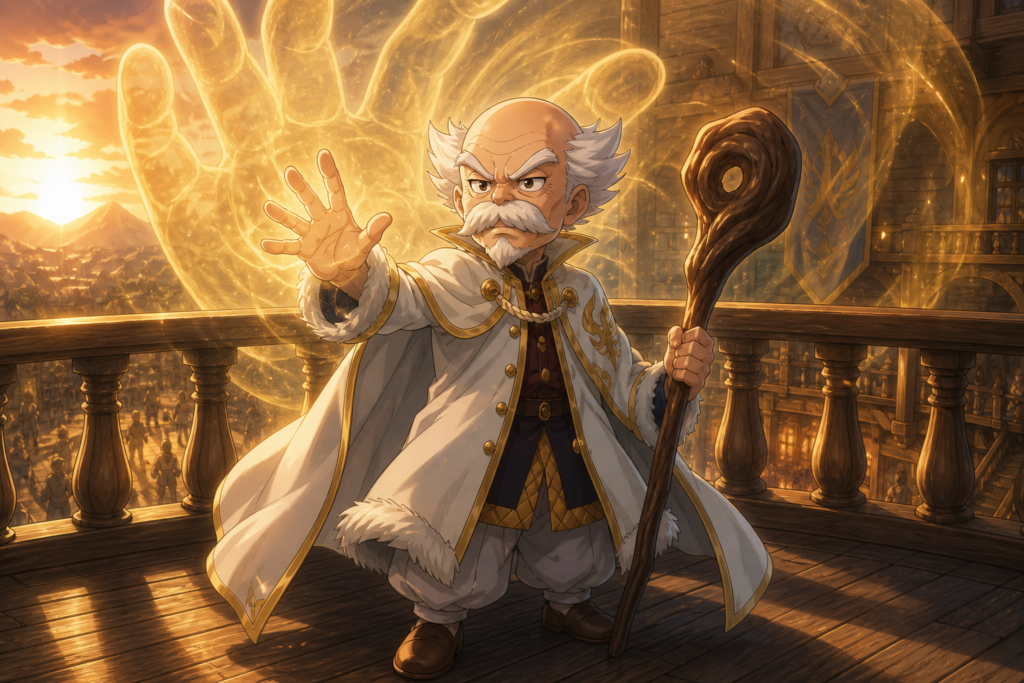
CVM Sekai character profile
Bottom line
Makarov Dreyar is the heart of Fairy Tail. He is also the reason too much of Fairy Tail’s survival depends on one elderly man’s heart continuing to beat. Both things are true. Makarov builds a guild where abandoned, frightened and difficult people can become family without first becoming respectable. Natsu can be loud. Gray can carry grief badly. Erza can be terrifying. Mirajane can fear her own magic. Laxus can be loved while still facing consequences. Makarov does not ask these people to become easier before they deserve a home.
That is real leadership. But his protection has a cost. He keeps dangerous information close, absorbs political risk by himself and repeatedly turns his own body into the guild’s last defensive wall. When he dissolves Fairy Tail after Tartaros and leaves for the Alvarez Empire alone, he calls it protection. The people he protects experience it as abandonment, confusion and another crisis they must solve without him.
Sir, that is not delegation. That is an organizational emergency wearing a tiny cape. Makarov’s story works because Fairy Tail does not make him a flawless father. That pattern makes him a loving leader whose strongest instinct can become his worst habit. He protects people beautifully. He does not always trust them enough to help carry the burden.
Who Makarov Dreyar is
Makarov Dreyar is a senior Fairy Tail mage, one of Ishgar’s Ten Wizard Saints and the guild master who occupies that office for most of the main story. He is the son of Yuri Dreyar, one of Fairy Tail’s founding members, the father of Ivan Dreyar and the grandfather of Laxus Dreyar. His small everyday body is part of the visual joke. His Giant magic can expand that body until he towers over buildings and battlefields. The contrast is funny, but it also tells us exactly how the series sees him. Makarov looks physically easy to underestimate until the guild needs shelter. Then he becomes the shelter.
His Japanese performer is Shinpachi Tsuji. This profile keeps Japanese performance scope only. Public official pages reviewed for this package do not provide a stable full vital sheet or an indexed exact manga debut entry, so this profile does not import unsourced age, height or first-chapter numbers from fan databases. What canon does make clear is more important: Makarov is old, medically vulnerable, politically experienced and still expected to stand between Fairy Tail and disasters created by institutions much larger than one guild. That last part should bother us.
A guild master raised inside the guild's first family
Makarov inherits Fairy Tail before he leads it. His father, Yuri, belongs to the founding generation with Mavis Vermillion, Precht Gaebolg and Warrod Sequen. That lineage gives Makarov legitimacy, but the series does not reduce guild leadership to blood inheritance. Fairy Tail’s master succession moves through founders, peers, temporary caretakers and reluctant replacements. The office is formal. The authority that makes people follow someone is lived. The clean succession chronology is:
- Mavis Vermillion, First Master.
- Precht Gaebolg, Second Master.
- Makarov Dreyar, Third Master.
- Macao Conbolt, Fourth Master during the Tenrou group’s seven-year absence.
- Gildarts Clive, Fifth Master.
- Makarov again, Sixth Master.
- Erza Scarlet, Seventh Master during the post-Tartaros crisis.
- Makarov again, Eighth Master.
That list is not trivia. The succession record exposes Fairy Tail’s leadership problem. Macao keeps the weakened guild functioning while its strongest members are missing. Gildarts receives the office, changes the succession structure almost immediately and does not remain in place. Erza accepts formal command during a crisis while the guild is rebuilding and searching for Makarov. Then the role returns to Makarov again.
Fairy Tail knows how to survive without him. The guild does not know how to stop returning all final responsibility to him. In organizational terms, that is a succession pipeline with a dependency problem. In family terms, everybody keeps handing Dad the keys because Dad always catches the falling roof. Nobody asks what happens when the roof falls on Dad.
His leadership philosophy: family with rules
Makarov calls Fairy Tail a family, but his strongest moments do not confuse family with immunity. He gives members emotional belonging and practical freedom. They can choose jobs, develop unusual magic and form teams through trust rather than strict military structure. He tolerates property damage and personality clashes that would make another administrator age twenty years before lunch.
He also expects the guild’s name to mean something. When outside powers attack Fairy Tail, Makarov’s response is fierce because the guild mark represents mutual obligation. A member does not fight alone. Harm against one member affects the whole community. That principle is emotionally powerful. That model is also easy to abuse when a leader treats every conflict as proof that the family must close ranks. Makarov is usually more careful than that. His defining test comes through Laxus.
Laxus: love does not erase accountability
Laxus is Makarov’s grandson, possible successor and deepest personal leadership failure. Makarov loves him. He also expels him after the Battle of Fairy Tail. The distinction matters. Laxus does not merely challenge an old man for a job. He turns Magnolia into a coercive battlefield, traps guild members, empowers the Raijinshū, also localized as the Thunder God Tribe, to enforce his plan and treats public fear as proof of strength. Freed, Bickslow and Evergreen are accountable for their own choices, but Laxus designs the crisis.
Makarov’s consequence is not a declaration that Laxus is unloved. The expulsion declares that love cannot protect Laxus from the meaning of his conduct. That is one of Makarov’s best decisions. He refuses two bad options. He does not excuse Laxus because they share blood. He also does not pretend expulsion kills the relationship. The farewell gesture during the Fantasia parade shows continued love without cancelling the consequence.
Confucian family ethics often frame senior authority through reciprocal duty, not one-way obedience. Elders owe care and moral example. Younger family members owe respect, but respect does not make harmful conduct righteous. Makarov’s choice works through that tension. He acts as grandfather and guild master, then accepts that the two roles hurt each other. His grief does not make the consequence cruel. His grief proves the consequence costs him too.
Ivan: the son he could not save from power
Ivan Dreyar is a different failure. Ivan is Makarov’s estranged son, Laxus’s father and the leader behind Raven Tail. His actions turn family access into surveillance, manipulation and institutional rivalry. He wants information and control more than belonging. Makarov’s relationship with Ivan shows the limit of chosen-family leadership. Makarov can create a home for many damaged young people. He cannot force his own adult son to value that home correctly.
The story should not use Ivan as proof that Makarov was secretly a bad father. Canon does not give us enough domestic history for that neat diagnosis. The story also should not use Ivan’s villainy to clear Makarov of every possible failure. A broken parent-child relationship has history even when the child becomes responsible for serious harm.
The clean boundary is this: Ivan chooses manipulation. Makarov cannot choose repair for him. Laxus eventually builds a different relationship to Fairy Tail than his father does. That difference matters because family inheritance is not fate. The Dreyar men carry power, pride and resentment across generations. Only one of them learns that strength without consent is not leadership.
Phantom Lord: protection becomes public war
The Phantom Lord conflict tests Makarov against another guild master, Jose Porla. Jose uses institutional power to attack Fairy Tail and target Lucy Heartfilia. Makarov’s response grows from his family ethic: Lucy is not an expendable new recruit. She is Fairy Tail. The speed with which the guild treats her as one of their own is one reason the early series sells its central promise so well.
Makarov’s confrontation with Jose also reveals a structural weakness in the Magic Council’s world. Guild masters with enormous personal power can turn organizational disputes into urban warfare. The Council recognizes Wizard Saints, licenses guild structures and punishes violations, but its systems repeatedly respond after communities are already in danger. Makarov is morally distinct from Jose because he fights to stop coercion, not to seize a person. Still, the scale of the conflict reminds us that Fiore’s legal guild system depends heavily on the character of individual leaders. That is not stable governance. That is hoping the old man with the giant fist has better ethics than the other old man.
Giant magic and the body as shield
Makarov’s signature Giant magic expands his body and physical reach. Giant magic gives the series an immediate visual language for protection: the smallest person becomes the largest barrier. He also uses Light Magic and the guild’s great spell Fairy Law. Fairy Law is not a random blast. Fairy Law judges targets through the caster’s perception of enemies, which makes moral recognition part of the spell’s danger. A spell built around identifying who counts as an enemy places terrifying weight on the user’s judgment.
That is why Makarov’s ethics matter as much as his power level. His magic is broad, but his body is not limitless. Age, heart strain, accumulated injuries and repeated magical overuse shape his later story. Porlyusica’s medical interventions stop the series from pretending endurance is the same as health. Makarov survives because people treat him, protect him and sometimes refuse to accept his self-sacrificial decisions as final.
The creative design is clear. Every time Makarov grows giant, the image says he can cover everyone. Every time his ordinary body collapses, the story shows the bill. Power does not cancel age. Love does not cancel physiology.
Porlyusica: the friend who sees the bill
Porlyusica is more than Fairy Tail’s convenient healer. She is a long-term peer who understands Makarov’s body, pride and repeated willingness to spend himself. Their trust gives the series a relationship rarely centered in action anime: an elderly man has a woman friend who can tell him he is medically reckless without the scene becoming romance, comedy or disrespect.
Her care also complicates Makarov’s heroic image. He can only keep standing because somebody does the quieter work of putting him back together. That is culturally important because action stories often treat recovery labor as invisible. The fighter gets the splash page. The healer gets the cleanup. Makarov’s repeated limits make Porlyusica’s work part of guild survival, whether the guild celebrates it enough or not.
Precht and Hades: leadership can rot
Precht Gaebolg precedes Makarov as Fairy Tail’s Second Master. He later becomes Hades, leader of Grimoire Heart. That history matters more than a simple hero-villain contrast. Precht helped build Fairy Tail, held its highest office and still followed power into a worldview that treated other people as pieces in a magical project. Makarov’s conflict with Hades is therefore institutional and personal. He is not only fighting an enemy guild. He is confronting proof that Fairy Tail’s legacy does not automatically make a former leader righteous.
This is the same lesson Laxus must learn from another direction. A title, bloodline or founding connection can explain authority. That history cannot justify conduct. Makarov’s model is better because he measures strength by protection and belonging. His leadership remains imperfect because he also hoards responsibility. Hades chases hidden magical truth at the cost of people. Makarov protects people at the cost of himself. One is morally worse. Both reveal what happens when a leader decides only he can carry the final answer.
Tenrou Island and seven stolen years
Tenrou Island brings Makarov into direct conflict with Hades, Grimoire Heart and finally Acnologia. The battle exposes the physical limit of his protective role. Makarov can delay danger. He cannot simply overpower every threat. When Acnologia attacks, Fairy Sphere saves the Tenrou group through collective magic and Mavis’s intervention, but the result removes them from ordinary time for seven years.
The people outside Tenrou live those years. Macao becomes Fourth Master. Romeo grows up. Fairy Tail loses status, money and influence. The returning group experiences almost no personal aging, but the guild they return to has carried absence, public decline and practical survival without them. Makarov’s return restores emotional authority. Makarov’s return does not erase Macao’s labor.
This is where the succession chronology becomes more than a list. Macao’s tenure proves the guild is not frozen when its strongest members disappear. Less celebrated people keep it alive. Fairy Tail loves dramatic power. Its actual continuity depends on maintenance.
Gildarts and the office nobody wants to keep
Makarov names Gildarts the Fifth Master after the Tenrou return. On paper, it makes sense. Gildarts is powerful, respected and deeply tied to the guild. In practice, he does not remain a conventional administrator. He uses the authority to reshape succession and returns leadership to Makarov. The moment is funny because Gildarts is Gildarts. The quick reversal is also revealing.
Formal rank and lived leadership are not the same thing in Fairy Tail. Gildarts can command respect without wanting daily governance. Makarov can want retirement without the institution being ready to release him. The guild keeps treating leadership as a personality problem rather than a system. Find the strongest respected person. Hand them the title. Hope they stay. That works until it does not.
Grand Magic Games and rebuilding public trust
After seven years, Fairy Tail must recover more than tournament standing. The guild must recover its public identity. Makarov supports the guild’s return to the Grand Magic Games because reputation in Fiore affects work, resources and dignity. The tournament is entertainment, but it is also labor-market theater. Guilds perform competence in front of clients, rivals and the state.
Fairy Tail’s victory restores pride. Makarov’s joy is real. Still, the arc also confirms how much the guild economy depends on spectacle. A community can be heroic for years and still need a public scoreboard before people treat it as legitimate again. That is an industry lens hiding inside a sports arc.
Tartaros and the decision to dissolve Fairy Tail
After the Tartaros crisis, Makarov dissolves the guild. His motive is protection. He knows Fairy Tail holds dangerous secrets and believes separation will reduce the target on his members. He later travels to the Alvarez Empire to address the threat tied to those secrets and vanishes from the guild’s ordinary reach. The motive does not remove the consequence.
Members scatter. Lucy loses daily contact with people who had become her home. Natsu leaves to train. Wendy and Carla join Lamia Scale. Juvia and Gray live together before Gray disappears into the Avatar infiltration. Other members rebuild separate lives under conditions they did not choose. Makarov protects them from one danger by creating another kind of instability.
This is his central leadership flaw in full form. He trusts his family enough to die for them. He does not trust them enough to participate in the decision that changes all their lives. A Buddhist lens can illuminate the attachment beneath the sacrifice. Makarov tries to control loss by removing himself and the institution from the board. But control does not end suffering. The dissolution redistributes that danger. The dissolution is not villainous. The decision is not cleanly wise either.
Mest and the ethics of useful manipulation
Mest, also known through the Doranbolt identity, complicates Makarov’s leadership history through infiltration, memory alteration, loyalty and extraction. His work can be useful. Useful manipulation can also violate consent. During the Alvarez crisis, Mest helps extract Makarov from danger. That action matters. So do the decisions surrounding hidden identity and altered memory. A profile that calls him merely loyal misses the method. A profile that calls him merely deceptive misses the risk he takes for the guild.
Makarov’s world repeatedly rewards people who act secretly because institutions are slow and threats are large. The story then has to ask whether a good outcome makes the secrecy acceptable. Usually, the answer should be: it explains the choice, but it does not erase accountability. That standard applies to Mest. The same judgment also applies to Makarov.
Alvarez: sacrifice, apparent death and survival
The Alvarez arc pushes Makarov’s self-sacrifice to its endpoint. He enters the empire to protect the guild, remains central to the conflict and later casts Fairy Law against a massive enemy force. The act is intended as a sacrifice. His body falls. The people who love him experience what appears to be his death. He survives.
Those three facts must remain separate. Calling Makarov canonically dead is wrong. Treating his survival as proof that the sacrifice cost nothing is also wrong. The emotional damage happens before anyone receives reassurance. His guild believes its father has spent his life for them. His body absorbs catastrophic strain. The story uses apparent death to make every member face what his leadership model has always threatened: one day, the man who catches everyone may not get back up.
There is also a structural cost. If the guild’s plan depends on Makarov converting his remaining life into a battlefield resource, then Fairy Tail has failed to build a safer alternative around him. His survival is grace. Survival is not retroactive permission.
Mavis, Erza and women carrying the office
Mavis creates Fairy Tail’s founding ideal. Erza temporarily becomes its Seventh Master during a crisis. Both women expose different parts of Makarov’s leadership inheritance. Mavis gives the guild its mythic and magical foundation. Her own history also shows how founding legends can hide exploitation, grief and morally compromised decisions. Erza accepts authority because the guild needs coordination, not because she has chased the title. Her leadership style is more openly disciplined than Makarov’s, but she shares his protective instinct. The danger is obvious: Fairy Tail can replace one self-sacrificing protector with another and call that succession.
Makarov’s best legacy would not be producing a younger person willing to die the same way. Real succession would produce leaders who share information, distribute authority and let care move in more than one direction.
Relationship atlas
Laxus Dreyar
Grandson, expelled member, returning protector and possible future leader. Their relationship proves love and consequence can coexist. Laxus’s growth belongs to Laxus, not to Makarov’s forgiveness alone. Makarov matters most when he refuses to turn family loyalty into a private exemption from public harm.
Ivan Dreyar
Estranged son and rival guild leader. Ivan turns family knowledge into leverage. Makarov cannot repair a relationship the other person keeps weaponizing. Their rupture also keeps the profile honest about parenthood, because love alone cannot undo an adult son’s repeated choices.
Gildarts Clive
Trusted powerhouse and Fifth Master. Gildarts’s brief tenure exposes the difference between personal authority and institutional commitment. Fairy Tail can recognize a successor’s strength while still failing to build a structure that makes the office sustainable.
Erza Scarlet
One of the clearest products of Makarov’s chosen-family model and later the Seventh Master. He gives her a home. She repeatedly protects the home, sometimes at dangerous cost to herself.
Natsu Dragneel
Makarov gives Natsu room to belong without demanding quiet obedience. Natsu returns that care through fierce loyalty, but he also challenges Makarov’s attempts to decide alone who gets to sacrifice himself.
Mirajane Strauss
Makarov helps reframe Mirajane’s feared demonic arm as Take Over magic rather than possession or moral corruption. That act of naming changes her family’s future. Adult authority becomes useful here because Makarov gives a frightened child language that replaces shame with practical understanding.
Porlyusica
Healer, peer and truth teller. Porlyusica sees the body behind the symbol and refuses to romanticize every collapse. Her presence reminds the guild that heroic protection still creates medical labor, fear and consequences somebody else must carry.
Mest
Useful operative and ethically complicated loyalist. Their shared history makes secrecy look effective, which is exactly why its consequences need scrutiny. Mest shows how a trusted institution can normalize invasive methods when urgent results keep arriving before accountability does.
Precht and Jose
Rival guild masters who show what authority becomes when people are subordinated to power, ideology or control. Precht and Jose sharpen Makarov’s better instincts, but their failures cannot replace a serious review of his own choices.
Makarov in *100 Years Quest*
Makarov remains at the guild rather than joining Natsu’s traveling 100 Years Quest team. That boundary matters. The sequel can use him meaningfully without pretending he is the central fighter in every new conflict. The official Episode 12 summary gives him a concrete role during the Aldoron conflict: Wraith possesses Makarov’s body and is surprised by their unusually high synchronization, which connects to an unexpected bond. The point is not that Makarov suddenly becomes a sequel powerhouse. His body, history and relationships still matter even when another spirit tries to use him as a vessel.
Later sequel material should remain proportional here. If a chapter gives Makarov a leadership decision, family beat or defensive action, include it. If he is simply present at the guild, do not manufacture importance because a complete profile feels nervous about quiet stretches. Not every elder must win a new war to remain relevant.
Adaptation and performance shelf
The television anime is especially good at using scale to define Makarov. His ordinary size supports comedy and warmth. Giant magic turns the same silhouette into protection. Close shots of his collapse bring the symbol back into an aging body. Shinpachi Tsuji’s Japanese performance supports that range through an authoritative elder register that can bend into irritation, laughter and fear for the guild. This profile does not invent episode-specific vocal technique without a direct viewing receipt. Observed delivery belongs here only when tied to an exact scene.
Official TV Tokyo character, staff and episode archives support the anime and Japanese cast frame. Kodansha’s main-series catalog establishes the 63-volume manga, and its Volume 52 summary directly supports Makarov’s journey to the Alvarez Empire to protect the guild and the rescue mission built around his disappearance. Official adaptations and spinoffs should be listed only when Makarov’s actual presence is confirmed through a roster, credit or licensed work. A long media list is not useful if half of it is guessed from franchise branding.
Final verdict
Makarov Dreyar gives Fairy Tail the home it needs. He also teaches that home to depend too heavily on him. His greatness is not that he never fails. His greatness comes from failures that grow out of a virtue the story takes seriously. He loves these people enough to stand between them and the world. Sometimes he loves them so protectively that he denies them information, choice and shared responsibility.
The Battle of Fairy Tail shows his best judgment. He chooses accountability over blood privilege. The post-Tartaros dissolution shows his worst habit. He chooses solitary protection over collective consent. Alvarez shows the final bill. His body becomes the resource everybody spends when the system runs out of answers. Makarov is Fairy Tail’s best father because he makes room for difficult people to belong.
He is its most dangerous bottleneck because he keeps acting like belonging means he must carry the ending alone. The next generation should inherit his care. They should not inherit his martyr complex.
Source ledger and clean boundaries
- Television Tokyo: official character page and Japanese cast
- Television Tokyo: official episode archive and DVD archive
- Kodansha Fairy Tail series catalog
- Kodansha Fairy Tail Volume 52 and its official Alvarez/Makarov summary
- Kodansha Fairy Tail: 100 Years Quest catalog
- Official 100 Years Quest Episode 12 story page
- Primary chronology and spell context: Hiro Mashima, Fairy Tail, volumes 1 through 63. Sequel claims are limited to published 100 Years Quest material and the official anime story page above.
Public official pages reviewed here do not expose a stable full vital sheet, a directly indexed exact manga debut chapter, a complete Makarov film/OVA/game roster or every spell’s first-use localization. Those details are omitted or bounded instead of imported from fan databases.