
Laxus Dreyar
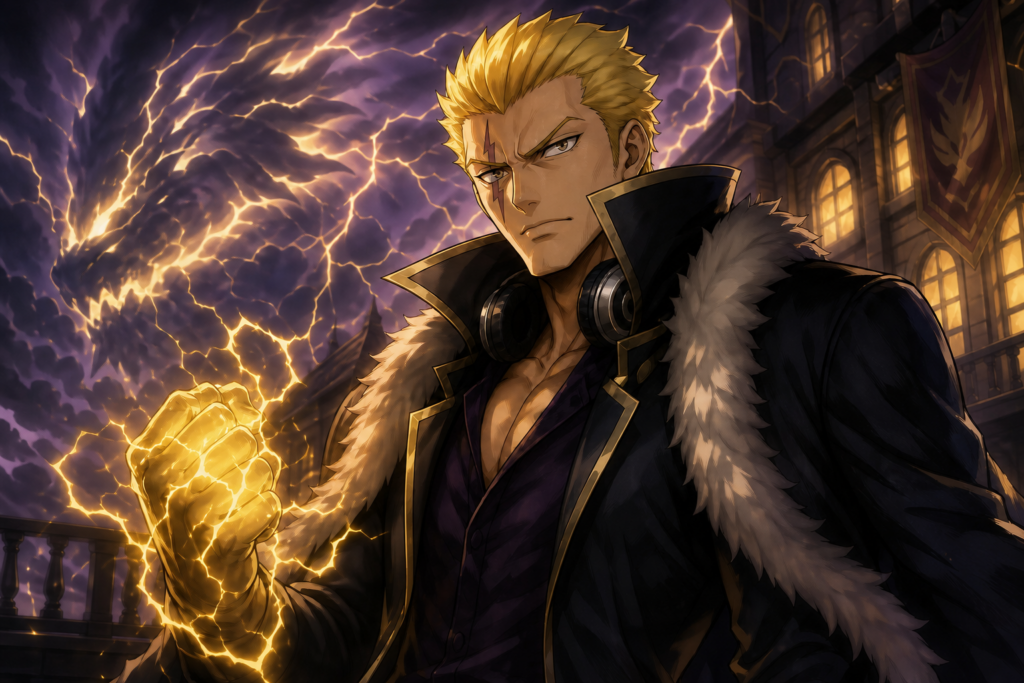
CVM Sekai character profile
Bottom line
Laxus Dreyar is not redeemed because he became strong enough to protect Fairy Tail. He was already strong when he tried to take it. His redemption begins when he stops treating the guild as inherited property and learns to serve people who have every reason to distrust his version of leadership. The Battle of Fairy Tail is the accountability center. Laxus and the Raijinshū, also localized as the Thunder God Tribe, trap their own guildmates, petrify women into hostages, threaten Magnolia and turn belonging into a civil war. His pain over Ivan, Makarov and family expectation explains the obsession with power. That history does not excuse the coercion.
Expulsion matters because love without consequence would teach him nothing. Tenrou, the Grand Magic Games, Tartaros, Alvarez and the 100 Years Quest then ask the only useful question: what does a man do with power after the title stops belonging to him? Laxus learns to protect without possessing. That is the story.
Who Laxus Dreyar is
His name is Laxus Dreyar, written ラクサス・ドレアー in Japanese. He is Makarov Dreyar’s grandson, Ivan Dreyar’s son, a Fairy Tail S-Class mage and a second-generation Lightning Dragon Slayer. Television Tokyo’s official character page explains the generation: Laxus uses lightning magic and has a Dragon Lacrima implanted in his body. He was not raised by a dragon. His Dragon Slayer power comes through the lacrima.
K MANGA indexes his licensed manga debut as Chapter 24, “Second Floor.” The public Television Tokyo material reviewed for this profile confirms Laxus in the Japanese cast and character archive but does not isolate his exact first animated frame. The manga debut is therefore stated precisely while the anime episode remains unstated. Katsuyuki Konishi is his Japanese performer.
Public official pages do not provide a stable canonical birthday, height or weight. Those numbers stay out. His design is recognizable through tall muscular build, swept blond hair, headphones, dark coat and the lightning-shaped scar crossing his anatomical right eye. In a frontal image, that scar appears on the viewer’s left. The rejected wrong-side local hero remains rejected.
A sick child becomes a family project
Laxus is physically frail as a child. Ivan has the Dragon Lacrima implanted in him, giving him power his body did not naturally hold. That origin is not only medical or magical. The implantation is political. Ivan treats strength as inheritance, leverage and proof. Makarov leads Fairy Tail and carries a public legacy. Laxus grows between a father who weaponizes ambition and a grandfather whose love is tied to an institution everybody watches.
A child in that position can learn that affection arrives with performance. The lacrima makes Laxus stronger. The lacrima also makes his body part of Ivan’s plan before Laxus can meaningfully consent. That does not make every later choice Ivan’s fault. That origin explains why Laxus confuses strength with the right to decide for other people. Fairy Tail eventually has to teach him that surviving a controlling father does not authorize becoming one.
Ivan and Makarov represent different failures of authority
Ivan is manipulative, power-hungry and willing to use family connection against Fairy Tail. His later Raven Tail scheme confirms that he treats guild structure as an instrument. Makarov is warmer and more ethical, but warmth does not remove pressure. He is guild master and grandfather at the same time. Every conflict with Laxus carries institutional and family consequences.
Laxus wants recognition from Makarov while resenting the rules that recognition requires. He wants Fairy Tail’s authority without accepting Fairy Tail’s mutual obligation. That contradiction drives the coup. The family analysis has to keep Ivan and Makarov distinct. Ivan’s abuse and ambition are not the same as Makarov’s imperfect leadership. Makarov can love Laxus and still fail to reach him before the crisis. Laxus can be harmed by Ivan and still harm others. Accountability works only when every relationship keeps its own verbs.
The Raijinshū are loyal people, not extensions of his personality
Freed Justine, Evergreen and Bickslow form Laxus’s closest team. The group is called the Raijinshū in Japanese and is also localized as the Thunder God Tribe. Use both labels once. Then choose one and stop making the reader perform subtitle archaeology. Their loyalty gives Laxus chosen family outside the Dreyar line. Their loyalty also enables him.
Freed builds barriers and writes rules that trap guild members. Evergreen petrifies women into coercive hostages. Bickslow joins the attacks. They are not innocent employees following a charismatic boss. Laxus is the planner and central authority. The others retain agency and responsibility. That distinction matters later because their continued devotion can become evidence of his change only if they also develop independent judgment. Chosen family should not mean a permanent obedience squad. The strongest version of their bond is not “they would do anything for Laxus.” The healthier promise is “they can love Laxus and refuse the next coup.”
The Battle of Fairy Tail is a civil war, not a tantrum
Kodansha’s official Volume 13 description is blunt: Laxus gathers powerful guild members and starts a Fairy Tail civil war. He tries to force leadership through spectacle and threat. Magnolia becomes a board. Guildmates become pieces. The women Evergreen petrifies become hostages. Laxus claims he wants a stronger Fairy Tail. His method proves he does not understand strength.
An institution is not strong because one man can terrorize everybody inside it. That is a hostage situation with branding. Natsu, Gajeel, Erza and others resist. Freed, Evergreen and Bickslow are defeated. The guild refuses to become Laxus’s inheritance. The conflict also exposes how fandom can misread charisma. Laxus is powerful, stylish and angry at a family system that deserves criticism. None of that makes the coup secretly correct. Good diagnosis does not excuse abusive treatment.
Fairy Law fails because his heart knows the lie
Laxus invokes Fairy Law, a judgment spell associated with Fairy Tail’s highest power. Fairy Law does not destroy the guild members and townspeople he has named as enemies. The failure is not random mercy. Fairy Law responds to the caster’s genuine recognition of enemies. Laxus’s heart does not fully accept Fairy Tail as the enemy his plan requires.
That is a sharp piece of magical psychology. He can threaten people, rationalize violence and announce that the weak should leave. The spell still finds the relationship underneath the performance. Fairy Law does not absolve him. Inner attachment did not stop the hostages, barriers or terror. The failed spell exposes self-deception. Laxus loves the guild while trying to control it. Love without respect becomes possession. The spell makes that contradiction visible.
Expulsion is consequence, not rejection of personhood
Makarov expels Laxus after the coup. The decision hurts both of them. That is why it matters. Fairy Tail’s parade gives Laxus a quiet sign that the guild still recognizes him. The gesture says love survives without cancelling the boundary. That is healthier than instant forgiveness. Expulsion does not declare Laxus permanently worthless. Expulsion declares that membership has conditions and that leadership cannot protect family from consequence.
Makarov’s choice also protects the institution. If the master’s grandson can launch a civil war and remain because everybody knows he has feelings, Fairy Tail becomes another hereditary power system. Laxus has to change outside the reward structure he tried to seize. That makes later service meaningful.
Tenrou Island is help without a demand for reinstatement
Laxus returns during the Grimoire Heart crisis on Tenrou Island and fights Hades. He helps because Fairy Tail is in danger, not because anybody promises his guild mark back. That difference is the first clean evidence of service. He cannot solve the entire battle. Natsu and the others remain central. Laxus contributes power and then passes momentum rather than insisting on sole ownership.
The island conflict lets him act like a member before he is formally restored. Redemption often fails when a story treats one dramatic rescue as payment in full. Tenrou should be read as one decision inside a longer pattern. Laxus returns, accepts that other people lead and helps without negotiating a title. That is growth.
Raven Tail forces him to face Ivan publicly
The Grand Magic Games bring Ivan and Raven Tail into direct conflict with Fairy Tail. Laxus faces a team built around his father’s manipulation and defeats them. The fight is personal, but it also has institutional stakes. Ivan tries to exploit Fairy Tail’s secrets and family fracture. Laxus refuses the inheritance Ivan offers. He does not become Makarov by defeating Ivan.
He becomes a man capable of choosing which family ethic he will serve. The tournament later places him against Jura and other top mages, confirming his status among Fairy Tail’s strongest combatants. Power is no longer the argument for leadership. His return is one contribution to collective victory. That separation is the redemption thesis in action.
Tartaros puts poison inside the protector fantasy
During Tartaros, Laxus acts against Tempester and the anti-magic particles threatening civilians and guildmates. He takes the particles into his own body to protect others and suffers lasting contamination. Television Tokyo’s official Episode 256 later shows him fighting while that poisoning has pushed him near collapse. The story calls the Raijinshū his family and frames the battle around carrying them.
The act is brave. The choice is also another version of Laxus solving responsibility through bodily sacrifice. Fairy Tail loves a man who will die for everybody because dying is often easier than apologizing, delegating or living with limits. Laxus has improved from sacrificing others to sacrificing himself. That is morally better. Bodily sacrifice is not the final form of health. The long-term poisoning keeps consequence visible. Protection has a physical bill.
The disbandment period proves the team can live outside his status
After Fairy Tail disbands, Laxus and the Raijinshū spend time connected with Blue Pegasus. The official Fairy Tail: Lightning Gods spinoff expands that period. Label the spinoff. The disbandment period is useful material because Laxus has to exist without Fairy Tail rank, Makarov’s institution or a coup to oppose. Freed, Evergreen and Bickslow also operate as people with relationships beyond one leader.
Their connection to Blue Pegasus and Ichiya creates tonal comedy, but the structural point is serious: chosen family can survive an institution’s closure without becoming a private militia. Laxus returns when Fairy Tail reforms because he chooses the guild again. Not because the building owes him a throne.
Alvarez makes old damage part of the battlefield
During Alvarez, Laxus fights Wall Eehto while anti-magic particle poisoning still affects his body. Television Tokyo’s official Episode 298 describes the contamination reaching a point where he cannot move while his lightning is ineffective against the opponent’s defenses. The battle forces Laxus to adapt rather than win through greater volume. His red lightning technique marks a new combat development, but the biography should tie exact mechanics and any lacrima intervention to licensed chapter text before claiming a clean scientific explanation.
Freed’s runes, the Raijinshū’s condition and Laxus’s long poisoning belong in the same consequence file. Tartaros did not end because the arc title changed. Laxus also contributes to the wider Acnologia conflict. As always, the victory requires many Dragon Slayers, Fairy Sphere and a large network of allies. Essential does not mean solitary.
Natsu is the rival who refuses hereditary authority
Natsu challenges Laxus before and during the civil war. Their rivalry is physical, loud and useful. Natsu refuses the premise that strength makes Laxus master. That refusal matters more than deciding who would win under twelve different tournament conditions and a full moon. Natsu’s own recklessness is not mature leadership either. He simply understands one truth Laxus has lost: Fairy Tail belongs to its relationships, not its strongest fist. Later rivalry becomes trust because Laxus changes what his strength is for. Natsu does not need to forget the coup to fight beside him.
Makarov's love survives without making Laxus heir
Makarov and Laxus remain grandfather and grandson through expulsion, war and return. Their relationship is strongest when succession is not the reward. Laxus does not need to become guild master to prove Makarov loved him. Makarov does not need to hand over authority to prove forgiveness. Fairy Tail’s formal leadership history is already messy. Lived authority, temporary office and family expectation do not always align.
Laxus becomes a leader through conduct: protecting members, making tactical choices, accepting other people’s command and allowing the Raijinshū to remain individuals. A title could recognize that someday. Makarov’s affection cannot create that trust.
Spoilers: Whiteout makes the old civil war repeat from the other side
The White Mage controls Fairy Tail members during the Aldoron conflict. Official Episode 9 explicitly compares the situation to another Battle of Fairy Tail as controlled Mirajane, Gajeel and Laxus attack their friends. This time Laxus is a weapon under someone else’s coercion. The reversal does not erase his old actions. Whiteout gives him bodily experience of control.
Official Episodes 12 and 13 place him against Kiria, then Erza. Episode 13 confirms that he defeats Kiria before the S-Class clash with Erza begins. Episode 14 closes the Erza fight. Kiria’s earlier ability to cut through strength and pride tests the identity Laxus built around being untouchable. His recovery matters because he does not remain defined by humiliation. Erza’s fight is not a permanent fandom trophy. The confrontation shows two S-Class leaders forced into conflict inside a larger control system.
Kirin and Elexion turn the lacrima into a history he did not consent to
Later licensed 100 Years Quest volumes place Laxus against Kirin in the Great Labyrinth and connect his implanted Dragon Lacrima to Elexion, the Lightning Dragon King. That revelation returns the story to Ivan’s childhood intervention. The lacrima is not only power. The implanted lacrima carries another being’s history and becomes part of a conflict involving Dragon Eaters.
Laxus confronts Kirin, the coffin and the source inside his body. The exact sequence of removing, consuming or transforming the lacrima remains bounded here by licensed volume wording. The central point remains strong: power placed in a child’s body without consent becomes an adult inheritance he must understand and redefine. Defeating Kirin does not make Ivan’s choice acceptable.
Understanding the lacrima lets Laxus reclaim authority over what Ivan’s choice made of him. Later Dragon God work remains proportional. Laxus contributes where the licensed record places him. He is not secretly following the core team through every Guiltina chapter because fandom power rankings miss him.
Katsuyuki Konishi has to preserve threat after reform
Katsuyuki Konishi is Laxus’s official Japanese performer. This profile does not invent breath, pitch or timing observations without a controlled Japanese-audio review. The performance challenge is continuity. Early Laxus needs charisma and threat without making coercion sound noble. Later Laxus needs restraint without becoming gentle wallpaper. The same man who terrified Magnolia now uses authority to protect it. The vocal identity should preserve capacity while changing purpose.
Direction has accountability too. The Battle of Fairy Tail should frame hostages and barriers as harm, not only cool setup for boss fights. Tartaros and Alvarez should show bodily cost. Sequel humiliation should not become fetish or permanent emasculation. Power is character information only when consequence stays visible.
Relationship atlas
Makarov Dreyar
Makarov is Laxus’s grandfather, guild master and moral authority. Love survives expulsion, but family connection does not cancel institutional consequence. Their bond becomes believable when affection remains present without turning the guild into a private inheritance.
Ivan Dreyar
Ivan is the father whose ambition and childhood lacrima implantation shape Laxus’s power and control issues. That history explains part of the damage without absolving either man’s later choices, manipulation or willingness to use other people.
Freed Justine
Freed is Laxus’s closest lieutenant and rune specialist. His planning in the coup carries responsibility, while later loyalty becomes strongest when friendship includes independent judgment, honest refusal and a life that does not orbit one leader’s approval.
Evergreen and Bickslow
Evergreen and Bickslow are Raijinshū teammates with separate agency. Their harm during the civil war and later service both belong, because repair becomes shallow when an ensemble remembers loyalty but quietly deletes the people harmed by that loyalty.
Natsu Dragneel
Natsu is the rival who refuses hereditary authority and later trusts changed conduct. His resistance matters because Laxus cannot earn legitimacy by defeating one challenger; he must keep making different choices after the crowd stops watching.
Gajeel Redfox
Gajeel is a Dragon Slayer peer and former target during the coup. Both men move from internal threat toward protection through repeated action, making their parallel useful without pretending identical powers or guild histories create identical moral journeys.
Erza Scarlet
Erza is a fellow S-Class mage and leadership equal. Their sequel battle tests power inside coercion rather than proving a permanent hierarchy, and the conflict works best when both characters retain judgment beyond whatever outside force controls the scene.
Kiria and Kirin
Kiria and Kirin are Dragon Eater opponents who challenge pride, combat identity and the inherited source of Laxus’s power. Those confrontations force him to examine what lives inside his body instead of treating inherited force as neutral equipment.
Fairy Tail
Fairy Tail is the community Laxus tries to possess before learning to serve. The guild is not his inheritance. The guild becomes his responsibility only after he accepts limits, consequence and the independent worth of people who may disagree with him.
Media and continuity shelf
The main biography follows Hiro Mashima’s 63-volume manga and the licensed 100 Years Quest sequel by Mashima and Atsuo Ueda. Anime-original arcs, films, OVAs and games remain labeled by medium. Fairy Tail: Lightning Gods is official spinoff material centered on Laxus and the Raijinshū. The spinoff enriches the shelf without being silently treated as main-manga chronology. Katsuyuki Konishi is the Japanese performer discussed here. English-dub performance remains outside this profile’s scope.
Final verdict
Laxus Dreyar begins by believing strength should place Fairy Tail in his hands. He becomes worthy of trust when he stops reaching for ownership. The coup remains real. The hostages remain real. Expulsion remains necessary. So do Tenrou, Tartaros, Alvarez and every later decision to carry power without demanding the chair. His redemption is not a straight line from villain to hero. His redemption is a change in grammar. “This guild belongs to me” becomes “I belong to this guild.” That one sentence is the difference between inheritance and service.
Source ledger and clean boundaries
- K MANGA licensed Chapter 24, “Second Floor”
- Television Tokyo Laxus character and second-generation Dragon Slayer summary
- Television Tokyo Japanese cast
- Kodansha Volume 13 and the Fairy Tail civil war
- Television Tokyo Tartaros Episode 256
- Television Tokyo Alvarez Episode 298
- Official 100 Years Quest: Episode 9, Episode 12, Episode 13 and Episode 14
- Kodansha 100 Years Quest: Volume 12 and Volume 13
- Kodansha official Lightning Gods series
Public official pages reviewed here do not expose stable age/vitals, a confirmed exact anime-debut frame, a complete film/OVA/game roster or simple public wording for every Kirin/Elexion mechanic. Those details are omitted or bounded for licensed volume confirmation.