
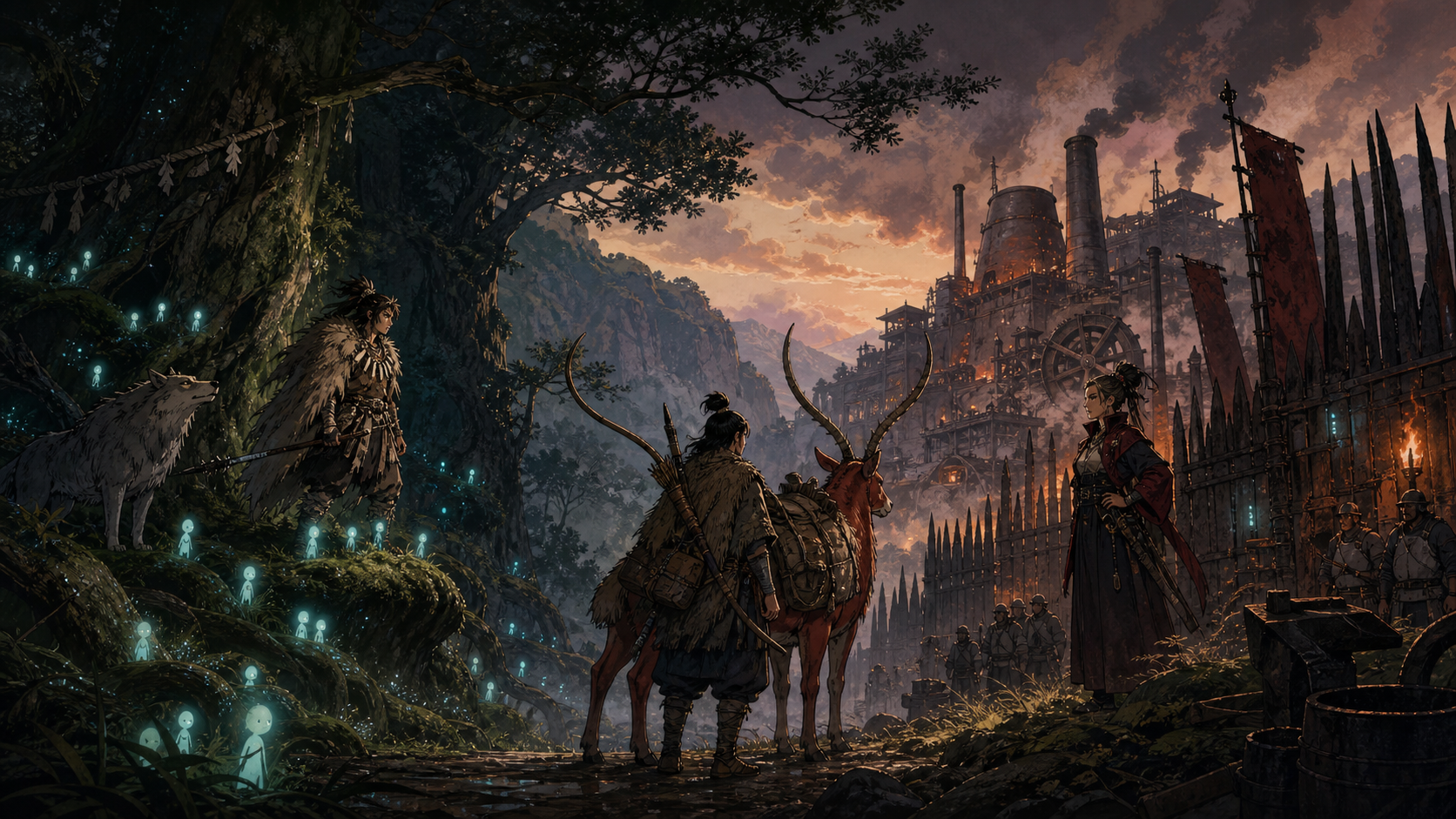
Princess Mononoke
Bottom line. Princess Mononoke refuses the comforting environmental story where nature is innocent, industry is evil, and one pure hero teaches everybody to live in harmony. Hayao Miyazaki gives the forest beauty, terror, appetite, memory, and a capacity for violence. He gives Iron Town guns, deforestation, ambition, refuge, paid labor, and a community built for people whom feudal society has discarded. Ashitaka does not discover a side without blood on its hands. He discovers a conflict where survival has been organized so badly that every group can explain why another group must disappear.
The movie’s famous instruction to “see with eyes unclouded by hate” is not a request for neutrality. Ashitaka never stands outside the conflict. A curse entered his body when he killed Nago to protect his village, and every choice changes who may live. Seeing clearly means refusing the lie that hatred makes consequences simple. Lady Eboshi can liberate women and lepers while destroying a forest. San can defend her home while treating every human life as contamination. Moro can love her daughter and prepare for revenge. The film asks viewers to judge actions without flattening people into moral labels.
That argument feels more adult than a story where compromise arrives because everyone calms down. Iron Town and the forest need material changes. Workers need safety, food, medicine, dignity, and a future that does not depend on clearing every tree. Animals and gods need territory, water, migration routes, and protection from extraction. A better ending cannot be a motivational speech about balance. A credible peace requires different technology, limits on expansion, political protection for vulnerable workers, and grief for losses that cannot be reversed.
The curse makes hatred physical without making hatred mystical.
Nago enters the film as a mass of black tendrils moving with pain and fury. Ashitaka sees a monster before learning that a boar god lived beneath the corruption. The iron ball lodged inside Nago connects supernatural rage to a material weapon. The curse is not random evil from another realm. Violence, injury, fear, and humiliation created conditions where a wounded being could no longer separate survival from revenge.
Ashitaka’s infected arm gives him terrifying strength. Arrows remove limbs, a sword cuts with impossible force, and anger makes the curse spread. Power does not reward righteousness. The same strength that protects travelers also tempts him to resolve conflict through domination. He must manage his body while moving through a political world that keeps offering reasons for rage. The curse therefore works as trauma, weapon, illness, and social inheritance at once.
The Emishi elders send Ashitaka west because his presence threatens the village, but exile also gives him a task. He must learn what caused Nago’s hatred. That duty prevents personal survival from becoming the only goal. Healing requires understanding a chain of harm that began beyond his home. The journey resembles a public investigation more than a chosen-one quest. Ashitaka carries evidence in his body.
Iron Town is exploitation and refuge in the same walls.
Lady Eboshi organizes iron production through environmental destruction and unusually broad social inclusion. She buys contracts held over women from brothels, pays them for skilled labor, arms them, and gives them authority inside the settlement. She houses people with leprosy, supports their treatment, and values their engineering knowledge. Those choices are not public relations gestures. Iron Town offers real dignity to people other communities treated as disposable.
The same economy depends on cutting the forest, mining the mountain, and killing animals who resist. Liberation for one group is financed through conquest of another community’s home. The contradiction makes Eboshi more dangerous and more believable than a greedy villain. She can point to every person who survives because Iron Town exists. The forest can point to every poisoned body, felled tree, and displaced god created by the same project.
Eboshi’s guns change the political balance. Firearms allow workers who lack samurai training to defend themselves against warriors, animals, and rival lords. Technology redistributes force downward inside human society while increasing human power over the forest. The movie refuses the claim that innovation is automatically liberating or corrupting. A gun can help a former sex worker repel a samurai and help hunters decapitate a god.
Iron Town’s women complicate any fantasy that returning to an older social order would create justice. The forest may survive if the settlement vanishes, but many workers would return to poverty, sexual exploitation, disease, or feudal control. Environmental politics becomes dishonest when conservation treats vulnerable people as excess population. Miyazaki forces the audience to imagine a future where workers remain free and the forest remains alive.
San is not nature in human form.
San was born human and raised by Moro after her parents abandoned her. She identifies with wolves because family, language, loyalty, and shared danger formed her life. Calling San a symbol of nature can erase the personal history underneath her rage. She does not protect the forest because humans possess an abstract duty to ecology. She protects her home, siblings, mother, gods, and the only community that refused to discard her.
Her hatred of humans is understandable and incomplete. San knows Iron Town through gunfire, logging, and Eboshi’s attacks. She does not begin with access to the women, lepers, or political pressures inside the walls. Ashitaka asks her to see people she has classified as one enemy. He also asks Iron Town to see San as a person rather than a beast. Recognition becomes a political act because dehumanization has made killing easier for both sides.
San never ends the film by returning to human society. She tells Ashitaka that she loves him but cannot forgive humans. The choice protects her from a familiar ending where romance absorbs a difficult woman into the hero’s community. Love creates a relationship across difference without erasing allegiance. Their future will require travel, negotiation, disappointment, and boundaries rather than one shared home.
Ashitaka’s restraint is active work.
Ashitaka is often described as calm, which can make him sound passive. His restraint requires constant decisions under physical and political pressure. He stops San and Eboshi from killing each other, carries San through a hostile settlement, rescues workers during attacks, confronts Jigo, and returns the Forest Spirit’s head. He does not avoid force. He tries to use force without allowing rage to choose the objective.
His position as an outsider gives him mobility and creates a limit. Ashitaka can see multiple communities because none fully owns him after exile. That distance helps him translate, but outsiders can mistake broad vision for authority. He cannot simply announce the correct settlement. The people who mine iron, defend the forest, and survive the samurai will live with consequences after he leaves a scene.
The best version of Ashitaka’s role is facilitator rather than savior. He carries information across boundaries, interrupts irreversible violence, and helps people experience one another outside propaganda. His relationship with Yakul reinforces that ethic. The red elk is partner, transportation, witness, and vulnerable life. Ashitaka’s care for Yakul makes interdependence ordinary before the film discusses any philosophy.
Moro and Okkoto show two responses to extinction.
Moro understands that the forest gods are weakening. She retains judgment, humor, and strategic patience even while planning to kill Eboshi. Her anger has a target, but her love for San prevents revenge from becoming her only identity. Moro recognizes Ashitaka’s courage without accepting his optimism. She knows that coexistence can become another word humans use while taking more land.
Okkoto arrives with pride, troops, and faith that courage can reverse decline. The boars march toward guns because retreat feels like surrendering their identity. Jigo’s hunters exploit that pride, disguise themselves, and turn the battlefield into a trap. Okkoto’s tragedy comes from bravery disconnected from accurate information. Leadership becomes dangerous when symbolic resistance matters more than the survival of followers.
His corruption mirrors Nago’s opening transformation, but viewers now understand the process from inside the forest. Injury, fear, betrayal, and desperate certainty create a demon. Hatred is not a species trait. Humans and gods can enter the same spiral when loss destroys every path except revenge.
The Forest Spirit is life and death without moral customer service.
The Forest Spirit heals Ashitaka’s gunshot wound and leaves the curse. That decision immediately breaks the expectation that a god will reward a worthy hero with complete restoration. The spirit governs life and death on a scale that does not match individual desire. Plants grow beneath each step and wither after contact. Creation and ending occupy the same movement.
The night form expands into the sky while the daytime form walks with an almost fragile body. Scale changes how viewers read power. A small face can decide whether a life continues. A vast body can move with silence. The design resists the Western fantasy that divinity must look morally reassuring. The spirit’s calm does not mean human safety.
When Eboshi removes the head, black life-seeking matter floods the landscape. The catastrophe resembles the curse on a regional scale. A body violated by organized extraction turns suffering outward. Jigo thinks a container and an imperial promise can convert sacred life into property. The failed capture exposes the absurdity of treating ecological systems as objects that remain passive after removal.
Five scenes carry the movie’s full argument.
Nago attacks the village. The opening gives no time for a neutral seminar. Ashitaka must protect people before he understands the attacker. Necessary violence still carries consequences because killing Nago transfers the curse. The scene establishes the moral grammar: urgent defense can be justified without becoming clean.
Ashitaka enters Iron Town. Workers celebrate Eboshi, women joke with confidence, lepers build weapons, and the settlement feels alive. Viewers who arrived ready to hate industry must face people whose safety depends on production. The scene widens the conflict without hiding smoke, labor, or resource hunger.
San attacks Eboshi. Their fight has personal intensity and political weight. Each woman believes the other threatens a community she protects. Ashitaka interrupts both through cursed force, then carries San past residents who have reasons to fear her. The sequence refuses a victory because victory would mean one community losing its defender.
Okkoto follows the disguised hunters. The boar god mistakes human deception for fallen warriors returning from death. Grief changes perception. San tries to protect him while the trap closes. The scene shows how people facing extinction can become vulnerable to stories that confirm hope or rage.
The head is returned. Ashitaka and San do not defeat the Forest Spirit or command forgiveness. They return what humans stole and accept exposure to overwhelming force. Repair begins with restitution, not a speech. Morning arrives after destruction, and new growth appears without restoring the old forest exactly.
The ending offers reconstruction, not balance.
Iron Town is destroyed, Eboshi survives, and the forest changes. She promises to build a better town. That line matters because the previous town already did good work for marginalized people. “Better” cannot mean abandoning workers or rebuilding the same extraction system with kinder language. A credible new settlement would limit mining, change weapon use, protect shared land, and negotiate with surviving forest communities.
San remains in the forest while Ashitaka chooses Iron Town. Their separation rejects the fantasy that one marriage can solve structural conflict. They plan to visit. The relationship becomes a bridge rather than an annexation. Neither person must surrender community to prove love.
The curse disappears, but Ashitaka keeps a mark. Healing removes active destruction without erasing history. The scar prevents restoration from becoming denial. His body records what hatred did and what repair could not reverse.
Fresh plants appear, and a kodama survives. The image offers hope without promising that the old gods will return. Ecological recovery can produce a living future that differs from the lost world. Grief and rebuilding occupy the same landscape.
Environmentalism becomes credible when labor stays visible.
The movie understands that people rarely destroy environments because they wake up hating trees. Iron Town needs fuel, ore, food, defense, trade, and political independence. Those needs become organized through an economy that treats expansion as survival. Telling workers to love nature cannot replace a plan for wages, medicine, housing, and security.
The forest also cannot survive through moral symbolism alone. Territory must remain connected, hunting must have limits, water must remain clean, and industrial power must face enforceable boundaries. Gods provide spectacular resistance, but institutions determine whether pressure returns after one battle. The film ends before showing governance, leaving readers and viewers to imagine the work.
A believable peace would create shared councils with Iron Town workers, Emishi knowledge holders, nearby communities, and representatives committed to forest protection. Mining zones would require limits and restoration. Gun production would answer to collective rules rather than one leader. Former brothel workers and people with leprosy would keep property, income, medical care, and political voice. Conservation would stop treating their freedom as negotiable.
Such reforms sound modern because the conflict remains modern. Communities still face false choices between jobs and clean water, housing and habitat, national development and Indigenous land. Princess Mononoke does not supply a policy manual. The movie does something equally valuable: the story makes every easy answer reveal who becomes disposable.
The animation makes consequence impossible to ignore.
Violence has weight because bodies react. Arrows remove heads and arms, bullets tear flesh, animals collapse, and Ashitaka’s curse moves under skin. Miyazaki does not use gore to declare adulthood. Physical consequence prevents heroic action from becoming a clean game. A beautiful frame can still contain irreversible damage.
The forest’s design avoids one green texture. Ancient trees, wet ground, quiet pools, distant light, insects, roots, fog, and small spirits create different layers of life. Iron Town receives equal attention through bellows, rooftops, wooden walls, crowded rooms, ironworks, meals, and shared labor. Detailed environments support the moral argument because neither side looks like an empty backdrop.
Movement gives each creature a political identity. Wolves run with coordinated speed, boars advance with mass, kodama tremble and turn, apes watch from damaged territory, and the Forest Spirit shifts between delicate steps and cosmic scale. Human technology also moves according to labor. Guns require crews, loading, aiming, transport, and repair. Power always has a body.
The historical setting refuses a clean national origin story.
The movie draws from Japan’s Muromachi period without pretending to provide a documentary reconstruction. Miyazaki uses historical distance to question which people become visible in official stories. Samurai power exists, but noble warriors do not control the moral center. Iron workers, women sold into brothels, people with leprosy, hunters, displaced communities, and nonhuman beings shape the conflict. The famous version of history built around elite men becomes one layer rather than the entire world.
Ashitaka’s Emishi identity matters within that choice. His community survives at the edge of a political order that has already pushed their people out of central power. Exile therefore removes him from a home that carries its own history of defeat and endurance. He reaches another frontier where Iron Town expands against older inhabitants. Ashitaka can recognize displacement because his life began inside its aftermath.
The film does not turn marginalized identity into automatic wisdom. Ashitaka can misjudge, San can hate beyond evidence, and Iron Town workers can celebrate destructive victories. Exclusion shapes knowledge without creating perfect people. That distinction protects the story from using oppressed groups as moral decoration.
Jigo connects local conflict to imperial desire. The emperor wants the Forest Spirit’s head because elite power imagines immortality as a resource that can be extracted from distant land. Officials do not bear the immediate risk. Hunters, workers, animals, and nearby settlements absorb the violence. The pattern resembles empires that treat frontier territories as warehouses for wealth while calling removal a national project.
Jigo is funny because extraction prefers a reasonable face.
Jigo eats with Ashitaka, shares information, complains, negotiates, and keeps moving. His humor makes him socially readable in a film full of gods and warriors. The same charm helps conceal the scale of his mission. He is not driven by personal hatred of the forest. He wants payment, status, and success within an imperial arrangement. Ordinary ambition makes him useful to extraordinary destruction.
His hunters wear skins from dead boars to manipulate Okkoto’s army. The tactic turns bodies into camouflage and grief into a weapon. Jigo understands that symbols can direct crowds faster than commands. He does not need the boars to believe his ideology. He needs them to misread the battlefield long enough to expose the Forest Spirit.
After the head is taken, Jigo still tries to preserve the container while black destruction swallows the landscape. The scene satirizes bureaucracy without becoming a joke. Orders and rewards remain psychologically real even when the world that produced them is collapsing. His commitment resembles institutions that protect an asset during a disaster caused by acquiring the asset.
A more believable political resolution would expose the emperor’s role instead of allowing responsibility to remain distant. Iron Town’s reconstruction could become vulnerable to another order from the capital. Ashitaka, Eboshi, and the workers would need alliances strong enough to resist renewed extraction. Peace with the forest cannot survive if outside power can purchase another expedition.
Women lead every major human and nonhuman faction.
Eboshi, San, Moro, Toki, and the women of Iron Town do not occupy one shared model of strength. Eboshi leads through organization, weapons, economic planning, and personal authority. San fights through speed, intimacy with terrain, and fierce loyalty. Moro combines physical power with strategic knowledge and maternal care. Toki leads workers through direct speech, humor, and practical courage when formal leadership leaves town.
The variety matters because “strong female character” often means one woman allowed to fight inside a world where men still define politics. Princess Mononoke builds communities whose survival depends on women making decisions. Their conflicts concern land, work, family, technology, revenge, and the future rather than competition for male approval.
Eboshi’s liberation project still deserves scrutiny. She holds concentrated power, organizes dangerous labor, and chooses expansion. The women admire her for reasons the movie earns, but loyalty does not make governance democratic. A better Iron Town would give workers formal control over production and defense instead of relying on one exceptional leader’s goodwill.
San’s freedom also carries cost. Her family loves her, yet her human body makes belonging vulnerable. Moro knows San may live beyond the wolves and refuses to force one identity. The ending protects San’s choice without pretending the forest offers easy security after the gods die. Autonomy means she chooses the uncertainty herself.
Joe Hisaishi scores grief without turning conflict into a sermon.
The music gives the landscape scale while preserving private emotion. Broad orchestral themes can make the forest feel ancient, but quieter passages return attention to Ashitaka’s loneliness, San’s guarded care, and communities working under threat. Hisaishi does not assign one simple sound to good nature and another to bad industry. Beauty crosses boundaries.
The main theme carries longing rather than victory. That emotional choice fits a story where no character can restore the world that existed before the iron ball entered Nago. Even successful action arrives with loss. Music gives viewers permission to mourn without telling them that mourning completes the repair.
Industrial rhythm appears through bellows, hammers, rifles, marching, and work songs as much as through the score. Iron Town has a soundscape built by coordinated labor. The forest has insects, water, wind, animal movement, and silence. When war intensifies, those environments collide. Sound makes ecological conflict audible before dialogue explains policy.
The movie’s innovation came from scale, labor, and moral complexity.
Princess Mononoke pushed Studio Ghibli toward a production scale that matched the story’s ambition. Large crowds, complex creatures, violent transformations, layered landscapes, and detailed machinery required enormous drawing labor. Digital tools supported selected effects and compositing, while hand-drawn performance remained central. The result does not treat technology as a replacement for artists. Different methods serve movement that would be difficult to achieve through one process alone.
The film also challenged assumptions about what a major animated release could contain. Severed limbs, disease, sex-work history, industrial politics, ecological collapse, and spiritual ambiguity appear inside a national blockbuster. Adult subject matter does not mean constant darkness. Kodama remain funny, workers tease one another, Jigo complains about food, and Yakul brings tenderness. Emotional range makes the violence more credible.
Moral complexity becomes an innovation of structure rather than a slogan. The screenplay repeatedly brings viewers into a community just after another scene made that community look like an enemy. Nago’s suffering introduces the forest’s case. Iron Town reveals the workers’ case. Moro and San reveal family inside resistance. Jigo reveals imperial manipulation. Each shift adds responsibility rather than erasing earlier harm.
The story never creates a hidden villain responsible for every conflict. The emperor’s demand and Jigo’s expedition escalate disaster, but Iron Town’s expansion existed before they arrived. Killing Jigo would not solve resource pressure. Removing Eboshi would not guarantee worker safety. Destroying the wolves would not create sustainable land. Systems continue beyond individuals.
Cultural impact changed the space available to anime.
The film became a major Japanese box-office event and helped demonstrate that animation could command national attention as cinema rather than niche merchandise or children’s programming. Later international success for Studio Ghibli did not begin from nothing. Princess Mononoke expanded the studio’s industrial position before Spirited Away reached an even wider audience.
International distribution introduced many viewers to a Miyazaki film far harsher than My Neighbor Totoro or Kiki’s Delivery Service. That range challenged the idea that a studio must own one tone. The same filmmakers could create childhood wonder, domestic grief, labor comedy, aerial adventure, and historical ecological war. Studio identity came from attention and craft rather than genre repetition.
The English-language release also became part of the history of anime localization. Translation had to preserve cultural specificity, political complexity, humor, and a large cast without turning dialogue into a lecture. Celebrity voices could attract attention while creating pressure to market the movie through recognizable names. The film’s survival across languages shows both the value and danger of localization. Access expands, while every adaptation can shift rhythm, meaning, and audience expectations.
Environmental discussions often use San, the Forest Spirit, or the kodama as icons. The images travel easily because design creates immediate recognition. The film’s argument travels less cleanly. A merchandise-friendly forest spirit can be separated from the workers, guns, imperial order, disease, and land conflict that give the symbol weight. Cultural impact includes inspiration and simplification.
Later fantasy films, games, and animation adopted versions of corrupted animals, ancient forest gods, morally complicated industrial settlements, and women who lead opposing political worlds. Influence does not require direct copying. Princess Mononoke helped make ecological conflict feel compatible with epic action and popular scale.
Symbolism works because physical causes remain visible.
The black tendrils represent hatred, but a bullet remains inside Nago. The movie never lets symbolism erase responsibility. Rage has emotional and spiritual dimensions, while mining, firearms, displacement, and injury provide material causes. That combination keeps the curse from becoming a vague lesson about negative feelings.
Ashitaka’s scar records consequence. San’s mask creates a frightening identity for human enemies while hiding the vulnerable face underneath. Eboshi’s rifle turns distance into power. The Forest Spirit’s head becomes a commodity because an emperor imagines life as transferable property. Each symbol also functions as an object within the plot.
Kodama show forest health through presence rather than exposition. Their bodies are small, strange, and numerous. Silence around them encourages attention instead of fear. When the forest dies, their disappearance makes ecological loss legible without a speech about biodiversity.
Iron Town’s walls protect workers and separate them from the land supporting production. Walls make social refuge possible while reinforcing the belief that danger exists outside human settlement. The ending’s destroyed walls create vulnerability and an opening for redesign. Reconstruction will reveal whether the community learned anything.
What ages well and what deserves harder criticism.
The refusal to divide the conflict into heroes and villains ages beautifully. Modern public debate often rewards instant classification, especially when a story involves environment, labor, gender, or colonial power. Miyazaki makes judgment slower without making judgment impossible. Viewers can condemn the attack on the Forest Spirit and respect Eboshi’s protection of vulnerable people.
The film’s treatment of people with leprosy is compassionate and historically striking, though they remain closely tied to Eboshi’s moral complexity and weapon production. Their individual desires receive less space than their collective gratitude. More personal voice would keep disability from functioning mainly as proof that Eboshi does good.
Ashitaka’s physical force sometimes solves immediate conflict too easily. Cursed strength lets him stop two leaders, escape a settlement, and survive conditions that would kill ordinary people. The power is dangerous, but the screenplay still benefits from a hero who can impose a pause. Real mediators rarely possess that advantage. Political change requires trust and institutions, not one extraordinary body standing between armies.
The apes receive less depth than wolves and boars. Their desperation to become human by eating humans expresses damaged adaptation, but the idea risks making them grotesque examples rather than a community with its own knowledge. More time with their response to habitat loss would widen the forest’s political range.
The ending grants Eboshi a reform-minded line without testing her. Her promise feels earned by catastrophe and incomplete by design. A follow-up scene showing workers debate reconstruction would strengthen the social argument. Better leadership should become shared governance instead of a wiser ruler.
Three quieter scenes explain the politics between battles.
Ashitaka eats rice with Jigo. The meal looks minor beside demon attacks, yet the conversation establishes how information moves through the region. Jigo recognizes the iron ball, knows rumors about the Forest Spirit, and offers enough truth to direct Ashitaka east. Hospitality and manipulation share the same fire. The scene warns viewers that useful information does not prove a source shares the listener’s goals.
The women work the bellows. Iron Town’s production floor turns economic structure into physical action. Heat, breath, rhythm, fatigue, joking, and group coordination reveal where Eboshi’s power comes from. The women are not passive beneficiaries waiting behind walls. Their labor creates weapons, income, and political independence. Any reading that calls the settlement evil while ignoring their work repeats the contempt they escaped.
Ashitaka feeds San. After carrying her from Iron Town, he cannot persuade her through argument. His injury makes speech difficult, and San initially responds with anger. Food becomes communication when ideology has reached a dead end. The moment does not erase their loyalties. Care simply creates enough trust for both people to keep listening.
These scenes keep the movie from becoming a chain of declarations between battles. Politics appears through meals, shifts, wounds, jokes, and travel. Large systems become believable because ordinary routines support them. The film knows that communities are rarely held together by speeches alone.
The English release reveals both the value and risk of localization.
International audiences needed a version that could carry names, historical distance, humor, and political conflict without flattening every idea into familiar Western fantasy. Neil Gaiman’s English script helped make the dense story legible while retaining much of its strangeness. The adaptation remains a translation, which means word choice can change emphasis even when plot remains stable.
Celebrity casting gave the American release visibility. Recognizable performers could persuade theaters and audiences to treat a subtitled or dubbed Japanese animated epic as a major film. The same marketing method risked making actors more prominent than the animators, director, composer, and production culture that created the work. Access and distortion arrived together.
Disney and Miramax’s involvement sits inside a broader history of American distributors recutting or rewriting imported animation. Princess Mononoke reached U.S. screens without the kind of structural mutilation earlier anime sometimes suffered. That outcome mattered. Respectful distribution does not require pretending cultural translation is neutral. Viewers benefit from knowing which version they watched and seeking the Japanese performance when possible.
The film also challenged the sales category assigned to animation. Graphic violence made a children’s campaign impossible, while spiritual imagery and historical politics resisted a simple action label. The marketing difficulty exposed a Western industry problem rather than a flaw in the movie. Animation describes a method, not an age group or genre.
Current U.S. viewing requires checking the date, not trusting an old guide.
Streaming rights move between services, and search snippets often preserve expired listings. As checked on August 14, 2026, JustWatch listed digital rental or purchase through Amazon Video, Apple TV Store, and Fandango at Home. The service also listed theatrical ticket availability connected to the current Studio Ghibli event cycle. Availability can change by region and month, so readers should confirm the listing before paying.
Physical editions remain useful for viewers who want stable access, language options, and supplements without depending on a rotating subscription catalog. Buyers should verify region compatibility and included audio or subtitle tracks. A legal copy protects image quality and supports the people and companies responsible for distribution, even though compensation systems across film production remain imperfect.
No review should present piracy as the normal answer to fragmented licensing. The better criticism targets rights management that makes culturally important films difficult to find. Distributors can improve access through clear catalog pages, consistent subtitle information, accessible captions, and fewer unexplained removals.
The details reward attention without becoming trivia bait.
Ashitaka’s people cut their hair during exile, giving his departure a visible finality before the plot reaches the west. Yakul’s loyalty then carries the emotional continuity of home. Clothing, tools, and settlement design distinguish communities without requiring characters to announce every difference. Production design performs historical and political work in the background.
The iron ball recovered from Nago creates a literal chain of evidence. Ashitaka does not begin with a prophecy naming a villain. He follows an object produced by human industry. The investigation moves from wound to weapon to settlement, allowing the moral question to grow from material facts.
Moro’s missing immortality matters. The wolves are gods, but rifles can wound them and time can reduce their power. Divinity does not guarantee safety from organized technology. The boars’ declining size and intelligence make ecological loss generational rather than instantaneous. A damaged world changes what future beings can become.
The surviving kodama near the end does not prove the old forest returned. One small life signals capacity for recovery. The distinction prevents hope from canceling extinction. Viewers who treat the final greenery as a full reset miss the scar on Ashitaka and the absence of the old gods.
Eboshi’s lost arm gives her a bodily record comparable to Ashitaka’s scar. Moro takes the arm after Eboshi takes the Forest Spirit’s head. The exchange is not cosmic bookkeeping, but consequence reaches the leader who ordered the attack. Her survival leaves reform possible while preventing a painless return to authority.
The final judgment is admiration with conditions.
Princess Mononoke remains one of animation’s strongest political fantasies because the movie never asks viewers to choose between caring about workers and caring about the forest. The hard question concerns how both can survive when an economy rewards expansion, an emperor funds extraction, and wounded communities turn fear into war. No single villain can absorb that responsibility.
The film earns praise for visual scale, character design, sound, moral structure, and an ending that chooses repair over conquest. San, Eboshi, Ashitaka, Moro, and Jigo represent different relationships to land and power without becoming cardboard positions in a debate. Iron Town feels worth saving, and the forest feels impossible to replace. Holding both truths gives every battle weight.
The weaknesses come from compression around the margins. The lepers, apes, and ordinary workers deserve more individual political voice. Ashitaka’s extraordinary strength creates pauses that real communities would need institutions to achieve. Eboshi’s promise of a better town closes an emotional arc before viewers see whether power becomes accountable.
Those limits do not weaken the central achievement. The story makes coexistence expensive, specific, and unfinished. San does not move into town. Ashitaka does not become ruler of the forest. Eboshi does not receive absolution. Morning arrives over survivors who must build a different economy on damaged land.
That ending explains why the movie still matters. Environmental fantasy often asks audiences to admire a pure landscape or defeat a greedy machine. Princess Mononoke asks who works, who eats, who owns weapons, who controls land, who receives protection, and who pays when leaders call destruction necessary. The answers remain uncomfortable because the questions remain alive.
A better future depends on changing power, not changing slogans.
Eboshi’s promise to build a better town could become meaningful only if the survivors define better together. Replacing iron production with a new industry would solve little if one leader still controls land, weapons, wages, and diplomacy. The workers who defended the settlement understand its strengths and costs. Their knowledge should shape rebuilding before merchants, samurai, or imperial agents return with another demand.
The women already possess the coordination required for shared leadership. They run furnaces, defend walls, rescue neighbors, and maintain morale during crisis. The patients whom Eboshi shelters possess technical knowledge because they design firearms. A council built from those groups could distribute authority across production, defense, health, trade, and land use. Leadership would become a practice instead of a personality.
Forest protection would also need more than a promise to cut fewer trees. The surviving animals and people require corridors, clean water, hunting limits, and land that cannot be sold by distant officials. San could serve as a negotiator only if Iron Town recognizes her community as a political party rather than a collection of obstacles. Ashitaka could help translate, but his friendship with both sides should never allow him to speak over either.
Economic survival creates the hardest problem. Mining funded the settlement and helped former brothel workers escape exploitation. Sudden closure could push the same people back toward poverty or dependence on violent landlords. A credible transition would reduce extraction while expanding farming, repair work, controlled trade, forestry, and skilled manufacturing. Environmental limits work best when workers receive security during the change.
The emperor’s reach remains a threat after the final scene. Jigo can report failure, but another agent may arrive with soldiers or money. Iron Town needs alliances with neighboring villages and displaced groups strong enough to resist outside seizure. Regional cooperation would turn the settlement from an isolated fortress into one member of a larger political network.
None of those reforms guarantee harmony. Wolves may reject negotiation after generations of loss. Workers may fear limits that reduce income. Survivors may blame San or Eboshi for dead relatives. The story’s moral force comes from allowing those conflicts to remain real. Peace means creating ways to handle disagreement before another leader reaches for a rifle or a god becomes a demon.
The film stops before this work because reconstruction lacks the visual shock of a headless god crossing the night. The missing process is still the real conclusion. Catastrophe can force enemies to pause, but only institutions, relationships, and repeated limits can keep the next catastrophe from becoming policy.
That political reading does not drain the wonder from the movie. Wonder becomes more powerful when beauty has conditions for survival. A kodama needs an intact forest, workers need material security, and peace needs limits that powerful people cannot ignore. The fantasy gives those dependencies faces and bodies. Viewers leave remembering wolves, rifles, trees, scars, and furnaces because the argument lives inside concrete things rather than floating above the story as a lesson.
Sources and further reading.
Production and film information were checked against Studio Ghibli’s official Princess Mononoke work page and the British Film Institute’s film record and writing on anime history. Historical and thematic context was cross-checked with academic work from Bloomsbury, Cambridge Core, the Journal of Religion & Film, and Springer. Current U.S. viewing information was checked through JustWatch on August 14, 2026.