
Erza Scarlet
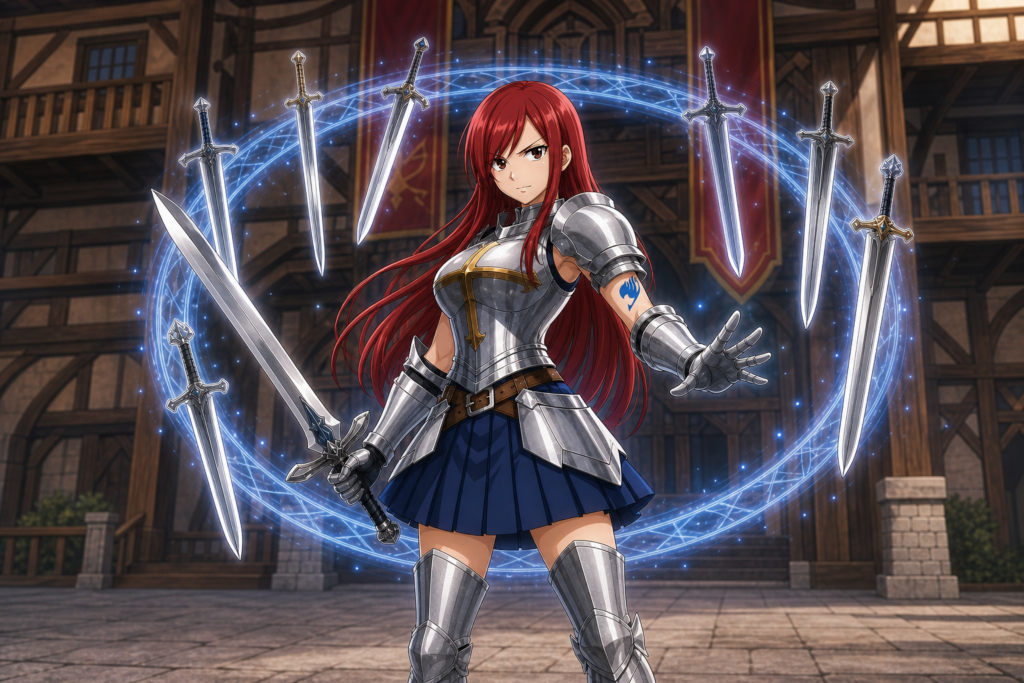
CVM Sekai character profile
Bottom line
Erza Scarlet is not strong because armor makes her untouchable. She is strong because a childhood built around captivity, torture and stolen choices did not stop her from choosing people again.
That difference matters.
Fairy Tail loves to introduce Erza as the woman Natsu and Gray fear more than common sense. She walks into the guild, grown men sit up straight, property damage suddenly develops consequences, and everybody remembers they were raised somewhere.
The joke works because Erza can back it up. She is an S-Class mage, Titania, and one of the guild’s best field leaders. Her magic, The Knight, lets her Requip weapons and armor from a separate storage space almost instantly. She can change defense, speed, resistance and attack style while the other person is still congratulating themselves for understanding the first outfit.
But the armor is not the point.
The point is control.
Erza was enslaved as a child. Adults treated her body as labor. Torture took her right eye. Jellal went from the boy who helped her survive to the person who helped keep the Tower of Heaven running under manipulation and obsession. Erza escaped, reached Fairy Tail and built a life where she could decide what touched her, what protected her and what version of herself entered the room.
Requip turns that need into action. She does not wait for danger to decide the terms. She changes the terms.
Her hardest lessons begin whenever the correct armor cannot solve the problem.
Who Erza Scarlet is
Her name is Erza Scarlet, written エルザ・スカーレット in Japanese. Jellal gives her the surname Scarlet because of her red hair during their Tower childhood. That memory carries tenderness and damage at the same time, which is pretty much the entire Jellal file.
The official Fairy Tail: 100 Years Quest character page calls her one of Fairy Tail’s few S-Class mages, identifies her as Titania and explains The Knight as a magic that stores armor and weapons in another space for instant Requip. Sayaka Ōhara is her Japanese performer across the television franchise and sequel.
Her licensed manga debut is Chapter 10, “The Armored Wizard,” as indexed by K MANGA. Television Tokyo’s official DVD archive places her anime introduction in Episode 5, also titled “The Armored Wizard.” Those are the formal debuts. A stray earlier image, recap or marketing appearance does not get promoted into a story entrance just to make a trivia box look busy.
The public official pages used for this draft do not provide a canonical age, birthday, height or weight, so those numbers are not here. This is a character profile, not a fan-wiki yard sale.
Erza’s core design is long scarlet hair, brown eyes, an athletic adult build and the familiar Heart Kreuz armor with its blue skirt silhouette. Her blue Fairy Tail guild mark sits on her left upper arm. Her right eye is artificial after the Tower injury.
That eye is part of the story, not a fun-fact sticker. It records what captivity did to her and later affects how certain eye-based magic works. Partial resistance is not universal immunity. Fairy Tail has enough dramatic loopholes without inventing new ones.
Design chronology: the silhouette stays while the choices change
Erza’s design needs a chronology because Requip makes change part of the character instead of a continuity mistake.
The Tower child has short, unprotected scarlet hair, plain captive clothing and the body of a laborer nobody expects to own herself. The injury to her right eye belongs to this period. Jellal’s gift of the surname Scarlet names the color adults will later recognize before they know the history attached to it.
Her Fairy Tail baseline is almost the opposite. Long scarlet hair, the Heart Kreuz breastplate, blue skirt, boots and the blue guild mark on her left upper arm give her a stable public silhouette. The armor says professional readiness. The guild mark says chosen affiliation. Neither one cancels the artificial eye or the child who needed it.
Mission clothing changes because function changes. Heaven’s Wheel surrounds her with organized blades. Flight Armor reduces bulk for speed. Elemental sets announce the resistance she selected for a specific opponent. Clear Heart Clothing removes most defensive protection so she can commit magical power and movement to sword offense. That last choice is not “the real Erza” emerging because less fabric equals more honesty. It is another tactical configuration with another cost.
The Grand Magic Games adds tournament presentation and public spectacle. Tartaros repeatedly damages, removes or makes armor irrelevant because curse, torture and sensory loss attack outside ordinary defense. Alvarez pushes her body past credible safety while keeping the artificial eye, guild mark and scarlet silhouette readable. The sequel refreshes clothing and equipment through a different manga and animation pipeline without turning every redesign into a new identity.
Ordinary clothes matter too. Erza likes dresses, costumes, theater, luggage and cake with a seriousness that can make the rest of the guild look undercommitted to life. Those scenes are not interruptions from Titania. They prove command, pleasure and ridiculousness can occupy one adult woman without asking which version is authentic.
The public official sources used here do not provide a canonical height, weight, birthday or fixed wardrobe inventory. The profile therefore records stable visual evidence and named story equipment instead of importing a fan-maintained measurement chart.
The Tower teaches her that bodies belong to power
Kodansha’s official Volume 10 description does not soften the premise: Erza was a slave at the Tower of Heaven, and her former companions later helped complete the same structure they were forced to build.
Children are made to turn their bodies into infrastructure for somebody else’s immortality project. That is the first authority system Erza knows.
She survives with Jellal, Simon, Shô, Wally, Millianna and Rob. They share hunger, fear, labor and the small private choices that keep a person from becoming only a number. Jellal gives her the surname Scarlet. Rob gives her another model of what a wizard and elder can be.
Then the Tower takes her eye.
Erza’s torture is not proof she was always superhuman. It is proof that a child was hurt and kept moving because the alternative was surrender to people who had already taken nearly everything.
Rob dies during the revolt. Erza’s magic erupts around abandoned weapons. That awakening is often treated like a power-up origin because battle series have trained us to see trauma and immediately ask what move it unlocked.
No. Sit down.
The magic matters, but the moral event is that children are fighting for ownership of their own lives.
Jellal becomes the fracture. Under Ultear’s manipulation and the Zeref obsession attached to it, he seizes control of the Tower and turns on the people who trusted him. The supernatural influence explains part of the mechanism. It does not erase what Erza, Simon, Shô, Wally and Millianna experience.
That distinction will matter every time the story asks for forgiveness.
Fairy Tail gives her authority without requiring captivity
Erza escapes and reaches Fairy Tail. She receives an artificial eye and a guild home. More important, she enters an institution where strength can create responsibility without legally owning her body.
Fairy Tail is not a perfect family. The guild destroys property like municipal budgets are a rumor. It also gives Erza peers, work, discipline, cake and the first place where people can be afraid of her without controlling her.
She rises to S-Class status. The official character copy verifies the rank. That matters because Erza is not only the group’s emotional center or emergency mother. She is a professional mage trusted with high-level work.
Her relationship with Makarov is part of that change. He is an authority figure who can correct her and depend on her without recreating the Tower’s ownership. That does not make every Fairy Tail leadership choice flawless. It gives her a different model to test.
Natsu and Gray become the loudest evidence of her social power. She can stop their fights with a look because they know what sits behind it: shared missions, earned trust and the certainty that she will stand in the same danger she orders them to face.
Authority without conduct is just volume. Erza has both.
Eisenwald shows what leadership looks like before the trauma reveal
Erza returns from a mission and pulls Natsu and Gray into a team response against Eisenwald and Lullaby. Lucy and Happy are drawn into a group whose members already have years of habits and grudges.
The arc introduces Erza as command presence. She organizes movement, pushes the boys past useless rivalry and treats the threat as work. Her leadership is not gentle, but it is legible. People know the objective, the danger and who is taking responsibility.
That is important before Tower of Heaven explains why control matters to her. The story lets us meet the functional adult before showing the child who built her.
Galuna Island then complicates the rulebook. Natsu, Lucy, Gray and Happy take an unauthorized S-Class job. Erza arrives to retrieve and punish them, only to find an active crisis involving Deliora, Lyon and Ur’s sacrifice.
She has to decide whether institutional discipline means dragging everyone home while people are in danger. Erza helps resolve the emergency, then keeps the misconduct visible. That is leadership with context. Rules are not useful if obeying them means abandoning the reason the rules exist.
Phantom Lord puts a bill on protection
Phantom Lord attacks Fairy Tail and targets Lucy.
Erza uses Adamantine Armor to absorb Jupiter’s blast. The image is easy to turn into another Titania poster: Erza stands in front, massive defense, everybody survives.
The cost matters more.
The armor does not make her invulnerable. The blast injures and drains her. Protection works because Erza accepts a physical bill the equipment cannot erase.
That does not mean sacrifice is automatically noble. It means this specific intervention protects people from an immediate attack. Later, Erza’s habit of making her body the final resource becomes a problem. Fairy Tail is at its best when it can tell the difference.
Lucy matters here as a teammate and target with agency. Erza does not rescue a decorative girl. She helps defend a guild member whose family history and choices drive the invasion. Their friendship grows through work, not through a generic “strong women support women” caption slapped over the evidence.
Tower of Heaven brings every unfinished consequence home
The return to the Tower strips Erza’s public identity down to the child who escaped.
Her old companions abduct her from the resort. Their anger is not irrational just because the audience knows more. They remained under Jellal’s rule. They carry a history in which Erza left and Jellal explained the leaving.
Survivors do not receive identical information or identical recovery schedules.
Shô, Wally and Millianna have their own responses. Simon knows more and still carries his own love, fear and loyalty. Erza cannot settle everybody’s past by declaring what really happened once.
Jellal’s role must stay equally precise. He was a child protector. He was manipulated. He also became the adult center of a system that coerced and deceived other survivors. Future remorse matters because conduct can matter. It does not travel backward and make harm unhappen.
Simon dies protecting Erza and Natsu. His death cannot become a coupon for the Erza/Jellal ship.
Kagura loses a brother. Millianna loses a friend and another part of the Tower family. Erza loses the person who understood more than he said. Jellal carries responsibility. All of those timelines remain real.
Then Erza offers herself to the collapsing Tower.
The funeral vision exposes the flaw underneath her heroism. She imagines people gathered after her death, but the scene is emotionally wrong because Erza is trying to manage grief from inside a sacrifice fantasy. If she disappears usefully enough, maybe everybody else can receive a clean ending.
Natsu refuses the script and pulls her back.
That is not a man saving a strong woman from weakness. It is a teammate denying her the right to decide alone that everybody would be better served by her death.
Armor is emotional language, not a fashion catalog
The Knight lets Erza store weapons and armor in a separate space and Requip them rapidly.
That means every battle can become a decision tree. Does she need defense, speed, elemental resistance, weapon volume or raw attack? Which protection is worth losing? Which set can the opponent bypass?
Heart Kreuz gives the baseline. Heaven’s Wheel creates an organized field of swords. Adamantine prioritizes defense. Flame Empress answers fire. Lightning Empress answers lightning. Giant Armor supports throwing power. Flight Armor trades protection for speed. Nakagami Armor reaches for enormous cutting power at enormous magical cost.
These names are a controlled functional shelf, not a claim that every subtitle track uses identical English. Heart Kreuz is her baseline armor. Heaven’s Wheel emphasizes many-sword control. Adamantine is defensive. Flame Empress and Lightning Empress answer specific elements. Giant Armor supports throwing force. Flight Armor trades protection for speed. Nakagami Armor delivers exceptional cutting power at exceptional magical cost. The licensed release used for the final post controls spelling whenever translations differ.
Erza loses armor. Armor breaks. Opponents bypass it. Magic runs low. Poison, sensory deprivation, spatial distortion, enchantment and emotional crisis create problems steel cannot solve.
That is why the fights stay interesting when the writing behaves.
The Knight, weapons and limits: what the catalog actually proves
The Knight is a specialized form of Requip. Erza keeps weapons and armor in an extradimensional storage space, retrieves them rapidly and changes equipment during combat. The official character copy establishes that core. It does not establish an infinite closet, infinite magic or automatic mastery of anything with a sharp edge.
Heart Kreuz is the recognizable baseline rather than the answer to every fight. Heaven’s Wheel supports simultaneous weapon control and organized sword formations. Black Wing favors offensive mobility. Flame Empress and Lightning Empress are elemental responses, useful because a resistance choice can narrow damage without deleting it. Giant Armor increases throwing power. Adamantine is a defense-first set built to absorb force at enormous cost. Flight Armor exchanges protection for speed. Robe of Yūen supports flexibility and movement. Nakagami Armor produces exceptional cutting power while demanding exceptional magic.
Purgatory Armor, Morning Star Armor, Sea Empress Armor and later sequel equipment belong on the shelf only when the licensed manga or official adaptation identifies the form and its use. A game costume, card illustration or subtitle variant does not quietly become a new main-manga feat because the wiki list looked impressive.
Her weapons are equally situational. Erza can wield one sword, paired blades, spears and large throwing weapons, or control many swords through a Requip formation. Swordsmanship remains a trained physical skill. The magic supplies access and configuration; it does not swing the blade for her.
Clear Heart Clothing makes the tradeoff impossible to miss. Erza reduces armor protection and relies on direct sword offense. The move can look like a dramatic reveal, especially when animation and marketing know exactly which screenshots travel. Its actual function is risk. She is choosing mobility and attack while accepting greater bodily exposure.
The limits are not optional footnotes. Requip consumes magic. High-output armor can drain her severely. Armor can break. Elemental resistance can be incomplete. Space magic can alter position before defense matters. Curse power can attack outside ordinary magical expectations. Poison can compromise her before the sword fight begins. Sensory deprivation can remove the information tactical switching requires. Enchantment can rewrite the conditions around her. Catastrophic injury can leave will intact while the body still fails.
Erza also has a decision-making limit: she is too willing to make her body the last available resource. That flaw produces heroic saves and terrible judgment. A complete ability profile has to record both because the same endurance fandom praises is the endurance enemies, leaders and sometimes the story learn to exploit.
This is why destroyed armor matters. Failure tells us what a set cannot do. Outside help matters for the same reason. Wendy’s healing and enchantment, Natsu’s refusal of sacrifice, guild magic, terrain and team coordination are conditions of survival, not embarrassing annotations beside the feat.
The artificial eye turns injury into altered perception
Erza’s right artificial eye follows the Tower injury. During the Battle of Fairy Tail, Evergreen’s Stone Eyes petrifies her only partially because the magic does not affect the artificial eye the same way. Erza can then break the condition and act. That is a specific counter in a specific encounter, not universal immunity to eye magic, illusion or enchantment.
That counter is not a random immunity. A disability and medical intervention change how a magical condition reaches her.
The story occasionally gets careless around Erza’s endurance, but this mechanic is structurally sharp. The body harmed by coercion returns with a difference coercive vision cannot fully process.
Partial resistance still requires Erza to act. She defeats Evergreen and reenters the Battle of Fairy Tail, where Laxus and the Raijinshū, also localized as the Thunder God Tribe, have turned guild members and Magnolia residents into pieces inside an internal power struggle.
Fairy Tail’s chosen-family language does not excuse abuse from inside the family. Erza’s response matters because loyalty includes stopping your own people when they weaponize belonging.
Jellal cannot be reduced to romance or villainy
The Oración Seis arc brings Jellal back with damaged memory while Erza is dealing with poison and a coalition mission.
Her feelings do not arrive in a clean category. She remembers the boy, the captor, the Tower, Simon and the possibility that the person in front of her is not identical to the person who did the harm.
Wendy’s healing work matters. The allied guilds matter. Jellal’s choices around Nirvana matter. Erza’s willingness to see personhood does not mean she controls the legal or social consequence.
His arrest is essential.
The story does not let one emotional reunion erase public accountability. Later freedom, Crime Sorcière and atonement have to be built through action.
That is the only version of the relationship worth defending. Love without accountability would turn Erza’s compassion into another system demanding that the survivor carry everybody else’s comfort.
Edolas gives her an authority mirror
Erza Knightwalker is not secret psychology for Earth-land Erza. She is an alternate-world double shaped by a different state and magical order.
The contrast still matters.
Both women are disciplined, formidable and visually linked. Knightwalker’s authority serves a regime that extracts magic and pursues enemies of the crown. Earth-land Erza’s authority has been rebuilt inside a guild where people can disobey, argue and still belong.
The difference is not which Erza can swing harder. It is what institution gets to define duty.
Tenrou proves that even Titania fights inside a system
On Tenrou Island, Erza participates in the S-Class trial before Grimoire Heart turns promotion into survival.
Her fight with Azuma is tied to the Tenrou tree and the magic of the guild itself. When that collective support is stripped away, individual strength changes. When the connection returns, so does possibility.
That makes the battle a useful correction to lazy power scaling. Erza is extraordinary. She is also not a sealed unit operating outside relationships, terrain and magic systems.
Acnologia’s attack then removes the protected Tenrou group from the world’s timeline for seven years.
Kodansha Volume 31 confirms the consequence: Fairy Tail loses standing without its strongest members, and the returning group faces a guild that had to survive their absence.
Erza did not choose to leave. The members who remained still paid the cost.
The Grand Magic Games turn reputation into labor
Fairy Tail enters the Grand Magic Games to restore its name.
Erza’s Pandemonium feat, defeating all 100 monsters, is one of the cleanest spectacle victories in the series. It establishes stamina, confidence, weapon selection and the ability to turn a scoring system into a statement.
It also creates the fandom problem where one iconic win becomes a blank check for every later argument.
No.
Erza can be exceptional and still need help, lose armor, misread an opponent or reach a limit. The feat means what it means. It does not swallow the rest of the manga.
Kagura and Millianna bring Simon’s death back into the tournament. Kagura’s anger toward Jellal is not a misunderstanding Erza is entitled to correct. It is grief with a body attached.
Erza’s role is to tell the truth without demanding instant agreement. Respect grows because Kagura and Erza act through conflict, not because the story hands out forgiveness as a team-building prize.
Minerva then uses space, injury and humiliation as strategy. Kodansha Volume 38 describes Erza as wounded in that fight. That adjective matters. The victory does not occur in a vacuum where pain is decorative.
Sun Village proves expertise still has edges
Sun Village moves the guild from tournament repair into a mission where the problem does not respect familiar categories. Giants and the Eternal Flame are trapped under unnatural ice, while Doriate’s curse can force experienced mages back into child bodies.
Erza’s value is not that Titania walks in and solves every condition. She can lead, fight and protect people while the team still needs Gray’s ice knowledge, Natsu’s relationship to flame and other members’ specific counters. The mission works because expertise overlaps without becoming interchangeable.
That matters for a character fandom often treats as the emergency answer to everything. Erza is strongest when the story gives her a role inside a system. She reads danger, keeps people moving and takes responsibility. She is less interesting when “Because Erza” replaces the rules.
Sun Village also prepares the tonal ground for Tartaros. The guild has restored public standing, but the wider magical world is producing curses, demons and old forces that ordinary job-board logic cannot contain. Erza enters Tartaros as a proven leader. That does not make her prepared for captivity to return.
Tartaros tests whether endurance becomes exploitation
Tartaros captures Erza and Mirajane. Kyôka tortures Erza and later removes sensory access during their fight.
This is where “Erza is strong” can become a writing excuse.
If a character survives pain, stories sometimes decide they can pile on more pain without paying for it. The audience is expected to cheer endurance while the direction lingers on the body being hurt.
RaeRae is not giving torture a glamour pass.
Erza’s survival matters. So do injury, fear, help and the fact that sensory deprivation changes the fight’s conditions. Her ability to continue does not prove damage is fake.
Kodansha Volumes 44 and 47 place her in the escape, counterattack and control-room push while Face threatens magic across the continent. That is major work inside a collective operation. It is not a solo rescue of all magic by Titania branding.
The collective part has to stay visible. Mirajane is captured in the same operation and faces a different form of bodily threat. Wendy and Carla confront Face directly. Dragon Slayers, guild members, former enemies and Celestial Spirits carry other parts of the crisis. Erza reaching Kyôka and the control room matters because it helps the operation continue, not because everybody else’s work becomes background decoration.
The fight also shows the limit of armor as a storytelling shortcut. Kyôka attacks sensation, pain and bodily access. Requipping steel cannot restore information Erza cannot receive. Her continuation depends on skill, instinct, endurance and the larger battle around her. Calling that “invincible” misses both the achievement and the horror.
Brief guild mastery reveals the difference between title and leadership
After Fairy Tail disbands and reforms, Erza briefly becomes the Seventh Guild Master during the Alvarez crisis. Television Tokyo’s official Episode 285 is titled “The Seventh Guild Master” and frames the choice as the requirement for restoring Fairy Tail as a formally recognized guild while Makarov is absent. The same official sequence then has Erza lead a small team west to recover Sixth Master Makarov. That is the succession context, not a long administrative reign.
The title makes sense. She has rank, field authority and institutional trust.
It also does not magically make administration her destiny. Fairy Tail’s succession history is messy because lived leadership and formal office do not always match. Erza’s brief tenure belongs in the biography without being inflated into a long governing era.
Her most important leadership act in Alvarez may not involve the title at all.
When Natsu and Gray turn grief and E.N.D. information into a lethal fight, Erza catches their attacks with her hands and cries.
Power-scalers see fire plus ice plus bare hands and start doing algebra. The scene is not algebra.
Erza stops them because the relationship reaches them where force has failed. She makes two men who have reduced each other to targets remember that they are family and that their pain is hurting somebody standing between them.
Emotional power is not fake power. It is also not a measurement unit.
Alvarez makes leadership collective or makes it useless
The Alvarez war is larger than Erza’s master title and larger than her battle with Irene. Fairy Tail faces an imperial force whose fighters bring enchantment, space control, mass armies, time pressure and personal histories into the same invasion.
Erza’s work is coordination under collapse. She participates in the guild’s restoration, helps pursue Makarov, returns to a battlefield where formal leadership changes hands again and keeps operating as fronts separate and reconnect. The exact succession matters: being named Seventh Master is a formal emergency office, not proof she administratively runs every later decision.
Her intervention between Natsu and Gray is one war consequence. The Irene battle is another. Neither erases what Lucy, Wendy, Juvia, Makarov, the Dragon Slayers, allied guilds and former enemies do elsewhere. Alvarez repeatedly asks whether Fairy Tail’s family language can become organized responsibility instead of a reason one famous member carries every emergency.
The answer is uneven because the story loves impossible endurance. Erza’s body is severely damaged before the meteor. Wendy’s presence, enchantment work and the larger battle conditions remain part of what follows. Irene’s final choices remain her own. Erza’s strike is extraordinary without becoming a solo authorship claim over the entire outcome.
That distinction is the standard for the war record: name what Erza does, name the condition she does it under and leave other people’s labor attached.
Irene is motherhood without a tidy reconciliation
Kodansha Volume 60 identifies Irene’s ancestry as the revelation at the center of their battle, and Volume 61 describes its emotional conclusion.
Irene is Erza’s biological mother. Her history involves war, Dragon Slayer enchantment, dragonization, pregnancy, bodily crisis and abandonment.
That history explains.
It does not erase.
Erza grows up without her. Irene later confronts her as an enemy while carrying a story in which Erza’s body is tied to survival, loss and resentment.
The relationship is too large for either “evil mother” or “she loved her all along.” Irene can be harmed, harmful, brilliant, monstrous, maternal and unable to complete the violence she begins.
Erza can feel compassion without pretending she received a childhood.
That is not reconciliation. It is recognition with damage still present.
The meteor feat belongs here too. Erza acts while catastrophically injured, with Wendy’s support part of the battle’s condition. It is a remarkable physical achievement. It does not mean bones, help and narrative circumstance stopped existing because Titania looked cool.
The relationship atlas is a survivor map
Jellal is childhood care, manipulated abuse, adult responsibility, love and atonement. Removing any one part makes the relationship easier and less honest. Erza can recognize the boy who named her, the adult who harmed the Tower survivors and the person trying to repair damage without pretending those are three unrelated men. Her forgiveness is a choice about her future. It is not legal authority over Simon, Kagura, Millianna, Shô or anybody else who carries the consequence.
Simon is Tower family, unspoken love and a death that other people keep living with. He understands more of Jellal’s control than several companions do and acts to protect Erza and Natsu. His death changes Erza, but it does not belong to her alone. Kagura’s grief and Millianna’s anger are not side quests attached to Erza’s romance.
Shô, Wally and Millianna prove that shared captivity does not create identical memory. Erza does not get to be the sole narrator of their recovery.
Natsu is the younger guild brother who breaks her sacrificial scripts. He does not make her softer. He makes disappearing harder. At the Tower, he refuses the death Erza has already staged in her mind. During Alvarez, her intervention returns the favor by stopping him from reducing Gray to E.N.D. and himself to a weapon. Their relationship is not obedience. It is repeated interruption when one of them confuses pain with destiny.
Gray is another guild sibling whose self-control can collapse under grief. Erza stopping him and Natsu works because years of brawls, missions and trust sit inside her hands. She has watched Gray use discipline as armor and sacrifice as an escape route. Her tears in Alvarez are not a sentimental upgrade to physical strength. They are evidence that his choice is injuring someone he trusts before either attack lands.
Lucy brings observation, language and emotional intelligence into the team. She participates in strategy and makes choices Erza respects. Phantom Lord makes Lucy the target of institutional and family power, yet Lucy still chooses the guild. Erza helps defend that choice instead of replacing it. Later missions work because Lucy can interpret people, contracts and magical rules while Erza organizes action. Their friendship does not need shopping and compliments pasted over it to count.
Wendy grows from protected junior to active battlefield partner. Healing, enchantment and the Irene conflict give her agency inside Erza’s story rather than reducing her to support equipment. Wendy heals, counters enchantment and makes decisions that change what Erza can survive. Calling that “support” as if it means lesser work is how battle fandom loses the plot while counting explosions.
Happy is not only transportation parked beside Team Natsu. His flight, reconnaissance and timing repeatedly change what the team can reach or escape. Erza treats him as a guild member inside the operation, even when his commentary is the only thing keeping the room from taking Titania’s seriousness at face value.
Kagura is Simon’s sister before she is Erza’s respected opponent. That order matters. The Grand Magic Games gives them combat and truth, but Erza cannot demand that Kagura process Jellal on Erza’s schedule. Respect becomes possible because Kagura remains a person with her own claim on the past.
Makarov gives Erza an authority model she can inherit without copying perfectly. He recognizes her as an S-Class mage and later leaves a guild capable of naming her master during crisis. His care does not make Fairy Tail institutionally perfect. It gives Erza proof that authority can be earned through protection, correction and trust instead of ownership.
Mirajane is a fellow S-Class mage, old peer and person who shares some of the guild’s burden of being treated like a dependable weapon. Their younger rivalry, different public temperaments and shared S-Class standing prevent the guild’s women from collapsing into one approved model of strength. Tartaros captures both, but their bodies, magic and consequences remain distinct.
Minerva begins as an opponent who uses injury, humiliation and spatial control to dominate the tournament. Later alignment cannot erase that conduct. Erza’s willingness to fight beside a changed former enemy is evidence about present behavior, not a receipt declaring the past harmless.
Irene is biological origin without lived motherhood. She explains Erza’s birth, dragon-related bodily history and abandonment while arriving as an enemy in Alvarez. Erza’s compassion preserves her own humanity. It does not create the childhood Irene did not provide.
100 Years Quest keeps the limits visible
The official sequel identifies Erza as part of the team authorized for the legendary 100 Years Quest.
Episode 4 gives her an early loss of agency when Kiria forces submission and Diabolos takes her with Natsu and Wendy. That is important. The sequel does not begin by pretending S-Class status blocks coercion.
Official Episode 12 places Erza against Jellal during the White Mage’s controlled guild conflict. Again, relationship and magical control become the battlefield.
Episode 13 places Erza against Laxus, another Fairy Tail S-Class mage, while she uses a Dragon Slayer-attributed weapon and he answers with new technique. Episode 14 confirms the fight reaches a conclusion. The value is not deciding which fandom camp gets a permanent trophy. The value is showing two trusted powerhouses forced into conflict by a larger control system.
Episode 22 brings the team against Youko’s endless yokai summons. Episode 25 confirms Natsu, Lucy, Gray, Erza and Wendy combining their attack against Alta Face to keep Elentear from collapsing.
Those are concrete sequel contributions in the officially indexed television run. Later manga conflicts are not named here unless the final publication copy can tie each claim to a licensed volume. That boundary is cleaner than laundering a fan-maintained matchup list into a biography.
Erza remains important. She does not become the answer to every continent.
Manga, anime, OVAs, spinoffs, films and games need separate shelves
Hiro Mashima’s main manga controls the core biography. The 2009 television series, 2014 continuation and final season adapt that record across changing production conditions. Direction, character design, color, censorship and animation economy affect how armor changes read. A rapid transformation can communicate tactical intelligence or reduce Requip to a costume cut depending on what the sequence shows before and after the flash.
The anime also contains original and expanded material. Those scenes can reveal performance, comedy and production priorities. They do not become missing manga chapters because the cast performed them well.
Fairy Tail: 100 Years Quest is the official sequel manga built from Hiro Mashima’s storyboards and original concept with art by Atsuo Ueda. Its television adaptation has its own credited production pipeline. That separation matters when discussing Erza’s later design, movement or battle staging. “The anime” is not one studio room that remained frozen for fifteen years.
Official bonus-animation and OVA releases belong to adaptation continuity. This profile does not drop beach, school, comedy or crossover events into the main chronology without an official title, release and placement record. Fan service still needs a source label. A swimsuit is not a timeline.
The official spinoff Fairy Girls centers Lucy, Erza, Wendy and Juvia after the Grand Magic Games. It belongs on the franchise shelf as supplementary continuity, not as authority to rewrite Mashima’s main-manga ability limits or relationship milestones.
Erza appears with the core team in the animated films Phoenix Priestess and Dragon Cry. The official Dragon Cry cast page credits Sayaka Ōhara as Erza, while the film’s official introduction describes it as an original story built from a roughly 200-page storyboard by Hiro Mashima. That makes creator involvement worth noting. It does not make every film event interchangeable with the manga’s chapter chronology.
She is also playable in Koei Tecmo and Gust’s 2020 Fairy Tail game, whose official material says its story range runs from Tenrou Island through Tartaros and lists Erza among more than sixteen characters. Fairy Tail 2 again includes her among the controllable guild members and adds game-original post-battle material. Game systems, costumes and original scenes belong under adaptation, not inside the manga ability ledger.
The shelves can inform one another without becoming soup. Manga establishes the central life. Television supplies voice, timing, color and adaptation choices. OVAs and spinoffs show supplementary priorities. Films create contained original stories. Games turn abilities into systems built for play. Each is useful once it stops pretending to be every other thing.
Sayaka Ōhara gives command a human center
Ōhara’s casting is official across Television Tokyo’s main-series staff page, the 100 Years Quest character page and the Dragon Cry cast page. In Television Tokyo’s cast interview, Ōhara describes Erza as a respected cool beauty whose love of sweets, poor room-reading and odd pace make her charming. That is useful performer intent because it rejects the flat “stern warrior” reading.
Ōhara’s performance has to hold several Erzas in one voice: the commander, the terrible joke-teller, the frightened survivor, the tender friend and the exhausted fighter. The useful question is not whether she “sounds strong.” It is whether the adaptation lets those registers belong to one woman instead of flattening her into a stern-warrior setting.
The anime’s craft has another challenge: Requip can become a transformation shortcut or a tactical decision. Direction, compositing and sound determine whether the viewer understands why an armor appears or merely receives another costume.
That distinction remains the standard for any later episode-level performance analysis. Vague praise does not pass.
Final verdict
Erza Scarlet is not a woman who learns to take off the armor and become real.
The armor is real. The sword is real. The authority is real. So are the cake, theater, fear, grief, attraction, bad social timing and need for people who refuse to attend the funeral she keeps trying to organize for herself.
Her growth is not softness replacing strength.
It is choice replacing captivity.
Tower guards decide what her body is for. Jellal decides what story the other children receive. Enemies keep trying to decide what she can feel, see, wear, endure or sacrifice.
Erza keeps Requipping.
Not because the right armor will solve everything.
Because choosing what comes next is the life she fought to own.
Primary source shelf
The identity, magic and sequel participation claims use the official 100 Years Quest Erza profile, TV Tokyo’s official Fairy Tail character materials and the official television cast page. K MANGA’s licensed Chapter 10 record supplies the manga debut, while TV Tokyo’s DVD episode archive supplies the Episode 5 anime introduction.
The Seventh Guild Master succession uses TV Tokyo’s official final-series episode archive. Sayaka Ōhara’s stated view of Erza comes from TV Tokyo’s official cast interview, not a translated convention anecdote passed around without a recording.
Film and game boundaries use the official Dragon Cry cast and introduction, Koei Tecmo’s 2020 Fairy Tail roster release and its official Fairy Tail 2 character announcement. Core chronology follows Hiro Mashima’s licensed Fairy Tail volumes 1 through 63 and the published sequel volumes by Mashima and Atsuo Ueda.
Canon boundaries
The factual floor now has official debut, core identity, design, magic, artificial-eye counter, guild-master succession, films, games, Japanese casting and televised 100 Years Quest receipts. Public official character pages do not provide a canonical age, birthday, height or weight, so this profile does not import those numbers. Armor translations can vary, so the functional shelf above controls claims while the licensed edition controls final spellings. Unverified OVA placement and later manga matchups stay out instead of surviving as instructions inside the post.