
Gray Fullbuster Profile
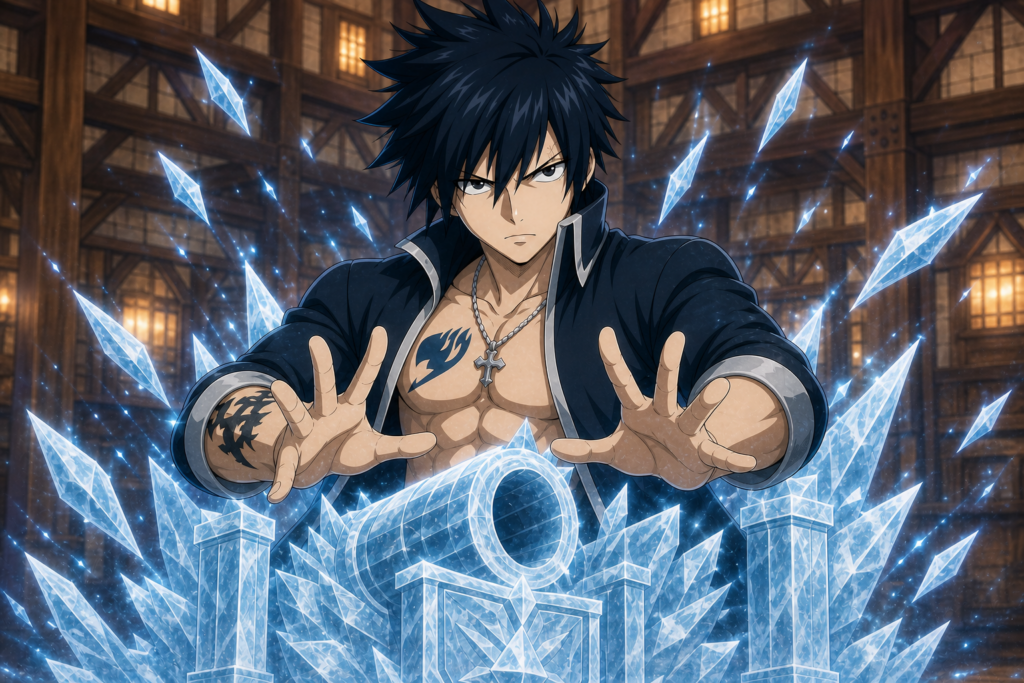
CVM Sekai character profile
Bottom line
Gray Fullbuster is not Fairy Tail‘s calm one. He is the man who learned to freeze grief into a weapon and keeps mistaking self-erasure for responsibility.
Yes, he is strategic. Yes, he can build a cannon, shield, staircase, prison or entire battlefield out of ice faster than most people can finish yelling a spell name. He also has a terrible habit of deciding that the cleanest way to protect everyone is to remove himself from the future.
Ur dies using Iced Shell after Gray charges Deliora alone. Lyon spends years trying to defeat what her sacrifice sealed. Silver gives Gray demon-killing power through another parental goodbye. Gray later reaches for Lost Iced Shell as if disappearing perfectly would settle every debt.
Fairy Tail keeps answering him with the same rude truth: surviving with people is harder than dying for them.
That is Gray’s real character arc. The ice is just how he makes it visible.
Who Gray Fullbuster is
Gray is a human Ice-Make wizard and a longtime member of Fairy Tail. He becomes one of the core field partners around Natsu, Lucy, Erza, Happy and later Wendy and Carla. The anime’s official TV Tokyo character pages describe him as a top-class guild fighter who shapes ice into weapons at exceptional speed. They also confirm the habit everybody notices before his trauma: Gray removes his clothes without realizing it.
The joke has an origin. Ur trained Gray and Lyon in extreme cold with minimal clothing so their bodies would adapt. Gray carries that training reflex into ordinary life long after the lesson ends. The series plays it for comedy, sometimes well and sometimes until the joke has filed for overtime.
But stripping is not the same thing as openness. Gray can stand in a room half-dressed and still hide the thought most likely to destroy him.
His primary Japanese performer is Yūichi Nakamura. In TV Tokyo’s official cast interview, Nakamura rejects the easy label of “cool rival.” He describes Gray as someone who looks cool but is actually hot-blooded, and he calls Gray’s connection with Natsu harder to define than a simple rivalry. That is the right door into the character. Gray’s control is technique. His emotions run hot enough to keep cracking it.
Gray Fullbuster fast facts
What the official public record does not confirm: No public Kodansha, K MANGA, TV Tokyo, or official sequel page located for this profile provides a canonical age, birthday, height, weight, guild-mark color, or exact mark placement. Those fields stay blank instead of borrowing unsourced fan-wiki numbers.
TV Tokyo describes Gray as a top-class Fairy Tail fighter, and the Tenrou story places him in the S-Class promotion trial. Neither fact makes him an S-Class mage. A promotion opportunity is not the promotion.
His design changes often, but the dark spiked hair, lean build, and recurring necklace keep him readable. Later Devil Slayer markings appear during magic use rather than replacing his everyday design.
Deliora destroys the first version of his life
Gray’s childhood begins with loss on a scale no child can process cleanly. The demon Deliora destroys his home and kills the family he knows. Ur takes him in and trains him beside Lyon Vastia.
Ur gives Gray skill, shelter and a standard he will spend years misunderstanding.
Ice-Make requires imagination and discipline. Gray learns to form static objects with two hands, balancing the shape and stabilizing the magic. Lyon becomes his fellow student, rival and grief mirror. They train under the same woman but do not inherit the same story about her.
Gray eventually tries to fight Deliora despite Ur’s warning. He is a grieving child aiming anger at the only target large enough to hold it. The choice is reckless. It is also the choice that makes Ur’s sacrifice necessary.
Ur uses Iced Shell, converting her own body into the ice that seals Deliora. Gray lives. Ur becomes the frozen prison. Lyon is left with an account of her death that feeds a different obsession.
The series is right not to let Gray walk away with a simple victim label. Deliora victimizes him. Gray’s actions also contribute to the situation in which Ur chooses sacrifice. Accountability is not blame without context. It is the refusal to erase cause because the person involved was hurting.
Gray learns the wrong lesson first: the strongest love is the kind that dies efficiently.
Fairy Tail gives him a home, not an automatic cure
Gray joins Fairy Tail and gains what he lost: routine, noise, peers, work and people who will notice when he vanishes.
Natsu becomes his most visible rival. Fire and ice make the contrast easy, so the anime can stage a fight before either man finishes a sentence. The deeper link is that both are boys shaped by missing parents and teachers who left impossible power behind. They compete because each recognizes something intolerably familiar in the other.
Natsu externalizes. Gray compresses. Natsu starts the fight. Gray acts like he was above it while throwing the second punch.
Erza knows them too well to buy either performance. Her authority over their brawls is funny, but it also establishes her as someone who can interrupt their worst impulses. That matters much later when rivalry stops being play and becomes a grief-driven attempt to kill.
Lucy enters this existing system and helps make it a team. Gray’s connection with her is quieter than his connection with Natsu or Juvia, but quiet does not mean empty. They share the Galuna job, guild-defense crises, allied missions, Tenrou survival, tournament work and the 100 Years Quest. The official sequel’s Episode 5 summary specifically confirms Lucy and Gray regrouping as the Diabolos conflict escalates. None of that requires manufacturing a “best friend” label the story never supplies.
Fairy Tail does not cure Gray’s grief. It gives grief somewhere to be witnessed.
Early guild work proves he is more than Natsu's ice-flavored argument
Gray’s early missions establish the part of him that trauma analysis can accidentally bury: he is good at the job.
During the Eisenwald and Lullaby crisis, the developing team has to operate under Erza’s direction while Natsu and Gray keep trying to turn every disagreement into a contest. The joke sells personality, but the mission structure sells competence. Gray can read a battlefield, create tools fast and cooperate before his ego has fully left the room.
That distinction matters. Fairy Tail does not keep Gray because his childhood was sad. The guild trusts him because he can work.
Phantom Lord then makes guild membership physical. This is not a neutral tournament or a private grudge. Another guild attacks Fairy Tail and targets Lucy. Gray fights Juvia, one of Phantom Lord’s Element 4, while the wider guild defends its members and home. The place that gave him somewhere to put grief becomes something he is willing to defend.
Juvia first enters his story inside that violence. Her later feelings cannot erase the fact that they meet as opposing combatants during an invasion. Romance analysis that starts at “she saw him and fell in love” skips the power situation standing right behind the joke.
The Tower of Heaven tests a different kind of loyalty. Erza’s history becomes the emergency, and the team follows her into a past she has tried to contain. Gray defeats Fukuro after the assassin has swallowed Natsu, freeing his teammate and helping the rescue continue. The guild does for Erza what it repeatedly does for Gray: it refuses to let one member decide that private suffering must stay private until it kills them.
The Battle of Fairy Tail turns that loyalty inward. Freed’s enchantments and Laxus’s coercive spectacle transform the guild’s own city and members into pieces on a board. Gray is trapped by an enchantment condition tied to age before joining the fight against Laxus’s plan. The institutional consequence matters: Fairy Tail‘s closeness does not make it immune to abuse from inside the family.
The Oración Seis alliance widens Gray’s work beyond one guild. His connection with Lyon cannot remain trapped on Galuna Island because they later have to function in the same broader field. Their history does not vanish. It becomes part of how they coordinate, compete and measure growth.
The point is not a breathless list of every punch. The work shows what Gray does, what he learns and who carries the cost when a team becomes a family without learning boundaries.
Galuna Island makes the past thaw in public
Lyon’s plan on Galuna Island forces Gray to confront the version of Ur’s death he has kept frozen.
Lyon wants to release Deliora so he can defeat the demon and surpass Ur. The plan is destructive, but it is not random villain ambition. Lyon is trying to turn grief into a measurable victory. If he beats the thing Ur could only seal, then her death can become a rung on a ladder instead of an absence.
Gray understands the damage because he has been doing his own version of it. Lyon performs the obsession outwardly. Gray carries it as guilt.
The revelation that Ur lives on as the ice sealing Deliora does not make the sacrifice less costly. It makes the body of the teacher into a battlefield, memorial and prison at once. Gray must defend her choice without pretending his earlier recklessness had no part in it.
This is where Iced Shell becomes more than a dramatic spell. It is an inherited script. When Gray later considers using it himself, he is not inventing a solution. He is repeating the most powerful act of love he ever witnessed.
That repetition is the problem.
Edolas asks who Gray is when Earth-land rules stop working
Edolas removes ordinary assumptions about magic and doubles familiar characters through alternate selves.
Gray’s work in Edolas remains separate from the Dragon Slayers’ final victory over Dorma Anim. His useful role is collective: he returns from lacrima form, helps free allies and supports the operation in a world with different magical access. Another character’s finishing blow does not belong on his résumé.
The Edolas version of Gray belongs to an alternate-world continuity. That double reverses familiar relationship comedy without becoming secret biography for Earth-land Gray. A gag-double is not psychological proof.
Edolas also restores Lisanna to the Earth-land guild. That return changes the team’s social field even when Gray is not the emotional center. A complete profile records major guild changes that affect his continuing home instead of pretending the world pauses whenever he leaves the foreground.
Ultear proves that grief does not belong to one child
Ultear Milkovich complicates Gray’s private ownership of Ur.
She is Ur’s daughter, and her life is shaped by separation, misinformation and rage around the same woman Gray remembers as teacher and surrogate parent. Their Tenrou Island conflict matters because Gray cannot treat Ur’s legacy as a story that belongs only to him and Lyon.
TV Tokyo’s official episode summary for “Living Power” frames Gray and Ultear as fighting through contradictory feelings about Ur. It also gives Ultear’s Arc of Time a direct advantage over Gray’s ice: she can push its time backward into water or forward toward evaporation.
That is good power writing. The counter is not arbitrary. Ultear can literally destabilize the material Gray uses to impose shape. The daughter he did not know can undo the frozen forms built from their shared loss.
Gray wins fights through construction and reading. Ultear forces him to read history too.
Tenrou, seven missing years and the Grand Magic Games change his place in the guild
Gray enters the Tenrou Island S-Class trial as a candidate, not as an S-Class mage. That difference has to stay clean. Being trusted with a promotion opportunity proves standing; it does not grant the rank when the trial is interrupted.
Loke serves as Gray’s trial partner. Their route brings them against Mest and Wendy before Grimoire Heart’s invasion destroys the promotion structure entirely. Tenrou tests ambition, inherited history and collective survival in the same location.
Acnologia’s attack suspends Gray and the other protected members for seven years. TV Tokyo’s official Grand Magic Games summaries confirm the seven-year return and Fairy Tail‘s fall from national prominence during their absence. Gray does not train through those years. The world moves without him.
That matters more than a time-skip costume. Members who remained had to carry the guild’s decline. The returning group inherits both a welcome and the consequences of being unavailable through no fault of their own. Fairy Tail‘s decision to enter the Grand Magic Games is therefore competitive, economic and reputational.
In the Grand Magic Games, Gray competes for Fairy Tail Team A, loses the Hidden event after Raven Tail’s interference, later defeats Rufus Lore and joins Juvia in the final-day attack on Lyon and Chelia. His work contributes to the guild’s restored standing, but it is not interchangeable with Erza’s Pandemonium feat, Natsu’s dragon-slayer showcase or another member’s points.
The Eclipse crisis creates an erased future in which Gray is killed while protecting Juvia. Ultear’s time reversal prevents that outcome. It belongs to the future-timeline record, not to ordinary surviving-timeline memory, and the anime’s expansion remains adaptation material.
This entire stretch corrects a common fandom shortcut. Gray does not move directly from Galuna trauma to Silver trauma. He spends years doing guild work, pursuing promotion, losing seven years and fighting to restore a collective reputation. That labor is character history too.
Sun Village prepares the Tartaros inheritance without becoming a footnote
Sun Village returns Gray to a landscape defined by unnatural ice. That makes it an important bridge between his established molding craft and the Devil Slayer inheritance waiting in Tartaros.
In Sun Village, Gray confronts Doriate and is temporarily reduced to a child by Retrogression. The village’s giant inhabitants and Eternal Flame have been frozen by Silver’s Devil Slayer ice, a source outside Gray’s ordinary Ice-Make. His expertise helps him recognize an ice problem; it does not make him the source or sole solution. Expertise is more interesting when it has edges.
Silver gives Gray power wrapped in another goodbye
Tartaros tears open Gray’s family history again.
Silver Fullbuster appears as an enemy using Ice Devil Slayer Magic. TV Tokyo’s official “Gray vs. Silver” summary makes the technical mismatch clear: Gray’s ordinary ice is ineffective against a man with the same attribute, while Silver’s Devil Slayer power can cut Gray’s body.
The next official summary, “Silver Memories,” confirms the emotional dilemma. Silver tells the story of how he reached this state, and Gray must face whether he can deliver a finishing blow to his own father.
This is not a reunion with a clean villain mask. Silver is father, opponent, victim of death, actor inside Tartaros and source of inherited power. Gray gets answers and loses him again in the same sequence.
Silver passes Ice Devil Slayer Magic to Gray. The inherited magic is designed to fight demons, lets Gray produce demon-slaying ice and manifests dark markings during heavy use. The manga also shows Gray consuming compatible ice. The story connects his most dangerous loss of judgment to grief, E.N.D. information and power pressure, but it does not provide a clinical “corruption” diagnosis. That boundary matters more than a neat metaphor.
Still, the structural meaning is already visible. Gray’s strongest new weapon arrives through another parent making departure look like duty.
No wonder he keeps confusing love with leaving.
Juvia needs analysis with boundaries, not ship slogans
Juvia Lockser’s love for Gray begins loudly and often one-sidedly. The series uses pursuit, jealousy and imagined romance as comedy. Some of those jokes are charming. Some treat Gray’s discomfort as a hurdle she is entitled to wear down.
The profile has to hold both the boundary problem and the later mutuality.
Gray does not owe Juvia romance because she is devoted. Juvia is also not frozen forever at her earliest gag. They fight together, protect one another, share training and domestic proximity after the guild’s disbandment, and accumulate experiences that change Gray’s responses.
Alvarez makes the bond impossible to dismiss as one-way comedy. Invel’s Ice Lock forces Gray and Juvia toward mutual killing. TV Tokyo’s official episode archive confirms that Juvia resists the controlled attack by turning the weapon on herself. Gray also chooses self-directed harm rather than kill her. Juvia then saves him through Water-Make blood.
That sequence is not romantic because two people try to die. It is tragic because both reach for self-erasure as the only agency left under coercion.
Gray’s later grief and rage show how deeply Juvia matters to him. In 100 Years Quest, Fairy Nail’s Juvina prompts him to think about Juvia, and the official Episode 17 summary places Gray and Juvia hand in hand against Metro after their allies entrust them with the fight. The sequel advances reciprocal feeling and Gray’s desire to become someone who can make her happy, but it does not need a fan-assigned marital label.
Love is not proven by who dies first. Gray’s growth is learning to stay.
The relationship atlas needs people, not labels
Ur is not only “the dead teacher.” She gives Gray craft, discipline and a home, then dies correcting a catastrophe he helped set in motion. Her sacrifice saves him and damages his model of love. Both truths have to remain visible.
Lyon is not only “the rival student.” He is the other child left with Ur’s absence and a different explanation for it. Galuna makes them enemies because each has built a moral system around the same loss. Their later ability to work near one another matters because reconciliation is conduct after conflict, not the magical disappearance of conflict.
Natsu is not only “fire versus ice.” Their brawls are comic ritual, competitive measurement and sometimes a way to avoid direct speech. The relationship becomes most honest when that ritual fails during Alvarez. Once they aim lethal grief at one another, the series has to bring Erza in to remind them that familiarity is not permission.
Erza is not simply the scary woman who stops the boys. She is a peer with her own catastrophic childhood who understands the temptation to carry pain alone. Her authority works because it is backed by shared missions and because she is willing to be emotionally legible when they are not.
Lucy needs more than the line “quiet friendship.” She joins after Gray’s guild relationships already have rhythm, but she becomes part of the team that turns those habits into dependable labor. They share the unauthorized Galuna job and repeated team operations; Lucy participates in stopping Gray’s Galuna self-sacrifice, and the official sequel archive later confirms their Episode 5 regrouping during the Diabolos fight. Lucy is a writer and observer inside the story, but she remains a participant rather than a neutral camera.
Silver is not a clean reconciliation. He withholds, performs hostility and forces Gray to make judgments under emotional pressure. His undead condition and Tartaros position constrain him, but they do not turn every choice into harmless theater. Gray receives truth, power and another loss at the same time.
Ultear breaks the fantasy that Ur belongs only to the boys she trained. Gray has memories of care that Ultear was denied. Ultear has a daughter’s claim that Gray cannot out-rank with grief. Their fight makes history contested, which is exactly why it belongs in a biography rather than a villain-of-the-week paragraph.
Makarov and the guild form the institutional relationship underneath the personal ones. Kodansha’s Ice Trail follows Gray’s post-Ur journey toward Fairy Tail, including the path that takes him to Magnolia. The S-Class trial later shows institutional confidence without a promotion guarantee. The disbandment creates the conditions for Avatar secrecy. The restoration gives Gray another chance to choose belonging over solitary usefulness.
Happy carries team members, provides reconnaissance and participates in the Galuna intervention that prevents Gray from disappearing into Iced Shell. Wendy and Carla join the later field team and share Tenrou, Alvarez and 100 Years Quest operations. Their relationship evidence is operational and familial; the canon does not require three generic friendship slogans for each teammate.
Avatar shows the cost of secrecy
After Fairy Tail disbands, Gray infiltrates Avatar.
The strategy displays discipline. It also depends on letting people believe he has crossed a moral line. Stories often treat undercover deception as automatically noble because the mission succeeds. RaeRae is not giving secrecy a free scholarship.
Gray takes risk onto himself, but he also decides what other people are allowed to know and feel. He and Erza work under a Council-backed infiltration plan while Juvia experiences his withdrawal and disappearance without the same information. His former guildmates confront evidence that appears to show betrayal. The interpersonal cost is part of the operation, not irrelevant fallout.
This is Gray’s control problem in another form. If he can carry the danger alone, he does not have to negotiate vulnerability.
E.N.D. turns rivalry into a loaded weapon
Gray inherits Silver’s mission to destroy E.N.D., the most dangerous demon associated with Zeref’s books. The official TV Tokyo character page confirms that goal after Tartaros.
When Gray learns E.N.D.’s identity, grief and inherited duty collide with Natsu.
The fight between them is not a triumphant payoff to years of rivalry. It is a failure. Both men are compromised by fresh loss, manipulation and incomplete knowledge. They point their most intimate powers at someone who has functioned like family.
Erza stops them. The image of her catching fire and ice matters because she refuses the logic that pain makes the fight inevitable. Her tears force both men to see a relationship where they had reduced each other to targets.
“They are like brothers” is not enough analysis. Brothers can still cause harm. Shared history raises the stakes; it does not excuse the blow.
Lost Iced Shell is the old mistake wearing better armor
Gray later prepares Lost Iced Shell against Zeref.
The variation is worse precisely because it looks more complete. It offers sacrifice plus erasure, removing Gray from memory while sealing the threat. He can save everyone and spare them the grief of remembering him. That is the fantasy.
It is also control.
Gray would decide for every person who loves him that their memories are acceptable collateral. He would convert relationship into fuel without consent. The act resembles Ur’s sacrifice, but Gray is no longer an isolated teacher making a split-second choice for children. He is a guild member with people actively fighting beside him and a long record of being stopped from disappearing.
Natsu interrupts him. The interruption matters more than another completed sacrifice would. Gray does not need the story to prove he is willing to die. We knew that. He needs somebody to deny him the moral shortcut.
Ice-Make is craft, not just an element
Gray’s magic works because it makes thought visible.
Ice-Make produces forms: shields, blades, hammers, prisons, floors, platforms, cannons and traps. His speed lets him adapt during a fight. His best battles are tactical arguments. He changes terrain, tests counters, creates false expectations and turns an opponent’s rule against them.
Ur’s two-handed molding method matters because creation requires balance. Gray’s recurring licensed spell shelf includes Ice-Make: Lance, Shield, Floor, Hammer, Cannon, Prison, Battle Axe, Bow, Clone and Grappling Hook. Subtitle and game variants remain separate rather than being stirred into one soup.
Gray favors static weapons, structures and restraints, while Lyon repeatedly favors living-animal forms. Their molding choices express different imaginations without turning either wizard into a one-trick label.
Ice Devil Slayer Magic adds another register. It is not merely darker ice. It carries anti-demon purpose, inherited obligation, compatible-ice consumption and visible markings during heavy use. The text supports emotional and magical instability in specific crises, not a permanent medical condition.
Gray is powerful because he constructs quickly under pressure. He is dangerous to himself because he can construct a sacrifice just as quickly.
The stripping joke deserves one honest paragraph
Gray’s habit comes from training in the cold. That is canon context. The anime uses it as a running visual gag, a censorship/framing problem and sometimes a reset button that makes serious scenes snap back into comedy.
The joke can show how deeply training lives in the body. It can also become lazy shorthand: Gray enters, clothing exits, everybody reacts, payroll processed.
Across production eras, the stripping joke usually lands through delayed realization and other characters’ reactions. Cropping, strategic framing and reaction timing keep the broadcast gag legible without making nudity the only visual point. “He strips a lot” is still a caption, not analysis.
Japanese performance and adaptation gate
Yūichi Nakamura’s own official description gives the receipt-backed performance frame: cool surface, hot interior and a Natsu relationship harder to reduce than ordinary rivalry. Public official pages do not expose a separately credited young-Gray performer, so this profile names only Nakamura.
This candidate does not invent scene-level vocal adjectives without an accessible Japanese-audio receipt. Nakamura’s own official account carries the performance analysis here: the cool appearance conceals heat, and the Natsu relationship resists a simple rivalry label.
The anime changes visual production across its long run. Early Ice-Make emphasizes quick blue-white construction; Tartaros gives Devil Slayer attacks black markings and harder contrast; Alvarez uses tighter facial framing when strategy collapses around Juvia and E.N.D. Films, OVAs and anime-original arcs remain visibly labeled adaptation continuity.
The adaptation shelf cannot dump every Gray into one continuity
The main manga by Hiro Mashima controls the core biography. The 2009 television anime, 2014 continuation and final season adapt that spine while changing production conditions, adding material and giving Gray a voice, timing and color design.
That anime history has its own craft record. Shinji Ishihira directs across the long television run, while credited animation studios and character-design teams change. The early production emphasizes fast blue-white construction effects and reaction-cut comedy around stripping; Tartaros adds black markings and harder contrast to Devil Slayer attacks; Alvarez uses tighter facial framing when strategy collapses around Juvia and E.N.D. These are visible production choices, not automatic proof of deeper psychology.
Fairy Tail: 100 Years Quest is a sequel manga built from Hiro Mashima’s storyboards/original concept with art by Atsuo Ueda. Its anime has a separately credited production led by chief director Shinji Ishihira, director Toshinori Watanabe, series composition by Atsuhiro Tomioka, character design by Yurika Sako and animation production by J.C.STAFF. Those credits matter because sequel design and movement should not be described as if the same production pipeline simply never stopped.
Gray appears with the guild ensemble in the official anime films Phoenix Priestess and Dragon Cry. Their film-only events and feats remain outside the main manga chronology. He also appears across official bonus-animation/OVA releases and licensed games, including Koei Tecmo’s Fairy Tail role-playing games. Bonus comedy, playable scenarios and command-menu moves remain adaptation material, not retroactive manga canon.
Anime-original arcs can still reveal adaptation priorities, comedy habits and performance choices. They just cannot be smuggled into the manga chronology without a label.
100 Years Quest: do not invent a promotion
Gray continues with Team Natsu into 100 Years Quest. Official TV Tokyo episode pages confirm his participation in Dragon God and Diabolos operations, including regrouping with Lucy during the Water God Dragon conflict.
The official Episode 5 summary supplies one concrete early action: Lucy and Gray reunite while the fight with Diabolos escalates, then the group returns toward Ermina and notices the town’s change from the sea. That is support and regrouping work, not a solo victory borrowed from somebody else.
The official Episode 8 summary gives Gray a quieter but important beat. In the celebrity-mirror guild Fairy Nail, he meets Juvina, a woman who resembles Juvia, and the encounter turns his thoughts back toward Juvia. That is sequel evidence that his feelings are active, but it is not permission to skip the exact later conversation that defines what he intends to do about them.
The official Episode 17 summary puts Gray and Juvia together against the God Seed Metro after allies entrust them with the fight. This is concrete mutual combat and collective trust. Metro controls an army of wood golems, and the pair attack the controlling God Seed rather than treating endless bodies as the real victory condition.
The official Episode 24 summary confirms Gray’s Elentear confrontation with Hakune, whose official character page identifies her snow-and-ice spirit arts. That matchup deserves analysis because it tests an ice specialist against a different magical system using a familiar material. It does not automatically prove Gray has universal ice immunity.
The sequel also keeps his Juvia-facing self-assessment important. Gray thinks about becoming someone who can make her happy, which can mark growth if the story lets him pair desire with honest action.
The sequel does not make Gray the solution to every Dragon God problem. He regroups with Lucy during the Diabolos conflict, reflects on Juvia through the Juvina encounter, fights Metro with Juvia and confronts Hakune in Elentear. Those are concrete actions. Other characters retain their victories, losses and central Dragon God decisions.
Final verdict
Gray’s story is not about learning to feel. He feels everything. His problem is deciding that feelings become honorable only after he converts them into pain he can carry alone.
Ur gives him ice and a life. Lyon forces him to face the history he froze. Ultear proves that grief has competing witnesses. Silver gives him power and another goodbye. Juvia makes self-sacrifice relational instead of abstract. Natsu and Erza keep refusing to let disappearance pass for maturity.
Ice is the easy part.
The hard part is staying long enough to be loved without turning love into a funeral.
Canon boundaries
The public primary record used for this candidate does not expose a canonical age, birthday, height, weight, guild-mark color or exact mark placement. Those fields are omitted. It also does not expose a separate young-Gray Japanese credit, so only Yūichi Nakamura is named.
Ice Trail is an official Kodansha spinoff about Gray’s journey toward Fairy Tail, not a replacement for the main manga’s core chronology. Phoenix Priestess, Dragon Cry, OVAs, anime-original arcs and game scenarios remain labeled adaptation or supplementary continuity. The erased future during Eclipse is not treated as ordinary surviving-timeline memory. Fairy Tail: 100 Years Quest is the official sequel and keeps its own manga/anime production credits.