
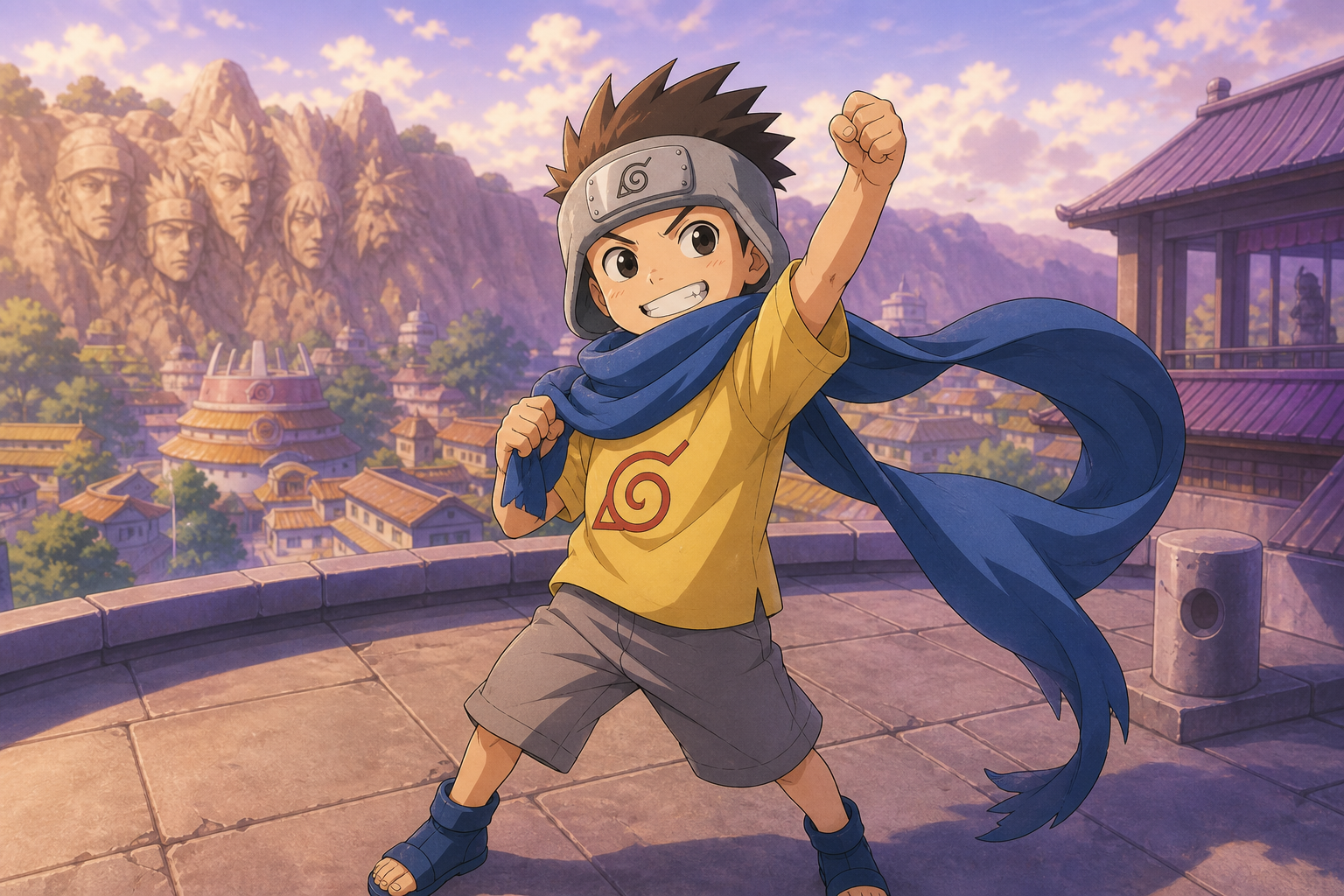
Konohamaru Sarutobi
The Third Hokage’s grandson begins as a child furious that everybody bows to his surname. Naruto gives him something inheritance cannot: a rival who sees the boy before the title.
Konohamaru is what happens when Naruto’s influence survives long enough to become a teacher.
Konohamaru enters the story as an eight-year-old trying to ambush his own grandfather because being the “Honourable Grandson” has swallowed his actual name. He wants the Hokage title, but he initially treats the hat like a prize he can seize through one clever trick. Naruto irritates that fantasy out of him. Becoming Hokage requires recognition, labor, relationships, and the strength to carry other people when applause disappears. Konohamaru does not copy Naruto because he lacks a self. He copies Naruto until imitation becomes a bridge toward one.
That distinction controls his whole biography. The child who weaponizes Sexy Technique grows into the genin who defeats a Path of Pain, the young man who records Naruto’s wedding messages, and the jōnin assigned to guide Boruto, Sarada, and Mitsuki. His adult record is not a clean victory reel. Boruto often places him beside students whose inherited power systems outgrow ordinary jōnin logic. That frustration is part of the meaning, not proof that his childhood promise vanished. Konohamaru becomes the mentor Naruto needed, even when the franchise does not always let the mentor look cool doing the job.
Verified identity, growth and continuity record
- Full name: Konohamaru Sarutobi (猿飛木ノ葉丸)
- Birthdate: December 30
- Blood type: B
- Ninja registration: 012707
- Age: 8 to 9 in Part I; 11 to 12 in Part II
- Height: 128.8 to 130.6 cm in Part I
- Part II height: 141.1 cm
- Blank Period height: 155 cm
- New Era height: 177.5 cm
- Weight: 27.8 to 29.5 kg in Part I; 36.9 kg in Part II
- Clan: Sarutobi clan
- Village: Konohagakure
- Ranks: Academy student, genin, later jōnin
- Teams: Team Ebisu; later leader of Team Konohamaru / new Team 7
- Manga debut: Naruto Chapter 2
- Anime debut: Naruto Episode 2
- OVA debut: Find the Four-Leaf Red Clover!
- Game debut: Naruto: Konoha Ninpōchō
- Movie record: first credited movie appearance in Naruto the Movie: Blood Prison
- Status: alive in the New Era
Konohamaru’s physical record matters because the franchise lets the audience watch childhood turn into adulthood rather than replacing one mascot with another. He grows from a 128.8 cm child hiding inside an oversized helmet into a 177.5 cm jōnin wearing a flak jacket and commanding a team. The body changes, the blue scarf survives, and the ambition remains legible across the silhouette.
His adult occupations vary by continuity. Anime material has used him as an Academy teacher and Genin Exams proctor. Manga-era material places him in senior village work, including service as the Hokage’s chief aide in later developments. Those roles should not be mashed together as though every medium shows the same office on the same morning. A complete profile records the branches and labels them.
Named for Konoha, raised beneath Hiruzen’s shadow
Hiruzen names his grandson after Konohagakure itself. “Konohamaru” carries the village name Konoha, while the traditional masculine suffix maru gives the child a name that sounds both affectionate and burdened with public meaning. Before Konohamaru can choose a role, his family has already tied his identity to the institution his grandfather leads. Very normal pressure for an eight-year-old. Absolutely no notes for the village elders.
Hiruzen Sarutobi is his paternal grandfather. Asuma Sarutobi is his uncle, not his father. Konohamaru’s parents are described in reference material as high-level shinobi associated with the Hokage’s protection, but the central manga does not give them a developed domestic storyline or widely established personal names. The omission shapes his early presentation: the grandfather’s office dominates the public record, Ebisu handles formal instruction, and Konohamaru searches for recognition through rebellion.
Servants and villagers call him Omago-sama, “Honourable Grandson.” The title sounds respectful, yet Konohamaru hears a cage. Adults do not defeat him, scold him, or praise him as an ordinary child because his grandfather’s authority changes every interaction. Privilege gives him access and protection. Privilege also makes honest feedback scarce. Naruto’s refusal to perform deference becomes valuable precisely because everybody else has confused care with flattery.
The helmet, goggles, scarf and adult flak jacket
Early Konohamaru has short spiky dark-brown hair, dark eyes, a small chipped tooth, gray shorts, blue sandals, and a yellow shirt carrying a red Konoha symbol. His first gray helmet has a hole that lets his hair stick through the top. The design makes him look like a child wearing an institution several sizes too large. After meeting Naruto, he trades the helmet for Naruto’s old goggles. The change is fan behavior, mentorship, and visual succession packed into one accessory.
The long blue scarf becomes his most consistent personal marker. During childhood, the scarf drags and flies with exaggerated length because Konohamaru’s ambition is larger than his body and considerably less practical. The scarf shortens as he grows. Part II gives him longer trousers, a pale green jacket, and his own forehead protector. The Blank Period narrows the silhouette again, while adult Konohamaru wears duty clothing, a flak jacket, a red Sarutobi armband, dark trousers, and the now compact blue scarf.
Masashi Kishimoto reportedly struggled to design a “punk” child smaller than Naruto without simply drawing a miniature Naruto. That production problem fits the story almost too well. Konohamaru begins through resemblance and must earn distinction. The final design accepts the echo through goggles, spiky hair, mischief, and loud ambition while anchoring him through Sarutobi symbols, the blue scarf, and a more formal adult trajectory.
Naruto sees the boy before the pedigree
Konohamaru first attacks Hiruzen in another failed attempt to claim the Hokage title. Naruto barges into the scene, knocks him down without recognizing the grandson, and refuses to apologize once the family connection becomes clear. That refusal becomes the foundation of trust. Naruto does not treat Konohamaru as a protected extension of power. He treats him as an annoying kid with a bad plan. For Konohamaru, disrespect finally feels like recognition.
Naruto then rejects the shortcut. Konohamaru cannot defeat Hiruzen with one forbidden trick and inherit public love. The Hokage title belongs to someone acknowledged by the village, and acknowledgment must be built through effort and relationships. Naruto speaks from hunger rather than authority, which is why the lesson lands. Both boys want the same hat because both believe the hat can solve loneliness. Their rivalry begins before either understands how much service the office will demand.
Sexy Technique becomes their first shared language because Naruto teaches through whatever he actually knows. The joke is juvenile, disruptive, and narratively precise. Konohamaru learns transformation, performance, timing, and the pleasure of embarrassing adults who hide behind status. Later variants become increasingly elaborate, including the infamous same-sex transformation gag used against Sakura. The technique is comedy, but the mentorship underneath remains serious: Naruto gives knowledge freely to a child whose official tutor keeps trying to control the path.
As the series advances, Konohamaru stops merely announcing Naruto as rival and starts using Naruto’s choices as a moral test. During Pain’s assault, he refuses to keep running because Naruto would not abandon the village. As an adult, he teaches Naruto’s son. Influence becomes institutional. Naruto does not inherit Hiruzen’s bloodline, yet Naruto’s values travel through Hiruzen’s grandson into the next Team 7.
Ebisu, Moegi and Udon turn rebellion into practice
Ebisu begins as Konohamaru’s elite private tutor and one more adult invested in producing a respectable Hokage candidate. He values pedigree, proper instruction, and controlled advancement. Naruto initially looks like the opposite of everything Ebisu wants near his student. Their conflict exposes two educational failures: prestige without emotional access and inspiration without a curriculum. Konohamaru eventually needs both.
After Hiruzen’s death and the passage into formal ninja training, Konohamaru joins Moegi Kazamatsuri and Udon Ise under Ebisu. The group is often treated as a cute miniature echo of Team 7, yet the team gives Konohamaru peers who do not bow to his surname. Moegi challenges his impulsiveness. Udon brings caution and observation. Ebisu supplies structure. Naruto remains the aspirational mentor, while Team Ebisu creates the daily social work through which aspiration becomes competence.
Konohamaru’s relationship with Ebisu also matures. The tutor who once dismissed Naruto eventually recognizes the value of Naruto’s influence. Konohamaru, meanwhile, stops treating formal instruction as an insult. The boy does not choose between the rebellious outsider and the respectable teacher. He learns to take different forms of care from both, which is a far healthier educational model than forcing one adult to become the entire village.
From comic ambushes to grief after the Third Hokage
Konohamaru’s earliest appearances revolve around pursuit, disguise, and the insistence that Naruto acknowledge their rivalry. The four-leaf clover OVA expands that childhood dynamic into a mission-sized adventure, with Konohamaru chasing a charm said to grant wishes because he wants help winning a girl’s affection. The material is comic, but the wish logic matches his central flaw: he keeps searching for one object, one technique, or one trick that can bypass the slow work of becoming worthy.
Hiruzen’s death during the Konoha Crush ends the safest version of Konohamaru’s rebellion. Complaining about being the Hokage’s grandson becomes impossible once the grandfather is gone. The funeral places personal grief inside public ritual. Konohamaru loses family while the village loses a leader, and neither loss cancels the other. The child who resented collective ownership of Hiruzen must now share mourning with the same institution that made the relationship difficult.
Afterward, Konohamaru initially resists Tsunade’s succession because accepting a Fifth Hokage can feel like replacing the Third. Naruto confronts him again, insisting that grief cannot freeze the office or the village. That exchange deepens their bond. Naruto does not ask Konohamaru to stop loving Hiruzen. He asks him to understand that leadership survives through continuation rather than possession.
Anime-original Part I missions and village episodes keep Team Ebisu visible as children learning teamwork, basic techniques, and the gap between fantasy and service. Such episodes vary in canonical weight, so a full profile should neither erase them nor use every gag as evidence for manga-level power. The consistent character line remains clear: Konohamaru gradually shifts from demanding a title toward accepting training.
Defeating the Naraka Path is not a joke victory
During Pain’s assault on Konoha, Konohamaru observes the Naraka Path interrogating and killing through the King of Hell. Ebisu tries to protect him, and Konohamaru initially flees. Then Naruto’s example changes the decision. He returns, analyzes the enemy’s method, uses shadow clones and deception, and lands a Rasengan that defeats the Path long enough to save his teacher.
The victory matters because Konohamaru does not win through inherited Sarutobi prestige. Hiruzen’s title cannot help him. The enemy does not care who his grandfather was. Konohamaru survives through a technique Naruto taught, tactical observation Ebisu helped cultivate, and courage produced by both relationships. The competing educational systems finally cooperate inside one action.
Power scalers sometimes treat the moment as either proof that child Konohamaru is secretly Kage level or proof that the Naraka Path became conveniently useless. Both readings flatten the scene. Konohamaru exploits surprise and a specific opening against one body in a distributed system. He shows exceptional growth without demonstrating that he can defeat all Six Paths, match Pain’s full information network, or reproduce Naruto’s later battle. Context is not an excuse. Context is what combat means.
The emotional payoff is equally important. Konohamaru once attacked Hiruzen because victory over the Hokage might force the village to say his name. During Pain’s assault, he attacks a stronger enemy because another person will die if he does nothing. Ambition has become responsibility. That is the actual promotion, even before paperwork catches up.
War turns the admirer into a keeper of memory
Konohamaru’s Part II appearances show a taller genin with improved transformation, shadow-clone use, Rasengan training, and a sharper understanding of village duty. He remains competitive with Naruto, yet the rivalry has become affectionate rather than delusional. Naruto is no longer merely the older boy across the street. Naruto is a world-changing shinobi whose path Konohamaru can study without surrendering his own future claim.
The Fourth Shinobi World War gives Konohamaru less central battlefield material than many fans wanted. His generation remains part of the village’s protected future while older shinobi absorb the front-line catastrophe. That limited deployment is not proof that he stopped growing. The institutional choice shows what the war is supposedly protecting: people who must live long enough to inherit the peace.
After the war, Konohamaru becomes the person recording messages for Naruto and Hinata’s wedding in The Last era material and the wedding OVA storyline. The camera role looks small until we remember his first appearance. He once needed everyone to look at him. Now he spends time looking at other people, collecting their voices, and preserving community for his mentor. Growth can be a Rasengan. Growth can also be knowing when the story belongs to somebody else.
Adult Konohamaru inherits Team 7’s impossible classroom
By the Boruto era, Konohamaru is a jōnin entrusted with Boruto Uzumaki, Sarada Uchiha, and Mitsuki. The team later carries the Team 7 name, placing Konohamaru inside a lineage connecting Hiruzen, Kakashi, Naruto, Sasuke, Sakura, and the next generation. He becomes the adult standing between gifted children and missions designed to prove that talent without coordination will get somebody hurt.
Boruto recreates the emotional problem Konohamaru once brought to Naruto. The Hokage’s child or grandchild can receive enormous privilege while still feeling erased by the office. Konohamaru understands that contradiction from the inside. He knows why Boruto resents Naruto’s absence, why inherited access does not feel like intimacy, and why public admiration can make private anger look ungrateful. The teacher does not always solve the problem elegantly, but the pairing has structural intelligence.
As a field leader, Konohamaru uses Rasengan, Fire Release, sealing tools, summons, tactical clones, and close combat while prioritizing his team’s escape and development. Boruto’s escalating Ōtsutsuki and Kāma systems often place ordinary jōnin competence beside god-tier mechanics. Konohamaru suffers from that scale change. Enemies can absorb ninjutsu, rewrite bodies, and arrive with information unavailable to the team. His losses therefore require encounter-level reading, not a meme about fraud.
Adult leadership also creates painful limits. A teacher can prepare students, set formation, and risk his body without controlling every inherited curse attached to them. Mitsuki’s origins, Boruto’s Kāma, Sarada’s Uchiha expectations, Kawaki’s trauma, and village politics exceed one squad leader’s authority. Konohamaru’s adulthood is the discovery that becoming responsible does not make the world manageable.
Rasengan, clones, elemental range, summons and honest limits
Konohamaru’s signature inheritance is the Rasengan, learned through Naruto’s teaching and used decisively against the Naraka Path. As an adult he can create the technique without the same childhood scaffolding, enlarge or vary the attack in adaptation material, and combine clones with feints to deliver the sphere. Rasengan symbolizes earned transmission. Bloodline gives him Sarutobi potential. Naruto gives him a method. Practice makes the method his.
Shadow Clone Technique supports reconnaissance, deception, and multi-angle attacks. Transformation remains unusually central because his first instruction with Naruto revolves around Sexy Technique. Konohamaru later demonstrates shuriken skill, taijutsu, barrier and sealing applications, chakra blades associated with Sarutobi combat language, and strong tactical awareness. He has used Fire Release and Wind Release in core reference records, with Lightning Release, Earth Release, and other techniques expanded across anime and game continuity.
His adult Fire Release includes large flame techniques consistent with the Sarutobi clan’s reputation. Wind nature can support projectile or Rasengan-related applications. Anime material gives him monkey-summoning ties, including the young monkey Enra, while toad associations reflect Naruto’s training line. These contracts connect two mentorship genealogies without making Konohamaru a duplicate of Hiruzen or Naruto.
Limits matter. He does not possess Hiruzen’s lifetime of mastery, Naruto’s jinchūriki reserves, Sarada’s Sharingan, Mitsuki’s engineered body, or Boruto’s Kāma. Konohamaru can be surprised, restrained, injured, or outscaled. He also tends to protect students at tactical cost. None of those boundaries erase jōnin rank. They define what a skilled human commander looks like in a sequel increasingly populated by inherited anomalies.
From wanting the hat to carrying the people beneath the hat
Child Konohamaru imagines Hokage as the opposite of invisibility. Adult Konohamaru learns that leadership frequently means becoming background support for someone else’s growth. He briefs missions, corrects formations, files reports, absorbs danger, and receives less narrative glamour than the students whose names sell the sequel. The office fantasy becomes labor before he ever reaches the office.
His story also complicates meritocracy. Konohamaru has access to elite tutors, clan techniques, the Hokage’s household, and Naruto’s attention. He works hard, but hard work begins from a privileged starting point. The profile does not need to punish him for inheritance or pretend inheritance disappeared. The stronger reading asks what he does with access. He turns private instruction into public protection and eventually teaches children whose own inheritances are equally complicated.
A consequence lens exposes the cost of institutional continuity. Hiruzen’s compromises shape Asuma’s generation, Naruto’s childhood, and Konohamaru’s burden. Naruto’s leadership shapes Boruto’s resentment and Konohamaru’s mentorship. Every Hokage leaves policies, absences, victories, and unfinished problems for younger people. The village survives because people inherit work, not because one heroic face on the mountain solves history forever.
Filial duty, chosen mentorship and the village as family
A Confucian lens clarifies Konohamaru’s early conflict. Respect for elders and family hierarchy should involve reciprocal care, instruction, and moral example. Konohamaru receives status-based deference without enough honest correction. Naruto violates etiquette by refusing to bow, yet that apparent disrespect restores a more ethical relationship because Naruto addresses the child’s actual character. Ritual respect without truthful care has become hollow.
Hiruzen names the village as family, and Konohamaru literally carries the village in his name. The symbolism can feel warm or suffocating depending on who is asked to sacrifice. Konohamaru’s growth works because he gradually chooses the collective responsibility that was assigned to him at birth. Chosen duty differs from inherited branding, even when both point toward the same Hokage office.
A Buddhist reading can focus on attachment to title and self-image. Young Konohamaru believes defeating Hiruzen or mastering one trick will produce a stable identity. Experience keeps dissolving that fantasy. His grandfather dies. Naruto leaves to train. The village is destroyed and rebuilt. Students surpass expectations. Leadership becomes impermanent service rather than permanent proof of worth. Konohamaru does not renounce ambition. He loosens the demand that ambition instantly cure insecurity.
The long scarf carries the same idea visually. Childhood desire trails behind him in huge dramatic loops, beautiful and impractical. Adulthood shortens the scarf without removing the color. Maturity does not require murdering the child who dreamed. Maturity learns how much fabric can survive a mission.
Ikue Ōtani, Akiko Koike and Hidenori Takahashi
Ikue Ōtani establishes Konohamaru’s Japanese child voice: nasal confidence, combustible embarrassment, comic timing, and sudden sincerity when bravado cracks. The performance keeps him young without making him meaningless. Konohamaru can sound ridiculous while declaring rivalry and still make Hiruzen’s death feel like a child losing the center of his world.
Akiko Koike temporarily performs Konohamaru during the Kazekage Rescue period, covering the role while Ōtani was unavailable. Hidenori Takahashi performs adult Konohamaru, lowering the register and adding command weight while preserving flashes of the boy’s impatience. The adult voice must lead a squad, argue with Naruto, and face threats larger than the mentor role was designed to contain.
CVM Sekai records the original Japanese performance line only. No English-dub material belongs in this profile. Each performer should receive a first-mention internal link only when a substantial performer profile is actually live. Until then, honest future-link status remains cleaner than sending readers toward an empty promise.
Manga, anime, novels, movies, OVAs and games
Konohamaru debuts in Naruto Chapter 2 and Episode 2, immediately after the protagonist’s origin establishes the village’s emotional wound. His early OVA record begins with Find the Four-Leaf Red Clover!, a Konohamaru-centered adventure. Later animated specials include wedding-era material such as The Day Naruto Became Hokage, where the franchise converts the long-promised ceremony into family chaos and gives adult Konohamaru a supporting role inside Naruto’s milestone.
His movie record includes Naruto the Movie: Blood Prison, The Last: Naruto the Movie, and Boruto: Naruto the Movie, with the latter positioning him as adult mentor to the new generation. The Last also supplies novel continuity and Blank Period design context. Boruto novelizations, anime arcs, manga chapters, and game adaptations expand his Team 7 leadership beyond the original Naruto series.
Game appearances begin with Naruto: Konoha Ninpōchō and continue across Ultimate Ninja, mobile, card, and crossover-style franchise releases. Games often grant selectable moves, team ultimates, or power scaling built for play. Those mechanics belong in the media record without automatically becoming proof that manga Konohamaru used every animation in canonical combat.
Anime-original arcs give adult Konohamaru more missions, romantic subplots, teaching duties, and technique demonstrations than the Boruto manga consistently supplies. Manga developments later move him into higher village responsibility. A complete profile preserves both records and labels the medium rather than forcing one continuity to impersonate the other.
The fraud allegation is funny until the joke replaces reading
“Konohamaru peaked against Pain.”
The Naraka Path victory is his cleanest crowd-pleasing payoff, but adulthood adds leadership, elemental range, summoning, sealing, mission command, and institutional responsibility. A sequel with alien-scale antagonists makes many conventional jōnin look smaller. That escalation changes the camera, not the character’s entire résumé.
“He only copies Naruto.”
Copying is how apprenticeship begins. Konohamaru takes goggles, Sexy Technique, clones, Rasengan, and a refusal to run. He then combines those lessons with Sarutobi fire techniques, clan symbolism, formal jōnin training, and his own students. Transmission without transformation would be imitation. Konohamaru’s life shows transformation, even when the ingredients remain visible.
“He should already be Hokage because he promised.”
A childhood promise establishes direction, not a guaranteed appointment date. Hokage selection involves capacity, timing, political trust, available candidates, war history, and village need. Naruto’s success does not turn every parallel dream into an automatic promotion. Konohamaru’s story becomes more honest when the office remains difficult rather than arriving as participation trophy.
My read: Konohamaru is one of Naruto’s most important measures of legacy. Naruto changes enemies through empathy, but changing a child through sustained example may matter more. Konohamaru carries that example past grief, past imitation, and into a classroom Naruto’s own son occupies. Legacy is not the stone face. Legacy is the student who eventually has students.
Viewing and reference shelf
Begin with Naruto Chapter 2 and Episode 2 for the complete first encounter, then follow the Konoha Crush aftermath, Tsunade succession material, and Pain’s Assault for the central childhood arc. Watch the Japanese-language performances across Part I, Part II, The Last era, The Day Naruto Became Hokage, Boruto: Naruto the Movie, and the Boruto anime’s Team 7 missions.
Profile facts were cross-checked against official character-data records and the cited manga, anime, film, novel, OVA, and game shelves summarized by major Naruto reference databases. Medium-specific abilities and occupations are labeled. Interpretive claims about inheritance, filial duty, symbolism, institutional labor, and fandom reception are CVM Sekai readings rather than invented creator statements.
Konohamaru’s parents remain minimally developed in the core narrative. No invented names, romance, secret promotion date, or guaranteed Hokage future is asserted. Adult manga, anime, novel, movie, OVA, and game records are separated where their details diverge.