
Release file
Released: December 20, 2024
Runtime: 03:03
Label / channel trail: Stray Kids
Sound: HAN offers comfort with the guitar turned up, because apparently healing can arrive sweaty, loud, and halfway through a sprint.
Sources:  Exact official playlist uploadDaily+25KTotal views32.6M.
HAN of Stray Kids · SKZ-PLAYER · RaeRae Reacts
Hold my hand
HAN offers comfort with the guitar turned up, because apparently healing can arrive sweaty, loud, and halfway through a sprint.
The quick file
HAN of Stray Kids
Hold my hand
December 13, 2024
December 20, 2024
合 (HOP)
HAN (3RACHA)
HAN, Vendors (Helixx)
Vendors (Helixx)
JYP’s official discography lists “Hold my hand” among the eight solo songs first performed during Stray Kids’ world tour and later collected on 合 (HOP). The album title plays with hap, the Korean word for joining or combining, and the “hop” inside hip-hop. That idea fits the project: eight separate solo voices return to one group record without pretending the members have identical inner lives.
HAN wrote the lyrics and shares composition credit with Vendors (Helixx), who also handled the arrangement. The official track description calls it a rock-based rap song with lyrical energy and refreshing vocals. That sounds like label copy until the chorus arrives and proves the useful part. The track moves like rock, thinks like a rap writer, and sings like HAN has decided the only reasonable response to loneliness is to grab a microphone and run toward somebody.
First listen: comfort forgot to whisper
The opening guitar tells you immediately that this will not be a soft piano rescue mission. It has forward motion, a little scrape, and enough brightness to suggest daylight without pretending daylight fixes everything. HAN enters with the energy of somebody already in the middle of the thought. He is not preparing a careful statement. He is trying to reach another person before the moment closes.
That urgency changes the meaning of “hold my hand.” In a weaker song, the phrase becomes greeting-card language. Here it feels physical. A hand can pull, steady, interrupt, or simply prove that another body is present. The arrangement treats the gesture as movement rather than decoration. The guitar pushes ahead while HAN keeps changing vocal texture, as if staying still would let the doubt catch up.
My first surprise was how naturally he moves between rap and singing. Fans know HAN can do both, but knowing a skill exists is different from hearing the transitions serve one emotional line. The rap gives his thoughts speed. The sung phrases give them exposure. When the melody opens, the song does not sound like a rapper pausing to prove he can sing. It sounds like the same person running out of places to hide.
My first complaint was also clear. Some of the language sits close to familiar youth-drama territory: roads, tears, hands, staying together. Those images have been used approximately nine million times because they work. HAN’s job is to make them feel owned. Most of the time, his restless delivery and specific emotional history do that work. A few lines still feel like they could play under the final scene of several different dramas.
What changed every time I replayed it
Second listen: the promise is not “I will fix you”
On the second play, I heard the restraint inside the big gesture. The song offers a hand, not a cure. That difference matters. Pop lyrics often turn love into a magical repair service. One person arrives, says the correct sentence, and suddenly trauma packs a suitcase. “Hold my hand” feels kinder because the central promise is presence. Stay here. Cry if you need to. Move when you can. The road does not disappear, but nobody has to cross it alone.
That is much closer to how support works in actual relationships. Friends, partners, family, and chosen family cannot complete another person’s healing assignment. They can help regulate the panic, share the weight, and remind someone that exhaustion has not made them disposable. The song’s speed keeps that care from sounding clinical. HAN is not conducting an emotional wellness seminar. He is yelling over the guitar because time matters.
Third listen: the drums are doing emotional labor
The rhythm section keeps the song from folding into sadness. The beat does not deny the hurt; it gives the hurt somewhere to go. That is why rock works so well for this idea. Distorted guitar can hold tenderness and frustration in the same sound. Drums can turn anxiety into motion. A bright melody can admit that the singer wants a future even while the verses show why that future feels difficult.
HAN’s rougher vocal edges become part of the arrangement. Perfectly polished singing would weaken the song. The breaths, pressure, and changes in attack make the invitation sound used rather than ornamental. He is not handing us a spotless prop. He is reaching with the same hand that has been clenching all night.
Fourth listen: this belongs beside his lonelier work
HAN’s solo writing often circles isolation, overthinking, exhaustion, and the strange distance between being surrounded and feeling reached. “Hold my hand” does not erase that catalog. It turns toward it. The speaker understands the locked room because he has written from inside versions of it. That history gives the offer credibility.
The emotional shift is not “sad HAN became happy HAN.” Human beings do not evolve like software patches. The shift is relational. Instead of documenting the private spiral alone, he imagines contact as an action. The person offering support may still be struggling. In fact, the song works better if we assume both people know the terrain. Mutual care is messier and more believable than one healthy rescuer dragging one broken person into sunlight.
Lyrics: one hand, several kinds of rescue
The hand is the song’s strongest symbol because it remains ordinary. A hand carries no automatic moral purity. It can restrain, demand, comfort, guide, or ask. Context decides. HAN frames it as an invitation rather than ownership. That matters in a genre where romantic language can slide from devotion into possession without anybody checking the paperwork.
Holding hands also creates an equal physical line. Neither person has to stand above the other. Compare that with rescue language built around saving, lifting, or carrying. Those verbs can make one person heroic and the other passive. A held hand allows both people to keep their feet. One can pull for a moment, then the balance can change. The gesture supports movement without stealing agency.
The tear imagery works because the song does not linger until sadness becomes spectacle. Crying appears as something the body does while connection remains possible. That feels especially important in the context of masculinity and idol culture. Male performers are often rewarded for showing controlled vulnerability, the attractive kind that fits inside a close-up and ends before the next schedule. Messy dependence is harder. HAN’s song moves closer to admitting that people need people, full stop.
From an MRT lens, the song values relationship as a resource without turning another person into a tool. The “mission” is not individual victory at any cost. The team keeps a person functional enough to continue, and the person remains responsible for taking the next step. That balance between interdependence and accountability is one reason the song avoids becoming emotional oatmeal.
A Confucian reading adds another angle. Care is not only a private feeling. It becomes behavior inside a relationship. You show up, accept responsibility, and protect the bond through action. Yet the song also resists the ugly side of duty, where somebody must endure harm because a relationship exists. The offered hand is voluntary. The other person can choose to take it.
A Buddhist lens makes the lack of a magical ending more valuable. Pain changes, but it does not vanish because the correct person arrived. The song’s forward motion accepts impermanence: this moment is brutal, this body is tired, and neither condition must become a permanent identity. Presence helps someone move through suffering. It does not promise immunity from the next wave.
The sound: rock bones, rap reflexes, pop lift
The guitar establishes genre quickly, but HAN’s phrasing keeps the track from becoming a generic idol-rock detour. He treats the beat like a rapper even when he sings. Syllables push against the bar, consonants add percussion, and the melody bends around his natural speech energy. The track feels authored by this performer rather than assigned to him after a concept meeting.
Vendors (Helixx) gives the arrangement enough shape to support those changes. The verses leave room for language. The chorus expands. The instrumental rises without burying the vocal. That sounds basic, but many rock-influenced K-pop tracks mistake louder guitars for emotional escalation. Here, the escalation comes from HAN exposing more of his voice as the instruments grow around him.
The melody aims for release without turning triumphant. I appreciate that choice. The song is hopeful, but the hope still has dirt on its shoes. The bright lift feels like the moment someone finally looks up, not a finale where all future problems have been legally prohibited.
The short runtime keeps the track urgent, though I would happily take a longer bridge. HAN has enough vocal color and lyrical instinct to make a late-song turn meaningful. One more quiet breakdown or perspective shift could have deepened the relationship between the person offering the hand and the person receiving it. The existing version chooses momentum over expansion.
Video deep dive: the camera follows the reaching
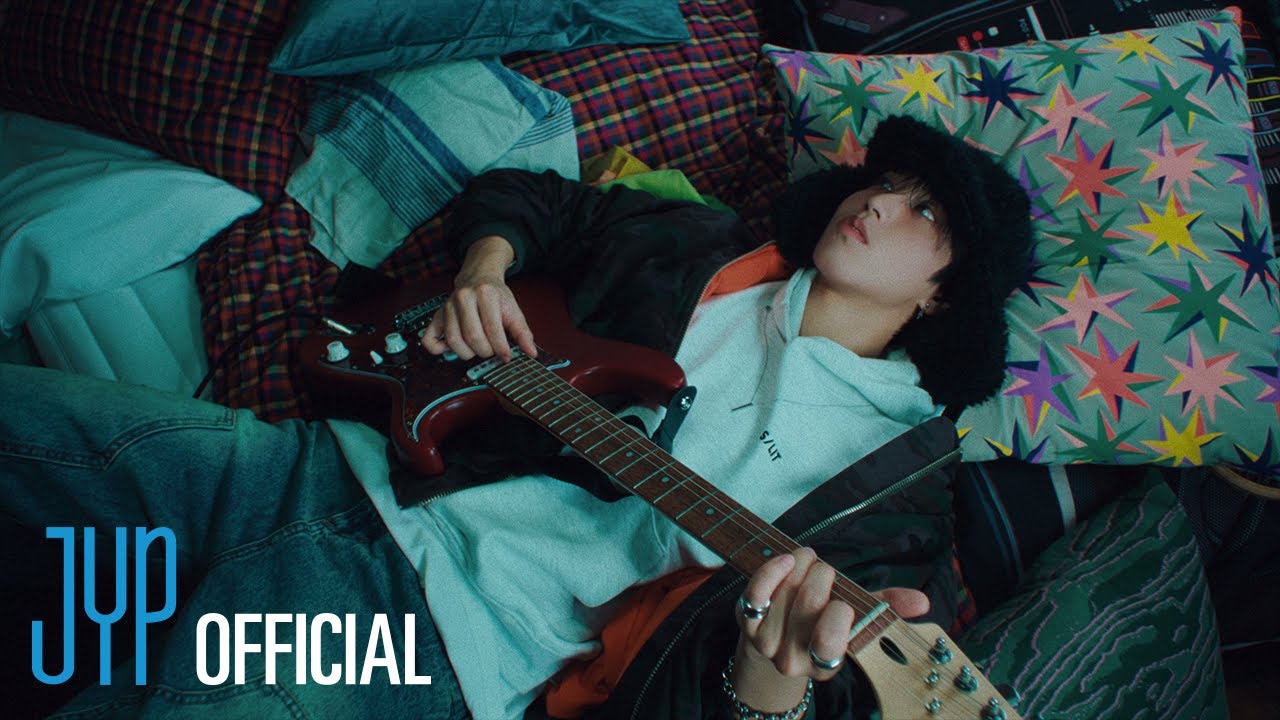
The official SKZ-PLAYER does not need a complicated plot because the song already has a strong verb: reach. The video keeps HAN in motion and lets performance carry the narrative. Close framing makes the invitation personal, while wider moments give the guitar energy room to register. He looks less like a character waiting for rescue and more like the person choosing to run toward contact.
The styling and youthful visual language fit the coming-of-age sound without locking him into childhood. That line is important. Nostalgia can turn an adult performer into a frozen younger self, especially when fans treat every reference as evidence that nothing has changed. The video allows earlier emotional textures to remain visible while the present HAN controls the frame.
I read the recurring sense of movement as emotional transition, not proof of a secret official storyline. That distinction matters. Fans can notice connections across a solo catalog without pretending every color, prop, or camera angle arrived with a decoder ring. The grounded interpretation is already rich: somebody accustomed to private spirals now performs a song built around reaching outward.
The camera’s intimacy also changes the vocal roughness. On audio alone, a pushed note reads as texture. With his face in frame, it becomes effort. That does not mean we can diagnose his private emotions from a performance. It means the director and performer use visible exertion to make the song’s urgency legible. Craft can communicate strain without the audience claiming ownership of the artist’s mental health.
The video’s simplicity is mostly a strength, but I wanted one visual action involving another person’s hand. Not a full romantic plot and definitely not a slow-motion stranger with suspiciously perfect lighting. One brief exchange could have made the title’s reciprocity physical. The current focus preserves the solo spotlight, but the concept remains slightly abstract for a song about contact.
Why this hits harder than “you are not alone”
“You are not alone” can be comforting, but it can also become a sentence people say before disappearing. “Hold my hand” requires proximity. The speaker must remain available long enough for contact. That is a higher standard. It turns care from an opinion into a commitment measured in time and behavior.
The song also understands that support needs permission. An offered hand is not a forced grip. That small distinction protects the person in pain from becoming a project. Good care does not invade, manage, or demand gratitude. It creates a reliable opening and lets the other person decide when to use it.
For fans, that message can feel intimate because idols and audiences already use language about staying together. The danger is pretending the relationship is literally mutual in the same way as friendship. A song can support a listener. A performer can mean the comfort he offers. Neither fact turns a parasocial bond into private access. The healthiest reading accepts the gift without inventing a personal claim on HAN.
That boundary does not reduce the song’s value. Art has always allowed strangers to recognize each other across distance. A writer names a feeling, a listener realizes the feeling has a shape, and the room becomes slightly less sealed. The connection is real as an artistic exchange even when it is not a personal relationship.
“Hold my hand” becomes most useful when it sends the listener back toward actual people. Text the friend. Sit beside the child. Admit you need company. Offer support without taking control. A fandom song earns its deepest value when the emotion survives outside the stream count.
What I like, what I do not, and what stays
What I like: HAN writes the song himself, the guitar gives comfort momentum, and the vocal shifts make the emotion sound lived rather than laminated. The central gesture respects agency. The track can be warm without becoming soft-focus wallpaper.
What I do not like: a few images lean on familiar coming-of-age language, and the short structure leaves little room for the relationship to change. I wanted a bridge that complicates the promise. What happens when the person offering the hand is tired too? That question is already hiding inside HAN’s broader catalog.
What stays: the rough vocal lift, the running energy, and the idea that support can be loud. Comfort does not always arrive with perfect words. Sometimes it arrives out of breath, with a guitar, saying, “I am still here. Grab on.”
RaeRae verdict
“Hold my hand” works because HAN does not confuse tenderness with stillness. He builds care out of movement. The rock frame lets frustration and hope occupy the same body, while his rap instincts keep the language urgent. It feels connected to his lonelier writing without pretending one encouraging chorus solved the person who wrote those earlier songs.
The familiar youth-drama images keep it from being his most original lyric sheet. The performance keeps them from becoming generic. HAN has the vocal flexibility and authorship to make a simple phrase carry history. We hear not only the offered hand, but the rooms he had to leave before he could offer it.
Replay? Yes. It belongs on the “I need motion before I can process feelings” playlist.
Best choice? Giving comfort a rock pulse instead of wrapping it in sad piano.
Final score: 8.7 out of 10. The hand is steady, the amp is on, and nobody is required to heal quietly.
Receipts and official links
- Stray Kids: HAN “Hold my hand” official SKZ-PLAYERDaily+25KTotal views32.6M
- Stray Kids official discography: 合 (HOP) and album context
- Stray Kids official notice archive: “Hold my hand” UNVEIL track listing
Continue with HAN’s canonical artist and Stray Kids member profile.