
Release file
Released: January 16, 2025
Runtime: 03:46
Label / channel trail: BABYMONSTER
Sound: Seven girls walked into a school crush, left the monster branding at the door, and found the kind of hook that waited a year before the internet finally did its homework.
Sources: Exact official playlist uploadDaily+71KTotal views133.1M.
BABYMONSTER | DRIP | RaeRae Reacts
Really Like You
Seven girls walked into a school crush, left the monster branding at the door, and found the kind of hook that waited a year before the internet finally did its homework.
Release file
The first listen removes the vocal obstacle course
The beat enters with an easy head nod instead of a warning siren. That alone changes how BABYMONSTER sounds. The group often gets production built like a talent examination: rap faster, belt higher, switch genres, prove the expensive trainees were worth the wait. “Really Like You” gives the members a pocket and trusts them to stay inside it.
The restraint makes the vocal colors easier to hear. Rami and Rora bring warmth without turning the song into a ballad. Pharita and Chiquita keep the upper register light. Ahyeon adds energy that does not need a skyscraper note. Ruka and Asa rap with conversational bounce rather than attacking the beat like it owes YG money.
The chorus is simple enough to feel obvious after one play. That is not an insult. Pop songs need a door people can find. The repeated confession works because the verses supply the nervous detail around it. A crush turns the brain into a low-budget surveillance office. Every glance becomes evidence. Every casual interaction receives a twelve-page internal report.
My first complaint is that the song behaves so politely it risks becoming background music. The groove stays pleasant, the hook stays clean, and the emotional temperature rarely spikes. One bridge with sharper harmonic tension or a bolder vocal arrangement could have turned a good B-side into an undeniable early single.
What changed every time I replayed it
On the first play, I heard a cute school song. On the second, the rap sections started doing more work. They break up the sweetness and keep the narrator from becoming one soft-focus feeling. The delivery suggests a girl trying to act normal while her thoughts sprint laps around the gym.
By the third play, I understood why the song later found a second life. It is built for casual repetition. The hook does not demand a dramatic mood. The beat fits walking, commuting, studying, or scrolling past a clip that suddenly requires another loop. In early 2026, YG described the song’s renewed popularity after a Japan fan-concert performance and released an official live clip. The comeback was not magic. A relaxed song finally met the setting that showed its charm.
The live version also exposes what the studio recording keeps neat. BABYMONSTER’s playful chemistry becomes part of the rhythm. Expressions, hand gestures, member reactions, and live vocals turn the confession into a shared joke. The song needs that social energy because a crush feels private, but talking about the crush is usually a group project.
Later replays made the production feel less generic. The 1990s hip-hop R&B influence is not a deep historical excavation, but the drum pattern and vocal spacing provide a real foundation. The song borrows an era associated with easy grooves and conversational melodies, then filters it through current idol precision.
The lyrics let a crush stay small enough to be true
The central feeling is not love, fate, or forever. It is liking somebody so much that ordinary time becomes crowded. The person appears in the narrator’s thoughts all day. That scale is believable. Most crushes are not cinematic. They are repetitive, inconvenient, funny, and impossible to explain without sounding slightly ridiculous.
The song avoids making the girls passive. Nervousness does not erase appetite. They know what they feel even when they do not know what the other person will do. That distinction matters for young female performers. Pop culture often treats a girl’s desire as acceptable only when it is innocent enough to require no agency. “Really Like You” lets the members confess, tease, imagine, and enjoy the feeling.
There is still a careful boundary around the writing. The crush remains safe and universal. We do not learn much about the person or the relationship. That makes the song easy to project onto, but it also keeps the narrator from becoming specific. Seven members could have offered seven different symptoms of attraction. The lyrics settle for one shared case file.
From an interpersonal lens, the song captures the period before a relationship becomes negotiation. Nobody has argued about attention, boundaries, expectations, or whose turn it is to text first. The crush exists mostly in imagination. That is why it feels light. It is also why the music should not pretend the emotion is deeper than it is.
From a Buddhist lens, the song is a tiny lesson in attachment without the lecture. The mind grabs one person and repeats the thought because repetition feels like closeness. The feeling is real. The story built around it may not be. BABYMONSTER does not solve that tension. The members dance inside it, which is more honest and much more fun.
The music video puts seven personalities inside one school day
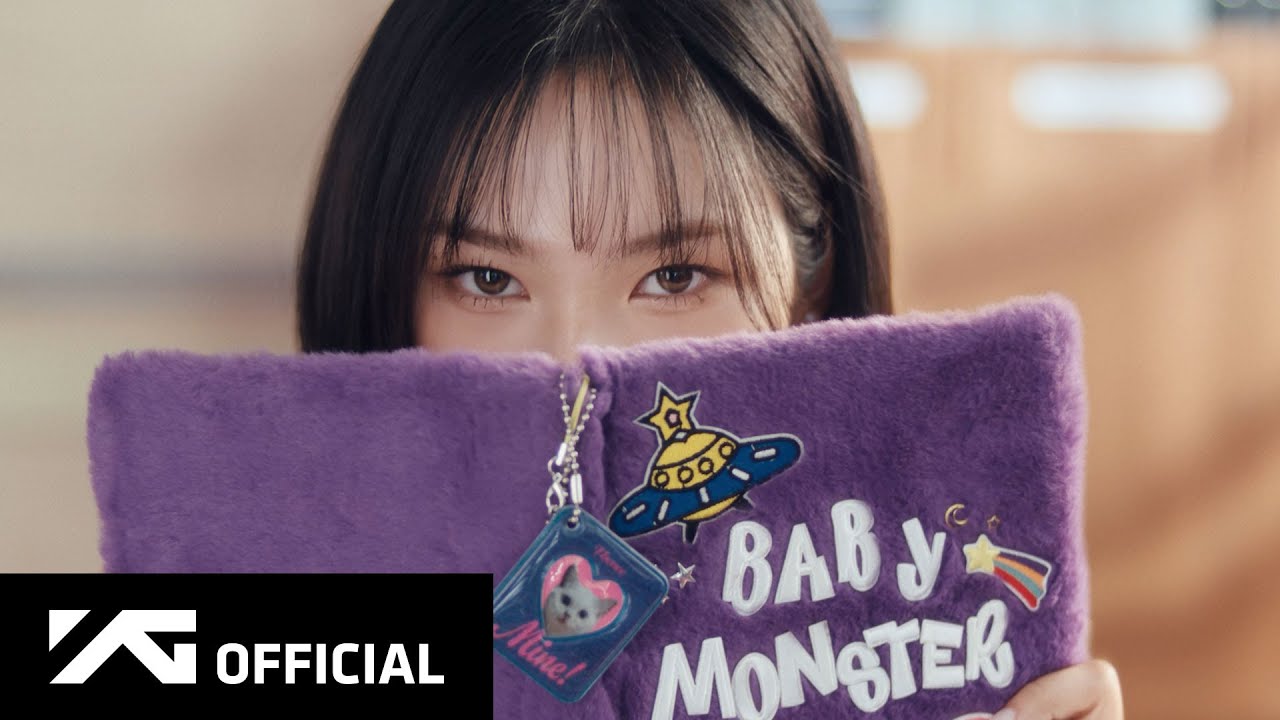
The classroom, hallway, gymnasium, uniforms, Polaroids, and friend-group chatter create a familiar high-teen setting. YG’s official description says the video focuses on ordinary activities and the excitement and nervousness of thinking about a crush. The concept is direct, and that helps. Nobody needs a decoder ring to understand why somebody is staring across the room.
The school setting can feel manufactured because idol videos have used it forever. BABYMONSTER makes it useful through member chemistry. The camera catches glances, teasing, small reactions, and moments where the girls appear to exist in the same social world. That shared world matters more than the desks.
The blue training outfits and gym scenes give the performance a relaxed visual identity. The choreography is readable without looking like a competition routine. Gestures support the confession, and formations keep seven members active without forcing each transition to announce itself.
The Polaroids are the clearest symbol. A crush turns temporary moments into objects the mind keeps handling. The photo freezes something that may not have meant much to the other person. It becomes valuable because the narrator supplies meaning afterward. Cute, yes. Also mildly dangerous if you have ever built a whole relationship from one smile and a borrowed pen.
I wish the video had trusted the members with more unscripted mess. The direction is tasteful, but the school feels extremely clean and the emotional beats arrive exactly where expected. A stranger detail, failed attempt, or awkward misunderstanding would have made the crush more human. Teenagers are not mood boards with backpacks.
The reverse run says something about how music gets discovered
“Really Like You” began as track four on a full album with louder songs receiving the main spotlight. A year later, performance clips and short-form circulation helped listeners return to it. This is how catalog music increasingly behaves. Release week is no longer the only courtroom. Songs can receive a delayed trial when a live stage, meme, edit, or algorithm gives the public a better entry point.
That delay can be healthy for artists. It proves an album track has value beyond the initial marketing plan. It can also encourage companies to treat every old song as dormant content waiting for unpaid fans to revive it. YG eventually released an official live clip and returned the group to music shows, but the audience did the early rediscovery work.
The song’s second life also confirms that vocal ease is part of BABYMONSTER’s appeal. Fans already know the members can belt and rap. “Really Like You” lets them look comfortable, playful, and connected. Talent is not only the hardest note somebody can survive. It is knowing when a simple groove needs personality more than fireworks.
RaeRae verdict
The good: The groove gives all seven members room, the hook earns repetition, and the school video uses chemistry instead of spectacle. The later live performance proves the song becomes stronger when the group can play with it in front of fans.
The limitation: The studio arrangement and video are almost too safe. The lyrics could use more member-specific detail, and the bridge needed one choice that disturbed the polished crush fantasy.
The final call: “Really Like You” did not need to shout its way out of the album. It waited until listeners noticed that BABYMONSTER sounds especially good when nobody is asking the members to win an imaginary trainee evaluation.
Credits and sources
- BABYMONSTER, “Really Like You” official music videoDaily+71KTotal views133.1M
- YG Entertainment, music-video release report
- YG Entertainment, song and video preview
- YG Select, DRIP track credits
- YG Entertainment, 2026 reverse-chart run and live clip report
Continue with BABYMONSTER’s group profile, browse the K-pop group directory, or return to RaeRae Reacts.
Canonical BABYMONSTER profiles
Bottom line
BABYMONSTER | DRIP | RaeRae ReactsReally Like YouSeven girls walked into a school crush, left the monster branding at the door, and found the kind of hook that