
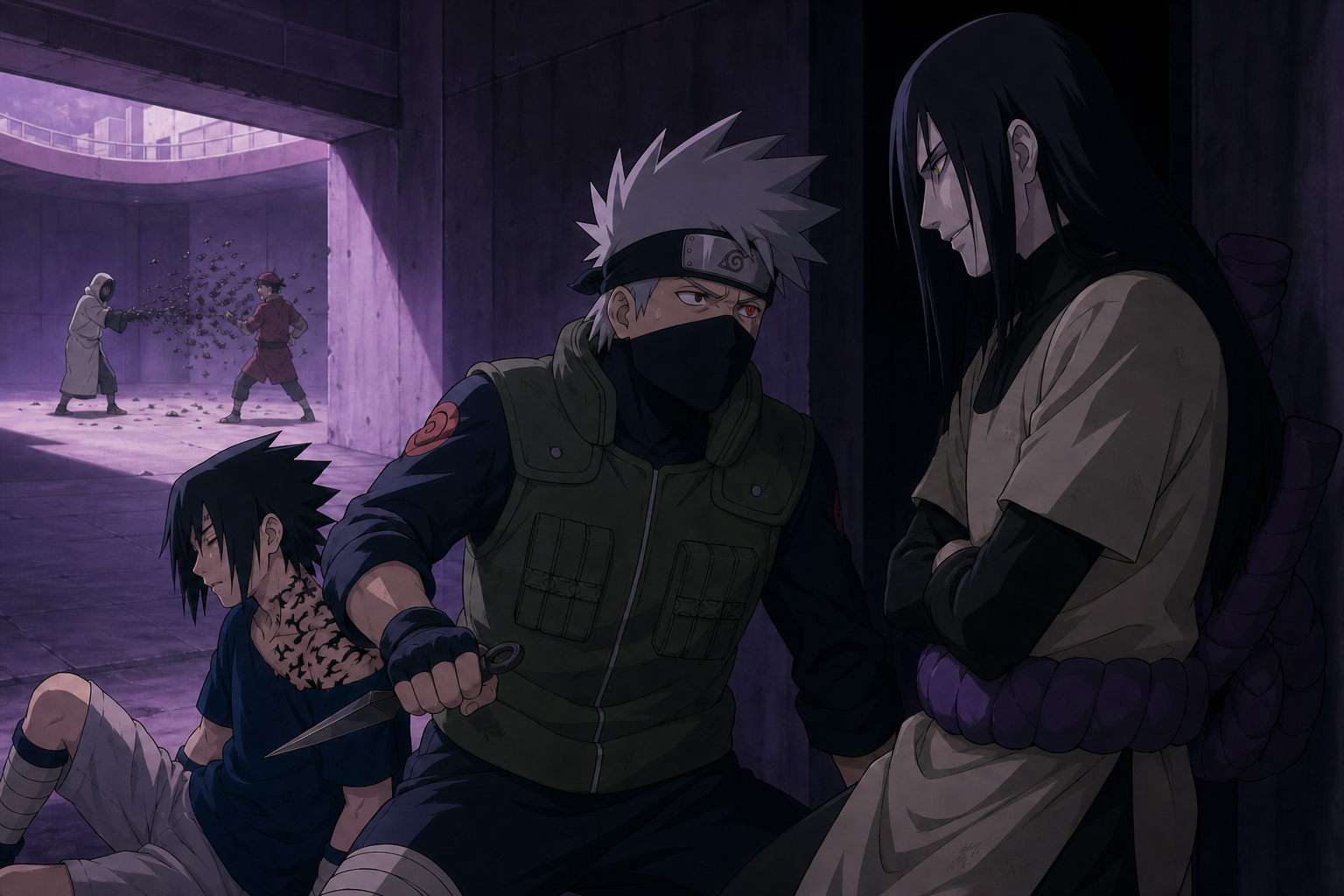
Kakashi and Orochimaru: Face-to-Face!
Kakashi seals Orochimaru’s mark, then discovers the predator already waiting in the room. Upstairs, Shino begins dismantling Zaku with the patience of somebody closing every exit before touching the door.
Episode 40 is about adults fighting over who gets to shape Sasuke’s future while Sasuke is unconscious on the floor. Kakashi uses a containment seal and stands between his student and Orochimaru. Orochimaru talks about the Sharingan like a rare component he has already ordered. One adult recognizes a child’s agency and tries to protect it. The other predicts that pain will eventually make the child volunteer for exploitation.
Meanwhile, Shino and Zaku show the same conflict through combat design. Zaku performs loud power and hides information. Shino studies the system, closes the airflow and lets consequences arrive from inside the weapon. One plot argues about ownership of a body. The other demonstrates why control without understanding is an accident waiting to collect somebody.
Kakashi treats the curse mark as a containment problem
After Sasuke wins the first preliminary, Kakashi Hatake removes him from the arena and performs the Evil Sealing Method around the mark on his neck. The technique does not erase Orochimaru’s seal. It builds a restraint around it.
Kakashi explains the ugly limitation: the containment depends partly on Sasuke’s will. If Sasuke chooses the curse mark’s power, the added seal may fail. Medical or technical intervention can create space, but it cannot permanently make the moral decision for him.
That is not a reason to blame Sasuke if the mark later activates. Orochimaru imposed the system and designed it to exploit desire under stress. Agency matters inside coercion without turning coercion into the victim’s fault.
The sealing ritual is care without a fantasy cure
Kakashi does not promise that one jutsu fixes everything. He gives Sasuke a barrier, information and supervision. That is more responsible than pretending the mark is gone because the pattern looks tidy.
The scene understands trauma management better than many magical cure stories. Containment can reduce immediate danger while the source remains active. A person may still need choice, support and repeated intervention.
Kakashi’s care is technical and relational. He knows the seal’s mechanics, and he knows Sasuke’s hunger for power. A generic medic could address the first problem. A teacher has to reckon with both.
Orochimaru was already inside the safe room
Orochimaru appears after the sealing. That entrance destroys the comfort of private treatment. Kakashi removed Sasuke from the public arena, but the person who violated him can still enter the protected space.
This is not a random jump scare. Orochimaru wants Kakashi to understand that ordinary boundaries do not contain him. Forest security failed. Exam security failed. Now the recovery room fails.
Predators cultivate that feeling of inevitability. If every door opens for them, resistance starts to look childish. Kakashi’s refusal matters because it rejects inevitability even when he knows the power difference is brutal.
Orochimaru speaks about the Sharingan as property
Orochimaru states that he wants the Uchiha clan’s Sharingan for his ambitions. Sasuke’s grief, identity and future disappear inside that sentence. The boy becomes a delivery system for desirable eyes.
That objectification sits at the center of Orochimaru’s science. Bodies are containers, techniques are collectible and subordinates are replaceable. Curiosity has detached from reciprocity and consent.
The series does not condemn knowledge itself. Kakashi just used sophisticated fūinjutsu to protect someone. The moral line is what knowledge serves and who gets treated as human during its pursuit.
He predicts that Sasuke will eventually come willingly
Orochimaru does not need to drag Sasuke away today. He believes Sasuke’s desire for revenge will lead him toward any source of power strong enough to kill Itachi.
That prediction is grooming logic. The predator creates a wound, offers himself as the answer and calls the victim’s later approach proof of free choice. It ignores how deliberately the options were manipulated.
Orochimaru also understands a real vulnerability. Sasuke has tied his worth to vengeance. Kakashi cannot protect him only by guarding doors. He has to offer a life and a form of strength that do not make Orochimaru’s bargain feel like the only road.
Kakashi threatens a fight he knows he may lose
Kakashi exposes the Sharingan, raises his weapon and tells Orochimaru that they can die together. The stance is protective, not delusional. He is buying a boundary with whatever threat he can credibly create.
After Orochimaru leaves, Kakashi recognizes how frightening the confrontation was. His body catches up with the bravado. That honesty makes the courage better. Courage without fear is sometimes just bad risk assessment wearing a cool pose.
Kakashi does not need to believe he is stronger. He needs Orochimaru to believe harming Sasuke will carry cost. Protection often begins before certainty arrives.
The Sharingan connects Kakashi and Sasuke without making them the same
Kakashi carries one Sharingan received from Obito. Sasuke carries the Uchiha inheritance Orochimaru wants. Both men know what it means for an eye to shape how other people value them.
Their histories remain different. Kakashi’s eye is a gift bound to grief and promise. Sasuke’s eyes are inherited through a clan whose massacre defines his life. Orochimaru flattens both forms of meaning into utility.
Kakashi’s defense therefore carries professional duty and personal recognition. He sees more than a rare technique because he knows what it costs when identity collapses into the power other people want from your body.
Upstairs, Shino begins with information
Shino Aburame faces Zaku Abumi in the next preliminary. Shino studies before he attacks. He knows Zaku’s arms channel destructive air pressure and that Sasuke injured one arm in the forest.
Zaku hides that both arms can still function. The deception is smart because Shino might build a plan around false limitation. Information is part of the battlefield, and Zaku understands that much.
The problem is that Shino also understands systems. He does not only watch which arm moves. He asks where the air travels and what the mechanism requires.
Zaku performs power because Sound trained him to be disposable
Zaku’s arm modifications produce dramatic force. He treats them as proof that he can overpower Shino directly. That confidence has history. Orochimaru selected and altered children to function as weapons, then sent them into an exam serving a different objective.
The Sound trio believe power may earn value from the adult controlling them. Orochimaru’s conversation downstairs tells us otherwise. He wants Sasuke. Zaku, Dosu and Kin are useful pieces until they are not.
Zaku’s aggression is still his responsibility. Exploitation explains why domination became his language; it does not make the damage harmless.
Shino warns before he punishes
Shino offers Zaku an opportunity to withdraw. That warning is not weakness or empty politeness. Shino has already begun shaping the battlefield.
He gives the opponent information about risk while preserving control over the information that matters. Zaku hears a quiet boy making a suggestion and mistakes volume for authority.
This is Shino’s recurring combat grammar. He does not need emotional spectacle to prove confidence. The calmer he is, the more likely the trap started before the other person realized there was a problem.
The insects attack infrastructure, not ego
The Aburame kikaichū consume chakra and move in coordinated swarms. Against Zaku, their usefulness is not limited to biting an opponent. They can occupy pathways and change how his arm mechanism behaves.
Shino treats the air tubes as infrastructure. If a weapon depends on controlled flow, blocking the route can turn pressure back toward its source. The strategic target is not the loud blast. It is the hidden condition that makes the blast possible.
That approach is why Shino’s fights reward attention. He attacks assumptions. By the time the opponent notices the visible consequence, the decisive work may already be done.
The two plots share a body-ownership argument
Orochimaru wants Sasuke’s body because of what it can carry. He also modified Zaku’s body to carry weapons. One boy is desired inventory; the other is deployed inventory.
Kakashi tries to preserve Sasuke’s ability to choose. Shino exposes how little care went into Zaku beyond function. The episode places protection and exploitation beside each other without needing a speech connecting them.
Power attached to a body is never only a combat statistic in this story. Somebody teaches it, inherits it, alters it, desires it or tries to control the person who owns it.
Japanese performance makes the threat intimate
Kujira performs Orochimaru in the original Japanese anime with a calm that makes possession sound like settled business. He does not need to shout because he believes time and desire already work for him.
Kazuhiko Inoue lets Kakashi hold professional control through the confrontation, then exposes the fear underneath after Orochimaru leaves. Noriaki Sugiyama’s exhausted Sasuke keeps the child’s physical cost present even while adults discuss his future.
Shinji Kawada gives Shino measured certainty, while Keijin Okuda gives Zaku the sharp confidence of a boy invested in force. The performances split the episode into quiet menace and loud insecurity without treating either as empty style.
Direction uses parallel spaces to expose hierarchy
The lower chamber is close, dark and private. Kakashi and Orochimaru discuss control of one unconscious child. The arena is open and observed. Shino and Zaku display abilities before officials and peers.
Both spaces belong to the same exam complex. Public competition sits above private predation. The architecture becomes an institutional diagram whether the building intended it or not.
Cutting between the scenes also keeps the episode from turning Orochimaru’s exposition into a pause. Each plot advances the same themes through a different rhythm.
A Confucian reading asks what teachers owe students
Confucian role ethics gives a teacher obligations beyond transmitting skill. Authority should cultivate, protect and model responsibility. Kakashi acts inside that duty when he seals the mark and stands between Sasuke and Orochimaru.
Orochimaru also calls himself a teacher and gathers students, but reciprocity is absent. He treats disciples as experiments and tools. Hierarchy without benevolence becomes domination.
The contrast matters because both adults possess knowledge. Expertise alone does not create moral authority. The relationship determines what the knowledge becomes.
A Buddhist lens sees craving reproduce harm
Orochimaru’s craving for techniques and immortality turns every person into something incomplete he might acquire. Satisfaction keeps moving because possession strengthens the habit of wanting more.
Sasuke’s craving for revenge makes that appetite able to reach him. Zaku’s attachment to proving strength makes Shino’s warning sound insulting rather than useful.
The episode does not argue that desire disappears through one good decision. It shows how unexamined craving narrows choices until exploitation feels inevitable.
What Episode 40 changes
Kakashi places an additional seal over Sasuke’s curse mark and learns directly that Orochimaru wants the Sharingan. Orochimaru predicts Sasuke will seek him for power.
Kakashi commits to protecting his student despite understanding the gap between his strength and Orochimaru’s. The confrontation confirms that the exam breach is part of a longer recruitment strategy.
Shino and Zaku begin the second preliminary. Zaku reveals that both arms remain usable, while Shino’s insects begin turning the weapon system itself into the battlefield.
RaeRae’s verdict
Kakashi standing in front of Sasuke while knowing Orochimaru can probably fold him like laundry is the point. Protection is not a power-scaling claim. It is a decision about whose body does not belong to the predator.
And Shino? That child does not fight your explosion. He audits the plumbing. By the time you understand the meeting agenda, the insects are already inside the presentation.
Fandom misreadings I am rejecting
“The Evil Sealing Method cures the curse mark.” It restrains activation and depends partly on Sasuke’s resistance.
“Sasuke will choose Orochimaru freely.” Future agency exists inside deliberate grooming, imposed harm and manipulated options.
“Kakashi was foolish to threaten someone stronger.” He was establishing cost and protecting a vulnerable student, not announcing a tournament prediction.
“Orochimaru values Zaku because he upgraded him.” Modification increases usefulness. It does not prove care.
“Shino is passive because he is quiet.” His strategy begins before visible impact and controls the mechanism beneath the fight.
“This episode is two unrelated plots.” Both examine adults or fighters trying to control what another body can do.
Receipts and official routes
Episode number, English title and official synopsis: Naruto Official Site. Japanese broadcast title and synopsis: TV Tokyo. Streaming availability varies by region; use the official options linked from the episode directory.