
Mirajane Strauss
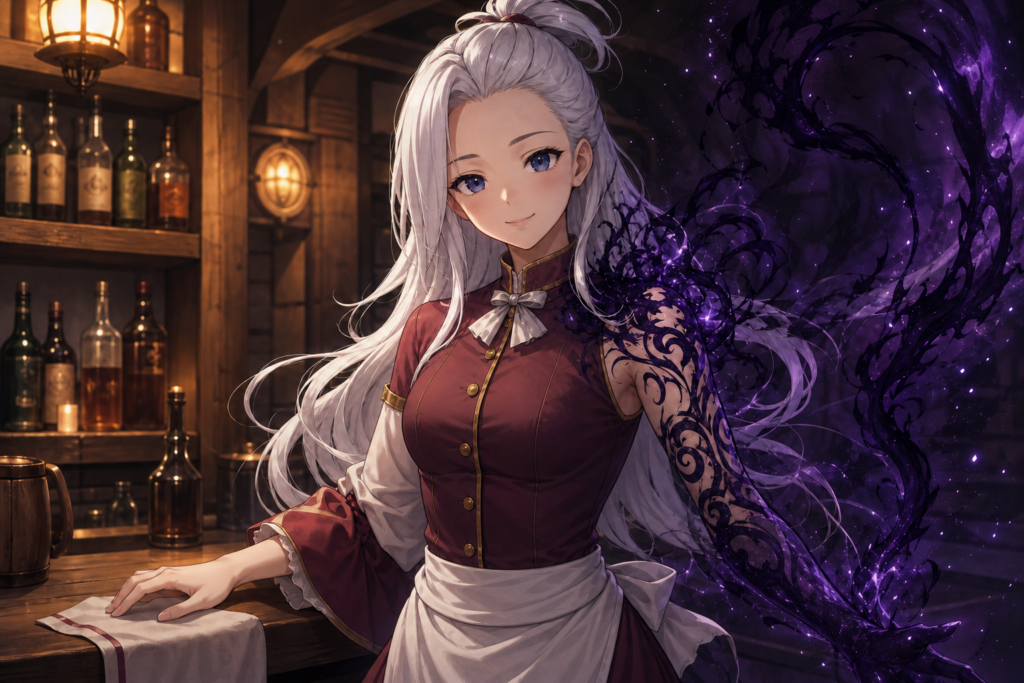
CVM Sekai character profile
Bottom line
Mirajane Strauss is not secretly powerful despite being kind. She is kind because she knows what uncontrolled power, public fear and private grief can do to a family. The younger Mirajane is aggressive, proud and willing to fight Erza over almost anything with oxygen. The adult guild-hall steward smiles, manages the bar, helps assign work and gives Lucy one of her earliest experiences of welcome inside Fairy Tail. Satan Soul does not expose the “real” woman hiding beneath a fake hostess.
Both identities are real. Lisanna’s apparent death changes how Mirajane uses her body, magic and authority. She steps away from missions and turns strength into caretaking. Later, when Elfman is threatened during the Battle of Fairy Tail, her combat magic returns. The point is not that grief made her weak and anger fixed her. The point is that survival reorganized her labor. Mirajane learns to fight again without giving up the person who kept the guild functioning while everybody else punched architecture.
Who Mirajane Strauss is
Her name is Mirajane Strauss, written ミラジェーン・ストラウス in Japanese. She is the oldest Strauss sibling, an S-Class Fairy Tail mage and a Take Over specialist best known for Satan Soul. Ryōko Ono is her Japanese performer in Television Tokyo’s official cast record. Mirajane appears in the guild from the opening stretch of the manga and anime. Her exact chapter debut stays unnumbered here until a licensed K MANGA page supplies a direct receipt. Television Tokyo’s DVD archive includes her from the first four-episode release because she is part of Lucy’s introduction to the guild.
Public official pages do not provide stable canonical height, weight or other full vitals. Those numbers stay out. Her recognizable design uses long white hair, blue eyes and the distinctive front tuft pulled upward. Her ordinary guild clothing and bar role are as canonical as her demonic transformations. A hero image that shows a modest guild uniform and partial Satan Soul can communicate both identities without making cleavage do the biography’s job.
A demon arm becomes a village verdict
Mirajane’s childhood changes when she uses Take Over on a demon and her arm takes on a demonic appearance. The village reads the visible difference as possession and moral contamination. That reaction is culturally familiar in stories where the body becomes evidence of spiritual danger. The community does not ask what happened, what control she has or what help she needs. The village sees a frightening limb and decides the child is the threat.
Fairy Tail offers another interpretation. Makarov identifies the condition as magic rather than proof that Mirajane is evil. The distinction gives the Strauss siblings a language for what happened and a place to learn. Naming is not a small kindness. “Monster” isolates. “Take Over mage” creates technique, limits and responsibility. Fairy Tail does not remove danger. Fairy Tail removes the idea that danger determines personhood.
Elfman and Lisanna refuse to let her carry monstrosity alone
Elfman and Lisanna remain with Mirajane. They later develop their own Take Over paths, Beast Soul and Animal Soul. Their choices turn magic into family language. Mirajane is no longer the one marked sibling everybody else has to protect themselves from. The family learns related techniques and builds shared understanding. That solidarity is loving. That solidarity also creates risk.
Take Over requires control over forms drawn from other beings. Power can exceed the user’s capacity. Elfman’s later loss of control proves that support does not delete mechanics. The Strauss siblings are not safe because they love one another enough. They are safer when love includes training, limits and permission to stop.
Erza and Mirajane are rivals before they are complementary leaders
Young Mirajane and Erza clash constantly. Both are powerful girls inside a guild that rewards spectacle, toughness and mission rank. Their rivalry is not simply “mean girl versus strict girl.” Erza uses armor and rules to establish control after captivity. Mirajane uses aggression and demonic power after a community labels her dangerous. Both girls perform strength before either has much reason to trust vulnerability.
As adults, they lead differently. Erza is visible field authority. Mirajane runs social infrastructure inside the guild hall and remains capable of S-Class combat. The difference should not become hierarchy. Hospitality is not lesser leadership. Combat rank is not a personality. Fairy Tail needs the woman who stops the fight and the woman who knows who has eaten, who needs a job and which newcomer is pretending not to be scared. Sometimes those are the same woman.
Lisanna's apparent death restructures the whole family
During a Strauss-sibling mission, Elfman loses control of a Beast Soul transformation. Lisanna appears to die while trying to reach him. The event is not one person’s trauma. Elfman carries guilt for the uncontrolled body and the harm that follows. Mirajane loses a sister and watches her brother become another casualty of the same moment. The family structure collapses around an absence nobody knows is actually an Anima displacement to Edolas.
Mirajane steps away from active combat and becomes gentler in public. That shift is often described as a personality change. The change is also labor redistribution. She moves from dangerous missions into guild-hall care, administration and emotional support. The guild benefits from her grief response. That consequence deserves attention. Institutions are very comfortable praising the nurturing person without asking what made her stop asking for anything else.
The guild bar is work, not decorative retirement
Mirajane serves drinks, handles information, assists with jobs and becomes one of Fairy Tail’s public faces. She welcomes Lucy into the guild’s social ecosystem. She interprets behavior, explains relationships and helps make chaos legible. That is not combat, but it is operational labor. The guild’s strongest fighters can leave on missions because somebody maintains the space they return to. Emotional care, record knowledge and hospitality keep chosen family from becoming a slogan shouted during boss fights.
Fairy Tail sometimes treats Mirajane’s bar role as evidence that she is retired, harmless or available for pinup framing. The profile rejects that reading. Care work is not a lack of ambition. Guild-hall care can be choice, grief response, skill and burden at the same time.
The Battle of Fairy Tail makes anger reopen the magic
During Laxus’s coup, Freed’s actions place Elfman in danger and push Mirajane back into Satan Soul. She defeats Freed. The scene is satisfying because the guild’s gentle steward reveals S-Class force. That control is also easy to misread. Mirajane did not need Elfman threatened in order to become her “real” self again. The transformation shows that the combat capacity remained connected to fear, grief and protective rage.
Freed remains responsible for participating in the coup and using barriers and combat against guildmates. His later reform does not make Mirajane’s trigger a helpful favor. The fight also gives her a new problem. Returning power does not instantly restore stamina, mission rhythm or emotional readiness. Trauma is not cured because the special effect looked expensive.
Satan Soul is controlled embodiment, not generic demon command
Take Over allows Mirajane to assume characteristics and power associated with demonic beings she has successfully absorbed or mastered under the series’ magical rules. Satan Soul changes her body, movement and attack capacity. Different forms emphasize different levels of force, speed, endurance and magical cost. The exact form shelf should follow licensed chapters because translations and adaptation-only material can blur the record. Satan Soul is the core identity. Sitri and Alegria belong only where the licensed source confirms their use and conditions. Halphas and other forms require medium labels rather than silent canon merging.
Mirajane does not control every demon in the franchise because she uses demon-themed Take Over. Absorption has conditions. Strong forms consume enormous magic. Injury, exhaustion and incomplete control matter. Her power is frightening because it is specific, not because the biography claims universal dominion.
Edolas returns Lisanna without returning the lost years
Edolas reveals that Lisanna survived through Anima displacement and lived with the Edolas Strauss family. The reunion gives Mirajane and Elfman their sister back. Lisanna’s return does not erase the years of grief. Lisanna also has her own experience. She knows the Edolas siblings are not biologically hers and stays partly to protect their happiness. Returning to Earth-land means losing another family structure.
Mirajane’s joy should not swallow Lisanna’s divided grief. Elfman’s guilt does not vanish because the event receives a new explanation. Nobody gets the old family back untouched. They build a new version with more truth inside it.
Tenrou Island shows the cost of interrupted training
Mirajane participates in the Tenrou Island period and fights Azuma during the Grimoire Heart attack. Her power is real, but so are stamina and tactical limits after years away from regular S-Class combat. The encounter uses Lisanna and sibling protection to pressure her. That pattern is becoming a bill: enemies repeatedly understand that threatening family can force Mirajane into greater output.
Protective rage is effective. The defeat is also predictable. Mirajane loses when the conditions and opponent exceed what emotion alone can solve. The defeat does not prove her S-Class status was hype. The outcome proves power needs current practice, information and resources. Fairy Sphere then removes the Tenrou group from time for seven years. Mirajane returns to a changed guild and again becomes part of rebuilding its social center.
Grand Magic Games fanservice cannot replace the record
The Grand Magic Games use Mirajane in Team B and in an exhibition with Jenny Realight. The exhibition leans heavily on modeling, costumes and audience spectacle. That is adaptation and industry information. The franchise knows Mirajane is popular, attractive and associated with magazine work. The franchise also knows fanservice can generate attention without advancing Mirajane’s combat or grief story.
The profile can acknowledge the scene without pretending a swimsuit display is a major magical feat. Mirajane’s tournament role still confirms that Fairy Tail considers her part of its high-level roster. Her absence from every decisive match does not make her powerless. That imbalance shows how ensemble allocation and marketable framing affect who receives narrative work. The industry lens is not prudishness. The criticism asks why a woman with Satan Soul keeps receiving wardrobe evidence where male S-Class peers receive battle evidence.
Tartaros makes Take Over an answer to coercion
Tartaros gives Mirajane direct conflict with Seilah, whose Macro curse controls other people’s bodies. Macro is the opposite of ethical care. Coercion removes agency and turns people into instruments. Elfman becomes part of that coercive chain. Mirajane’s sibling history makes the violation especially sharp: once again, an outside force uses a family member’s body to reach the rest.
Mirajane’s eventual absorption of Seilah’s power gives her access to a form of that ability, but the biography must not flatten this into unrestricted mind control. The source, conditions and later use matter. Alegria and the Tartaros environment also push her Take Over capacity and magic reserves. Her escape and combat contribute to a collective operation involving many teams. She does not absorb Tartaros as a category and become queen of all demons. Specificity is stronger than fandom inflation.
Alvarez tests endurance after the spotlight moves elsewhere
During Alvarez, Mirajane fights Jacob Lessio and faces other dangerous opponents as the war shifts across Magnolia. Irene also transforms two swords into female combatants who engage Mirajane. Their individual names should appear only when the licensed chapter or episode is directly verified. This candidate keeps the description functional instead of gambling on a subtitle spelling.
Mirajane enters these encounters after earlier battles have already consumed magic. That matters. Ensemble stories often show a powerful character losing late and let fandom call it inconsistency while ignoring the resource chain. Satan Soul is expensive. Multiple transformations and fights accumulate cost. Surprise and opponent mechanics matter. The profile should preserve what she accomplishes and what the war takes from her without turning endurance into invulnerability.
Lucy receives welcome, then has to fight the controlled version
Mirajane helps introduce Lucy to Fairy Tail’s social life. Their early relationship is not maternal ownership. Lucy is a young adult newcomer, not a child assigned to the bar woman. Mirajane offers warmth and information while Lucy builds her own place. In 100 Years Quest, the White Mage’s control turns Mirajane and Elfman against Lucy during the Aldoron conflict. Official Episode 10 places Lucy against Mirajane’s group and gives Lucy a new Star Dress Mix technique to answer powerful guildmates.
The reversal matters. The woman who made the guild feel safe becomes an involuntary threat inside it. Lucy has to protect herself without treating controlled friends as willing enemies. Mirajane’s strength remains credible because Lucy needs strategy and new magic. Lucy’s victory or survival does not require degrading Mirajane. Agency is the battlefield, not fandom ranking.
Spoilers: the sequel keeps her important without adding her to the travel team
Mirajane remains a Fairy Tail member while Natsu, Lucy, Gray, Erza, Wendy, Happy and Carla travel on the 100 Years Quest. She is not part of that core traveling party. The White Mage conflict brings her into the Aldoron operation through guild-wide control. Official Episodes 9 and 10 place controlled Mirajane among the attackers and then against Lucy. Episode 16 describes liberated guild members joining the larger God Seed battle.
Those are concrete contributions. Later guild defense and family material belong where licensed volumes place them. The profile will not invent finishing blows, Dragon God travel or secret missions because Mirajane fans reasonably want more screen time. Wanting more is fandom interpretation. Claiming it happened is bad biography.
Elfman carries guilt, but Mirajane cannot carry it for him
Elfman’s lost control connects directly to Lisanna’s apparent death. He changes his relationship to masculinity, courage and transformation after the event. Mirajane protects him fiercely. Protection can become overfunctioning when one sibling manages everybody’s pain and leaves no room for her own. Elfman has to build his own accountability and recovery. Mirajane cannot make the accident harmless by becoming permanently gentle. She cannot prevent every later coercion by fighting harder. Their strongest relationship is mutual: he protects her without needing to be “the man,” and she trusts him without becoming his emotional shield.
Lisanna's return cannot be used to cancel grief
Lisanna is not a lesson delivered to Mirajane and Elfman. She is a person who experiences Earth-land, Edolas, two sibling groups and reintegration. Mirajane’s profile must keep Lisanna’s agency visible. The reunion heals some uncertainty and creates new complexity. Grief was real because the loss was real to the people living it. Later information changes the future, not the past tense.
That is why Mirajane’s adult personality remains meaningful after Lisanna returns. She does not snap back into the aggressive teenager because the original trigger has been corrected. Growth is not a software rollback.
Ryōko Ono has to hold the two public registers together
Ryōko Ono is Mirajane’s official Japanese performer. This profile does not invent breath, pitch or timing observations without a controlled Japanese-audio review. The performance challenge is continuity. Guild-hall warmth, deadpan teasing, grief, sibling panic and Satan Soul authority must sound like one woman whose register changes with context. If the battle voice becomes a separate demon persona, the adaptation loses Mirajane’s control. If the gentle voice becomes empty sweetness, it loses the labor and grief underneath.
Direction has the same responsibility. Transformation can be powerful without sexualizing every stage. Fanservice can be labeled as industry framing rather than mistaken for character depth. Quiet bar scenes need enough attention to make the guild feel like a place Mirajane actually maintains. The spectacle and the service are both canon.
Relationship atlas
Lisanna Strauss
Younger sister whose apparent death restructures Mirajane’s identity. Edolas survival changes the future without erasing the grief years or Lisanna’s second-family loss. Their reunion matters because both women must meet again as changed people, not pretend the missing years never existed.
Elfman Strauss
Younger brother tied to the Beast Soul accident, mutual guilt and later coercion. Mirajane cannot heal him by carrying every feeling herself. Elfman’s recovery requires his own choices, while Mirajane’s care becomes healthier when support stops meaning silent self-erasure.
Erza Scarlet
Childhood rival and adult S-Class peer. Mirajane and Erza model different forms of visible leadership without one invalidating the other. Their adulthood works best when the story treats hospitality, field command, emotional steadiness and combat skill as complementary forms of labor.
Lucy Heartfilia
Lucy enters Fairy Tail through Mirajane’s welcome and later faces her as a controlled guild opponent. Their relationship preserves Lucy’s adulthood and independent competence while showing that Mirajane’s warmth is active social work, not passive decoration behind a bar.
Freed Justine
Freed’s willing role in the Battle of Fairy Tail and threat to Elfman trigger Mirajane’s return to combat. Later alliance does not erase responsibility. Their shared guild membership only becomes believable when reconciliation keeps the original harm visible.
Makarov Dreyar
Makarov gives the Strauss siblings language for Take Over as magic rather than moral corruption. That intervention changes their possible future because a trusted adult replaces a village’s panic with technique, boundaries and a place where frightened children can learn.
Fairy Tail
Fairy Tail is the chosen home that benefits from Mirajane’s combat power and care labor. The guild should value both without exploiting either, especially when members praise her kindness while assuming she will absorb every administrative and emotional burden without complaint.
Media and continuity shelf
The main biography follows Hiro Mashima’s 63-volume manga and the licensed 100 Years Quest sequel by Mashima and Atsuo Ueda. Anime-original arcs, films, OVAs and games remain labeled by medium. Some Satan Soul forms and exhibition material vary by adaptation. Exact form names, first uses and continuity must follow licensed receipts. Game costumes and abilities do not set manga canon. Ryōko Ono is the Japanese performer discussed here. English-dub performance remains outside this profile’s scope.
Final verdict
Mirajane Strauss does not have a gentle side and a powerful side. She has one life shaped by fear, family, grief, labor and choice. The demonic arm was never proof she was a monster. The bar apron was never proof she stopped being dangerous. Satan Soul does not reveal a truer woman than the person who welcomed Lucy. Kindness is not what remains after power leaves. Kindness is what Mirajane chooses to do with power after learning exactly what power can cost.
Source ledger and clean boundaries
Public official pages reviewed here do not expose stable full vitals, a directly indexed exact debut chapter, a complete film/OVA/game roster or every Satan Soul form’s first-use wording. Those details are omitted or held for licensed receipts. The transformed-sword opponents in Alvarez remain unnamed until a direct episode or chapter verifies spelling.