
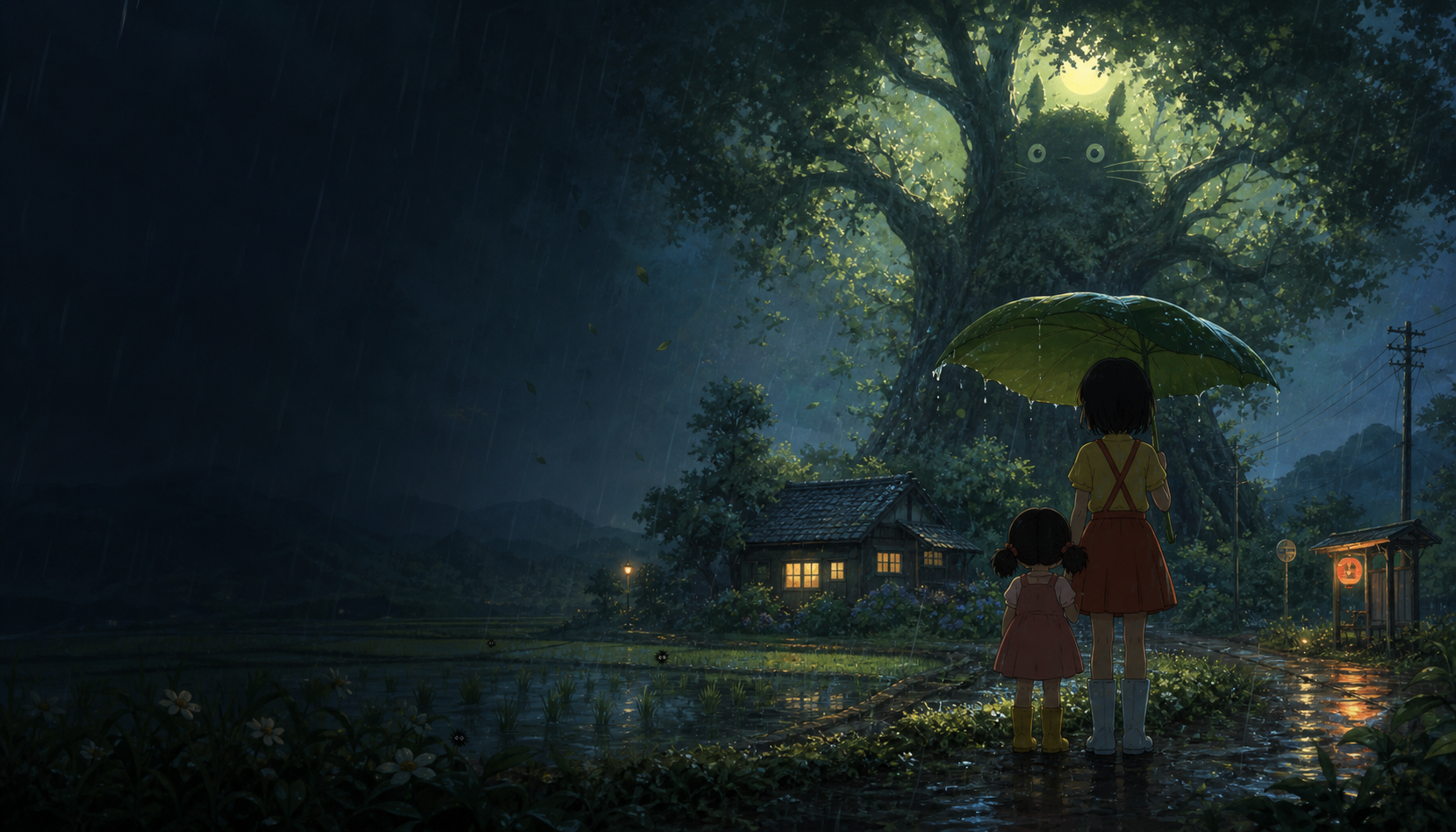
My Neighbor Totoro
A mother is sick, a family is waiting, and Hayao Miyazaki refuses to turn childhood fear into either tragedy porn or a motivational lesson.
My Neighbor Totoro has been merchandised so thoroughly that the soft gray forest spirit can look like the entire point. Totoro appears on plush toys, lunch boxes, studio branding, stage productions, and the mental list of characters adults use when they want to prove that they remain whimsical. The film surrounding him remains stranger, quieter, and more emotionally precise than that commercial afterlife suggests. Hayao Miyazaki did not make a story about a magical friend who fixes a family. He made a story about two sisters living beside uncertainty, where wonder gives fear somewhere to breathe without making fear disappear.
Satsuki and Mei move to the countryside with their father because their mother is receiving treatment at a nearby hospital. That sentence supplies almost every conventional plot engine a family movie could exploit. A lesser script might reveal a villain, cure the mother through belief, or make the children learn a tidy lesson about patience. Miyazaki avoids all three. Illness stays ordinary and frightening. Adults stay loving and limited. The forest stays alive without becoming a customer-service desk for human wishes.
Contents
- My actual reaction
- A family without a villain
- The countryside and satoyama
- What Totoro is
- Childhood beside illness
- Satsuki and Mei
- The adults get to be human
- The radical patience of the film
- Sound, music, and weather
- Four scenes worth studying
- The death theory problem
- Production history
- Cultural and industry impact
- What aged well
- Final take
My actual reaction: nothing is chasing them, and I still worry
The first half feels almost plotless until the viewer notices how much emotional work happens through chores. The family opens shutters, pumps water, sweeps rooms, cooks, bathes, bikes, waits for buses, and visits the hospital. Ordinary tasks establish safety through repetition. When the children encounter soot sprites or a forest spirit, magic does not interrupt reality. Magic joins a household already learning its rhythms.
The film’s suspense comes from information that nobody can control. Their mother may recover, but another cold can delay her return. The father can reassure his daughters, but he cannot promise a date with certainty. Satsuki can manage school and lunch and Mei until one more disappointment breaks the arrangement. Nobody behaves like a villain. That absence makes the fear more honest. Most childhood emergencies do not begin because an evil adult announces a plan. They begin because a loving family reaches the edge of available energy.
Totoro gives the movie an image large enough to hold feelings the dialogue leaves alone. He can roar, sleep, fly, wait, grin, and make seeds grow. He never explains himself. Children do not need a lecture before accepting comfort. Adults often demand that a symbol declare one meaning. Mei climbs onto a breathing forest body and takes a nap.
A family without a villain
The Kusakabe family feels unusual because affection does not erase strain. Tatsuo loves his daughters and remains distracted. Yasuko loves her family and cannot leave the hospital on schedule. Satsuki loves Mei and resents the labor that love sometimes requires. Mei loves everybody and still screams when waiting becomes unbearable. The film allows each person to be kind without requiring endless emotional competence.
Tatsuo’s parenting receives both warmth and scrutiny. He treats the soot sprites seriously because his daughters need their discovery respected. He laughs inside the creaking bath to help everyone face the unfamiliar house. He also brings Mei to Satsuki’s classroom because no childcare solution exists. His academic work continues while Satsuki performs a surprising amount of domestic labor. Miyazaki does not frame him as negligent, yet the household shows how quickly an older daughter becomes a second caregiver when a mother is absent.
That detail makes Satsuki’s eventual breakdown necessary rather than shocking. She has been “the capable one” for most of the story. Adults praise capable children because capable children reduce adult anxiety. Praise can hide a dangerous bargain. The child receives approval in exchange for needing less. Satsuki manages until news from the hospital threatens the promised visit, and then her borrowed adulthood collapses.
Mei’s response looks irrational only from an adult schedule. Her mother’s return has already been postponed before. A corn cob becomes a gift that can bridge distance. When Satsuki snaps, Mei loses the sister who has functioned as caregiver and translator. Running to the hospital follows a child’s logic: if waiting cannot bring Mother home, movement might bring Mei to Mother.
The neighbors turn family into a wider network. Granny feeds children, watches Mei, and joins the search. Kanta delivers an umbrella while pretending embarrassment. Farmers stop work. A village looks through ponds and paths. Community does not replace the parents. Community prevents one family’s worst day from becoming private.
The countryside is not empty
Urban stories often treat the countryside as absence: fewer people, fewer buildings, fewer opportunities, less noise. Totoro treats rural space as crowded with relationships. Water connects fields. Paths connect homes. Wind moves through grass before anybody speaks. Insects, frogs, trees, seeds, weather, shrines, and neighbors create a social world that includes more than humans.
Scholars often connect the setting to satoyama, landscapes where settlement, agriculture, forest, and water form a managed border between human life and less cultivated nature. The movie does not show untouched wilderness. Rice fields require labor. Roads cut through vegetation. The old house sits near a forest. That mixture matters because Miyazaki’s environmental imagination rarely asks humans to vanish. The question concerns how people live within systems they did not create alone.
The great camphor tree anchors that relationship. Tatsuo bows at the shrine and thanks the tree for welcoming Mei. His gesture does not require confirmation that Totoro exists. Respect comes before proof. The father understands that a landscape can deserve gratitude even when adults and children describe the landscape differently.
The movie’s nostalgia deserves examination. The setting evokes a greener postwar Japan, away from dense urban development. Nostalgia can turn rural labor into decoration or pretend that old communities were automatically gentle. Miyazaki avoids some of that trap through physical detail. The house is dusty. The bath needs fuel. Transportation takes time. Rain causes problems. The countryside offers beauty, not convenience.
Nature also refuses obedience. Seeds grow through a magical nighttime dance, yet morning reveals small shoots rather than the giant tree the girls saw. The scene can be read as a dream, a spiritual event, or a child’s memory enlarging experience. Every reading preserves one fact: growth follows its own pace. Totoro can celebrate growth. Totoro does not turn a garden into a vending machine.
What Totoro is, and why the film never answers
Mei names Totoro after mishearing or reshaping a word associated with a troll. The name therefore begins as child language, not scientific classification. Totoro may be a forest spirit, an animal, a dream figure, a household guardian, or a form that the landscape takes when children need company. The film provides behavior instead of taxonomy.
His size makes safety physical. Mei lies on his stomach and rises with each breath. Satsuki stands beside him under an umbrella and becomes the person explaining an ordinary object to a much older presence. The relationship reverses adult authority without making either child powerful in a dangerous way. They can approach mystery. They cannot command mystery.
Totoro’s delight in raindrops reveals another kind of intelligence. Satsuki offers an umbrella because she assumes rain creates discomfort. Totoro discovers that large drops striking the fabric make a satisfying sound. He jumps, shakes the trees, and produces a downpour. The scene turns protection into percussion. An object made to separate a body from weather becomes a way to experience weather more intensely.
His long absences protect the story. Totoro does not attend every crisis or become the family’s permanent solution. Mei cannot summon him whenever she wants. Satsuki reaches him during the search because desperation, memory, landscape, and chance align. Magic stays generous because magic remains beyond ownership.
The smaller Totoros deepen that uncertainty. They move like shy wildlife and folklore at once. Mei’s pursuit resembles following an animal trail, yet the path ends inside a tree. The sequence teaches viewers how to see the film: pay attention, accept incomplete access, and do not confuse a glimpse with possession.
Childhood beside illness
The hospital shapes the whole story without dominating the screen. Yasuko looks alert, affectionate, and capable of laughter. Her illness remains serious enough to require a long stay and unpredictable enough to cancel a visit home. Miyazaki avoids the visual shorthand that makes a sick mother into either a saint or a countdown.
That restraint reflects how children often experience adult illness. Medical details arrive filtered through phone calls, changes in plans, facial expressions, and phrases meant to reassure. Satsuki knows enough to fear and not enough to evaluate the fear. Mei understands even less. Their imaginations fill the space between facts.
The hospital telegram triggers panic because communication technology delivers urgency without context. Satsuki must find a phone, reach her father, absorb his explanation, and then regulate Mei. Adult viewers can understand that a cold may be precautionary. The children hear another broken promise attached to the place keeping their mother away.
The corn becomes emotionally exact. Mei believes fresh corn can help her mother recover. Adults may call that magical thinking, but caregiving often produces similar bargains at every age. People bring soup, flowers, vitamins, prayers, jokes, and carefully chosen gifts because helplessness needs a task. Mei’s corn gives love a shape she can carry.
The final visit respects that gesture. The Catbus brings Satsuki and Mei to the hospital tree. They watch their parents through the window and leave the corn without entering. The children gain reassurance while the parents keep their calm conversation. Magic does not cure Yasuko. Magic gives the girls information and closeness that ordinary transportation could not provide that night.
Satsuki and Mei are allowed to love each other badly
The sisters’ relationship carries the movie because Miyazaki understands that sibling love includes imitation, dependence, embarrassment, jealousy, play, and occasional rage. Mei follows Satsuki because Satsuki connects her to the wider world. Satsuki protects Mei because nobody else can perform that role every minute. The arrangement works until normal pressure becomes too heavy.
Satsuki’s name and Mei’s name both evoke May, a small detail that makes them feel paired without making them interchangeable. Satsuki has school, friends, responsibilities, and growing awareness of adult risk. Mei experiences the world through immediate sensation. When she sees tiny creatures, she follows. When she gets tired, she sleeps. When she gets angry, her whole body announces anger.
The classroom scene shows the compromise clearly. Mei arrives because Granny cannot keep her settled. Satsuki lets her sit nearby, trying to occupy student and caregiver roles at once. Classmates accept the interruption with more grace than many real institutions would. The scene remains funny, yet the humor does not hide the workload.
Their fight before Mei runs away hurts because both girls have a point. Satsuki needs space to be frightened. Mei needs reassurance from the person who has supplied reassurance. Satsuki calls Mei a baby. Mei calls Satsuki stupid. Neither insult reveals a hidden truth. Each girl grabs the fastest available weapon.
During the search, Satsuki’s guilt becomes physical exhaustion. She runs, asks, doubles back, and imagines the sandal in the pond belonging to Mei. Granny identifies the sandal as someone else’s, creating relief without solving the disappearance. The movie understands how fear operates: one catastrophe can be disproved while the body continues preparing for another.
The Catbus does not make Satsuki a better sister through a speech. The ride simply lets her reach Mei. Their reunion contains laughter, tears, and the quick restoration of ordinary closeness. Children can survive a cruel sentence from someone who returns and takes responsibility through action. The movie grants repair without pretending the fight never happened.
The adults get to be human
Tatsuo may be one of animation’s most quietly radical fathers. He does not defeat anything. He listens, laughs, cooks, works, apologizes, visits, and sometimes fails to notice how much Satsuki carries. His value comes from presence rather than mastery.
When Mei describes Totoro, he does not demand evidence or tell her that imagination is silly. He walks with both daughters to the camphor tree and offers thanks. That response models respect without pretending certainty. Adults can support a child’s experience without claiming ownership of the experience.
Yasuko’s conversation at the end reveals that she sees Satsuki’s strain. She worries that Satsuki tries too hard to be grown. The observation confirms what the movie has shown without turning the mother into an all-knowing figure. Yasuko cannot fix the household from a hospital bed. Recognition still matters.
Granny provides practical care rooted in community knowledge. She knows the fields, food, children, roads, and pond. Her confidence during the search stabilizes everyone. The film avoids making her a mystical rural stereotype. She believes in old stories and also checks a sandal with sharp attention.
Kanta occupies the uncomfortable bridge between childhood and adolescence. He teases Satsuki, lends an umbrella, gets soaked, and cannot admit kindness without a performance of reluctance. His behavior is funny because the emotional grammar remains recognizable. Care often arrives wearing embarrassment when children begin policing one another’s vulnerability.
The radical patience of the film
Many family movies fear stillness. A quiet minute seems dangerous because children might become bored. Totoro trusts observation. Mei studies a bucket. Wind crosses grass. Satsuki waits. The family bikes down a road. These pauses do not sit between important events. Attention becomes the event.
Miyazaki has discussed the value of breathing room, sometimes described through the Japanese concept of ma, the interval that gives surrounding movement shape. The bus stop scene demonstrates that principle without becoming an abstract exercise. Waiting takes long enough for fatigue, rain, darkness, and anticipation to accumulate. Totoro’s arrival feels wondrous because the movie allowed time to become noticeable first.
That patience also respects children. Mei’s exploration does not get edited into a rapid montage. She notices, follows, loses sight, finds another clue, crawls, falls, and arrives. The route gives her curiosity weight. A child’s attention can reorganize a whole afternoon.
The pacing creates emotional safety without removing danger. Viewers learn that the film will not manufacture a threat every thirty seconds. When Mei disappears, the change in rhythm becomes alarming. Fast movement now means that ordinary patience has failed. The village search feels urgent because the earlier film established how long a normal walk or bike ride should take.
Joe Hisaishi scores curiosity, not cuteness
Joe Hisaishi’s music can sound simple enough to hum after one viewing. That accessibility hides careful emotional placement. Synth textures, light percussion, melody, and playful rhythm give the countryside a modern 1980s sound rather than pretending the setting exists outside time. The score joins nostalgia and contemporary childhood.
The opening song invites movement with almost marching clarity. The ending turns daily images into a communal memory. Between those songs, music often waits for discovery rather than telling viewers to feel wonder in advance. Environmental sound carries long passages: cicadas, rain, frogs, footsteps, wood, water, and wind.
Totoro’s roar operates between animal sound and musical event. The children answer rather than flee. Breath, voice, and forest become connected. During the tree-growing dance, rhythm turns imitation into participation. Satsuki and Mei copy the spirits until everybody seems to pull growth upward together.
The Catbus has another sound world, mixing creature, vehicle, and wind. Paws strike ground with impossible speed. The body creaks and flexes. Destination signs change like thought. Transportation becomes alive without losing the recognizable pleasure of catching a ride.
Four scenes worth studying
The soot sprites in the old house
The move begins with dust, rotten wood, acorns, and nervous laughter. Soot sprites give the house a previous life without turning that life into horror. Granny explains that the creatures leave when a place becomes lively again. Occupancy is not conquest. One household gives way to another.
Mei asleep on Totoro
The scene makes scale comforting. Totoro’s body fills the frame, but softness, breath, and stillness remove threat. Mei does not win his trust through virtue. She arrives, names him, and sleeps. Childhood confidence becomes a temporary passport.
The bus stop
Satsuki carries sleeping Mei while waiting for a late father. Her responsibility has literal weight. Totoro appears beside them, equally willing to wait. The umbrella exchange creates communication across species through sound and imitation. Then the Catbus arrives and proves that the scene can become even stranger without breaking its calm.
The search for Mei
The movie drops most playful rhythm. Landscape becomes distance. Every path could be wrong. The sandal at the pond introduces death without showing death. Granny’s recognition releases one fear. Satsuki then turns toward the forest because ordinary systems have reached their limit.
The death theory problem
A persistent internet theory claims that Mei died, Satsuki entered a spirit realm, and Totoro functions as a god of death. The theory points to the sandal, shadows, the Catbus, and the children watching their parents from outside the hospital. Studio Ghibli has rejected the claim. More importantly, the film itself does not require that machinery.
The theory appeals because viewers expect every gentle story to hide a grim code. Darkness can look like seriousness, while straightforward emotional observation gets mistaken for simplicity. Totoro already contains mortality. A mother remains hospitalized. A child goes missing near water. Adults fear the worst. Turning those fears into a secret death twist does not deepen the film. The twist converts uncertainty into a puzzle with an answer.
The ending shows the sisters returning safely in the credits, alongside their mother at home. One can always claim that credits are fantasy, but that move makes contrary evidence impossible. A theory that survives by labeling every contradiction another clue has stopped interpreting and started protecting itself.
Totoro can remain connected to old forests, spirits, and death without becoming a murderer or ferryman. Nature includes death. Childhood includes awareness of loss. Miyazaki lets those truths sit near joy without forcing one to reveal the other as fake.
Production history and the strangest double feature
Studio Ghibli produced My Neighbor Totoro alongside Isao Takahata’s Grave of the Fireflies. Both films opened as a double feature in Japan. Ghibli’s own history describes the simultaneous production of two features as nearly impossible, especially because the studio wanted quality to rise rather than fall. Distribution was difficult because both projects appeared less commercial than earlier adventures.
The pairing has become legendary because one film follows children through wartime starvation while the other follows children through rural wonder. The contrast is real, but both works examine young lives shaped by circumstances adults cannot fully repair. One shows social collapse without a protective community. The other shows fear held by family, neighbors, landscape, and imagination.
The initial box office was not enormous. Critical response was strong, and Totoro won major Japanese film honors. Later television broadcasts, home video, and merchandise expanded the audience beyond dedicated animation fans. Ghibli emphasizes that the plush-toy boom began after the film rather than driving the film’s design. That sequence matters. Totoro became merchandise because a completed character inspired attachment, not because a marketing department requested a saleable shape.
The profits from merchandise helped support the studio, and Totoro became Ghibli’s logo. A quiet movie that distributors once considered difficult became the face of the company. The history offers a useful correction to modern franchise logic. Cultural durability cannot always be measured during opening weekend.
Cultural and industry impact
Totoro’s silhouette now represents Studio Ghibli before films ranging from domestic dramas to violent historical fantasies. That logo does more than advertise a character. The logo promises a relationship to imagination: handmade, curious, environmentally attentive, and willing to trust silence.
The film helped establish Ghibli’s domestic reputation and later became a global entry point. BFI’s 2022 critics’ poll placed My Neighbor Totoro among the highest-ranked films in cinema history, not merely animation. Repertory screenings continue bringing parents, children, and adults without children into the same room. The audience renews through use rather than obligation.
Influence appears in countless stories about children encountering creatures without defeating them. The film demonstrated that fantasy can organize emotion without supplying a conventional quest. Totoro does not need an origin, villain, or final battle. The children’s changed relationship to fear provides enough movement.
The movie also raised expectations for animated acting. Mei moves like a small child rather than a miniature adult. She runs with poor efficiency, shifts attention suddenly, copies Satsuki, and lets emotion reorganize posture. Those details require observation and labor. “Cute” becomes an outcome of specificity, not a substitute for specificity.
Environmental readings helped the film travel, although foreign audiences sometimes flatten Shinto, folklore, and rural Japanese history into a generic message that nature is magical. The film offers something more demanding. Nature remains present, social, worked, feared, and loved. Human beings belong inside that relationship but do not own the terms.
The Royal Shakespeare Company’s stage adaptation shows the story’s structural strength. Puppetry, music, bodies, and stagecraft can translate the forest without copying animation frame by frame. A weak story would disappear when separated from famous drawings. Totoro survives because waiting, illness, sibling care, and landscape already form a dramatic architecture.
Child height changes the moral scale
Miyazaki repeatedly places the viewer near the children’s physical height. Doorways become tall. Grass hides paths. Adults enter frames as partial bodies before faces appear. A ditch can interrupt a journey. A tree tunnel can become a complete world. The perspective does not merely make surroundings look large. The perspective changes which problems count as serious.
Adults watching Mei may know that the tiny white creature cannot be documented, that a hospital cold usually passes, and that corn does not function as medicine. Such knowledge does not make Mei foolish. Her actions respond to the information and tools available. The film judges adults by whether they can enter her scale long enough to help.
Satsuki moves between scales. At school she remains a child. At home she cooks and supervises. With Mei she becomes an authority. With her mother she can finally be a daughter. The constant shift explains why she seems older than her age without making maturity her natural personality. Responsibility has trained her attention.
The search exposes the danger of adult distance. Mei is small enough to disappear into a landscape neighbors know well. Paths that look obvious from a bicycle or map can branch into confusion at walking height. Her small body cannot cover the distance her plan requires. The same determination that adults praise in Satsuki becomes dangerous when Mei copies determination without Satsuki’s judgment.
Totoro and the Catbus solve scale through companionship. Totoro makes largeness gentle. The Catbus turns distance into a living route that knows the passenger’s need. Neither spirit makes Mei taller or more adult. Magic adapts the world to the child for a brief period. That fantasy feels generous because ordinary institutions so often demand the opposite.
Animation built from observation
The film’s technical achievement hides behind ease. Animating a motorcycle chase advertises labor through speed and complexity. Animating a child who hesitates before stepping onto a rotten floor asks for a different precision. Weight must transfer. Curiosity must interrupt caution. A face must change before dialogue catches up.
Mei’s movement remains especially convincing because animators preserve inefficiency. Small children do not walk like scaled-down adults. Their balance sits differently. Arms assist turns. Steps change length. Interest can pull the upper body ahead of the feet. Mei’s run toward the tiny Totoro contains personality because movement follows desire rather than a reusable cycle.
Satsuki’s body carries responsibility. She leans into bicycle pedals, adjusts Mei’s weight, prepares meals quickly, and sits with the controlled posture of a student trying to remain composed. During the hospital crisis, that control changes. Shoulders tighten. Movement becomes abrupt. Tears arrive after language fails.
Background animation keeps the environment responsive. Wind does not move every plant identically. Rain changes surfaces. The house reacts to footsteps. Water catches reflected light. These details prevent nature from becoming wallpaper behind magical characters. Totoro belongs because the ordinary world already moves.
The design of the house deserves special attention. Rooms connect in ways the viewer can understand. The family opens the building, discovers damage, and gradually makes space livable. A coherent floor plan gives soot sprites somewhere to travel. Fantasy gains credibility from architecture.
Color tracks emotional weather without forcing a code. Daylight greens can feel energetic or exhausting. Hospital whites remain calm rather than sinister. Night blues create mystery without turning the forest evil. Warm windows mark human shelter. The palette lets tension grow through context instead of announcing danger with a sudden visual genre change.
Folklore without a glossary
International discussions often label Totoro a Shinto spirit and stop there. The connection between sacred presence and landscape matters, but a single label can create false certainty. Miyazaki combines folk feeling, personal invention, animal behavior, childhood language, and visual comedy. Totoro does not arrive with a known mythological biography.
The shrine near the camphor tree places the forest within a Japanese tradition of sacred natural sites. Sacredness does not require a talking deity who explains rules. Rope, architecture, gesture, and age mark a relationship built before the Kusakabes arrive. Tatsuo’s bow acknowledges that history.
The soot sprites operate similarly. Granny recognizes the idea of beings inhabiting an empty house, while the girls give those beings a vivid form. Old knowledge and child perception overlap without becoming identical. The movie neither proves Granny scientifically correct nor treats her stories as obsolete superstition.
The Catbus blends folklore with modern infrastructure. A supernatural animal becomes public transportation, complete with route display and seats. That mixture captures how living traditions change alongside technology. Modernity does not automatically erase wonder. Wonder can learn the bus system.
Western viewers sometimes search for direct equivalents such as fairies, trolls, or guardian angels. Comparisons can help at first and mislead after that. Totoro’s cultural location matters, but so does his resistance to classification. The film teaches cross-cultural attention by refusing to translate every mystery into a familiar category.
Food, work, and the physical shape of care
Meals in Totoro perform more than cozy decoration. Preparing food shows who carries responsibility and how affection travels when language feels inadequate. Satsuki packs lunch with competence learned through repetition. Granny offers vegetables grown nearby. Mei carries corn to the hospital as though nourishment can shorten distance.
The garden scene gives vegetables the excitement another movie might reserve for treasure. Granny teaches the children how food grows and invites them to taste. The lesson links soil, labor, season, body, and pleasure. Environmental care becomes practical before becoming philosophical.
Food also marks the mother’s absence. Satsuki’s skill is admirable because the household needs that skill. Admiration should not erase why a school-age girl has become efficient. The film lets warmth and burden occupy the same lunch box.
Mei’s corn carries a message scratched into the husk. She has converted produce into communication. The gift does not reach Yasuko through ordinary delivery, yet the final placement on the hospital windowsill validates Mei’s intention. Adults see the corn and understand that their daughters came close. The object says what the children could not safely say in person: we were scared, we wanted to help, and we needed to see you.
Totoro beside Grave of the Fireflies
The original double feature can sound like an industry accident, but watching the films together reveals a difficult conversation. Both center siblings. Both remove the mother from daily care. Both watch children create private worlds inside circumstances shaped by adults. One village gathers to find Mei. Wartime society fails Seita and Setsuko.
The comparison makes community the dividing line. Satsuki and Mei face illness, uncertainty, and a distracted father, but they remain surrounded by people who bring food, lend shelter, share telephones, and search. Seita rejects some available help, yet the wartime world around him also normalizes hunger and hardens adults. The difference between survival and catastrophe does not rest on a child’s moral quality.
Both films refuse to make children sentimental mascots. Mei can be exhausting. Satsuki can be cruel in anger. Seita can be proud and shortsighted. Setsuko can demand what no one can provide. Their humanity matters because children under pressure do not become symbols on schedule.
Ending a theatrical program with one film rather than the other would change the walk home dramatically. Viewers who saw Fireflies last carried grief. Viewers who saw Totoro last carried provisional safety. The pairing insists that childhood contains both possibilities and that social conditions help decide which possibility becomes real.
What aged well, and where nostalgia needs supervision
The emotional intelligence aged beautifully. Children receive complex feelings without adult speeches explaining those feelings. Parents remain loving without becoming perfect. Community care appears practical rather than sentimental. The film trusts young viewers with ambiguity and trusts older viewers to remember how ambiguity felt before they had vocabulary.
The domestic labor deserves a modern conversation. Satsuki cooks and cares for Mei while her father works. Historical setting and family crisis explain the arrangement without making the burden invisible. Viewers can admire Satsuki and still ask why competent girls so often become unpaid infrastructure.
Rural nostalgia can also hide who gets excluded from an idealized community. The film focuses tightly on one family and a welcoming village. That focus creates warmth but does not represent every postwar rural experience. Treating the setting as universal Japan would erase regional, class, and historical differences.
The English-language history includes different dubs and translations, each shaping tone. Names, vocal ages, songs, and line readings affect how foreign viewers understand the family. No dub can reproduce every cultural association. A good release provides choices rather than declaring one English performance definitive.
The lack of a conventional climax may still frustrate viewers. Mei is found, the mother remains in treatment, and life continues. That refusal is the movie’s strength. Children rarely receive a final scene where every adult uncertainty gets resolved. They receive enough safety to reach tomorrow.
Final take
My Neighbor Totoro understands comfort better than most films made specifically to comfort people. Comfort does not require denying fear. Comfort means fear can exist without owning every room. Yasuko remains sick. Satsuki remains young. Mei remains impulsive. Tatsuo remains imperfect. The family still has a forest, a village, a bicycle, a bus route, a corn cob, and one another.
Totoro never solves the adult problem. He gives the children a way to inhabit the waiting. That difference protects the film from sentimentality. Magic does not replace medicine, parenting, neighbors, or effort. Magic expands the emotional world around those ordinary forms of care.
The movie’s deepest fantasy may not be a flying forest spirit. The deepest fantasy is a community that notices when a child goes missing and searches together. Wonder lives beside responsibility. Neither cancels the other.
Rating: Essential. The film looks gentle because Miyazaki has removed every unnecessary act of cruelty. What remains is not shallow. What remains is life at child height, where a delayed visit can feel like disaster and one shared umbrella can make the world large again.
Sources and further reading
- Studio Ghibli: My Neighbor Totoro, official credits, runtime, release date, and production still archive.
- Studio Ghibli history, simultaneous production with Grave of the Fireflies, reception, merchandising, and the studio logo.
- BFI: My Neighbour Totoro, critical context, pastoral form, environmental meaning, and Sight and Sound ranking.
- BFI Sight and Sound: Anime, the little word that conquered the world, Ghibli’s slow international growth and anime distribution history.
- BFI: Castles in the Sky, Miyazaki’s domestic pacing and the influence of earlier children’s animation.
- Royal Shakespeare Company: My Neighbour Totoro, official stage adaptation context.
- Miyazaki and Akira Kurosawa conversation, Miyazaki’s childhood and postwar perspective.
Why the film keeps finding new children
The movie avoids romantic destiny. Kanta’s awkward kindness toward Satsuki remains a small social detail, not a promise that teasing will mature into marriage. The girls’ central relationships remain familial, communal, and environmental. A story about girls carries enormous emotional stakes without organizing those stakes around being chosen by a boy.
The film also avoids turning imagination into a school subject. Nobody grades Mei’s description of Totoro. Satsuki receives no certificate for believing. Tatsuo does not use the forest encounter to teach creativity. Wonder remains valuable without producing measurable achievement. That choice feels increasingly radical in cultures that convert children’s play into résumé development.
Modern parenting conversations may question the freedom the children receive to roam roads, fields, and forest. The setting includes real danger, as Mei’s disappearance proves. Constant surveillance would create another kind of loss. Children need room to build judgment, and adults need systems that notice when judgment fails. Granny, Kanta, farmers, and neighbors form such a system more effectively than a tracking device alone could.
The environmental message benefits from restraint. No character delivers a speech about saving the planet. The audience learns value through duration. After spending time with frogs, rain, camphor roots, vegetables, wind, and field paths, destruction would feel personal. Attachment comes before instruction.
A final note on growing up with Totoro
Children who meet the film early often remember the creature. Adults returning later tend to notice Satsuki’s lunch preparation, Tatsuo’s divided attention, Granny’s practical kindness, and Yasuko’s worry about the daughter who acts older than she feels. The drawings stay the same while the viewer moves between roles.
That change may explain why the movie resists becoming disposable nostalgia. A nostalgic object asks us to recover one lost feeling. Totoro offers new feelings as experience changes. A child can want the Catbus. A caregiver can recognize the search party. A patient can understand Yasuko watching her family from a hospital room. A tired adult can recognize Satsuki standing under the umbrella while carrying somebody else’s weight.
The film never says childhood was perfect. The film says childhood perception was serious. Wonder and panic both arrived at full size. Adults who remember that scale may become better listeners when the next child describes something impossible.
The final measure of the movie is therefore not how many questions Totoro answers. The measure is how carefully the film watches people who cannot get answers yet. Miyazaki makes uncertainty livable through routine, humor, food, neighbors, and a forest presence that never asks the girls to explain why they need him. That approach gives the fantasy moral weight without turning comfort into a cure.
Few family films trust care, silence, and unresolved time with comparable confidence or such lasting generosity.
The patience matters because childhood fear rarely ends on schedule, and the story refuses to pretend otherwise.