
STORY WORLD 101 · NOVEL WORLD 101
Wushu vs Wuxia: Practice and Storytelling Share a Root, Not a Definition
Wushu names Chinese martial arts and, in a narrower international sports context, modern competitive disciplines. Wuxia names stories about martial heroes. The words resemble each other because both contain wu (武), but one does not become the other by adding moonlight and a tragic flute.
The clean answer
Real practice influences fiction. Fiction shapes how audiences imagine practice. That exchange is important. It does not make a competition routine a novel genre or turn a fictional swordswoman into a certified coach.
Wushu is not one single style
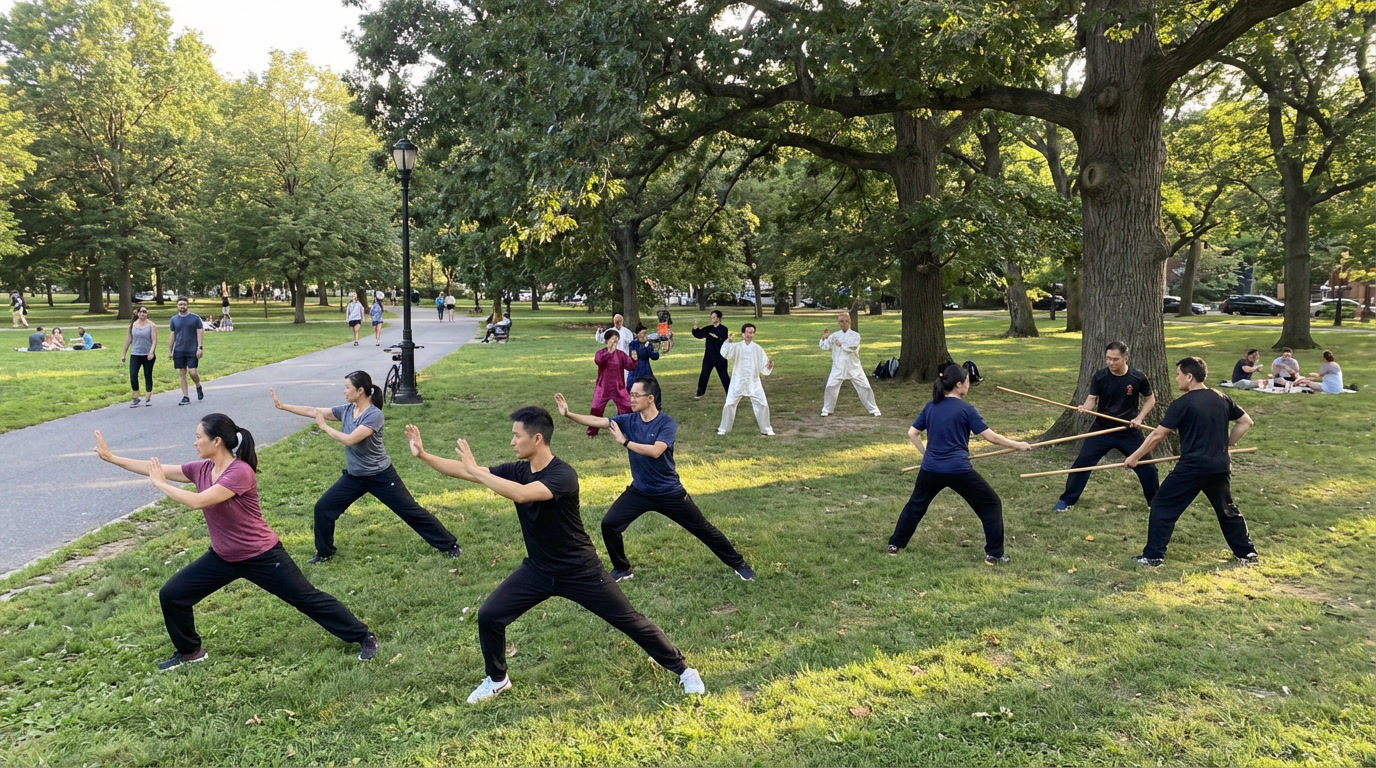
Wu (武) concerns martial or military matters. Shu (术) means art, method, technique, or skill. In Chinese usage, wushu can function as a broad umbrella for martial practices developed across different regions, lineages, historical periods, and training goals.
That umbrella contains tremendous variation. Some practices emphasize forms, applications, weapons, conditioning, health, performance, self-cultivation, fighting, or combinations of those things. Taijiquan is not identical to Changquan. Wing Chun is not Sanda. “Wushu” does not erase those differences any more than “dance” makes ballet and breaking the same discipline.
Sport wushu needs its own sentence
International audiences often hear “wushu” and picture the modern competitive sport governed globally by the International Wushu Federation. Taolu evaluates choreographed routines, including bare-hand and weapon events. Sanda is a full-contact combat sport using striking, kicking, throwing, wrestling, and defensive methods under competition rules. These are real athletic disciplines. They are not the complete history or practice of every Chinese martial art.
The old page said Wushu is “what Olympians do.” That was sloppy. Wushu has appeared in major multi-sport events and the Dakar 2026 Youth Olympic Games program, but it is not automatically an Olympic medal sport at every Games. The precise claim matters.
Wuxia is a genre, and xia is the heart of it
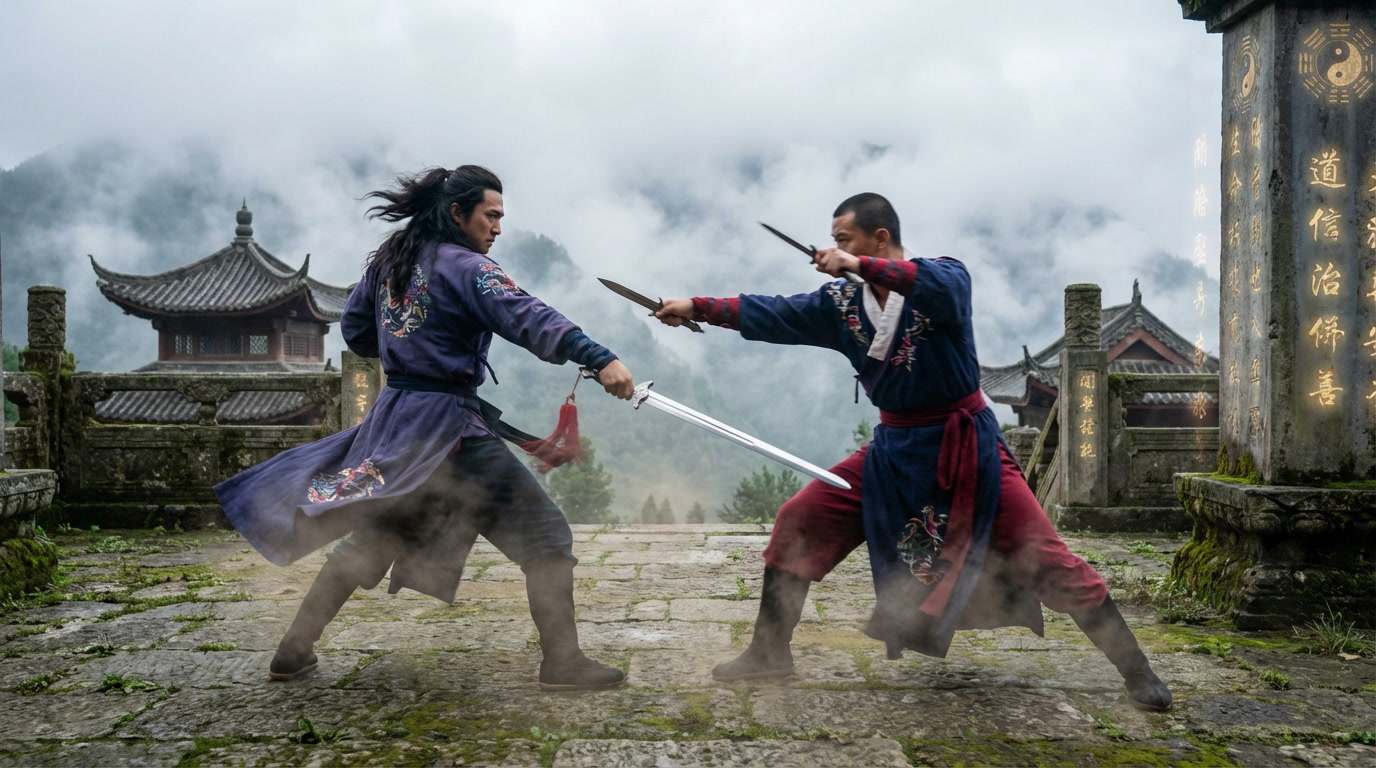
Wuxia combines wu (martial) with xia (侠), a figure often translated as knight-errant, chivalrous hero, or righteous wanderer. No English phrase catches the whole inheritance. A xia may oppose corrupt authority, protect vulnerable people, honor a promise, avenge injustice, or follow a personal moral code that conflicts with law.
Martial skill matters because it gives characters the power to act. The genre’s deeper question is what they do with that power. A villain can be the better technician. A frightened beginner can show more xia than an undefeated master. Sword choreography is the visible argument. Character is the verdict.
Wuxia is heightened, not simply “realistic”
Wuxia draws from real martial vocabulary, ideas, weapons, bodily training, and performance traditions, then transforms them. Qinggong movement, internal force, pressure-point attacks, extraordinary endurance, and impossible leaps are familiar genre conventions. That does not automatically make the story Xianxia. Xianxia usually organizes its world through cultivation toward transcendence, immortals, tribulations, reincarnation, divine or demonic beings, and cosmic law.
Side by side
| Question | Wushu | Wuxia |
|---|---|---|
| What is it? | Chinese martial arts; also a narrower modern sport context | A genre of martial-hero fiction |
| Primary medium | Training, teaching, performance, competition, combat practice | Literature, film, television, opera, comics, games, and animation |
| Core vocabulary | Technique, forms, application, conditioning, weapons, rules, lineage | Xia ethics, Jianghu, sects, loyalty, revenge, justice, martial mastery |
| Relationship to physics | Practitioners have actual bodies and consequences | Fiction may heighten bodies, movement, and internal power |
| Relationship to the other | Provides practices, imagery, terminology, and cultural material | Reimagines martial culture for narrative and spectacle |
Why English conversations turn into soup
Kung fu became a catch-all
Gongfu (功夫) broadly concerns skill acquired through effort, not one neat martial category. Film marketing helped “kung fu” become the familiar English label for Chinese martial arts.
Modern sport and traditional practice get collapsed
Some people use “wushu” only for standardized performance sport. Others use it broadly for Chinese martial arts. Context decides which meaning is active.
Fiction borrows real terminology
A novel may name genuine weapons, stances, medicines, schools, or training ideas beside impossible techniques. Familiar vocabulary does not certify the entire scene as historically or physically literal.
Movies teach with images, not footnotes
Audiences see athletes, stunt performers, opera traditions, wirework, editing, and genre convention fused into one gorgeous fight. The result is art, not a taxonomy lecture.
The correction worth remembering
Do not insult Wushu by treating it as boring Wuxia without special effects. Real martial practice contains history, sport, pedagogy, performance, physical risk, community, identity, and debate. Do not flatten Wuxia into fake fighting either. Fiction uses the martial body to ask who deserves loyalty, when law fails, and whether righteousness can survive power.
Receipts and further reading
- International Wushu Federation, the international governing body for sport wushu.
- Academy of Chinese Studies, “Chinese Martial Arts”, on the history and terminology of wushu.
- Cambridge University Press excerpt on Chinese martial arts, discussing wushu terminology and history.
- Stephen Teo, Chinese Martial Arts Cinema: The Wuxia Tradition, on Wuxia cinema’s literary and film history.
- Research on martial-arts fiction and Jin Yong, treating Wuxia as a major genre of Chinese popular literature.
Continue the trail: Read CVM Sekai’s Wushu guide, Wuxia guide, and Jianghu vs Wuxia.