
NOVEL WORLD 101 · ANIME 101 · STORY WORLD 101
Wushu (武术): Chinese Martial Arts, Traditional Lineages, and Modern Sport
The word is broader than one style, older than one competition system, and far more complicated than “the acrobatic sword routine.”
What the word actually covers
Wǔshù is written 武术 in simplified Chinese and 武術 in traditional Chinese. Wǔ means martial or military. Shù means art, method, or skill. In modern usage, wushu can function as a collective term for martial practices developed in China. That is why translating it only as the name of one flashy competition style causes immediate trouble.
The umbrella includes many systems with different histories, methods, regional identities, weapons, training goals, and communities. Taijiquan, Baguazhang, Xingyiquan, Wing Chun, Bajiquan, and numerous Shaolin-associated traditions do not become interchangeable because English puts them all under “Chinese martial arts.” They are relatives, not clones.
Traditional wushu is a living collection, not one frozen museum object
The International Wushu Federation describes traditional wushu, often called kung fu outside China, as the root from which sport wushu developed. Traditional systems grew across regions and communities, absorbing local culture, tactical needs, ethical teachings, health practices, family transmission, military knowledge, religious environments, and plain human experimentation.
Training may include solo forms, paired drills, conditioning, stance work, footwork, weapons, applications, sparring, breath regulation, strength, flexibility, balance, and lineage-specific theory. Not every school does all of these. Not every explanation attached to an old practice is historically verifiable. “Traditional” tells you that a practice claims or maintains inherited transmission. It does not automatically prove every legend told beside it.
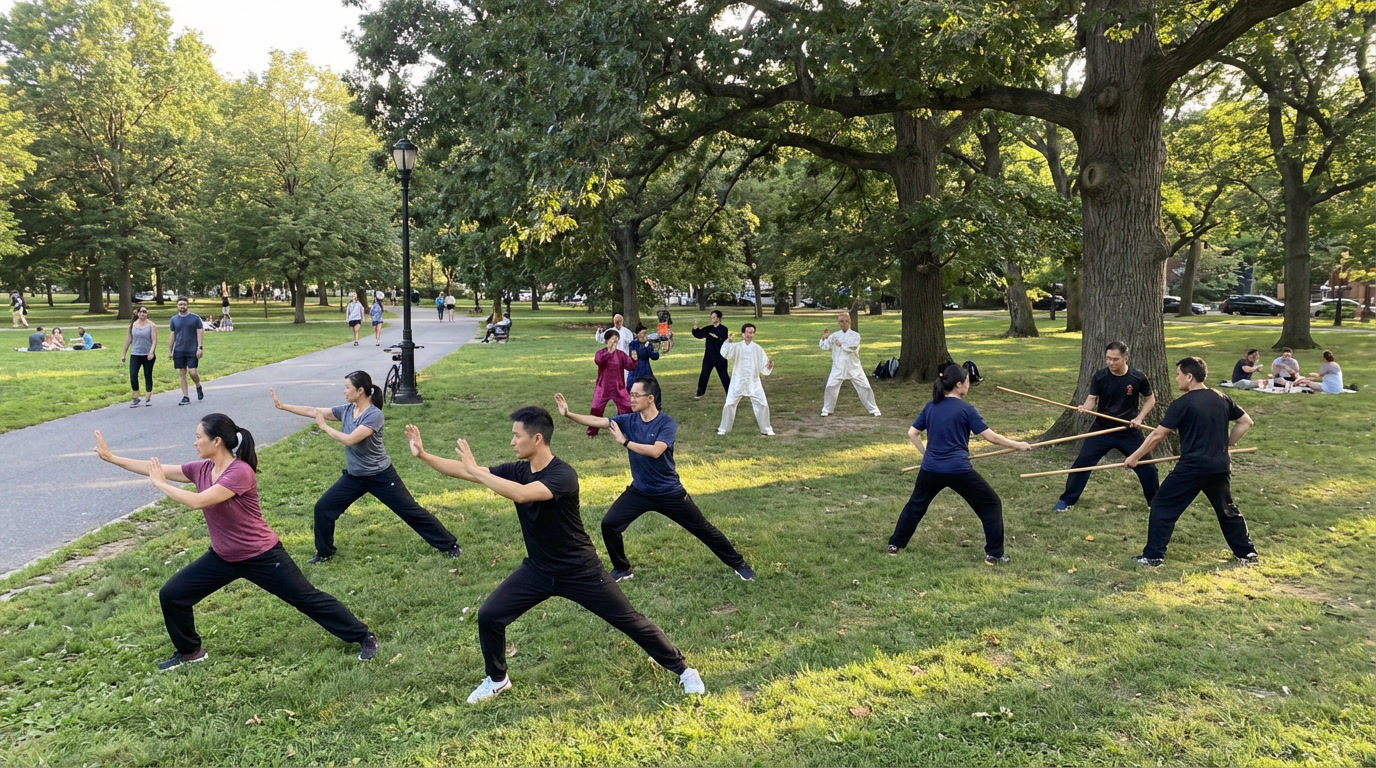
Taijiquan shows why reduction fails. UNESCO describes it as a practice involving movement, breathing, attention, routines, and partner work, shaped by several schools and passed through family and master-disciple transmission. Calling it merely slow exercise misses the martial, cultural, and social structure. Calling every park routine combat training misses something else.
Modern sport wushu has two major competitive branches
Taolu: routines
Athletes perform connected sequences of techniques, stances, jumps, balances, sweeps, and weapon work. Competition judging considers movement quality, overall performance, and difficulty. Taolu may be compulsory, optional, individual, group, or choreographed pair work.
Sanda: combat
Sanda is a full-contact sport using punches, kicks, throws, wrestling, defense, and tactical movement. Official bouts use protective equipment and an elevated leitai platform. It is not taolu with somebody standing in the way.
The highly acrobatic routines many international viewers associate with “wushu” are real sport, not fake martial arts. The mistake is treating that visible branch as the whole tree. Competitive rules shape training just as boxing rules, judo rules, or Olympic fencing rules shape their sports. That does not erase history. It does mean the competition product has its own priorities.
A short history without the five-thousand-year fog machine
Chinese combat practices have long histories tied to warfare, self-defense, performance, physical culture, ritual, community, and health. Different names and classifications appeared in different periods. Written military and martial manuals, local traditions, schools, associations, and family transmission all contributed to what modern speakers now gather under wushu.
In the late Qing and Republican periods, firearms, urbanization, nationalism, public education, and new physical-culture movements changed the field. Organizations such as the Jing Wu Athletic Association promoted public instruction and standardized presentation. National competitions and demonstrations helped turn selected practices into modern sport.
The International Wushu Federation was founded in 1990. World championships began in 1991, and the IOC recognized the federation in 2002. These dates belong to international sport governance, not to the birth of Chinese martial arts. A federation can standardize events. It cannot retroactively become the ancestor of every village teacher, family system, temple tradition, and military manual.
What happens when wushu enters fiction and film
Real martial practice supplies movement vocabulary, weapon handling, posture, training imagery, and cultural memory. Screen choreography then reshapes that material for camera, character, rhythm, safety, spectacle, and emotion. Wirework, editing, sound design, stunt doubling, visual effects, and performance turn a fight into storytelling.
In wuxia, martial skill helps define the hero and the jianghu. In xianxia, martial training may become one early layer beneath cultivation, magic, and spiritual power. Neither genre should be used as a training manual. A beautiful bamboo duel can communicate tension, balance, longing, and mastery without pretending two actors literally ignored gravity.
This distinction protects both sides. Fiction does not need to apologize for being stylized. Real practitioners do not need their work explained through one movie clip somebody saw in 2001.
The terms people keep swapping
| Term | Useful meaning | Common mistake |
|---|---|---|
| Wushu 武术 | Chinese martial arts collectively; also used for the organized modern sport | Only acrobatic taolu |
| Kung fu 功夫 | Skill developed through sustained effort; widely used abroad for Chinese martial arts | A single standardized style |
| Wuxia 武侠 | Martial-hero fiction and screen tradition | The name of a real fighting system |
| Taolu 套路 | Connected routines or forms | The whole of wushu |
| Sanda 散打 | Modern full-contact wushu competition | Stage fighting |